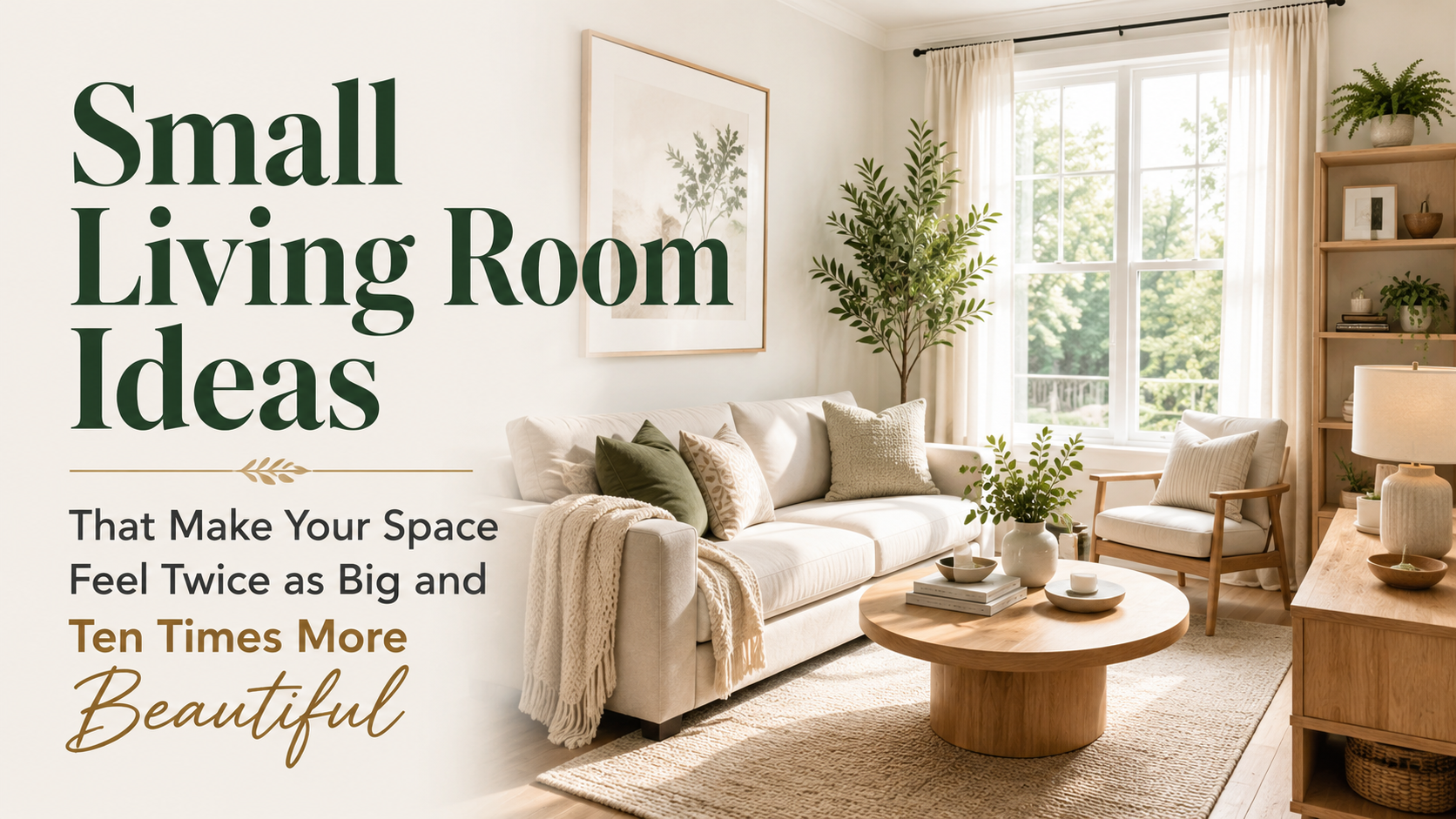
The Truth About Small Living Room Ideas — and Why the Best Small Living Room Design Solutions Are Almost Free
If you have a small living room, the most important thing you need to know is this: the most transformative changes available to you cost almost nothing. Hanging curtains at ceiling height instead of above the window costs $8–15 extra for a longer rod. Moving furniture away from windows costs nothing. Colour drenching the room costs one tin of paint, around $15–30.
These three changes together create more perceived space than spending thousands on new furniture — because they address the actual causes of small room problems: curtains that make ceilings feel low, furniture that blocks light, and contrasting surfaces that define and emphasise boundaries. This is the foundation of smart small living room design, practical small living room decor, and a better small living room layout.
This guide gives you 12 small living room ideas grounded in spatial psychology, layout thinking and real-life design logic. Whether you need small living room ideas apartment, a better small living room set up, cozy small living room ideas cozy, or beautiful small living room inspirations, these strategies will help your space feel genuinely designed rather than compromised.
From ceiling-height curtains and visible floor space to mirrors, storage, vertical shelving and natural light, these ideas will help you improve your small living room interior without needing a full renovation.
Quick Answer — How Do I Make a Small Living Room Look and Feel Bigger?
The five highest-impact small living room ideas — in order of cost:
- Free: Move all furniture away from windows and declutter all surfaces. Light and floor visibility are the two biggest spatial assets.
- $8–15: Replace bulbs with 2700K warm white and hang curtains at ceiling height. This improves lighting and vertical proportion.
- $15–30: Colour drench all surfaces in the same warm neutral. This dissolves visual boundaries.
- $55–80: Add one large leaning mirror adjacent to the window. This doubles perceived depth and light.
- $15–35: Mount the TV on the wall. This frees the most visible floor area in the room.
Together, these changes improve your small living room decor, make your small living room layout feel cleaner, and help even a compact apartment living room feel more open.
Which Small Living Room Ideas Are Right for Your Apartment, Layout and Decor Style?
Find your situation in seconds:
| Idea | Focus | Cost | Impact |
|---|---|---|---|
| Ceiling-Height Curtain Trick | Vertical proportion | $23–72 | Very High |
| Visible Floor Principle | Elevated furniture | $15–25 add legs | High |
| The Large Mirror | Spatial doubling | $55–120 | Very High |
| Multi-Functional Furniture | Every piece serves 2+ | $705–1,220 | High |
| Colour Drenching | Dissolve boundaries | $15–30 | Very High |
| Vertical Space | Shelving + height | $78–140 | High |
| One Sofa + One Chair | Layout intelligence | $670–1,280 | Medium |
| Floating + Wall-Mounted | Free the floor | $64–120 | Very High |
| Maximise Natural Light | Brighten + expand | $77–152 | High |
| Storage + Decluttering | Remove clutter | $153–290 | High |
| Personality in Small Rooms | Character + beauty | $105–250 | Medium |
| Under £100 Budget Plan | Maximum value | $91–143 | Very High |
Idea 1: Ceiling-Height Curtains — A Small Living Room Decor Trick That Makes Any Room Feel Taller
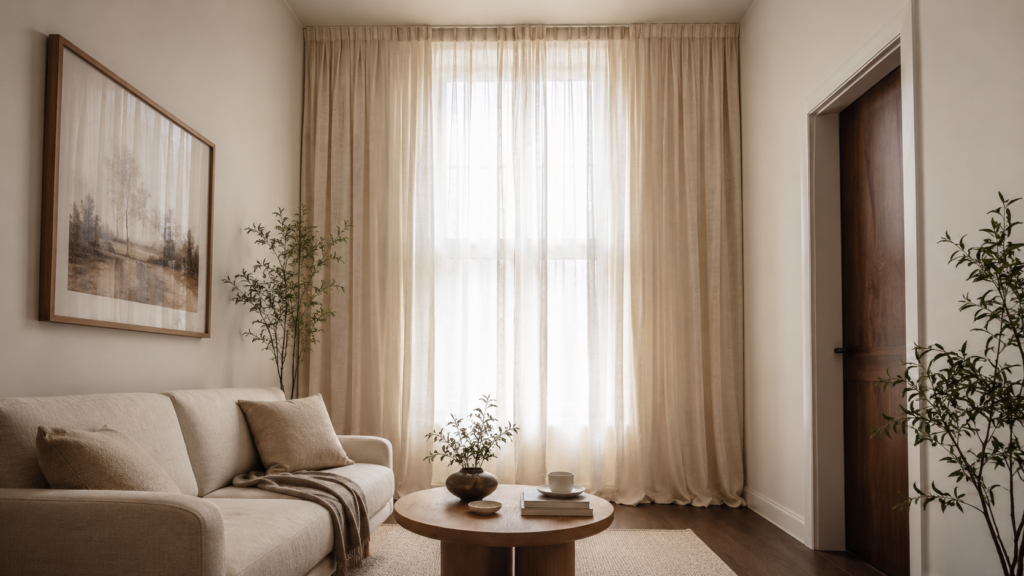
The single most impactful small living room decor idea that costs the least and requires no skill whatsoever is also the most consistently underestimated: hanging curtains within two inches of the ceiling rather than above the window frame.
This positioning — which costs only the price of a longer curtain pole, around $8–15 extra — makes the ceiling appear dramatically taller, the windows appear full-height, and the room appear significantly larger in all dimensions.
This is one of the easiest small living room decor ideas because it improves the room without changing furniture, layout or expensive design elements. It is the interior design version of a visual illusion that anyone can implement before lunch, and the effect is so significant that it registers as a spatial change rather than a decorative one.
How to Style This Look
Mount the rod within 2 inches of the ceiling — not above the window:
The rod should be as close to the ceiling line as possible. If you are unsure how close, go closer. The ceiling proximity is what creates the full-height window illusion that transforms the room.
Buy curtains 10–15cm longer than you think you need:
The curtains must reach the floor — ideally with a slight puddle, around 5cm extra length on the floor. Curtains that stop short of the floor immediately signal incorrect hanging and lose all the height-creating benefit.
Match curtain colour to the wall colour:
Curtains in a colour close to the wall colour create visual continuity that makes the wall appear to continue behind the curtain rather than ending at the window. White curtains on white walls, cream curtains on cream walls — the similar tone extends the wall plane and maximises the height effect.
One wide curtain panel per window — not two narrow ones:
A single wide curtain panel per window, pulled to one side when open, creates the impression of a larger window than two narrow panels divided in the middle. Wider perceived windows mean wider perceived rooms.
Linen or sheer fabric — never blackout for daytime in small rooms:
Sheer or light linen curtains in a small living room allow natural light to filter through, keeping the room feeling open and bright during the day. Blackout curtains block the most powerful space-expanding element available: natural daylight.
How to Recreate
✓ Longer curtain rod: Amazon, $8–15 extra for a longer pole vs standard length — mount within 2 inches of ceiling
✓ Floor-to-ceiling linen curtains: IKEA LILL, $7–12 per pair, or BLEKVIVA, $25–45
✓ Measure from ceiling to floor plus 5cm puddle
✓ Curtain colour: match to wall colour as closely as possible
✓ Command strip curtain rod brackets: Amazon, $8–15 — for rented homes, no drilling needed for lighter rods
Budget Tip
Ceiling-height curtain transformation: $23–72 for longer rod and floor-to-ceiling linen curtains.
This is the highest impact-to-cost ratio of any idea in this article. Around $23 in materials creates a spatial transformation that rivals expensive renovation work.
Pro Tip
Interior designers and architectural stagers consistently cite ceiling-height curtain hanging as the single most cost-effective space-expanding technique available — more impactful per dollar than any furniture purchase, mirror, paint choice or decluttering effort.
The technique exploits a specific quirk in human spatial perception: the eye uses the height of vertical elements to estimate ceiling height, meaning tall curtains are processed as evidence of a tall room regardless of the actual ceiling measurement.
Next Up
Curtains create vertical space. The floor — what you put on it and how visible it is — creates perceived horizontal space. Idea 2 shows exactly how rug placement and leg visibility combine to make a small living room layout feel larger from the ground up.
Idea 2: The Visible Floor Principle — A Smarter Small Living Room Layout With Legs, Rugs and Open Space
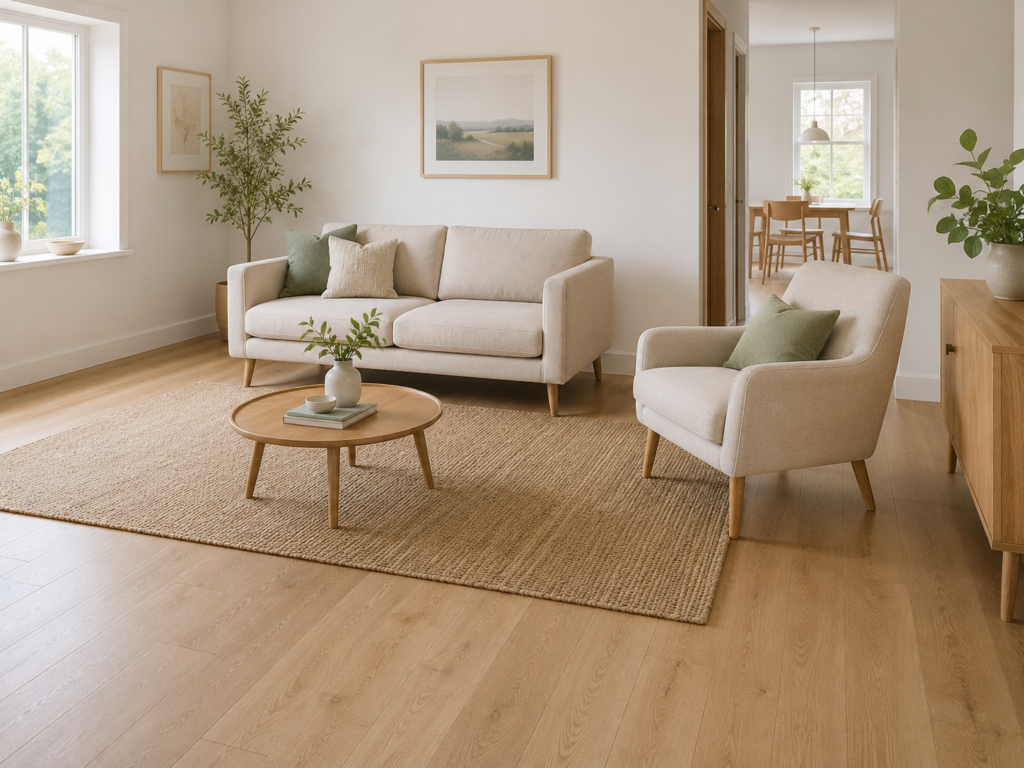
The most consistently underused small living room layout strategy is one of the simplest: keeping as much of the floor visible as possible.
In a small room, every visible square foot of floor is perceived space. A sofa that skirts to the floor occupies every inch of its footprint visually; a sofa on legs with 15cm of space beneath it frees the floor plane beneath it and creates the impression of a significantly larger room.
This principle is especially useful for a small living room apartment, where every visible inch of flooring helps the room feel more open, lighter and better planned.
This is why furniture with visible legs is the most important single furniture specification in any small living room design — and why the rug must be large enough to extend beneath the sofa legs rather than stopping short of them.
How to Style This Look
All primary furniture on visible legs — minimum 15cm height:
Sofa, armchair and side tables should all be on visible legs. The visibility of floor beneath each piece dissolves their physical presence and creates continuity across the floor plane. Skirted sofas in small rooms are spatial disasters because they block every inch of floor they occupy.
The rug must reach beneath the sofa’s front legs:
A rug that stops short of the sofa legs creates a visual cut that fragments the room. The rug should extend at least 20cm beneath the sofa front, connecting the sofa visually to the floor plane and creating the impression that the seating arrangement is anchored within a larger defined space.
One rug — correctly sized:
In a small living room, layered rugs can feel cluttered. One correctly sized rug — typically 200x300cm for a small living room — that extends beneath all furniture legs and defines the seating area clearly is more effective than two smaller overlapping rugs.
A round or oval coffee table rather than rectangular:
Round and oval coffee tables take up less visual space than rectangular ones because they have no sharp corners to block pathways. In a small living room, a round coffee table allows people to move around it freely from any direction, which creates a more open, less obstructed experience of the floor plane.
Keep the floor clear of objects — always:
Floor-level objects such as bags, books, boxes, trailing cables and plant pots placed directly on the floor break the floor plane and shrink the room’s perceived size. Every object that can be elevated onto a shelf, table or hook should be. The floor is the room’s most valuable visual asset in a small space.
How to Recreate
✓ Sofa with visible legs: IKEA ÄPPLARYD, $500–900, or KLIPPAN, $350–550
✓ Always verify that the sofa has exposed legs before buying
✓ Correctly sized area rug: minimum 200x300cm — IKEA STOENSE, $80–150, or Amazon, $70–140
✓ Round coffee table with legs: Amazon, $80–200
✓ Search term: “small round coffee table visible legs oak”
✓ Leg levellers for existing furniture: Amazon, $15–25, to add legs to any legless sofa or unit
Budget Tip
Visible floor small living room: $645–1,265 for new sofa, rug and coffee table — or $15–25 to add leg levellers to existing furniture.
The $15–25 leg leveller addition to existing furniture is the single highest spatial-impact item per dollar in this article.
Pro Tip
The visual processing research behind floor plane visibility was formalised by architect and cognitive scientist Harry Francis Mallgrave at Illinois Institute of Technology, who found that the human brain uses visible floor area as one of its primary signals for estimating room size.
A room where 60% of the floor is visible is processed as significantly larger than an identical room where 30% of the floor is visible — regardless of actual dimensions.
Elevated furniture is not just an aesthetic preference; it is a direct spatial intervention.
Idea 3: The Large Mirror — A Small Living Room Interior Trick That Doubles Light and Depth
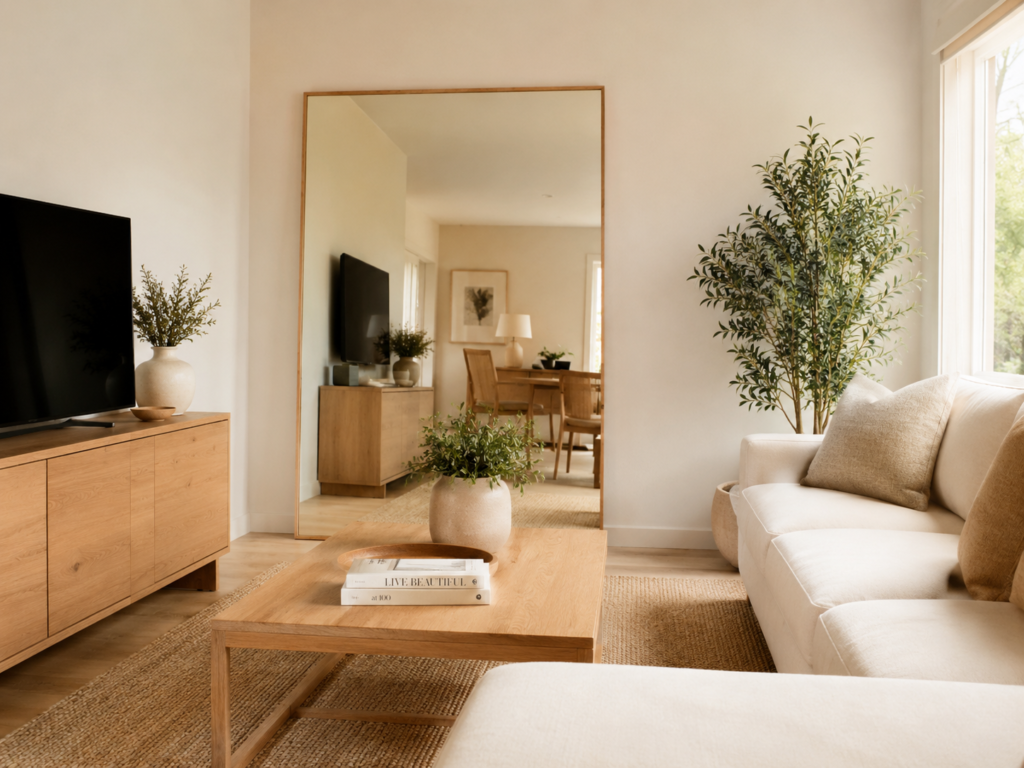
A large mirror in a small living room interior is the most time-tested spatial expansion technique in all of interior design — and it works because it literally creates another space.
A large mirror placed on or adjacent to the wall opposite the room’s light source doubles the perceived depth of the room and reflects the natural light across the entire space, simultaneously creating the impression of a larger and brighter room from one purchase.
For anyone collecting small living room inspirations, this mirror technique is one of the most reliable because it works in almost every room style, from modern apartments to cozy traditional interiors.
The technique is so effective that professional stagers use it in every small-room staging scenario, and yet most small living rooms are mirrorless. This is the most impactful single change available for a compact living room that costs under $100.
How to Style This Look
Position the mirror opposite or adjacent to a window:
The mirror should reflect the window — or the light from the window — rather than reflecting a dark wall or a closed door. A mirror that reflects natural daylight doubles the room’s perceived brightness and warmth simultaneously. A mirror that reflects the back of the sofa does nothing useful.
Go larger than feels comfortable:
The most common mirror mistake in small rooms is buying one too small. A small mirror looks like a single decorative object; a large mirror creates a new “window” into perceived space. Minimum 80cm wide for a compact room; ideally 100–120cm. A full-length leaning mirror creates the maximum spatial effect.
Lean against the wall rather than hanging flush:
A large mirror leaning against the wall at a slight angle reflects the floor as well as the opposite wall, creating a deeper spatial impression than a flush-mounted mirror. It also eliminates the need for drilling and is easily repositioned.
Choose a simple frame — not an ornate or heavy one:
A thin or frameless mirror makes the reflected space appear more continuous with the actual room. A heavy ornate frame announces itself as a decorative object and draws attention to the mirror as a thing rather than the space it reveals.
A round mirror for an intimate feel; rectangular for maximum expansion:
A large round mirror, around 80–100cm diameter, creates a beautiful focal point without appearing to take up space. A large rectangular mirror creates the maximum spatial expansion but is more imposing.
How to Recreate
✓ Large leaning floor mirror: Amazon, $55–120, or IKEA HOVET, $90–150
✓ Minimum 80cm wide; 100x170cm is ideal
✓ Position adjacent to or opposite the window — always reflecting daylight
✓ Wall protection: felt pads on back corners, $5–8
✓ Alternative: large round mirror mounted flush on the wall, IKEA LOTS, $20–25
Budget Tip
Large mirror spatial transformation: $20–120 for a large mirror.
The IKEA LOTS 78cm round mirror, around $20–25, is the best value spatial intervention available. A full-length leaning mirror, around $55–120, creates the maximum spatial effect.
Pro Tip
The mirror-opposite-window technique was codified in interior design practice by Dorothy Draper in the 1940s and remains one of the most universally taught space-expanding strategies in professional design education.
Research by spatial psychologist Roger Downs at Penn State University confirmed that mirror-reflected spaces are processed by the brain as genuinely additional space rather than as reflections — meaning the spatial benefit is perceptually real, not merely intellectual.
Next Up
The mirror creates perceived space through reflection. Now for the technique that creates actual space through furniture intelligence — Idea 4 shows how multi-functional furniture improves a small living room set up by eliminating the need for multiple separate pieces.
Idea 4: Multi-Functional Furniture — Smart Small Living Room Set Up for Apartments and Compact Homes
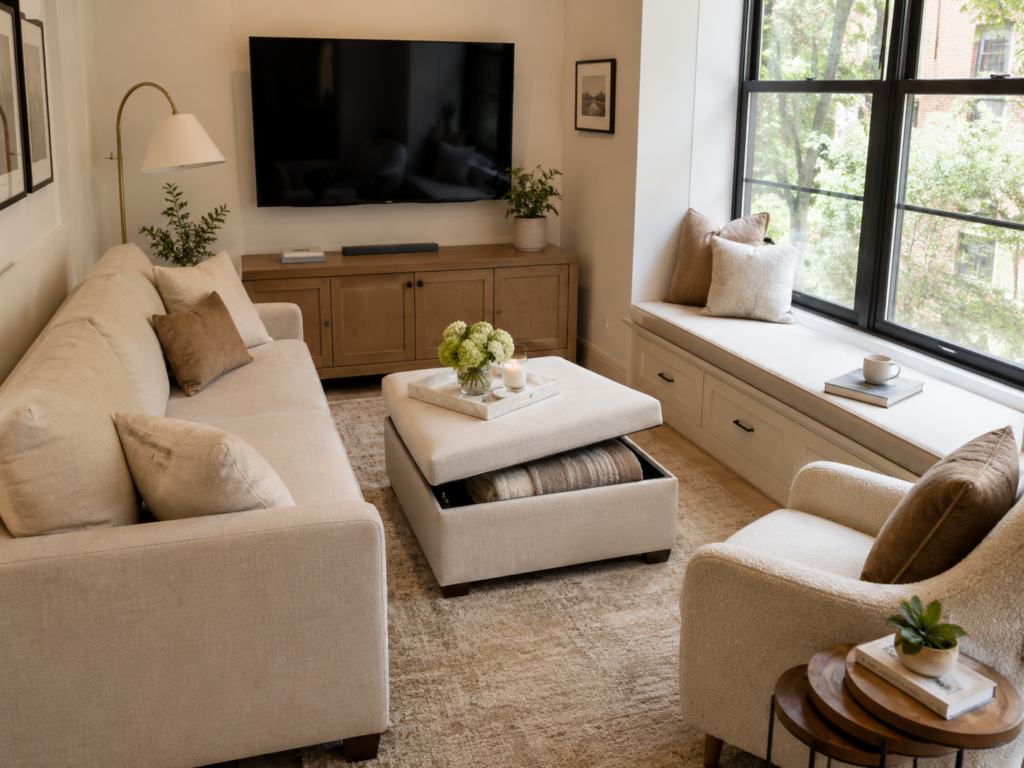
In a small living room, every piece of furniture occupies a significant percentage of available floor space — which means every piece of furniture must justify its presence not just aesthetically but functionally.
The multi-functional furniture approach applies a simple rule: every piece must serve at least two distinct functions.
A good small living room set up is not about adding more furniture; it is about choosing pieces that work harder, store more and reduce visual clutter.
A storage ottoman replaces the coffee table and stores blankets and provides extra seating. A shelving unit replaces a TV unit and provides book storage and display space. Each dual-function piece eliminates one separate piece that would otherwise occupy additional floor space — and in a small living room apartment, every eliminated piece is a significant spatial gain.
How to Style This Look
A storage ottoman replaces the coffee table:
A large upholstered storage ottoman serves as a coffee table with a tray on top, extra seating for guests, footrest and storage for throws and cushions — four functions in one piece. It also has no hard corners, which means it causes no pathway blockage in a small room.
A sofa bed eliminates the guest bedroom requirement:
A quality sofa bed allows a small living room to host overnight guests without a dedicated spare room. The 2026 generation of sofa beds is significantly more comfortable than earlier versions, and many provide genuine sleeping quality.
A media console with closed storage instead of an open unit:
A TV console with closed doors below provides the same storage as an open shelving unit but without the visual clutter of displayed objects. A visually tidy small room feels larger than an equally full small room with visible objects.
Nesting tables instead of a fixed side table:
Two small nesting tables pulled apart when needed and stacked when not in use take up less floor space than one fixed side table and provide the same combined surface area. In a small living room this flexibility is valuable.
A bench at the window — seating, storage and a reading perch:
A window bench with storage underneath provides seating for one person with a view, concealed storage for cushions and seasonal items, and a reading position that uses the window’s natural light without any additional furniture.
How to Recreate
✓ Storage ottoman: Amazon, $90–180 — hinged lid, large enough to store three throws
✓ Use a tray on top as a coffee table
✓ Quality sofa bed: IKEA FRIHETEN, $450–700, or Amazon, $400–650
✓ Avoid budget spring sofa beds; click-clack mechanism is better than pull-out for small rooms
✓ Nesting tables set of 2: Amazon, $45–90
✓ Window bench with storage: Amazon, $120–250, or DIY with IKEA KALLAX unit plus cushion pad
Budget Tip
Multi-functional small living room furniture: $705–1,220 for sofa bed, storage ottoman, nesting tables and window bench.
The storage ottoman, around $90–180, replacing the coffee table is the single highest-value swap. It saves the cost of a separate coffee table and provides blanket storage, eliminating another piece entirely.
Pro Tip
The Japanese concept of “MA” — deliberate empty space as a design element — is the philosophical foundation of multi-functional furniture design.
In Japanese traditional interiors, furniture that serves only one function is considered wasteful not just spatially but philosophically: every object should justify its place through multiple contributions to daily life.
Next Up
Multi-functional furniture creates space by eliminating redundant pieces. For the technique that creates perceived space without removing any furniture — using colour psychology to dissolve the room’s visual boundaries — Idea 5 covers the small living room design colour strategies that work specifically in compact spaces.
You can also read Minimalist Room Ideas That Feel Cozy, Calm & Beautiful in 2026 for more details
Idea 5: Colour Drenching — Small Living Room Design and Paint Ideas That Make Walls Feel Seamless
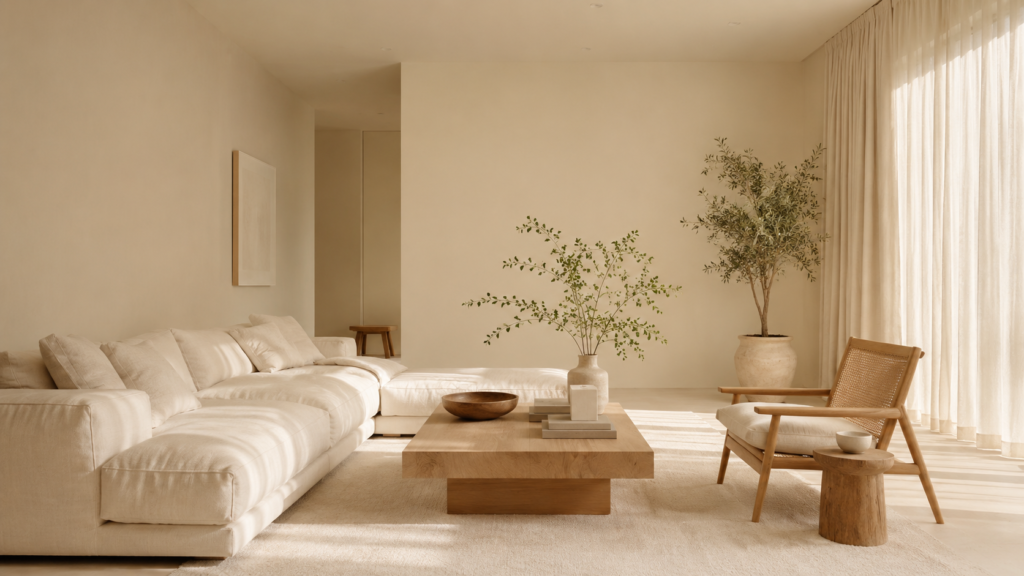
Colour is one of the most powerful tools available in a small living room design — and the most frequently misunderstood.
The standard advice, “use pale colours to make small rooms feel larger,” is partially correct but incomplete. The full picture is more nuanced: pale walls with contrasting furniture colour create visual fragmentation that emphasises the room’s edges and boundaries.
This is one of the most effective small living room design choices because it makes the walls, ceiling and trim feel connected instead of broken into separate visual blocks.
Colour drenching — one colour applied to all surfaces simultaneously — eliminates the visual breaks between surfaces and creates a seamless, boundary-dissolving effect that makes rooms feel significantly more spacious in all directions regardless of the chosen colour.
How to Style This Look
Colour drench all surfaces — walls, ceiling, woodwork:
Applying one paint colour to walls, ceiling, skirting boards and door frames eliminates every colour break in the room. The eye can no longer register the boundaries between surfaces, which means the room’s dimensions are no longer clearly legible.
Warm neutrals drench for maximum calm openness:
Colour drenching in warm cream, oat or warm white creates an airy, light-filled expansiveness. The same technique in a saturated colour creates intimacy and warmth rather than openness.
Match furniture upholstery to the wall colour approximately:
A cream sofa on cream walls creates visual continuity that makes the sofa appear part of the room rather than an object occupying space within the room.
Dark accent colour on one wall only — never all four for small rooms:
A single dark accent wall in an otherwise pale room creates depth rather than compression. All four dark walls in a small room can feel heavy unless the lighting is exceptional.
Paint the ceiling the same colour as the walls — always:
A white ceiling against coloured walls creates a visible boundary that defines and limits the ceiling height. A ceiling in the same colour as the walls removes this boundary and makes the room’s vertical dimension feel unconstrained.
How to Recreate
✓ Warm cream colour drench: one tin of Dulux “Jasmine White” or Sherwin Williams “Alabaster” for walls, ceiling and woodwork, $15–30
✓ Ceiling paint: use the same emulsion as the walls
✓ Cream sofa: match to wall colour tone as closely as possible
✓ Key rule: apply paint to ceiling, skirting boards and door frames simultaneously with walls
Budget Tip
Colour drenching a small living room: $15–30 in paint for the entire transformation.
The technique costs one tin of paint and creates more perceived space than most furniture purchases. The ceiling extension of the wall colour costs nothing extra beyond applying the same tin to the ceiling.
Pro Tip
Colour drenching was identified by Farrow & Ball, Dulux and Benjamin Moore as a top trending paint technique of 2025 and has remained dominant into 2026.
Interior designers who previously recommended white ceilings in all contexts are now widely recommending ceiling colour extension because of the spatial benefits and superior aesthetic coherence of seamless colour envelopes.
Idea 6: Vertical Space — Small Living Room Interior Ideas Using Shelves, Plants and Height
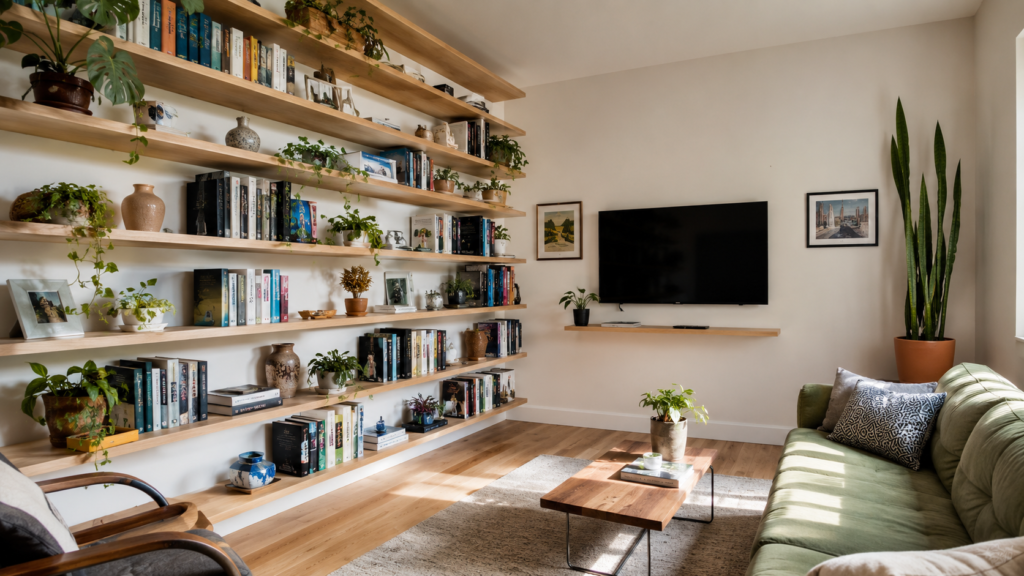
The most underused space in any small living room interior is the space above eye level.
Most small living rooms have 2.4–2.8m of wall height and use perhaps the bottom 1.2m of it — leaving the top half of every wall entirely empty.
For a compact small living room interior, vertical design is essential because it moves storage and decoration upward instead of crowding the floor.
Vertical space is free storage, free display and free visual interest that requires no floor space whatsoever. The principle of going vertical in a small living room is simultaneously a practical storage solution and a spatial design strategy — tall elements draw the eye upward and make the ceiling feel higher, which makes every dimension of the room feel more generous.
How to Style This Look
Floor-to-ceiling floating shelves — not waist-height:
Shelving that runs from near the floor to near the ceiling uses the full vertical resource of the wall and draws the eye upward continuously. Waist-height shelving is half as visually effective and provides less than half the storage.
A tall narrow bookcase rather than a wide low one:
A bookcase that is 200cm tall and 60cm wide occupies the same floor footprint as a low unit but provides dramatically more storage and draws the eye upward effectively.
Tall plants in corners:
A tall snake plant, bird of paradise or bamboo palm in a corner reaches toward the ceiling using vertical space rather than horizontal space.
Picture rail height for art and mirrors:
Hanging art and mirrors slightly higher than standard, around 160–170cm centre, creates the visual effect of pulling the room’s contents upward and making the wall feel taller.
A wall-mounted TV:
A wall-mounted television at the correct eye height eliminates the need for a TV stand or unit, freeing an entire wall of floor space.
How to Recreate
✓ Floor-to-ceiling floating shelves: IKEA BERGSHULT, $25–45 per shelf, plus GRANHULT brackets, $10–15 per bracket
✓ Install from 20cm off floor to 20cm below ceiling
✓ Wall-mounted TV bracket: Amazon, $15–35
✓ Floating media shelf below TV: IKEA LACK, $8–15
✓ Tall snake plant or bamboo palm: IKEA or local nursery, $20–45
Budget Tip
Vertical space maximisation: $78–140 for floor-to-ceiling shelving materials, TV bracket and floating media shelf.
The TV wall mount, around $15–35, alone frees the most floor space per installation cost of any item in this list — eliminating an entire TV console from the floor.
Pro Tip
The decision to mount a television on the wall rather than placing it on a TV console is estimated by home stagers to recover between 0.8 and 1.5 square metres of perceived floor space in a small living room — more than the physical floor area of the TV console itself.
Next Up
Vertical space exploited. For the layout rule that solves most small living room apartment problems, Idea 7 shows why one sofa plus one chair often works better than two sofas.
Idea 7: One Sofa Plus One Chair — The Small Living Room Layout Rule That Changes Everything
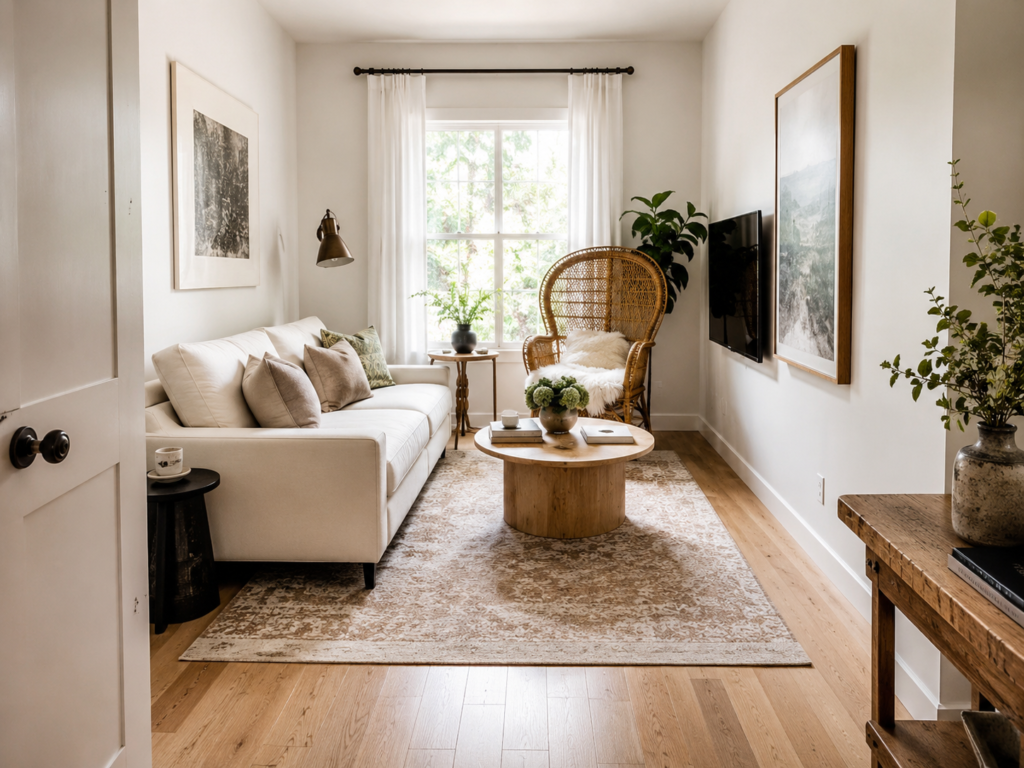
The small living room layout that causes the most problems is the one that seems most obvious: two sofas facing each other across a coffee table.
In a small room, two sofas create immediate visual and physical congestion — the room feels like it is primarily furniture, with living happening in the small gaps between pieces.
This small living room layout works beautifully for apartments because it gives you comfortable seating without making the room feel blocked, heavy or overfilled.
The layout that works in small living rooms is almost always asymmetric: one generous sofa plus one comfortable armchair positioned at an angle or alongside the sofa. This arrangement provides comfortable seating for three or four people while occupying significantly less floor space, and creates visual interest through the asymmetry that a matching sofa set cannot.
How to Style This Look
One sofa as the dominant piece:
The sofa should be the largest piece of furniture the room can accommodate while still allowing comfortable movement around it. A small room with one appropriate-sized sofa looks designed; a small room with one undersized sofa looks temporarily furnished.
One armchair positioned at 90 degrees to the sofa:
An armchair placed at the end of the sofa at a 90-degree angle creates an L-shaped seating arrangement that uses corner space efficiently and creates a defined seating zone without the visual bulk of a second sofa.
The Peacock chair or rattan chair for the accent seat:
A rattan Peacock chair as the accent seat provides visual interest and character without the visual weight of an upholstered armchair. Its open weave structure allows the eye to see through it to the wall behind, reducing its perceived bulk.
Face all seating toward one focal point:
Sofa and armchair should both face the same focal point — the fireplace, the TV, the window or a piece of art. Unified orientation creates coherence and makes the room appear more intentional.
Leave one clear pathway of at least 90cm width:
There must be one clear, unobstructed walking pathway through the room of at least 90cm width, ideally 100–120cm. The clear pathway is the breathing space that makes the layout feel comfortable.
How to Recreate
✓ Compact two-seater or two-and-a-half seater sofa: IKEA ÄPPLARYD, $500–900
✓ Rattan Peacock chair: Amazon, $90–200, or Facebook Marketplace vintage, $20–60
✓ Small round coffee table, 60–80cm diameter: Amazon, $80–180
✓ Layout tip: leave 90cm clear pathway minimum — measure before positioning any furniture
Budget Tip
One sofa plus one chair small living room: $670–1,280 new, or $590–1,140 with a vintage Peacock chair from Facebook Marketplace.
The rattan Peacock chair provides the most personality and character per square foot of any armchair option — its visual lightness is uniquely suited to small rooms.
Pro Tip
The 90-degree offset armchair placement in a living room was documented as a design principle by modernist architect and designer Charlotte Perriand in her 1950s Paris apartment.
The arrangement creates social ease because neither conversant must turn their neck sharply to maintain eye contact, which reduces the physical effort of conversation and makes the seating feel more comfortable for longer periods.
Idea 8: Floating and Wall-Mounted Furniture — A Clean Small Living Room Set Up That Frees the Floor
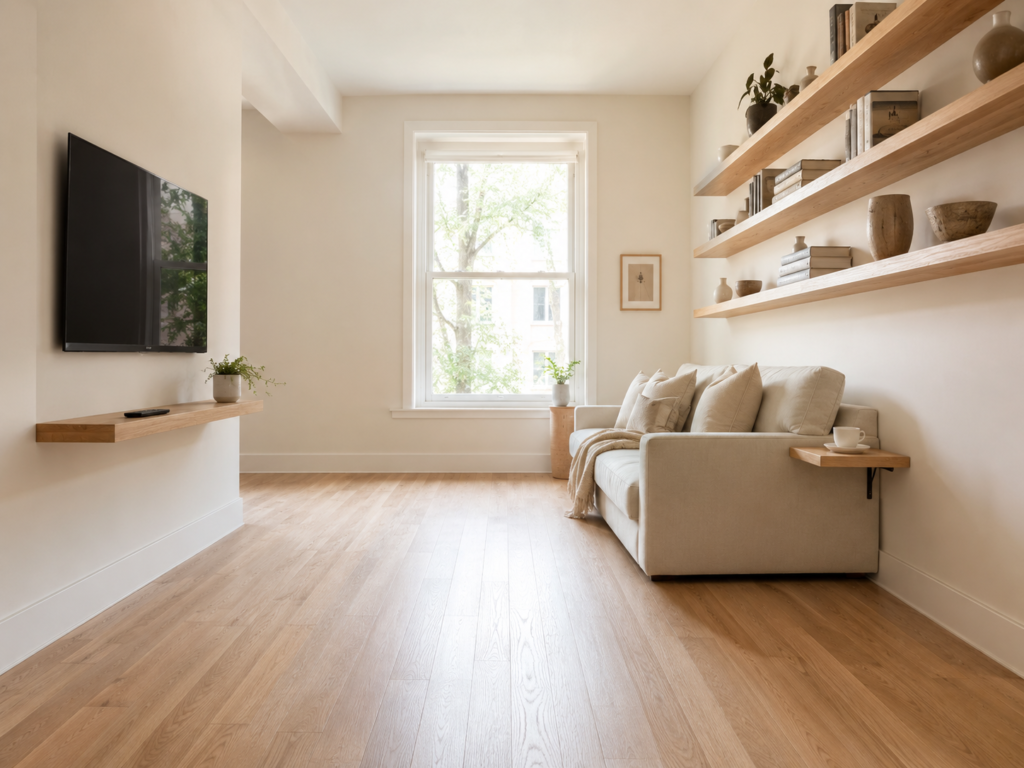
The most spatially sophisticated approach to small living room furniture is one that most people overlook entirely: mounting furniture to the wall rather than standing it on the floor.
A floating TV shelf, floating side tables and a wall-mounted bookcase all provide the same functional surfaces as their floor-standing equivalents while keeping the floor entirely clear beneath them.
This idea is perfect for small living room ideas apartment searches because wall-mounted furniture helps renters and apartment owners create more usable space without a major renovation.
This visibility of the full floor plane — uninterrupted from wall to wall except for the sofa and armchair — creates the impression of a room significantly larger than its actual dimensions.
How to Style This Look
Wall-mounted floating side tables at sofa height:
Slim wall-mounted brackets with a small shelf surface at sofa arm height replace floor-standing side tables while freeing all floor space beneath.
Floating TV shelf — one slim board below the TV:
A single slim floating shelf below a wall-mounted TV holds a remote, a console and one small object. This replaces the TV console entirely and frees the floor below the television.
Wall-mounted bookcase instead of freestanding:
Floating shelves mounted at varying heights from floor to near-ceiling replace a freestanding bookcase while keeping all floor space beneath visible.
A folding or wall-mounted desk for studio flats:
In a studio apartment or small flat where the living room must also accommodate work, a fold-down wall-mounted desk provides workspace without occupying floor space when not in use.
Wall hooks at the entrance:
A row of wall hooks near the living room entrance eliminates the need for a freestanding coat rack or hallstand, freeing floor space at the most visible point of entry.
How to Recreate
✓ IKEA LACK shelf as wall side table: $8–15 each
✓ Wall-mounted TV bracket: Amazon, $15–35
✓ Floating TV shelf: IKEA LACK, $8–15
✓ IKEA BERGSHULT floating shelves: $25–45 per shelf
✓ Wall hooks near entrance: Amazon, $8–15 for a set
Budget Tip
Wall-mounted furniture small living room: $64–120 for all floating elements, including wall side tables, TV shelf and entrance hooks.
These items together free more floor space than most furniture purchases because they eliminate the floor footprint of multiple pieces simultaneously.
Pro Tip
The wall-mounted furniture approach is the defining spatial strategy of the Japanese micro-apartment design tradition, particularly developed in Tokyo where apartments average around 38 square metres.
Japanese micro-apartment designers consistently achieve remarkable livability within tiny footprints by treating the floor as sacred and mounting everything possible to the walls.
Next Up
Wall-mounting frees the floor. For the small living room apartment that makes the most of the one resource that all homes have regardless of floor plan — natural light — Idea 9 shows how to maximise daylight as the room’s most powerful spatial ally.
you can also visit Cozy Farmhouse Bedroom Ideas for more details
Idea 9: Maximising Natural Light — Cozy Small Living Room Ideas That Make the Space Feel Brighter
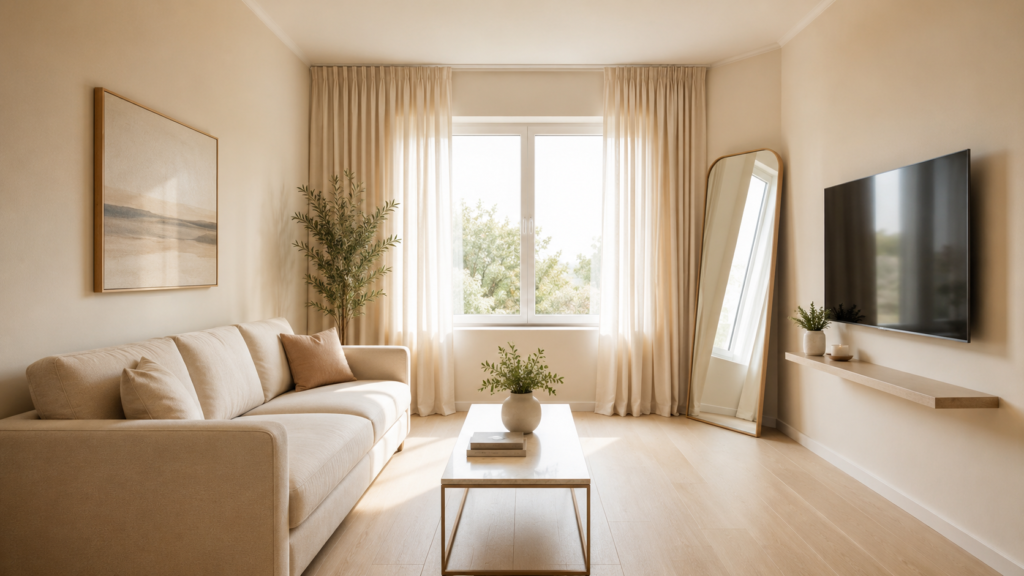
Natural daylight is the single most powerful spatial expander available in any small living room — and it costs nothing.
A small room flooded with natural light feels significantly larger than an identical room in shadow, because the brain reads bright spaces as larger than dark spaces as a fundamental spatial heuristic.
If you want small living room ideas cozy, natural light should be your first priority because it makes the room feel warm, soft and visually larger at the same time.
Most small living rooms block, reduce or fail to amplify their natural light through curtain placement, furniture position and window treatment choices that are entirely reversible without cost.
How to Style This Look
Never place furniture in front of a window:
A sofa or bookcase placed in front of a window blocks the room’s primary light source and simultaneously creates a dark shadow behind it. Reposition all furniture so every window face is clear.
Light-coloured furniture facing the windows:
Furniture positioned between the window and the rest of the room acts as a light surface or a light blocker depending on its colour. A light cream sofa reflects light; a dark sofa absorbs it.
Sheer curtains for daytime light:
Use sheer curtains for daytime and blackout only at night if needed. Never close opaque curtains during daylight in a small room.
A mirror opposite or adjacent to the window:
A large mirror positioned to reflect the window’s light doubles the room’s perceived brightness and creates natural-feeling spatial expansion.
Light floors:
Light-coloured flooring reflects ambient light upward and across the room. If the existing floor is dark, use a large light-coloured rug.
How to Recreate
✓ Reposition furniture clear of windows: free
✓ Replace opaque curtains with sheer linen: IKEA LILL, $7–12 per pair
✓ Large leaning mirror adjacent to window: Amazon, $55–120
✓ Light cream rug over dark flooring: Amazon, $70–140
Budget Tip
Natural light maximisation: $77–152 for sheer curtains and mirror.
Repositioning furniture and opening curtains during daylight costs nothing and creates immediate improvement. The large mirror combined with sheer curtains is the most effective light-maximising combination for under $135.
Pro Tip
Studies in visual cognition found that humans systematically overestimate the size of well-lit rooms and underestimate the size of poorly-lit rooms.
Natural light is not just an aesthetic preference; it is a genuine spatial perception tool that makes a small room feel measurably larger without changing any physical dimension.
Idea 10: Small Living Room Storage — Small Living Room Decor Ideas That Remove Clutter
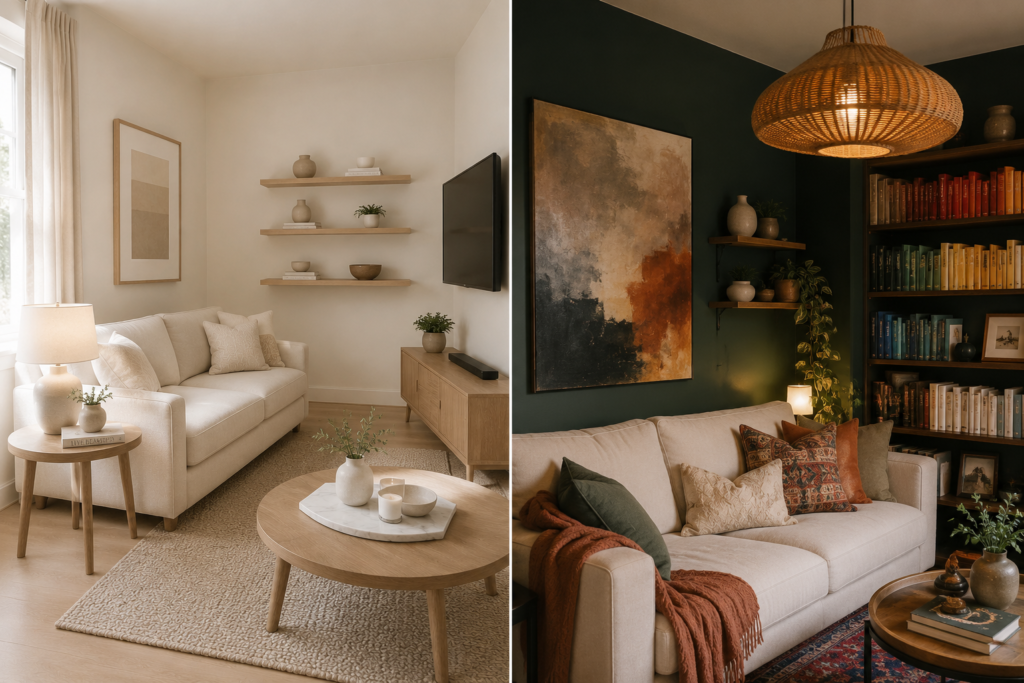
In any small living room, the most powerful space-creating intervention is the one that costs nothing: removing clutter.
Visual clutter — the accumulated presence of many small objects, visible cables, stacked items and displayed possessions — measurably reduces the perceived size of a room more than almost any physical spatial constraint.
The best small living room decor is not only beautiful; it is also edited, organised and intentional, so every visible item feels chosen rather than accidental.
A small, tidy, deliberately edited room feels significantly larger than an identically sized room filled with visible clutter.
How to Style This Look
The rule of surfaces — maximum three visible objects per surface:
Every visible surface in a small living room should have a maximum of three displayed objects. More than three creates the visual reading of a cluttered surface; exactly three creates the visual reading of a deliberately styled surface.
All cables hidden — always:
Visible cables are among the most powerful clutter signals in any room. Cable management clips, cable boxes, wireless charging pads and a cable tidy behind the TV can eliminate one of the most common small room visual problems.
Closed storage for things used infrequently:
Anything not used daily should be stored behind closed doors. The TV console should have doors. Shelving should have at least some closed sections.
A tray on every styled surface:
Trays contain and define object groupings so they appear as deliberate compositions rather than random collections.
Weekly five-minute tidy:
A small living room maintained with a five-minute weekly tidy never reaches the threshold of visible clutter that requires a day-long effort to resolve.
How to Recreate
✓ Cable management kit: Amazon, $8–15
✓ TV console with closed doors: IKEA BRIMNES, $120–200, or Amazon, $100–180
✓ Decorative trays for coffee table and side table: Amazon, $15–30 each
✓ Lidded wicker baskets for shelf storage: Amazon, $15–25 each
Budget Tip
Small living room storage clarity: $153–290 for cable kit, closed TV console, two trays and two lidded baskets.
The cable management kit and five-minute weekly tidy habit together eliminate the two most common small room clutter sources entirely.
Pro Tip
Research published in the journal Personality and Social Psychology Bulletin found that people in cluttered rooms produce measurably higher cortisol, the stress hormone, throughout the day than people in tidy equivalent spaces.
Tidying a small living room is not just aesthetically beneficial; it is a measurable stress-reduction intervention.
Next Up
Storage discipline creates spatial clarity. For the complete small living room interior that does everything right — combining colour, light, furniture choice, storage and personal touches — Idea 11 is the master approach to small living rooms that feel entirely intentional.
Idea 11: Small Living Room Inspirations — How to Add Personality Without Overcrowding the Room
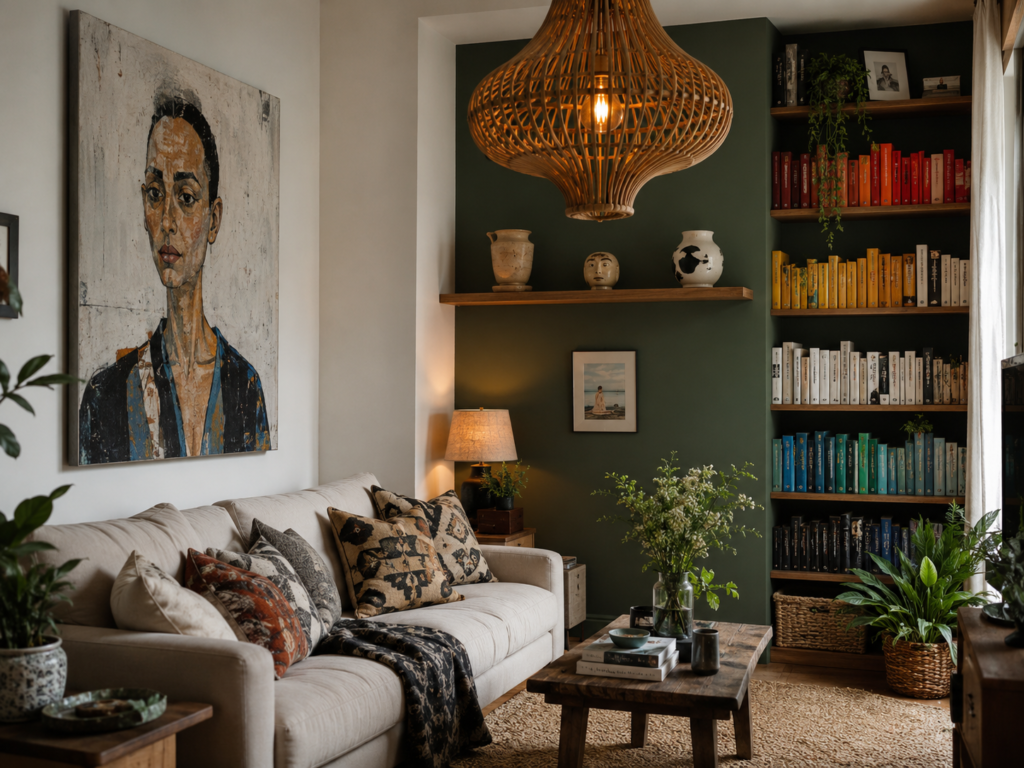
The most common fear about designing a small living room is that the space constraints will force blandness — that the room will end up generic and impersonal because there is not enough space to express character.
The opposite is true.
This is where small living room inspirations become personal: one bold wall, one large artwork, one meaningful collection and one beautiful lighting choice can give a compact room real character.
Small rooms are the most efficient vehicles for personality expression available, because in a small room, every visible object is seen from very close range and given full visual attention, rather than being one of many objects surveyed from a distance in a large room.
One magnificent piece of art, one characterful piece of furniture and one personally meaningful object collection fill a small room with specific, visible character more effectively than the same pieces would in a large one.
How to Style This Look
One large piece of art — scale up, never down:
In a small living room, go large with art. One oversized canvas or print — 80x100cm minimum — on the main wall creates a genuine focal point that fills the room with visual interest.
One bold colour or wallpaper on the feature wall:
A single feature wall in a bold colour or characterful wallpaper pattern creates the room’s personality anchor. Deep forest green, rich teal, warm terracotta or a botanical print can make the space feel intentional.
A statement lighting fixture:
An unusual, beautiful or characterful pendant light above the seating area creates instant personality in any small room.
Your own books as a deliberate display:
A shelf of books you have genuinely read — arranged by colour or by subject — is one of the most characterful and most space-efficient display choices available.
The three-object collection:
One small curated collection of three objects with genuine personal meaning creates more character in a small room than a shelf full of unrelated purchased accessories.
How to Recreate
✓ Large statement art print, 80x100cm: Society6 or Etsy, $25–60, plus IKEA frame, $15–25
✓ Feature wall bold colour: one tin of paint, $15–30
✓ Sculptural bamboo pendant light: Amazon or IKEA, $35–80
✓ Compact bookcase or floating shelves: $25–80
✓ Personal ceramics, books or objects: use meaningful pieces you already own
Budget Tip
Personality-rich small living room: $105–250 depending on art, paint, lighting and shelving.
The biggest impact comes from one large art piece and one confident wall colour. These two elements can make a small room feel deliberate instead of limited.
Pro Tip
Small rooms actually reward specificity. A large room can absorb generic decor, but a small room exposes it. That means every object needs to be intentional. The fewer items you display, the more important each one becomes.
Idea 12: Small Living Room Ideas on a Budget — A Practical Small Living Room Apartment Makeover Plan
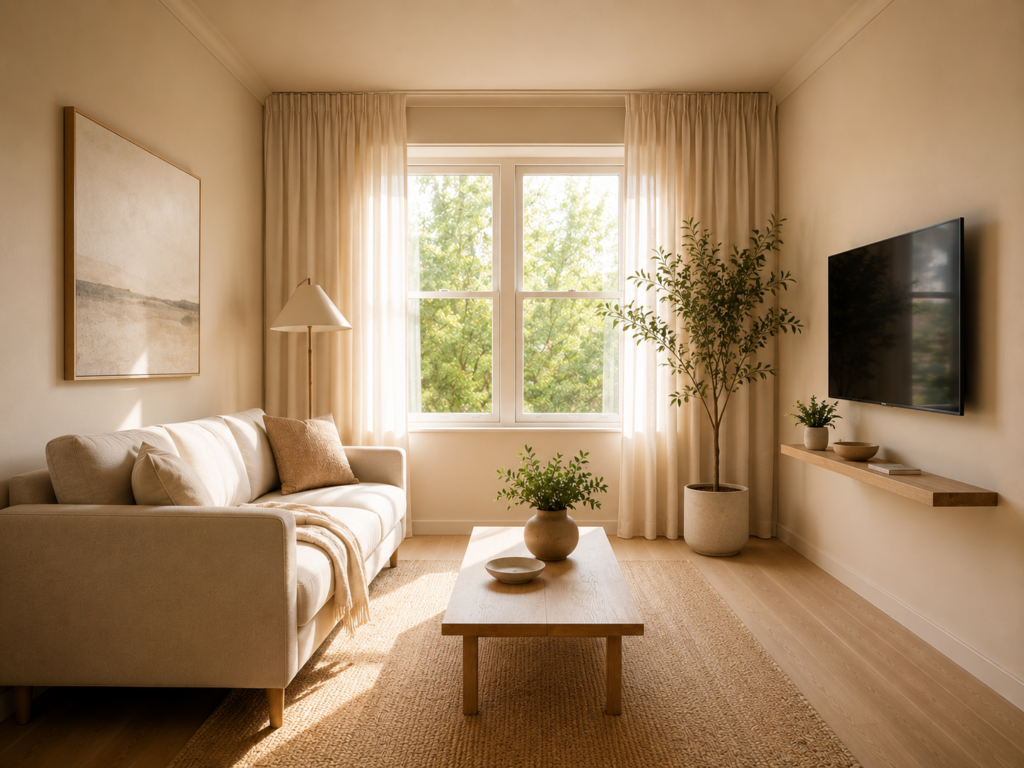
A beautiful small living room does not require a large budget. In fact, the most transformative ideas in this article are also the cheapest: ceiling-height curtains, colour drenching, decluttering, moving furniture away from windows and mounting the TV on the wall.
This budget plan is especially useful for a small living room apartment because it focuses on low-cost improvements that change the feeling of the space without requiring new expensive furniture.
The under £100 plan focuses on the five changes that create the biggest visual difference for the least money. It is not about buying more decor — it is about correcting the spatial mistakes that make a small room feel smaller than it really is.
How to Style This Look
Start with furniture position:
Move every piece of furniture away from windows. Natural light is your most valuable space-expanding tool, and blocking it makes the room feel smaller immediately.
Raise the curtains:
Move the curtain rod as close to the ceiling as possible and use floor-length curtains. This creates the illusion of taller ceilings and larger windows.
Colour drench with one warm neutral:
Paint the walls, ceiling and woodwork in one warm cream or oat tone. This removes visual breaks and makes the room feel more seamless.
Add one large mirror:
Place one large mirror adjacent to the window so it reflects daylight into the room and creates perceived depth.
Remove floor clutter:
Clear the floor completely. Use shelves, hooks and trays instead of floor-level storage.
How to Recreate
✓ Move furniture away from windows: free
✓ Declutter all surfaces and floor: free
✓ Longer curtain rod: $8–15
✓ Sheer or linen curtains: $7–12 per pair
✓ Warm cream paint: $15–30
✓ Wall-mounted TV bracket: $15–35
✓ Floating shelf below TV: $8–15
✓ Large mirror: budget option $20–80 depending on size
Budget Tip
Under £100 / budget small living room transformation: approximately $91–143 depending on mirror and curtain choices.
The most important point is that the highest-impact changes are not luxury purchases. They are spatial corrections: raise curtains, reflect light, clear the floor, remove clutter and unify the surfaces with paint.
Pro Tip
A 2024 survey of homeowners who renovated their living rooms found that the most transformative changes were better lighting, furniture repositioning and decluttering — all low-cost or free improvements.
This proves the central point of small room design: the solution is usually not more spending. It is better spatial decision-making.
Complete Budget Summary — All 12 Small Living Room Ideas
| Item | Budget | Mid-Range | Why It Matters |
|---|---|---|---|
| Ceiling-height curtains | $23–72 | $80–150 | Makes the room feel taller |
| Add legs to existing furniture | $15–25 | $50–100 | Reveals more floor |
| Large mirror | $20–120 | $150–300 | Doubles light and depth |
| Storage ottoman | $90–180 | $200–400 | Replaces coffee table + storage |
| Colour drenching paint | $15–30 | $40–80 | Dissolves boundaries |
| Floating shelves | $78–140 | $150–300 | Uses vertical space |
| One sofa + chair layout | $670–1,280 | $1,200–2,500 | Solves layout congestion |
| Wall-mounted TV setup | $64–120 | $150–300 | Frees floor space |
| Sheer curtains + mirror | $77–152 | $200–400 | Maximises natural light |
| Closed storage + baskets | $153–290 | $300–600 | Removes visible clutter |
| Personality wall + art | $105–250 | $300–700 | Adds character |
| Under £100 plan | $91–143 | $150–250 | Maximum value transformation |
Frequently Asked Questions About Small Living Room Ideas, Layout, Decor and Apartment Design
How can I make my small living room look bigger?
Hang curtains near the ceiling, use light-reflecting colours, add a large mirror, choose furniture with visible legs and keep the floor clear. These simple changes improve your small living room layout and make the room feel more open.
What colour makes a small living room look bigger?
Warm neutrals such as cream, oat, beige and warm white work best. For a seamless small living room design, paint the walls, ceiling and trim in the same colour.
What furniture works best in a small living room?
Choose compact furniture with visible legs and hidden storage. A storage ottoman, slim sofa, round coffee table and one accent chair can create a practical small living room set up without overcrowding the space.
How do I choose the right sofa for a small living room?
Choose a sofa that fits the longest wall and still leaves a clear walking path of at least 90cm. In a small living room apartment, one good sofa is usually better than two bulky seating pieces.
Should I use dark or light colours in a small living room?
Light colours make the room feel open and airy, while dark colours make it feel cozy and dramatic. For small living room ideas cozy, use warm neutrals with soft lighting and natural textures.
What is the best layout for a small living room?
The best small living room layout is usually one sofa, one chair, a round coffee table, wall-mounted storage and a clear walking path. Avoid placing furniture in front of windows.
Your Small Living Room — Start With the Curtain Rod, the Paint and a Better Layout
Every small living room idea in this guide builds toward the same experience: a room that feels genuinely complete and perfectly proportioned rather than a compromise dictated by square footage.
The spatial techniques here — curtains at ceiling height, colour drenching, the large mirror, elevated furniture and the visible floor — address the actual perceptual mechanisms that make small rooms feel small.
Whether you are planning a small living room apartment, improving your small living room interior, searching for small living room inspirations, or simply trying to create a more comfortable small living room set up, the best changes begin with proportion, light, layout and visual clarity.
They cost almost nothing and require no renovation, no landlord permission and no specialist skill.
Start tonight: measure the distance from your window curtain rail to the ceiling. Buy a longer rod. Rehang the curtains from as close to the ceiling as possible. Stand in the doorway and look at the room.
This single change, costing around $8–15, is one of the most transformative design decisions you will make this year — and everything else in this guide builds on the spatial clarity it creates.