Introduction
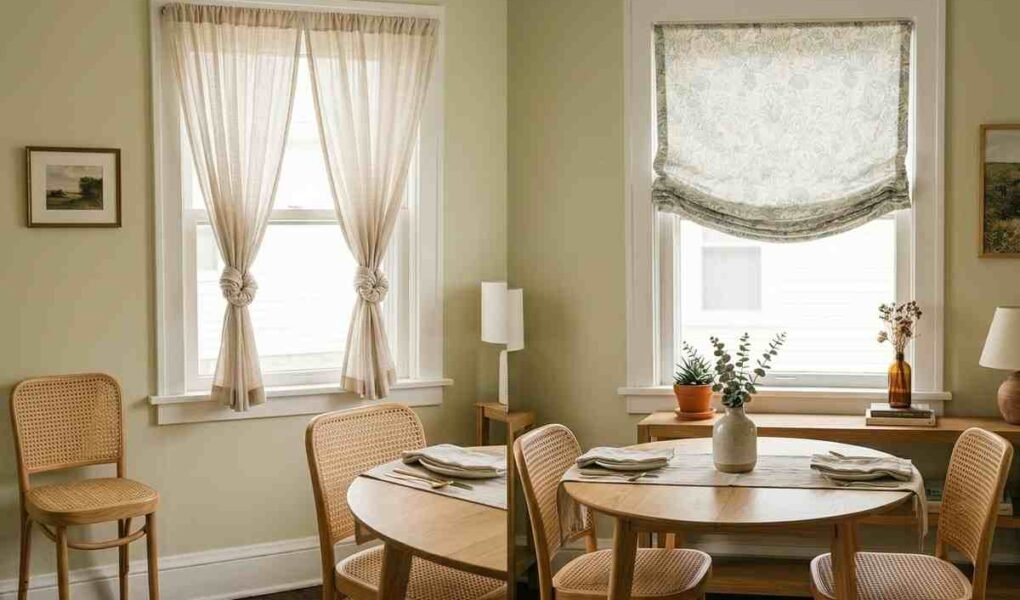
The most common curtain mistake in a small dining room has nothing to do with the fabric, the colour, or even the pattern. It is the rod — mounted tight to the window frame, exactly where it looks like it belongs, and doing quiet damage to the room’s sense of space every single day as a result.
A curtain rod mounted two inches above a window frame rather than near the ceiling, and extending only as far as the window’s own width, can make an already compact dining room feel noticeably more closed in — not dramatically, not obviously, just persistently. Conversely, the same window dressed with a lightweight fabric on a rod mounted high and wide can make a small dining room feel a size larger than it actually is, simply by directing the eye upward and outward rather than stopping it at the edge of the glass.
This guide covers the specific choices — rod placement, fabric weight, colour, and what to do in an open-plan dining space — that reliably make a small dining room feel more generous than its actual square footage. Every recommendation is the kind that makes an immediate, visible difference rather than a theoretical one.
🔗 You can also use our Free Decor Style Tool for styling
Why Curtain Choice Matters More in a Small Dining Room
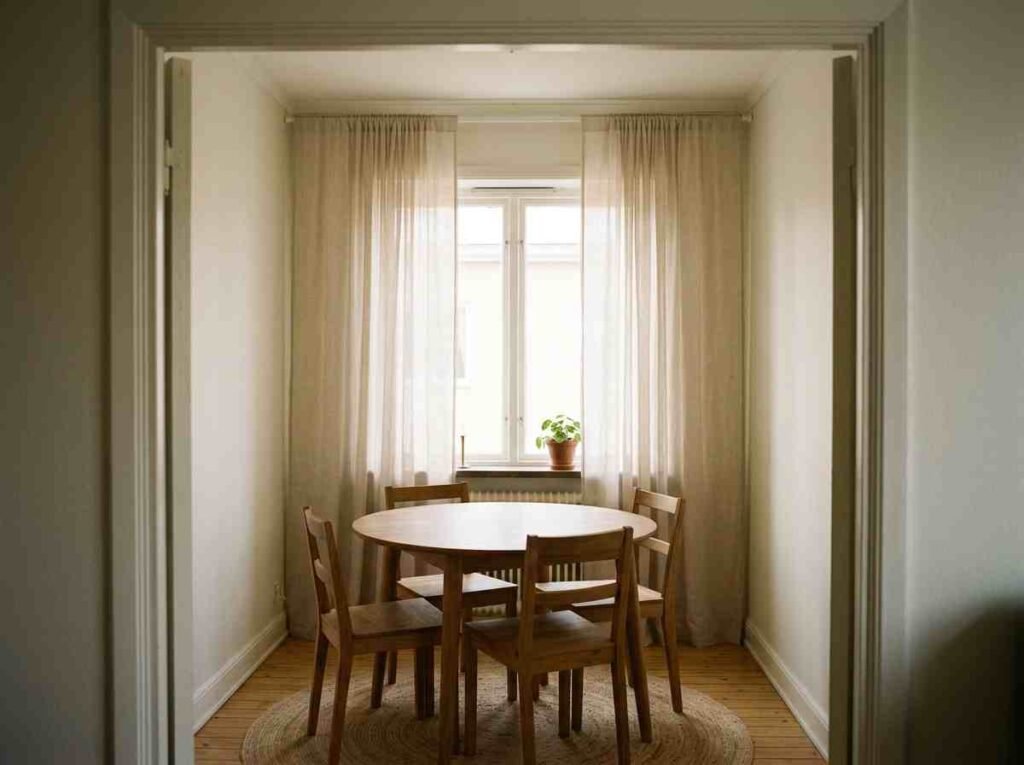
In a larger room, a curtain is one of many elements competing for visual attention — the table, the chairs, the art, the rug all share the load. In a small dining room, the window and its curtain are often one of the few large surfaces in the entire space, which means whatever happens there has an outsized effect on how the whole room feels.
This is why the general advice for dining room curtains (choose a fabric you love, pick a colour that suits the formality of the room) needs a second, more specific layer of guidance when the room itself is small: every choice also needs to be evaluated for how it affects the room’s perceived size, not just its style.
The Mounting Trick That Matters Even More Here
Mounting the curtain rod high and wide is good advice in any dining room, but it’s the single highest-impact change available in a small one specifically.
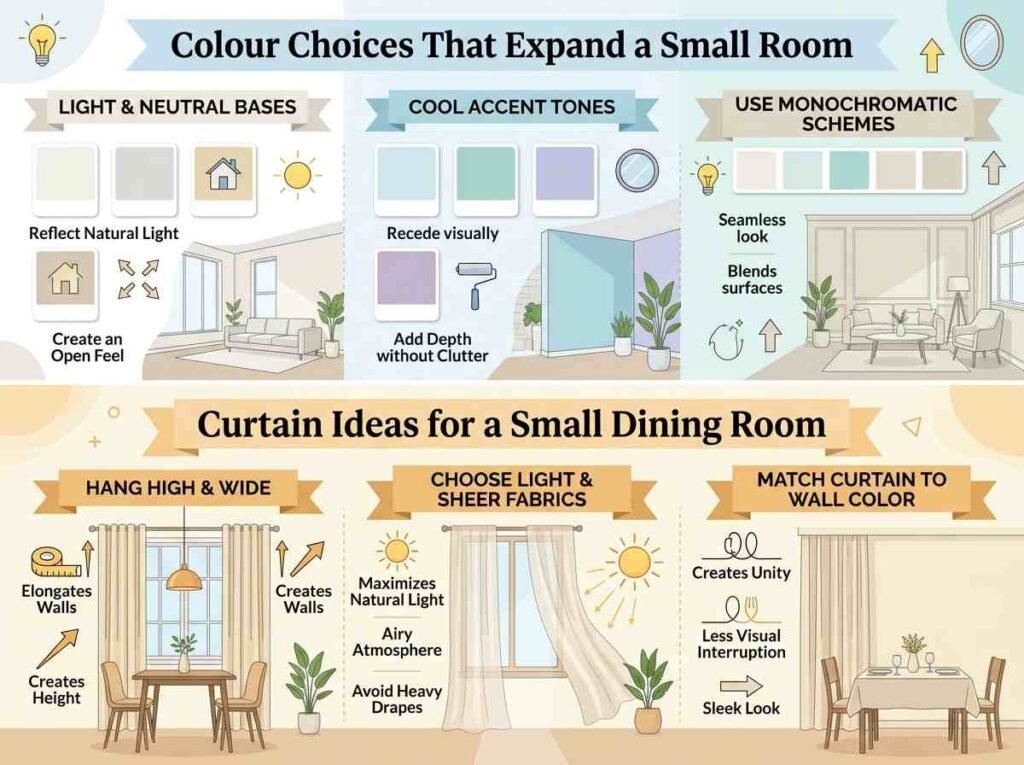
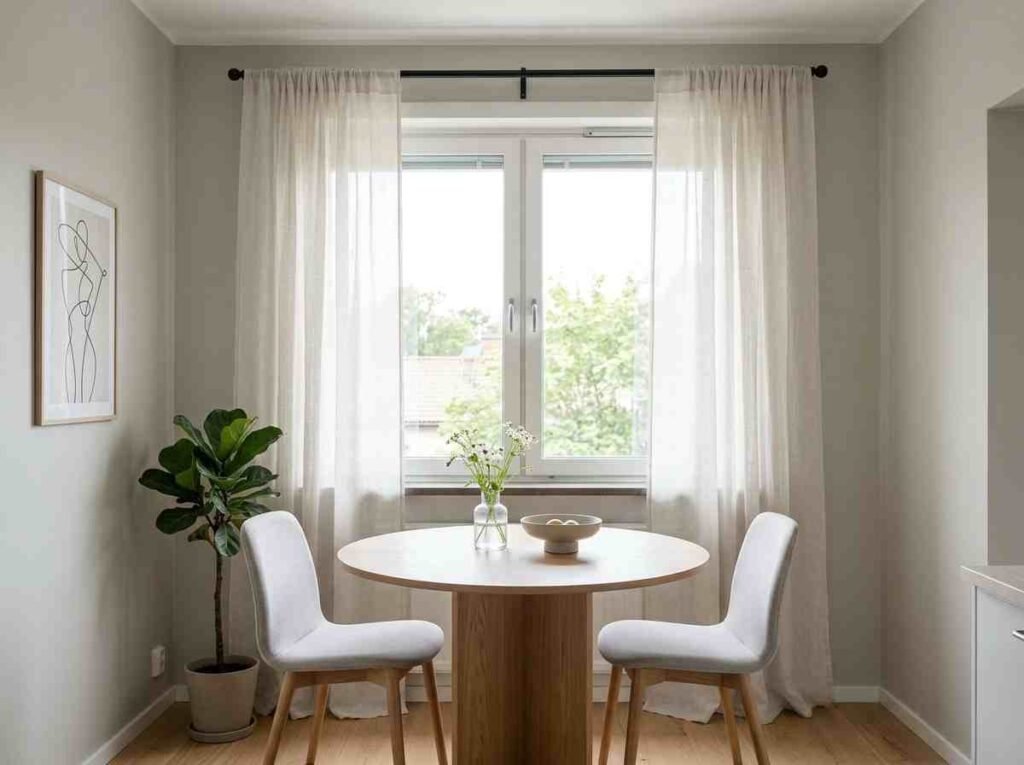
Mount the rod close to the ceiling, at minimum 6 inches above the window frame and ideally closer to the ceiling itself if the wall height allows. This draws the eye upward, visually extending the height of the entire wall and making the room feel taller — which matters disproportionately in a small room, where every inch of perceived extra space counts.
Extend the rod well beyond the window frame on each side — at least 6 inches per side, more if the wall space allows. This lets the curtains stack back fully against the wall when open, exposing the maximum amount of window glass and the most natural light possible. In a small dining room, a curtain that covers even a few inches of usable window glass when “open” is meaningfully reducing the room’s light and its sense of openness.
The combined effect of mounting high and wide is the closest thing to a guaranteed improvement available — it costs nothing beyond the curtain rod itself and works in almost every small dining room regardless of the room’s specific style or window size.
Fabric and Weight — Lighter Is Almost Always Better
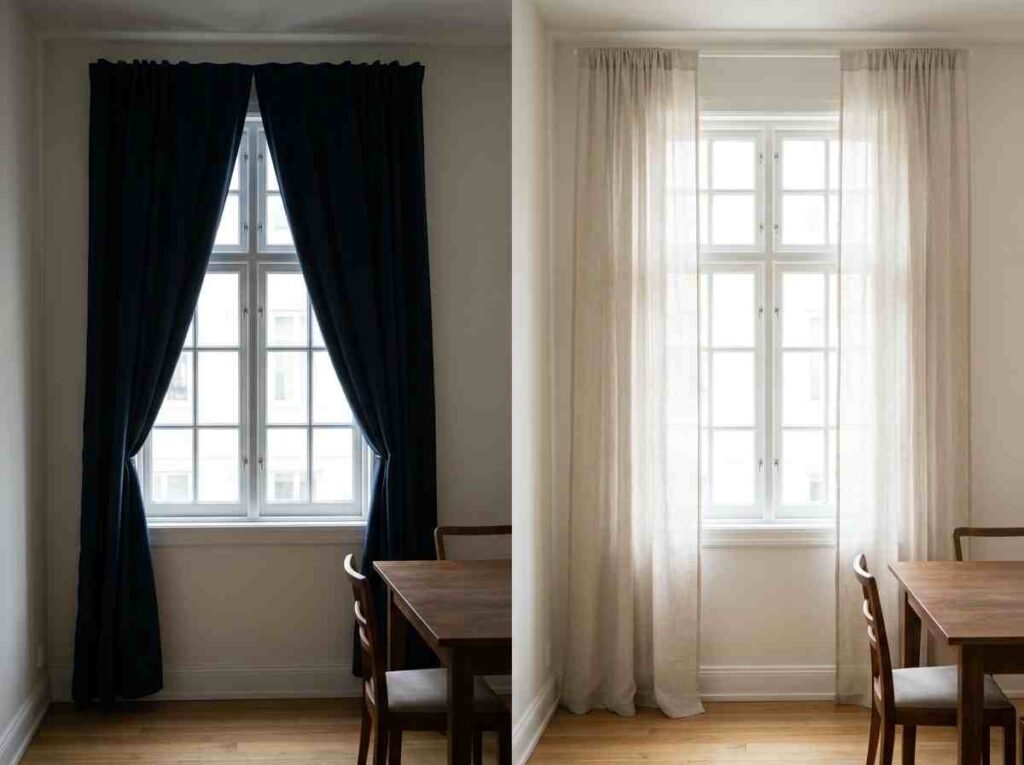
Sheer or lightweight fabrics are the most reliable choice for a small dining room. Linen, voile, and light cotton let daylight filter through fully, keeping the room feeling bright and airy rather than enclosed. A heavy, opaque fabric — however beautiful in isolation — visually adds bulk to a small window in a way that a lighter fabric simply doesn’t.
If a heavier, more formal fabric is wanted, balance it with restraint elsewhere. A single panel of a richer fabric, rather than a full, generously gathered pair, can bring some formality into a small dining room without the bulk that a fuller treatment would add.
Avoid heavy layering in a genuinely small space. The layered sheer-plus-blackout combination that works beautifully in larger dining rooms can feel cluttered and visually heavy in a small one, where there’s less wall space to absorb the visual weight of two full layers of fabric.
You can also read Baddie Room Ideas & Y2K Aesthetic Bedroom: The Complete Guide
Colour Choices That Expand a Small Room
Light, pale colours — white, cream, soft grey, pale linen tones — are the most reliable choice for making a small dining room feel bigger. They reflect rather than absorb available light, and they minimise the visual contrast between the curtain and a similarly light wall colour, which helps the window blend into the room’s overall envelope rather than standing out as a heavy, separate block of colour.
Matching or closely coordinating the curtain colour to the wall colour is a particularly effective trick in a small room — when the curtain and the wall are close in tone, the eye doesn’t register a hard visual break at the window, and the wall appears to continue uninterrupted, making the whole room feel more expansive.
If a bolder colour or pattern is genuinely wanted, keep it to one wall’s worth of curtains rather than introducing it elsewhere in the room too. A small dining room can usually only support one strong colour statement before it starts to feel busy rather than characterful.
Vertical stripes or a vertically-oriented pattern can reinforce the height-drawing effect of high mounting, subtly contributing to the sense of a taller room.
You can also read Romantic Bedroom Lighting: The Complete Candles, Fairy Lights & Ambience Guide
Small Windows Specifically
A small dining room often comes with a genuinely small window, not just a small room around a normal-sized one, and this requires slightly different handling than the room-size advice above.
Don’t shrink the curtain to match the window’s small size. This is the most common and most counterproductive small-window mistake — hanging a narrow curtain that closely tracks the actual width of a small window makes both the window and the curtain look smaller and more apologetic, rather than disguising the window’s modest proportions. Mounting wide, exactly as described above, matters even more when the underlying window itself is small, since the curtain’s width becomes the visual cue for “window size” rather than the glass itself.
Consider a single panel rather than a symmetrical pair for a genuinely narrow window. A single panel, pulled fully to one side, can sometimes suit a small or narrow window better than two panels that each have very little fabric to work with and can look skimpy when only partially open.
Floor-length curtains generally suit small windows better than sill-length ones. A short curtain on a small window tends to emphasise exactly how small the window is, while a floor-length curtain extends the visual line of the window treatment well past the glass itself, making the window feel like a more deliberate, larger feature of the wall.
You can also read Blush Pink & Rose Bedroom Decor: The Complete Romantic Guide
Curtains for an Open-Plan Small Dining Room
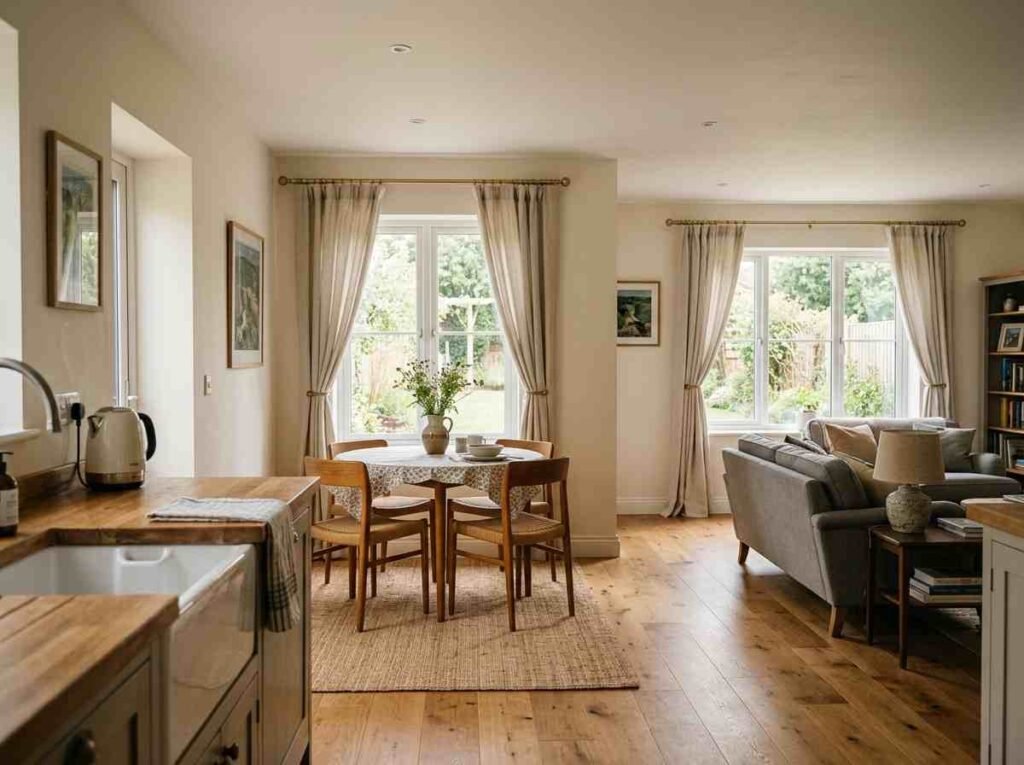
Many small dining rooms aren’t fully enclosed rooms at all — they’re a dining area within an open-plan kitchen or living space, which raises a slightly different question: should the dining area’s curtains match the rest of the open-plan space, or can they be different?
Matching the curtain style and colour across the whole open-plan area is generally the safer, more cohesive choice, since a clear style change at the dining window in an otherwise continuous open space can read as visually disjointed rather than as a deliberate zone marker.
If a subtle distinction for the dining zone is wanted, keep the fabric and colour identical to the rest of the space but vary a small detail — the tieback style, a slightly different header pleat — rather than introducing a genuinely different colour or pattern, which risks fragmenting an open-plan room that’s already working hard to feel cohesive despite serving multiple functions.
You can also read Galactic Room & Galaxy Bedroom Ideas: How to Design a Cosmic Space
Frequently Asked Questions
Q: Do curtains make a small dining room look smaller?
A: They can, but only if chosen and hung poorly. Heavy, dark, or tightly-mounted curtains genuinely reduce a small room’s sense of space and light. Light-coloured, lightweight curtains mounted high above the window frame and well beyond its width have the opposite effect, drawing the eye upward and outward and making the room feel noticeably larger than its actual dimensions.
Q: What is the single best change for curtains in a small dining room?
A: Mounting the curtain rod high — close to the ceiling rather than tight to the window frame — and wide, extending well beyond each side of the window, is the single most reliable improvement available. It costs nothing beyond the rod itself, works regardless of the room’s specific style, and consistently makes the room feel taller and the window appear larger and more deliberate.
Q: Should curtains be light or dark in a small dining room?
A: Light, pale colours are generally the better choice, since they reflect available light and help the curtain visually blend with a similarly light wall rather than standing out as a heavy block of colour. A bolder or darker colour can still work as a deliberate style choice, but it’s worth balancing with a lighter wall colour and keeping the rest of the room’s colour palette relatively restrained to avoid the space feeling visually heavy.
Q: What should I do if my small dining room has a really small window?
A: Avoid sizing the curtain to closely match the window’s actual width — mount the rod wide regardless of how narrow the window itself is, since the curtain’s width becomes the visual cue for the window’s apparent size. Floor-length curtains generally suit small windows better than short ones, extending the visual line of the treatment well past the glass and making the window read as a more substantial, deliberate feature of the wall.
Q: Should my small dining room’s curtains match the rest of an open-plan space?
A: In most cases, yes. Matching the curtain fabric and colour across an open-plan kitchen, living, and dining area generally reads as more cohesive than introducing a different style at the dining window specifically, since an abrupt style change within a continuous open space can fragment a room that’s already working to feel unified. A small detail change, like the tieback style, is a subtler way to acknowledge the dining zone without disrupting the overall consistency.