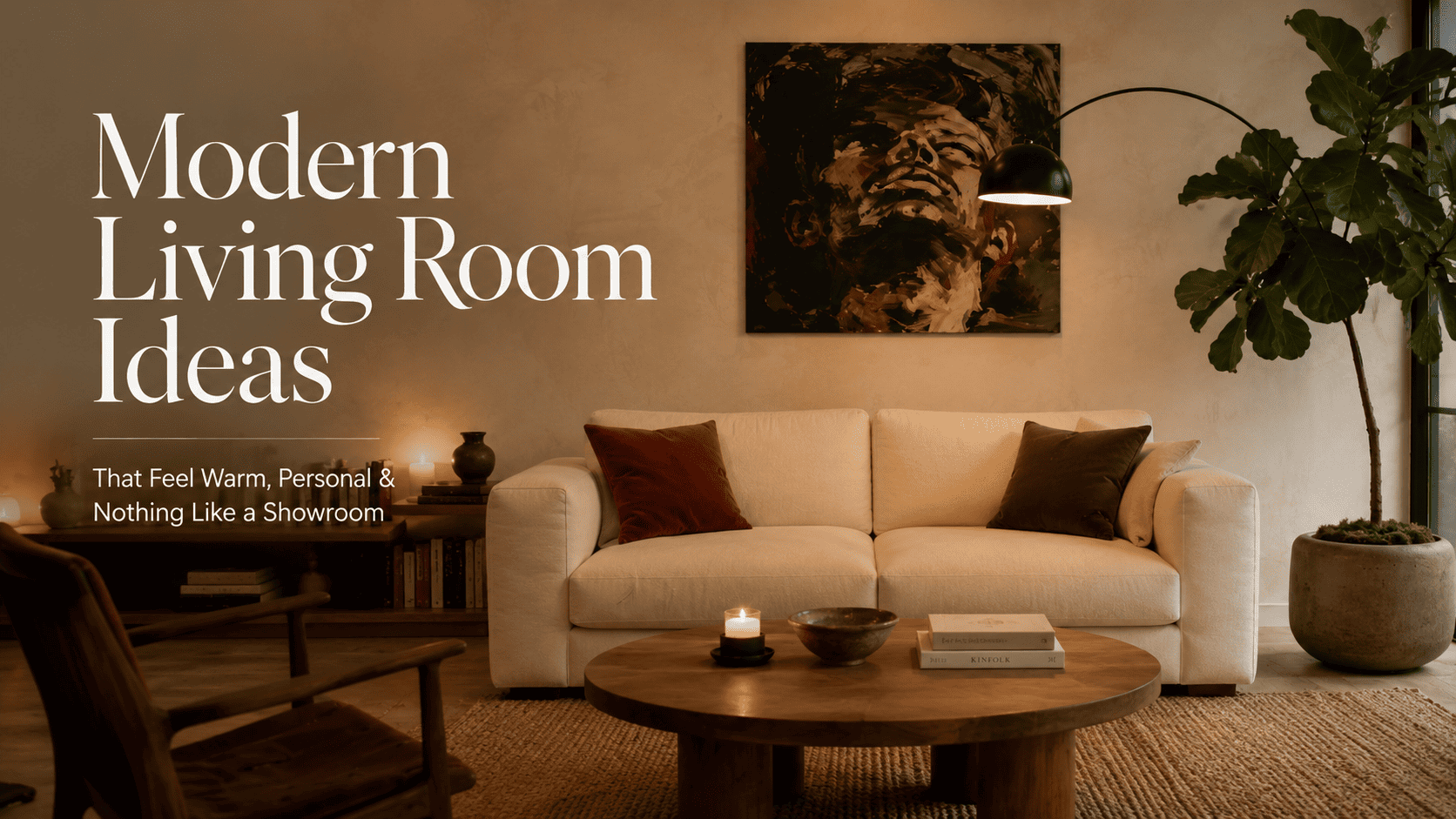
The Problem With Modern — and Why 2026 Fixes It
For most of the last decade, modern living room design meant one thing: clean lines, cool whites, minimal accessories, the conspicuous absence of warmth. It photographed beautifully and felt terrible to inhabit. It was the interior design equivalent of wearing beautiful but uncomfortable shoes — aesthetically impressive, practically miserable. In 2026, modern living room design has evolved in a direction that most people have been waiting for: warm, tactile, personally expressive and deeply comfortable while remaining entirely clean, considered and uncluttered.
The 2026 modern living room is defined by organic modern aesthetics, curved furniture forms, natural materials, warm lighting and biophilic elements — a living room that is simultaneously architecturally intelligent and genuinely human. This guide gives you 12 modern living room ideas covering everything from organic modern and limewash walls to open-plan zoning and the complete budget transformation — each with a cinematic AI prompt, recreation guide and honest budget.
What Makes a Living Room Look Modern in 2026?
Four elements define the 2026 modern living room:
- Curved furniture forms: rounded sofas, oval coffee tables, arched lamps. Hard corners are 2015.
- Natural materials: warm oak, linen, bouclé, travertine, rattan. Never chrome and glass alone.
- Warm 2700K lighting from multiple sources: never single overhead cool white. Always layered warm amber.
- One dramatic plant as architectural element: not scattered succulents — one large sculptural floor plant in a clean concrete planter.
Which Modern Living Room Idea Is Right for You?
Find your direction in seconds:
| Idea | Modern Style | Budget | Vibe | Go To |
|---|---|---|---|---|
| What Modern Means in 2026 | Design principles | $95–210 | Foundational warmth | Idea #1 |
| Organic Modern | Curved + natural | $783–1,455 | Nature-connected | Idea #2 |
| Modern Colour Formula | Bold + committed | $110–245 | Confident palette | Idea #3 |
| Modern Furniture Selection | Sculptural quality | $1,075–2,200 | Considered pieces | Idea #4 |
| Open-Plan Zoning | Layout intelligence | $160–410 | Intimate in large space | Idea #5 |
| Modern Lighting System | Sculptural + warm | $158–375 | Evening atmosphere | Idea #6 |
| Modern Minimalist | Precision + soul | $775–1,470 | Clean but alive | Idea #7 |
| Modern Wall Treatments | Limewash + panels | $25–120 | Textured character | Idea #8 |
| Biophilic Modern | Plants as architecture | $78–180 | Nature-connected | Idea #9 |
| Small Modern Living Room | Compact + confident | $668–1,245 | Sophisticated compact | Idea #10 |
| Modern on a Budget | $78–135 total | $78–135 | Affordable modernity | Idea #11 |
| Personal Modern Room | Yours specifically | Any budget | Human + warm | Idea #12 |
Idea 1: What Modern Actually Means in 2026 — Warm, Human and a Long Way From Cold
The word “modern” in living room design has spent the last decade meaning the wrong thing — associated with cold, hard-edged, all-white, devoid-of-comfort spaces that photograph beautifully and feel terrible to actually inhabit. In 2026, modern living room design has fundamentally changed direction. Interior designers across the industry have reached a clear consensus: truly modern means warm, human-scaled, textured and personal — the opposite of the clinical minimalism that dominated the previous decade. Understanding this shift is the most important thing you can know before designing a modern living room in 2026.
Modern ≠ minimal and cold: The most frequently published and most admired modern living rooms of 2026 are warm, layered and deeply comfortable. They use clean lines as the structural framework but fill that framework with natural textures, warm lighting and personal objects. Modernism’s original principle was “form follows function” — and in 2026, that means comfort is the primary function.
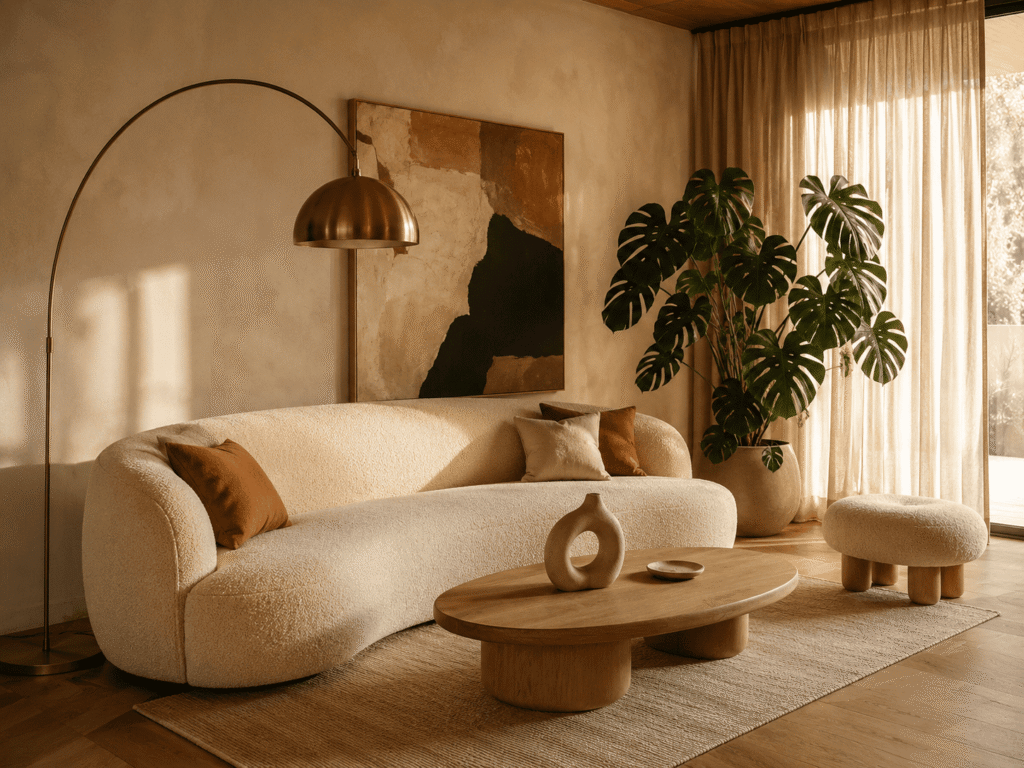
Clean lines + warm materials = the 2026 formula: A modern living room sofa with a clean, unadorned profile in warm cream bouclé fabric is more modern than a hard-edged chrome and leather piece. The clean form is modern; the warm material is the 2026 evolution. Natural wood, linen, bouclé, warm ceramic and rattan within clean architectural forms is the contemporary synthesis.
Natural materials as the defining quality of contemporary design: Designers universally identify natural, tactile materials — handmade tile, warm wood with visible grain, unlacquered metals, woven fibre — as the primary driver of modern interior design in 2026. These materials feel authentic and age beautifully, which is the direct response to the previous decade’s synthetic, easy-clean, timeless-but-soulless aesthetic.
Curves replacing hard corners: Rounded sofas, oval coffee tables, arched doorways, circular mirrors and curved shelving have replaced the square-cornered furniture that defined 2010s modern design. Curves feel more human, more approachable and more genuinely welcoming than right angles — and research in environmental psychology confirms that curved forms reduce visual tension in residential spaces.
Personal expression as the modern imperative: The most respected interior designers of 2026 consistently state that personalised, layered, collected spaces are more modern than generic minimal ones. Brad Ramsey, Principal Designer at Brad Ramsey Interiors, says: “In 2026, we’ll see a strong shift toward deeply personal and layered spaces” — directly contradicting the impersonal minimalism that “modern” once implied.
How to Recreate
✓ Curved cream bouclé sofa: Amazon or IKEA ($500–900) — search “curved cream bouclé sofa modern”
✓ Oval natural oak coffee table: Amazon ($120–280) — the modern but organic centrepiece
✓ Limewash paint for textured walls: Portola Paints or Roman Clay ($30–60 per tin) — the 2026 modern wall finish
✓ Arched brushed brass floor lamp: Amazon ($65–150) — sculptural and warm simultaneously
✓ Large monstera in concrete planter: local nursery ($20–45) + Amazon ($15–25 for planter)
Budget Tip
Modern 2026 living room: $730–1,400 with new sofa, coffee table, limewash paint, arc lamp and monstera. The limewash paint ($30–60) plus arched brass floor lamp ($65–150) together create the most immediately modern 2026 atmosphere for $95–210 — these two items before any furniture purchase.
Pro Tip
Did you know? The Bauhaus school — the foundational institution of modernism in design, founded by Walter Gropius in 1919 — explicitly taught that good design must serve human comfort and wellbeing as its primary goal. The cold, impersonal minimalism of the 2010s was therefore not more modern than the warm, comfortable rooms of 2026 — it was actually a betrayal of modernism’s original principles. The warm, human-centred modern design of 2026 is more philosophically coherent with the Bauhaus tradition than the sterile minimalism it replaced.
Next Up
The principles of modern design in 2026 defined. The specific sub-aesthetic that most embodies these principles — and that has been the fastest growing named interior style of the past three years — is Idea #2: organic modern.
Idea 2: Organic Modern Living Room — The 2026 Style Everyone Is Searching For
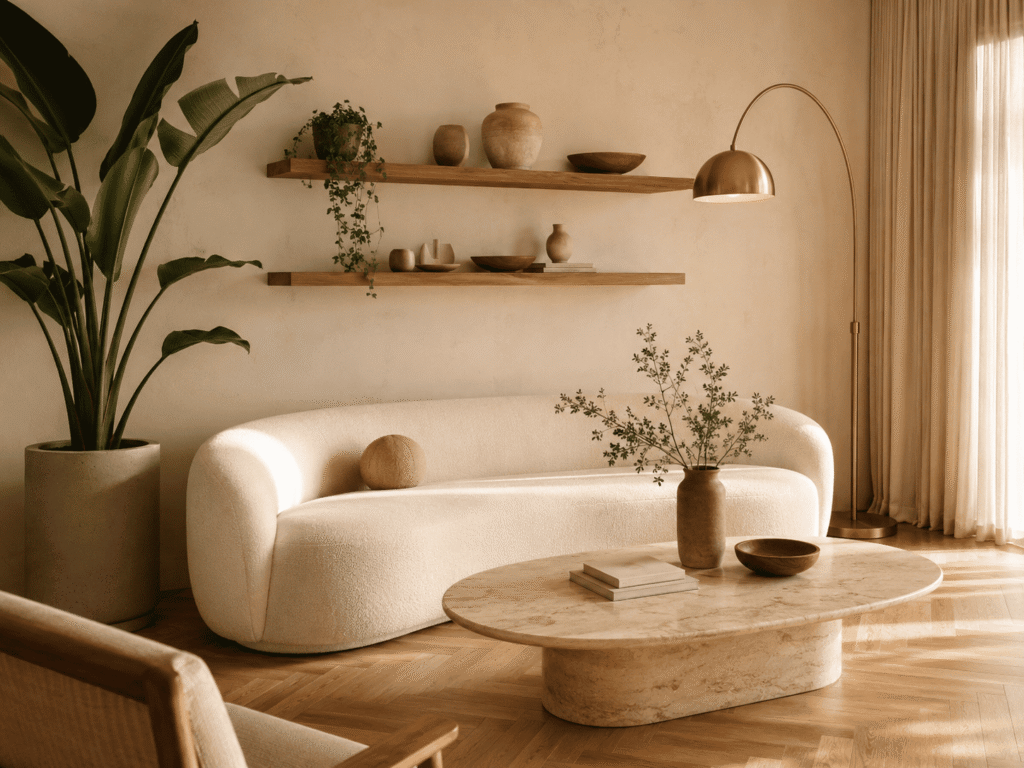
Organic modern is the fastest-growing named living room aesthetic of 2023–2026 — and its appeal is immediately obvious. It solves the central tension of modern design by combining the clean, spatial clarity of contemporary architecture with the warmth and natural authenticity of organic materials. Where cold minimalism gave you clean lines but no warmth, and where maximalism gave you warmth but no calm, organic modern gives you both simultaneously. The aesthetic is defined by warm oak, curved furniture forms, natural stone, linen, rattan and one large dramatic plant — all within a restrained, architecturally clean framework that never feels cluttered.
Warm oak as the defining material: Organic modern uses warm oak consistently throughout — flooring, coffee table, floating shelves, side tables — creating a warm material thread that runs through the entire room. Not dark walnut, not white-washed ash — specifically warm honey oak that reads as simultaneously modern and natural.
Curved furniture forms throughout: A curved sofa, an oval coffee table, a rounded armchair, a circular mirror — in organic modern design, curved furniture is not a detail, it is a structural principle. Curved forms feel organic while remaining completely contemporary in silhouette.
Natural stone as a surface accent: A travertine or marble coffee table top, a stone side table, a natural stone sculpture on the shelf — organic modern uses natural stone as a material accent that bridges the contemporary and the natural.
One large dramatic plant — not many small ones: Organic modern uses plants as architectural elements rather than decorative accessories. One large, dramatically shaped plant — a fiddle-leaf fig, a bird of paradise, an oversized monstera — in a clean-lined concrete or ceramic planter in the corner is the organic modern approach.
Warm neutrals throughout — never stark white: Organic modern uses oat, cream, warm greige and warm white rather than pure brilliant white. The slight warmth in the palette creates the human-scale comfort that makes the clean modern lines feel inviting rather than clinical.
How to Recreate
✓ Curved cream sofa: Amazon ($500–900) — search “curved upholstered sofa cream organic modern”
✓ Oval travertine or stone-effect coffee table: Amazon ($200–450) — the defining organic modern centrepiece
✓ Warm oak floating shelves: IKEA BERGSHULT ($25–45 each) — the material thread at upper level
✓ Bird of paradise in concrete planter: local nursery ($25–55) + Amazon ($18–30 planter)
✓ Warm oat-cream wall paint: Sherwin Williams “Alabaster” or “Antique White” ($15–30)
Budget Tip
Organic modern living room: $783–1,455 with new sofa, travertine coffee table, shelves, plant and paint. Without new sofa: $283–555 for the specific organic modern elements. The travertine-effect coffee table ($200–450) is the single item that most immediately establishes organic modern identity.
Pro Tip
Did you know? “Organic modern” as a named style was catalogued by Houzz in their 2022 Emerging Styles Report with a 340% search growth rate — making it the fastest-emerging style they had tracked in their platform’s history to that point. By 2026 it is mainstream, appearing in every major interior design publication’s trend reports and on every major retailer’s marketing.
Next Up
Organic modern is the defining 2026 style. For the specific colour decisions that make modern living rooms feel confidently contemporary rather than cautiously neutral — Idea #3 covers the modern living room colour formula.
You can also visit Small Living Room Ideas That Make Your Space Feel Twice as Big and Ten Times More Beautiful
Idea 3: Modern Living Room Colour — Warm Neutrals, Colour Drenching and One Bold Statement
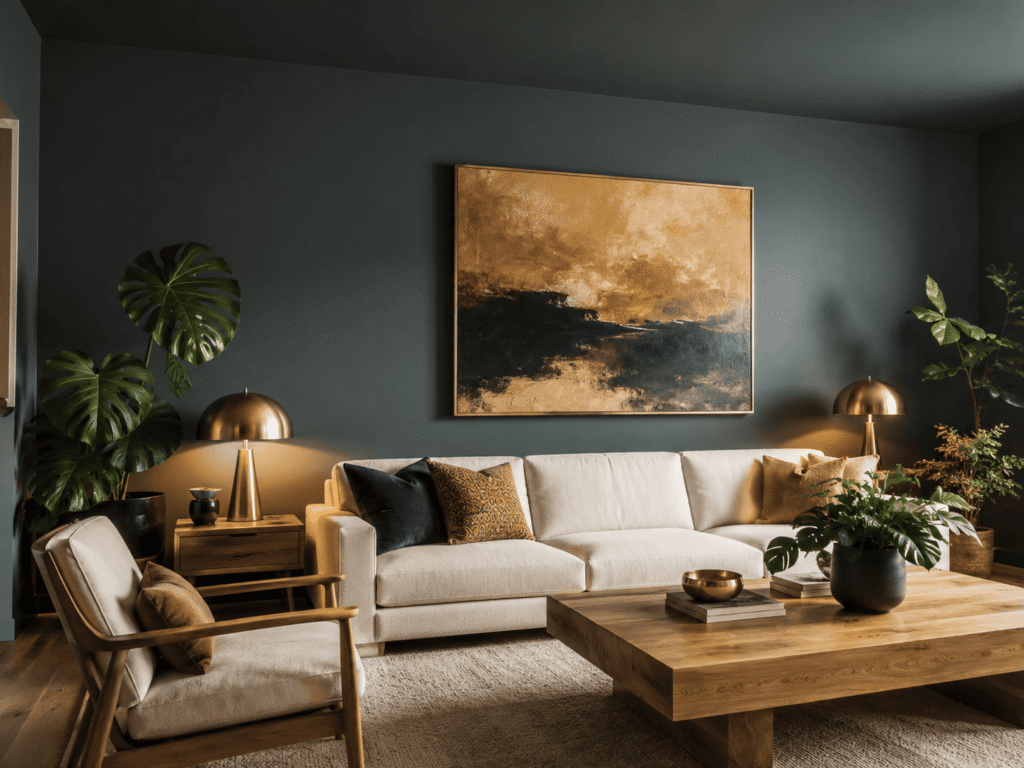
The most sophisticated modern living room colour decisions of 2026 share one characteristic: they are committed rather than safe. The era of cautious magnolia and non-committal mid-grey as default “modern” colours is definitively over. In 2026, modern living room colour means choosing with conviction — whether that conviction leads to a deeply warm neutral, a bold colour drench or one saturated accent wall. What links all the best modern colour decisions is not a specific hue but the quality of confident, deliberate choice — the opposite of “I chose this because it seemed safe.”
Warm neutrals with strong undertones — not neutral-by-default: The most modern neutral living room colours of 2026 are those chosen specifically for their warmth: SW “Accessible Beige,” F&B “Elephant’s Breath,” Behr’s “Hidden Gem,” and Valspar’s “Warm Eucalyptus.” Each of these has a strong, specific quality that makes it a conscious design choice rather than a default.
Colour drenching — the technique that reads as most contemporary: Applying one colour to walls, ceiling and woodwork simultaneously creates the most modern, envelope-like space available. In a contemporary living room, a single deep warm colour on all surfaces reads as architecturally intelligent and sophisticated.
Quietly colourful tones replacing bold primaries: The 2026 direction is “quietly colourful” — muted variations of bold colours that feel fresh without dominating. Dusty sage rather than vivid emerald. Warm terracotta rather than vivid orange. Muted teal rather than electric blue.
One saturated accent wall for maximum modern impact: If full colour drenching feels too committed, one deeply saturated wall — the chimney breast, the wall behind the sofa, the wall framing the TV — creates the modern design statement while keeping three walls in a neutral backdrop.
Wood tones guide the ideal paint undertone: The wood tones in a modern living room should guide the wall paint undertone. Light oak flooring pairs best with warm cream or warm greige walls. Darker walnut pairs best with warm whites or deep warm colours.
How to Recreate
✓ Smoky blue-green colour drench: Behr “Hidden Gem” or Valspar “Warm Eucalyptus” ($20–40 for full room including ceiling)
✓ Cream linen sofa: cream or oat — the light counterpoint to the saturated wall colour
✓ Brushed brass table lamps: Amazon ($45–100 each) — warm metal against deep coloured walls creates luxury instantly
✓ Oversized artwork in complementary tones: Society6 or Etsy print ($25–70) + large IKEA frame ($20–35)
✓ Test pot rule: always test in your specific room — quieter colours can appear dramatically different in different orientations
Budget Tip
Modern colour drench living room: $110–245 for paint, brass lamps and artwork — transforming any existing room with a light sofa. The colour drench paint ($20–40 for a full room) is the most architecturally transformative single purchase in this idea.
Pro Tip
Did you know? Benjamin Moore named “Cinnamon Slate” as its 2026 Color of the Year — a warm, quietly colourful clay-mauve that sits precisely at the intersection of warm neutral and subtle colour. Sherwin Williams named “Mango Tango” — a warm terracotta-orange — as its 2026 recommendation, reinforcing the move toward warm earthy saturation over cool or stark palettes.
Idea 4: Modern Living Room Furniture — Low-Profile, Sculptural and Built to Last
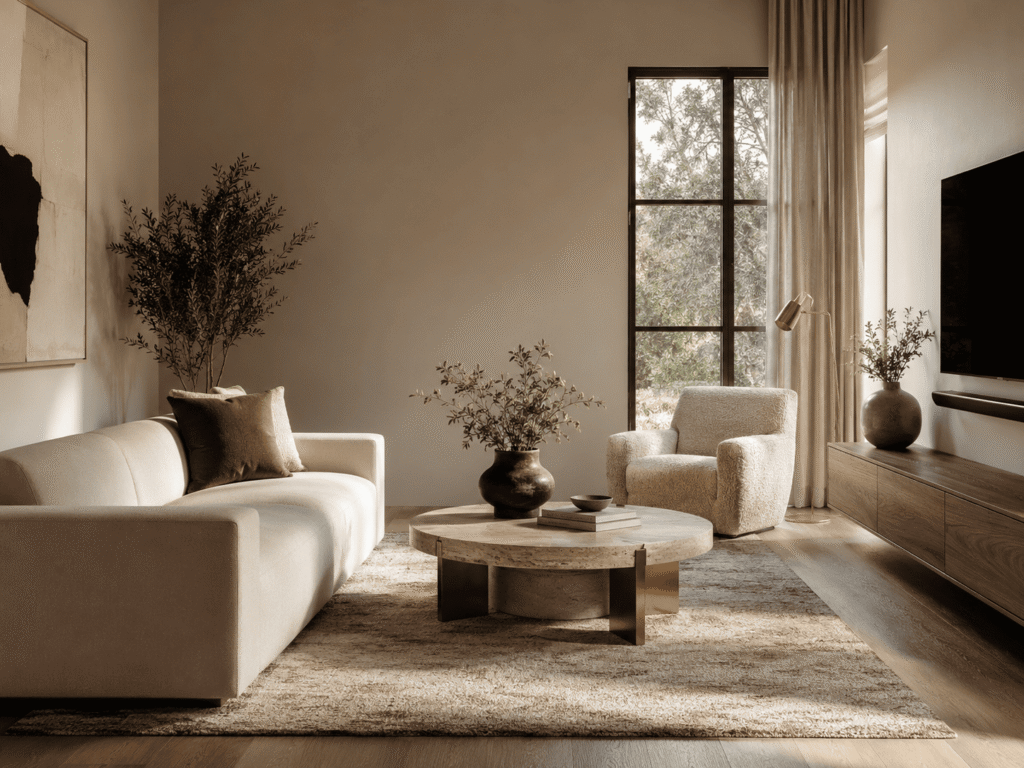
The furniture decisions that define a modern living room in 2026 are guided by a set of principles that are simpler than they appear: fewer pieces, better quality, lower profile, more interesting form. Modern living rooms are not made of many pieces of standard furniture; they are made of a small number of carefully considered pieces each of which has genuine material quality and a distinctive enough form to justify its presence in the room. A modern living room with six average pieces looks like a showroom. A modern living room with three exceptional pieces looks designed.
Low-profile sofas and seating — close to the floor: Low-slung sofas with seats at 38–42cm from the floor create the contemporary lounge-like quality that defines modern living rooms in 2026. Lower seating creates an immediate sense of relaxed sophistication.
A sculptural coffee table as the room’s centrepiece: The coffee table in a modern living room should have a distinctive form — a sculptural base, an unusual material, an architectural profile. A round travertine coffee table, a brass-legged glass top, a concrete slab on minimal legs or a live-edge wood plank can all create specific, intentional quality.
One accent chair with a completely different character to the sofa: A modern living room with two identical sofas looks like a furniture set; with one sofa and one distinctively different armchair, it looks curated.
Invest in quality upholstery — not just the form: In a modern living room where there are fewer pieces, the material quality of each piece is more visible and more important. A sofa in performance linen or high-quality bouclé justifies its place in the room through material quality alone.
Floating and wall-mounted furniture for spatial lightness: Wall-mounted TV shelves, floating sideboards and wall-bracket side tables create a sense of spatial lightness that makes the room feel larger and more architecturally resolved.
How to Recreate
✓ Low-profile sofa: IKEA KIVIK or Vimle ($500–900) — verify seat height is 40–42cm before purchasing
✓ Sculptural coffee table: Amazon or Wayfair ($200–450) — the design centrepiece
✓ Bouclé accent armchair: Amazon or H&M Home ($150–350) — the distinctive accent piece
✓ Floating walnut sideboard: Amazon ($200–450) — search “floating wall-mounted sideboard walnut modern”
✓ Wall TV bracket + slim shelf below: Amazon ($25–50 total) — eliminates all TV console floor footprint
Budget Tip
Modern living room furniture suite: $1,075–2,200 new, or $575–1,200 sourcing sofa and armchair second-hand. The sculptural coffee table ($200–450) is the single item that most establishes modern design intelligence.
Pro Tip
Did you know? The low-slung sofa — sitting at 35–42cm from the floor rather than the standard 44–48cm — was first popularised in European modernist design by Le Corbusier’s LC2 and LC3 sofas in 1928 and later refined by Florence Knoll and Mies van der Rohe. Its contemporary revival in 2026 is directly connected to the trend toward lounge-like, low-key, informal living.
Next Up
Furniture selection complete. For the living room that must work hardest of all — the modern open-plan space where living, dining and kitchen must coexist — Idea #5 addresses modern layout and zoning.
Idea 5: Modern Open-Plan Living Room — Zoning, Flow and Making Large Spaces Feel Intimate
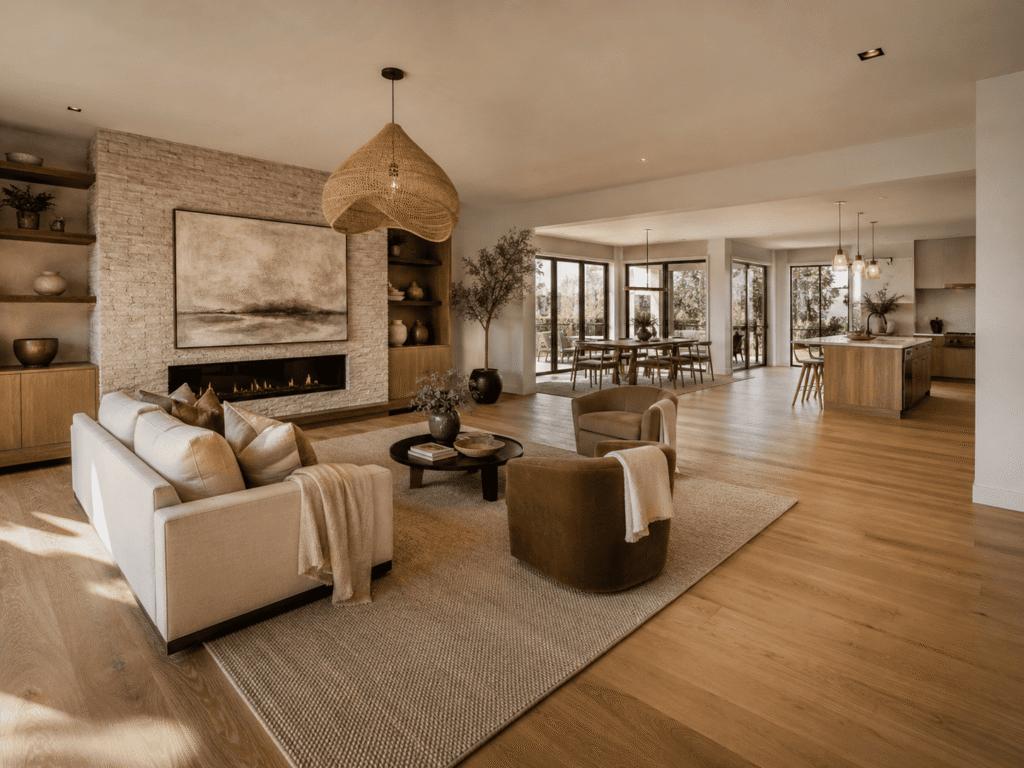
The modern open-plan living room is simultaneously the most aspirational and the most commonly mishandled interior design challenge — because the same open plan that feels airy and generous when correctly zoned feels cold, directionless and uncomfortable when not. The principle that transforms an open-plan living space is deliberate zoning — using rugs, furniture arrangement, lighting and subtle architectural interventions to create distinct areas within the continuous floor plan that each feel like purposeful, contained spaces. The living zone should feel like a room within the room — defined and intimate even within the larger open space.
A large rug to anchor and define the living zone: The rug is the single most important tool for creating a defined living zone within an open plan. All sofa legs on the rug, rug extending 20–30cm beyond the sofa on all sides — this creates a complete, defined living “room” without any walls.
Arrange seating to face inward — not outward: Open-plan living furniture positioned with the sofa’s back toward the room’s entrance and facing a defined point — the fireplace, a feature wall, the TV — creates an inward-facing zone that feels intimate and gathered.
A pendant light over the living zone — separate from the kitchen: Distinct overhead lighting for each zone creates visual separation between the living, dining and kitchen areas in an open plan. A sculptural pendant above the living area seating creates a light “ceiling.”
A feature wall behind the sofa to anchor the zone: In an open-plan space, the wall behind the sofa provides the visual anchor that most defines the living zone. A textured paint finish, a gallery wall, built-in bookshelves or a bold colour on this wall creates the sense of a defined backdrop.
Don’t fight the openness — work with the volume: The most beautiful open-plan modern living rooms use tall elements — floor-to-ceiling curtains, tall bookshelves, a large pendant lamp — to celebrate the ceiling height rather than filling it with low-level furniture.
How to Recreate
✓ Large area rug for zone definition: minimum 270x360cm for a standard open-plan living zone — Amazon or Rugs USA ($100–250)
✓ Sculptural pendant above living zone: Amazon ($45–120) — the visual “ceiling” that completes the zone
✓ Feature wall paint behind sofa: one colour or textured finish on the sofa-backing wall only ($15–40)
✓ Low-profile sofa facing inward: the sofa’s back to the open plan, front facing the feature wall
✓ Layout rule: sofa back should face the kitchen/dining, not the exterior wall — this orients the zone correctly
Budget Tip
Modern open-plan living zone: $160–410 for rug, pendant and feature wall treatment. The large rug ($100–250) is the most important single purchase — without it the living zone does not exist as a defined space, regardless of how good the furniture is.
Pro Tip
Did you know? Research in environmental psychology shows that humans prefer spaces with a defined prospect and refuge balance — enough openness to survey the environment combined with a sense of enclosure and protection. Open-plan living rooms that are correctly zoned satisfy both needs simultaneously: the open plan provides prospect; the defined seating zone provides refuge.
Idea 6: Modern Living Room Lighting — Sculptural Fixtures and the Layered Warm Formula
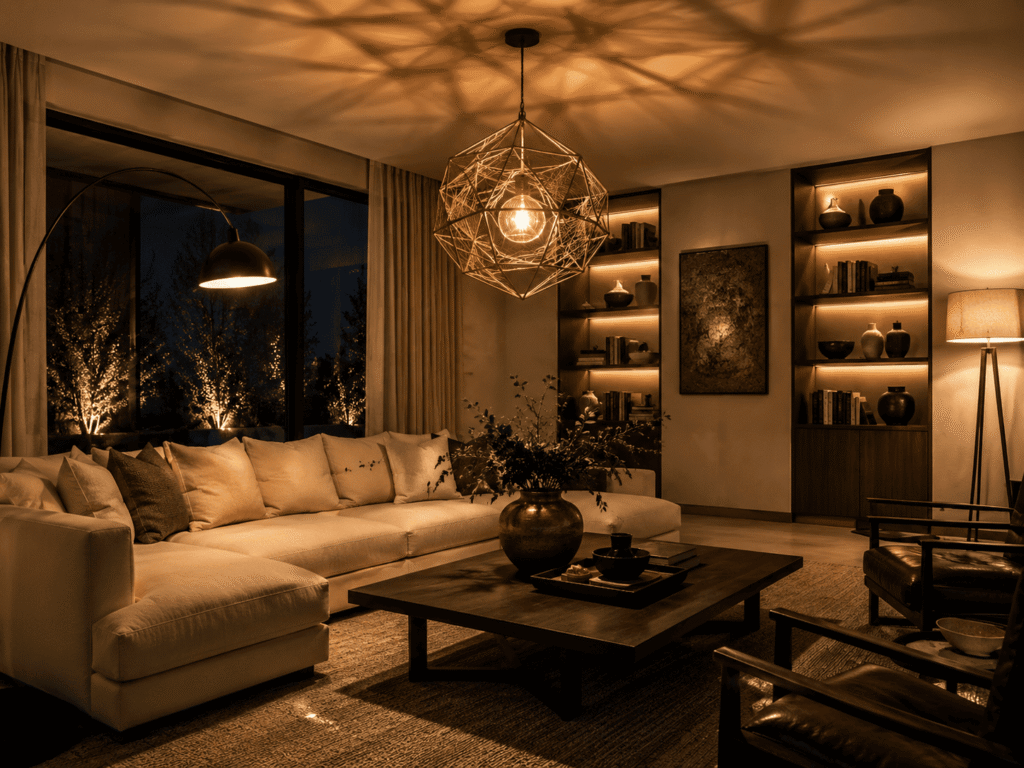
In a modern living room, lighting serves a dual function that most rooms do not require: it must provide warmth and atmosphere and act as a sculptural design element. Modern living rooms use fewer decorative accessories than maximalist or boho rooms — which means the lighting fixtures carry more of the room’s visual interest. A dramatic pendant, a sculptural arc floor lamp or a distinctive wall sconce in a modern living room is simultaneously a light source and a piece of design that defines the room’s character. The lighting in a modern living room should be as carefully chosen as the sofa.
A statement pendant above the seating as the room’s focal fixture: In a modern living room, the pendant lamp above the coffee table or seating area is the most important single design decision after the sofa. A sculptural geometric brass pendant, a dramatic oversized rattan globe or a plaster-look drum shade is where the room’s modern aesthetic becomes immediately visible.
An arched floor lamp as the sofa’s design companion: An arc floor lamp serves as sofa-side reading light, ambient fill light and sculptural design element simultaneously.
Warm 2700K throughout: All fixtures should use 2700K warm white. A contemporary room with cool white lighting reads as a design studio rather than a home. The bulb colour temperature is the invisible foundation that makes every other design decision work.
Dimmer switches on all circuits: A modern living room’s evening character depends entirely on the ability to reduce lighting to 20–40% of maximum output. Full-brightness even in 2700K creates flat illumination; 30% brightness with multiple warm sources creates depth and shadow.
Integrated LED strips for architectural ambient layers: Warm LED strip lighting integrated into the back of a floating sideboard, along the base of a TV unit or within built-in bookcase alcoves creates a soft architectural glow without any visible light source.
How to Recreate
✓ Sculptural geometric brass pendant: Amazon ($55–150) — search “modern geometric pendant light brass living room”
✓ Arched floor lamp: Amazon ($65–150) — the most versatile modern living room lighting investment
✓ Warm LED strip lights: Amazon ($15–35) — install in bookcase alcoves or behind TV unit
✓ Dimmer switch for all circuits: Amazon ($15–25 each) — mandatory for modern living room atmosphere
✓ 2700K warm white bulbs for all fixtures: Amazon ($8–15) — replace before any other change
Budget Tip
Modern living room lighting system: $158–375 for statement pendant, arc lamp, LED strips, dimmers and warm bulbs. The arched floor lamp ($65–150) is the highest impact-to-cost lighting investment in a modern living room — it is simultaneously sculptural, practical and atmosphere-creating.
Pro Tip
Did you know? The arc floor lamp was first designed by Italian manufacturer Flos in 1962 — the Arco lamp designed by Achille and Pier Giacomo Castiglioni. The original design used a Carrara marble base and a polished aluminium shade, and was specifically intended as a solution to reading light placement in rooms without ceiling light sockets above the seating area. Over 60 years later, the arc lamp principle remains one of the most functional and most visually beautiful living room lighting solutions ever designed.
Next Up
Lighting creates the modern living room atmosphere. For the interpretation of modern design that is most emotionally resonant and most widely aspired-to — Idea #7 builds the modern minimalist living room with soul.
Idea 7: Modern Minimalist Living Room — Clean, Considered and Completely Alive
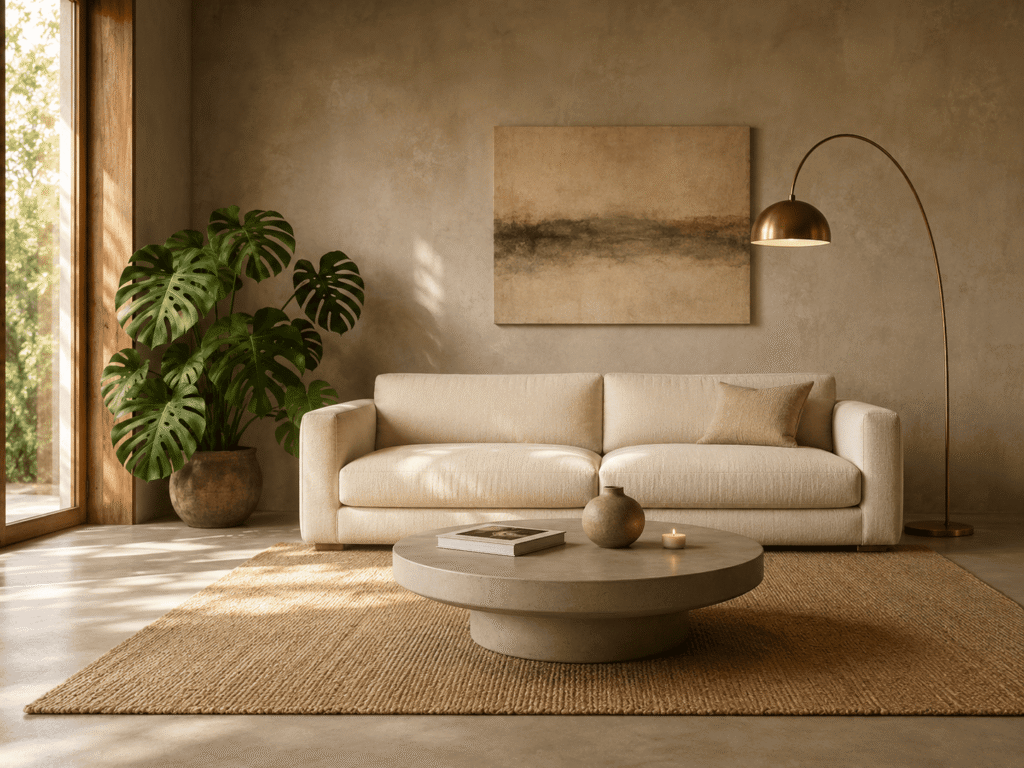
The modern minimalist living room of 2026 is fundamentally different from the minimalism of the 2010s — and the difference is best captured in a single phrase: minimalism with a heartbeat. Where previous-decade minimalism was about removal, restraint and the conspicuous absence of objects, 2026 minimalism is about precision — the confident selection of exactly the right elements, placed with exactly the right intention, creating a room that is as warm and welcoming as a maximalist room while remaining completely uncluttered. The modern minimalist living room demonstrates that warmth is not a function of quantity — it is a function of quality and intentionality.
Each visible element must earn its place through beauty or function: In a minimalist living room every object that remains after editing earns its place through being either genuinely beautiful or genuinely functional. Objects that are neither are removed.
One significant artwork — never multiple small ones: A modern minimalist living room uses one single large piece of art — a canvas at least 80cm wide, a photography print of real presence or a textile work of genuine scale. This single piece provides all the visual focal point the wall needs.
The coffee table as sculpture — not storage: In a minimalist room, the coffee table is a sculptural object whose surface should display a maximum of three items: a book, a ceramic object and a small plant or candle.
Texture variety within a restrained palette: A modern minimalist living room achieves warmth not through colour variety but through surface variety: smooth painted wall, rough-textured linen sofa, woven jute rug, smooth ceramic vase, visible wood grain and brushed brass sheen.
Negative space as deliberate design: Empty wall space, clear surface areas and unobstructed floor are deliberate design decisions that give each present element room to be seen. In a minimalist room, the empty space is as important as the filled space.
How to Recreate
✓ Limewash or Roman clay wall finish: Portola Paints “Roman Clay” or Amazon limewash paint ($35–70) — the textured wall in a minimal room
✓ Clean-lined cream linen sofa: IKEA ÄPPLARYD or Amazon ($500–900) — the single dominant seating piece
✓ Concrete or stone sculptural coffee table: Amazon ($200–400) — form that justifies the table’s presence
✓ One large art canvas: Etsy or Society6 print ($40–100) — the wall’s single significant element
✓ Three-item coffee table edit: your most beautiful book, one ceramic and one candle — free from existing possessions
Budget Tip
Modern minimalist living room: $775–1,470 with new sofa, coffee table, limewash paint and art. The limewash wall finish ($35–70) is the most impactful modern minimalist transformation — it creates the only wall texture in the room and signals immediately that the space was designed with considered restraint.
Pro Tip
Did you know? The concept of negative space in interior design — the deliberate treatment of empty areas as a positive design element rather than an absence of design — was first theorised by Japanese architect and philosopher Arata Isozaki drawing on the Zen Buddhist concept of MA: the meaningful pause between notes in music, applied to physical space. This principle is the theoretical foundation of modern minimalist design.
You can also visit Cozy Farmhouse Bedroom Ideas for more details
Idea 8: Modern Living Room Wall Ideas — Limewash, Panelling and Statement Surfaces
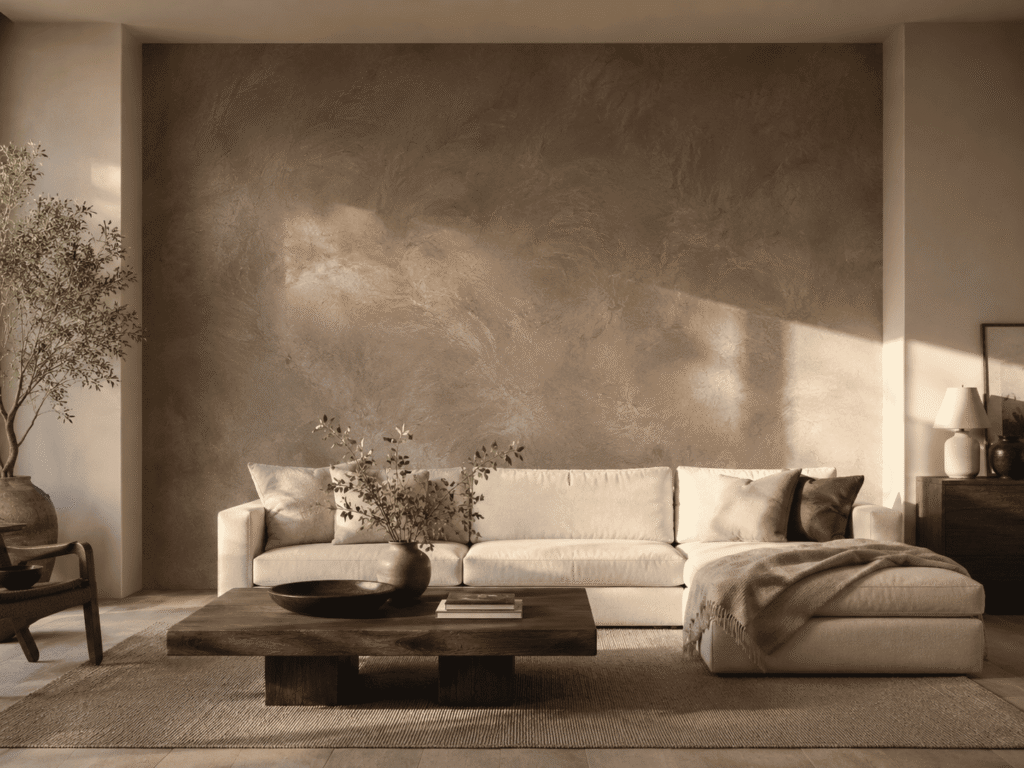
The walls of a modern living room in 2026 are being treated with significantly more design attention than in previous decades — because the pendulum has swung back from plain flat paint toward walls with genuine surface character. Limewash paint, Venetian plaster, Roman clay, wood panelling, fluted wall panels and colour-capping create the depth, texture and architectural presence that flat emulsion cannot provide.
Limewash paint — the most accessible textured wall finish: Limewash paint creates a mottled, layered, subtly textured surface through a simple one or two-coat application. The resulting wall has depth and variation that flat emulsion does not — and it looks specifically contemporary in 2026.
Fluted MDF panels — the architectural wall detail of 2026: Vertical fluted or ribbed MDF wall panels, applied to the chimney breast or sofa-backing wall, create a distinctively modern architectural texture at significantly lower cost than solid wood panelling.
Wood slat panels for warmth and rhythm: Horizontal or vertical natural wood slats — applied as a feature wall panel behind the TV or sofa — create warmth and organic rhythm in a modern room.
Colour capping — the 2026 evolution of colour drenching: Colour capping applies deepening tones from the same colour family moving from floor to ceiling. This creates a subtle gradient that adds architectural dimension.
A gallery wall in a modern room — the specifically modern approach: Modern gallery walls use uniformly sized frames in the same thin metal or wood finish, arranged in a tight grid or precise horizontal line rather than the eclectic organic composition of boho gallery walls.
How to Recreate
✓ Limewash paint for feature wall: Portola Paints “Roman Clay” ($35–60 per tin) or DIY limewash from Amazon ($25–40)
✓ Fluted MDF wall panels: Amazon or B&Q ($30–80 for a feature wall panel) — pre-primed, paint in your chosen colour
✓ Wood slat feature panel: Amazon ($45–120 per wall panel) — search “natural wood slat wall panel modern”
✓ Colour capping technique: lighter shade on lower walls, slightly deeper same family on upper walls and ceiling
✓ Modern grid gallery wall: same-size frames in thin black metal ($8–15 per frame) + prints in consistent style
Budget Tip
Modern living room wall treatment: $25–120 for a feature wall transformation. A limewash feature wall behind the sofa ($25–60 for the tin) changes the entire room’s character from one paint application.
Pro Tip
Did you know? Limewash paint is one of the oldest wall treatment materials available — it has been applied to walls continuously for over 4,000 years, from ancient Egyptian temples to medieval European buildings. Its modern revival as a contemporary interior finish represents a complete arc from ancient to ultra-contemporary.
Next Up
Walls transformed. For the modern living room that brings the natural world inside as a structural design element — rather than as decoration — Idea #9 builds the biophilic modern living room.
Idea 9: Modern Living Room With Plants — Biophilic Design as Architecture
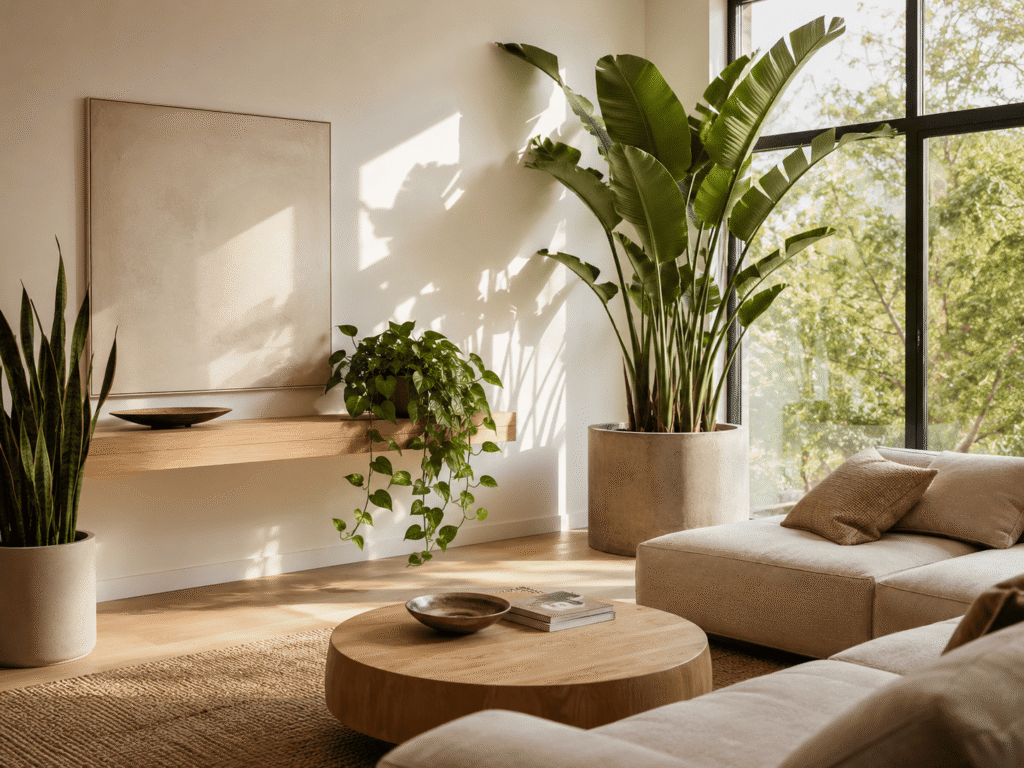
The biophilic modern living room — one that uses living plants as structural design elements rather than as decorative accessories — is the most forward-thinking and most research-supported approach to modern living room design currently available. Biophilic design is the application of the scientific evidence that humans require connection to the natural world for physiological and psychological wellbeing — and that this connection can be provided within architectural spaces through living materials. In a modern living room, plants are not pretty objects; they are functional wellbeing interventions that make the room genuinely healthier to inhabit.
One large architectural floor plant as the room’s living focal point: In a modern living room, the floor plant should be chosen for its architectural quality — a tall, dramatically shaped form that holds its own against the clean architectural lines of the room.
Plants as vertical architectural elements: A tall narrow planter with a bamboo palm or snake plant in a corner uses vertical space as an architectural element — drawing the eye upward and creating the appearance of a taller ceiling without any structural change.
Concrete or stone planters for modern authenticity: In a modern living room, terracotta pots read as boho or rustic; concrete, stone-effect or matte ceramic planters read as contemporary. The container choice is as important as the plant choice.
Trailing plants on shelves for organic movement: A trailing pothos, string of hearts or philodendron on a floating shelf creates organic, flowing movement that softens the clean lines of a modern room.
Living walls and green installations for bold statements: A living plant wall — either a professionally installed system or a DIY modular panel — creates the most dramatic and restorative plant intervention available in any living room.
How to Recreate
✓ Bird of paradise: local nursery or IKEA ($25–60 depending on size) — the most dramatically architectural floor plant
✓ Clean concrete planter for floor plant: Amazon ($20–45) — contemporary container is essential
✓ Trailing pothos for shelf: local nursery ($5–10) — nearly unkillable, grows quickly, creates organic movement
✓ Matte ceramic tall planter for corner plant: Amazon ($18–40) — modern container vocabulary
✓ Snake plant: IKEA or local nursery ($10–25) — upright architectural form, extremely low maintenance
Budget Tip
Biophilic modern living room plants: $78–180 for three plants with modern containers. Plants are uniquely the only modern living room element that becomes more impressive over time rather than depreciating — a $25 bird of paradise becomes a $120-worth architectural statement within 18 months of appropriate care.
Pro Tip
Did you know? Research by environmental psychologist Roger Ulrich at Texas A&M University found that hospital patients with a view of natural vegetation recovered faster, required less pain medication and reported significantly higher wellbeing scores than patients with a view of a brick wall. Subsequent research applied this finding to offices and residential spaces: rooms with living plants measurably reduce cortisol levels and improve cognitive performance compared to equivalent plant-free spaces.
Idea 10: Small Modern Living Room — Contemporary Design in Compact Spaces
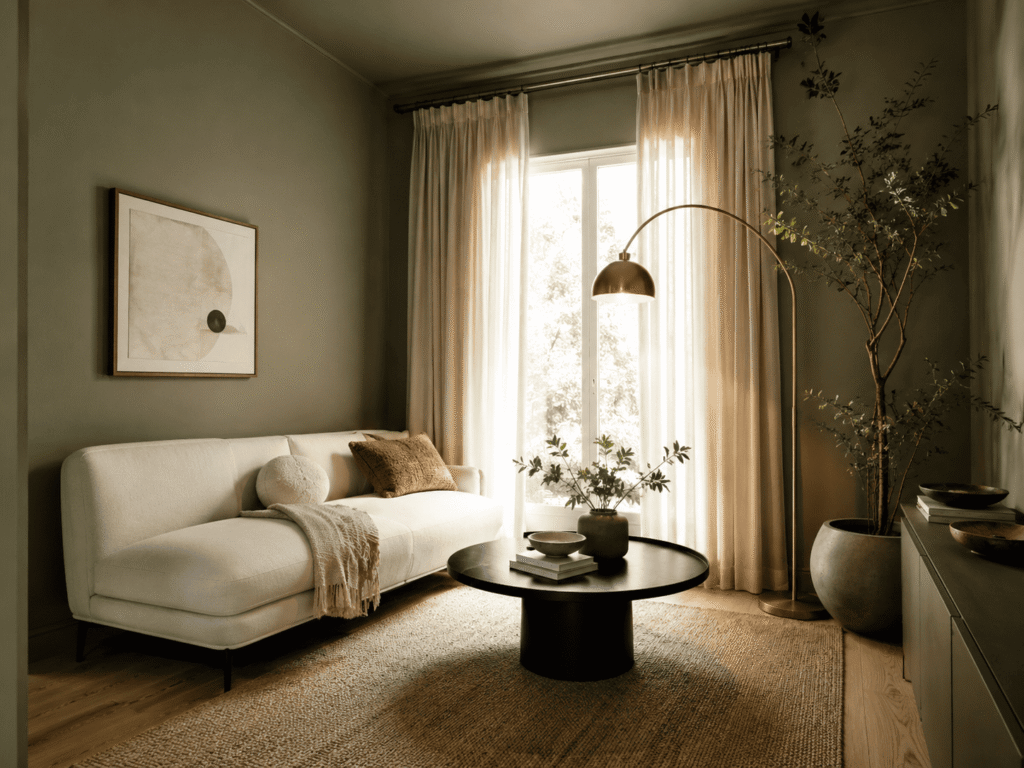
The small modern living room is one of the most achievable design challenges available — because modern design’s defining principles of restraint, spatial intelligence and quality over quantity are precisely the principles that work best in compact spaces. A small room with three exceptional pieces of modern furniture, clean walls and intelligent lighting looks more designed than a large room filled with average furniture — because in a small space, every design decision is fully visible and fully impactful. There are no corners far enough away to be irrelevant, no walls large enough to be ignored.
Colour drench in a warm mid-tone — not pale to enlarge: Resist the instinct to use pale colours to make a small modern room feel larger. A small modern room colour-drenched in a warm mid-tone — warm greige, soft terracotta, dusty sage — creates a room that feels deliberately intimate and cocooning rather than apologetically small.
One sofa sized correctly for the room — never compromised: A small modern living room should have one sofa that is the largest the room can accommodate while still leaving a 90cm clear pathway.
Vertical elements to exploit ceiling height: Floor-to-ceiling curtains, a tall slim bookcase and a statement tall floor plant draw the eye upward and create the impression of a significantly taller space.
Multi-functional furniture only: A storage ottoman replacing the coffee table, nesting tables instead of a fixed side table and a sofa bed for dual function all help a small modern room work harder.
One statement design piece to give the room its character: Even the smallest modern living room benefits from one exceptional design piece that gives it instant character — a curved bouclé armchair, a sculptural floor lamp or an unusual coffee table.
How to Recreate
✓ Warm dusty sage colour drench: Sherwin Williams “Retreat” or “Privilege Green” ($15–30)
✓ Low-profile compact sofa: IKEA ÄPPLARYD ($500–750)
✓ Round sculptural coffee table: Amazon ($80–200) — round prevents pathway obstruction in tight spaces
✓ Arc floor lamp: Amazon ($65–150) — provides reading and ambient light without requiring a side table
✓ Ceiling-height curtain rod: $8–15 extra — the most impactful small room spatial strategy
Budget Tip
Small modern living room: $668–1,245 with new sofa, coffee table, floor lamp, paint and curtains. The colour drench paint ($15–30) plus ceiling-height curtains ($8–15 extra for rod) together cost under $50 and create both the modern atmosphere and the spatial expansion that a small room needs.
Pro Tip
Did you know? Ludwig Mies van der Rohe — one of the founders of modern architecture — designed his famous Barcelona Pavilion in 1929 at only 360 square metres of total floor area, and it remains one of the most celebrated architectural spaces of the 20th century. His principle that “less is more” argues that a small, perfectly resolved space is more architecturally successful than a large, undecided one.
Next Up
Small rooms mastered. For the final idea — the complete modern living room transformation available for those with very limited budget — Idea #11 shows that the most impactful modern changes cost very little.
Idea 11: Modern Living Room on a Budget — Contemporary Transformation for Under $200
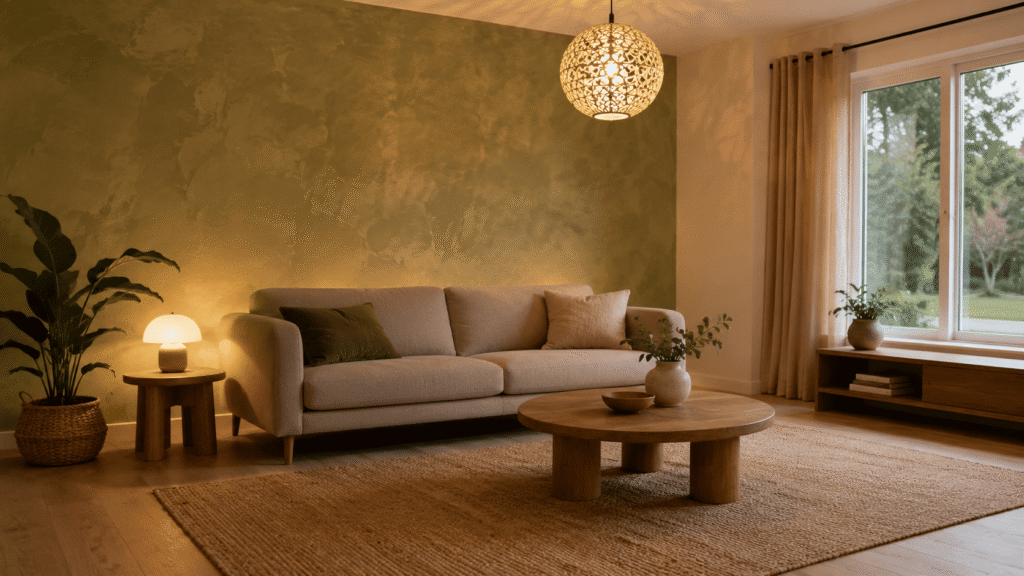
The modern living room on a budget is achievable because the defining qualities of modern design — clean, uncluttered, warm, considered — are primarily achieved through editing and quality of decision rather than quantity of spending. A modern room is not one where expensive furniture was purchased; it is one where every visible element was deliberately chosen and where nothing unnecessary remains. The free aspects of modern design — decluttering, rearranging for spatial intelligence, choosing correctly — are often more transformative than any purchase.
Priority 1 — Declutter to the modern baseline: Remove everything from every surface and return only items that are genuinely beautiful or functional. Apply the three-object maximum per surface rule. Clear all visible cables. Move any furniture that blocks windows.
Priority 2 — Replace all bulbs with 2700K warm white: Warm lighting immediately makes any room feel more deliberately designed. The same room under cool white overhead lighting reads as utilitarian; under warm 2700K it reads as consciously considered.
Priority 3 — One wall of limewash or textured paint: A limewash or Roman clay finish on the feature wall behind the sofa creates the contemporary wall texture that most signals modern design investment.
Priority 4 — One sculptural lamp: Replacing any standard table lamp with a sculptural contemporary form — a simple globe pendant, a slim brass arc lamp or a geometric ceramic base — is the most visible single modern upgrade available per dollar spent.
Free — rearrange for a modern spatial logic: Float the sofa away from the wall, ensure all furniture legs are visible beneath their pieces and verify there is one clear unobstructed 90cm pathway through the room.
How to Recreate
✓ Declutter and rearrange: free — Priority 1, done before buying anything
✓ 2700K warm white bulbs: Amazon ($8–15) — Priority 2, immediate transformation
✓ Limewash paint for one feature wall: Amazon ($25–40 for DIY limewash kit) — Priority 3, most contemporary wall upgrade
✓ Sculptural globe pendant or arc lamp: Amazon ($45–80) — Priority 4, most modern design signal per dollar
✓ Total: $78–135 for a complete modern living room transformation
Budget Tip
Complete modern living room budget transformation: $78–135. The free interventions — decluttering, rearranging for spatial intelligence and floating the sofa from the wall — create more of the modern atmosphere than all purchased items combined. Do these first.
Pro Tip
Did you know? Architectural theorist Christopher Alexander, in his 1977 work “A Pattern Language,” identified that the most beloved rooms share specific patterns of light, proportion, human scale and personal meaning — not expensive objects. This is why budget modern transformations can be genuinely successful: the principles are architectural and behavioural before they are financial.
Idea 12: Your Modern Living Room — Choosing Your Direction and Making It Completely Yours
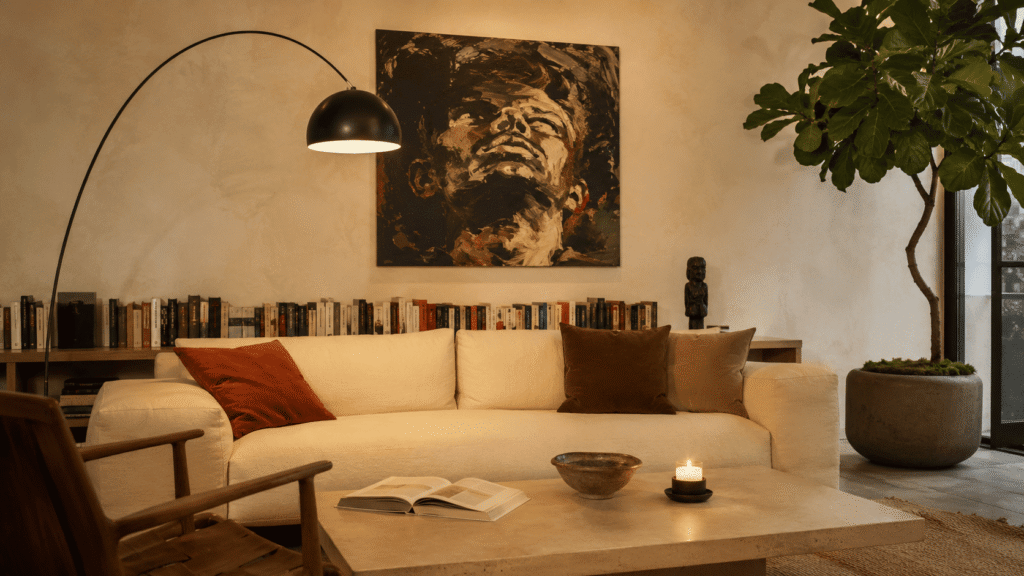
The most important thing about modern living room design in 2026 is something that was frequently missing from the previous decade’s interpretation of the aesthetic: genuine personal expression. The most admired modern living rooms are not those that most accurately execute a trend — they are the ones that are most clearly and most confidently the rooms of a specific, interesting person. The clean architectural framework of modern design is not a constraint on personality; it is the amplifier of personality — because against a clean, uncluttered backdrop, every object that remains is seen with full attention and read as intentionally chosen.
Choose one specific direction and commit to it: The least successful modern living rooms are those that have not committed — vaguely warm neutrals with no specific quality, furniture that is modern-ish but not specifically anything, accessories that are safe but not distinctive. Choose whether your modern room is organic modern, warm minimalist, bold colour drench or textured plaster — and pursue that direction with confidence.
Your book collection as the room’s character layer: In a modern living room, a shelf of books you have genuinely read — arranged by colour or subject or simply as they have accumulated — creates more personal character than any purchased accessory.
One piece of art that you genuinely love: In a modern living room with a restrained palette and clean surfaces, the single piece of art on the wall communicates more about its occupant than any other element. Choose art that moves you — not art that matches the sofa.
A personally meaningful object on the coffee table: The three-item coffee table in a modern living room — the book, the ceramic, the candle — should include at least one object with genuine personal significance.
Resist the periodic urge to neutralise the room: The impulse to make a modern room “cleaner,” “more minimal” or “safer” by removing the personally resonant objects that give it character is one of the most common and most damaging decorating instincts. A modern room without evidence of a specific person living in it is less modern, not more.
How to Recreate
✓ Art that you love: Etsy print from an artist whose work you believe in ($20–80) — or something you already own
✓ Your own books displayed on shelf: free — arranged how they have actually accumulated, spine-out
✓ One personally meaningful coffee table object: from your own possessions — free
✓ Favourite candle scent: any local candle maker ($12–25) — your room’s specific scent signature
✓ Commit to one modern direction: the choice costs nothing and is the article’s most important advice
Budget Tip
The personal modern living room has no fixed budget — its most important elements cost nothing. The personally resonant art ($20–80), your own books and one meaningful object together create more character than $2,000 of perfectly coordinated modern accessories could. Spend on quality; personalise for free.
Pro Tip
Did you know? Architect Tadao Ando — one of the most celebrated contemporary architects alive, known for his minimalist concrete buildings — keeps his own personal spaces filled with books, art and personal objects despite designing spaces of extraordinary restraint for clients. His personal spaces perfectly embody the principle of this idea: the framework can be modern; the life within it must be human.
Complete Budget Summary — All 12 Modern Living Room Ideas
| Item | Budget | Mid-Range | Notes |
|---|---|---|---|
| Limewash or Roman clay paint | $25–55 | $55–120 | Most modern wall transformation per £ |
| 2700K warm white bulbs | $8–15 | $20–35 | Priority 1 in any modern room |
| Curved cream bouclé sofa | $500–900 | $1,000–2,500 | The defining 2026 modern sofa form |
| Sculptural coffee table | $200–400 | $400–900 | The modern design centrepiece |
| Arched brass floor lamp | $65–150 | $150–400 | Most versatile modern lighting piece |
| Sculptural pendant lamp | $55–120 | $120–300 | Room’s most visible design element |
| Large area rug for zone definition | $100–200 | $200–450 | Essential for open-plan living |
| Bird of paradise or fiddle-leaf fig | $25–55 | $55–120 | Architectural plant — grows more valuable |
| Concrete or matte ceramic planter | $18–40 | $40–90 | Modern container vocabulary |
| Warm LED strip lighting | $15–35 | $35–80 | Architectural ambient glow |
| Bouclé accent armchair | $150–350 | $350–800 | The accent piece with distinct character |
| Total Estimate | $1,161–2,320 | $2,425–5,764 | Full transformation range |
Frequently Asked Questions About Modern Living Room Ideas
What makes a living room look modern in 2026?
Curved furniture, natural materials, warm 2700K lighting and one large architectural plant define the 2026 modern living room. The best modern rooms feel warm, human and carefully edited rather than cold or showroom-like.
What is organic modern interior design?
Organic modern design combines clean contemporary lines with natural materials such as warm oak, linen, bouclé, travertine, rattan and large sculptural plants. It gives you a clean modern look without losing warmth.
What colours are modern for a living room in 2026?
Warm, specific and committed colours feel most modern in 2026. Smoky blue-green, muted sage, warm terracotta, clay-mauve, warm greige and oat-cream all work beautifully, especially when used through colour drenching.
What furniture is modern in 2026?
Modern living room furniture in 2026 includes low-profile sofas, curved silhouettes, sculptural coffee tables, bouclé accent chairs, floating sideboards and arched floor lamps. The key is fewer pieces with better shape, material and intention.
What is the difference between modern and contemporary living room design?
In everyday use, modern and contemporary living room design are often used for the same look: clean-lined, current, warm and forward-looking. Strictly speaking, modern refers to the modernist design movement, while contemporary means what is current now.
How do I make my living room look modern without spending much?
Start with three low-cost changes: replace bulbs with warm 2700K lighting, add limewash or textured paint to one feature wall and float the sofa slightly away from the wall. Together, these changes can make a room feel much more modern without buying new furniture.
Your Modern Living Room — Start With One Curved Form and Build From There
Every modern living room idea in this guide builds toward the same experience: a room that is architecturally intelligent and genuinely human simultaneously — the resolution of the central tension that plagued modern design for the previous decade. The clean lines are still there; the warmth is now also there.
If you start anywhere, start with the limewash paint on your feature wall ($25–55) and the 2700K bulb replacement ($8–15). These two changes together cost under $70, require no furniture purchases and create the textured warmth and atmospheric light that are the invisible foundation of every beautiful modern living room in 2026. Everything else — the curved sofa, the travertine coffee table, the arc lamp and the bird of paradise — builds on what those two decisions create.