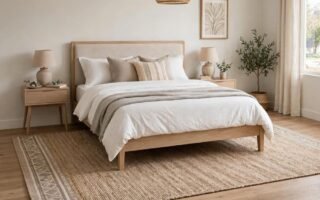
A small bedroom feels bigger when three things are right: the bed is in the best spot, everything has a home, and the light works for sleep as well as for getting dressed. Paint colour helps, but it cannot fix a bed that blocks the door, a wardrobe that swallows the room, or a ceiling light that makes the room feel flat at night.
This guide is the starting point for the whole small bedroom cluster on this site. It covers layout, storage, light and sleep, walls, bedding, plants and special situations, and it links to a detailed guide for each one. Use it to plan your room in order: measure first, place the bed, fix storage, then light, then style.
Key takeaways: measure the room and the door swing before buying anything; leave at least 60 centimetres of clear walkway beside the bed; use vertical and under-bed storage before buying a bigger wardrobe; layer light instead of relying on one ceiling light; and choose renter friendly fixes first if you cannot drill or paint.
Measure First
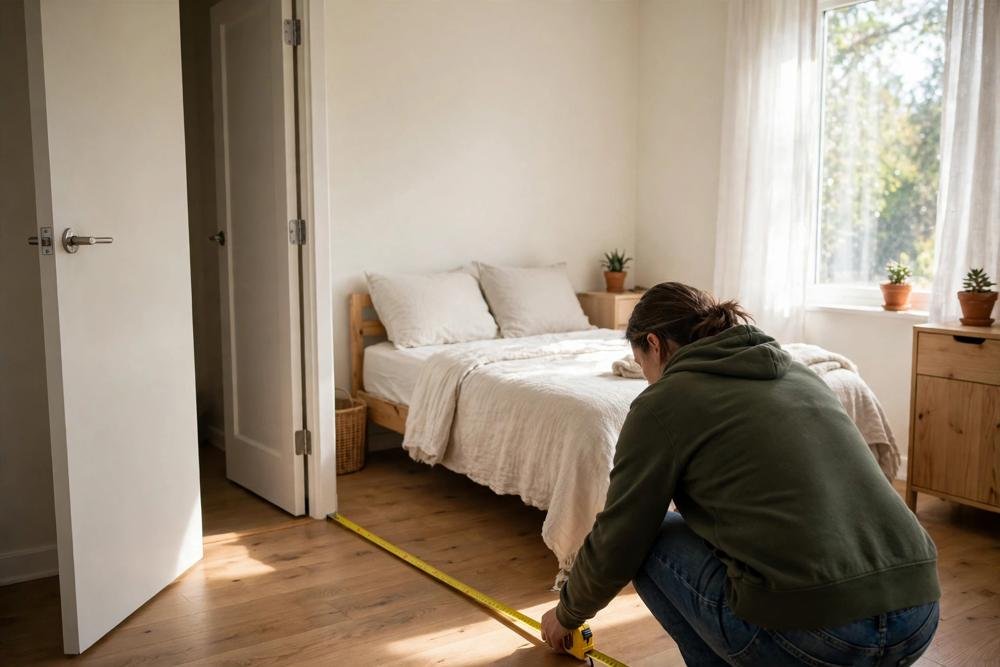
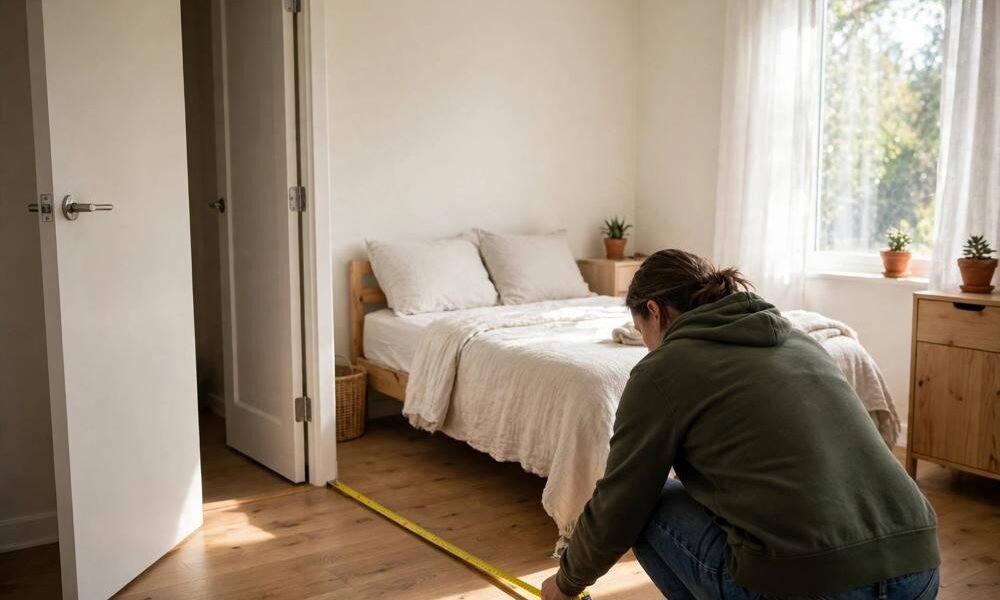
Start with a tape measure, not a shopping list. Measure wall to wall, floor to ceiling, the door opening and the swing of the door, and the space beside and at the foot of the bed. Note plug sockets, radiators, windows and wardrobe doors, because each one limits where furniture can go.
The numbers that matter most are walkway clearances. Aim for at least 60 centimetres beside the bed so you can get in and out without turning sideways, and at least 75 centimetres where you dress or open drawers. A bed that fits with 30 centimetres to spare on paper will feel cramped in real life, especially if drawers or a wardrobe door need to open into that space.
Write the measurements down and keep them on your phone. They decide rug size, curtain rod width, bed size and whether a second piece of furniture fits at all. Our rug calculator can help once you know your bed size and how much rug you want showing on each side, and our curtain calculator helps with rod length and panel width before you buy fabric.
Layout: Where the Bed Goes
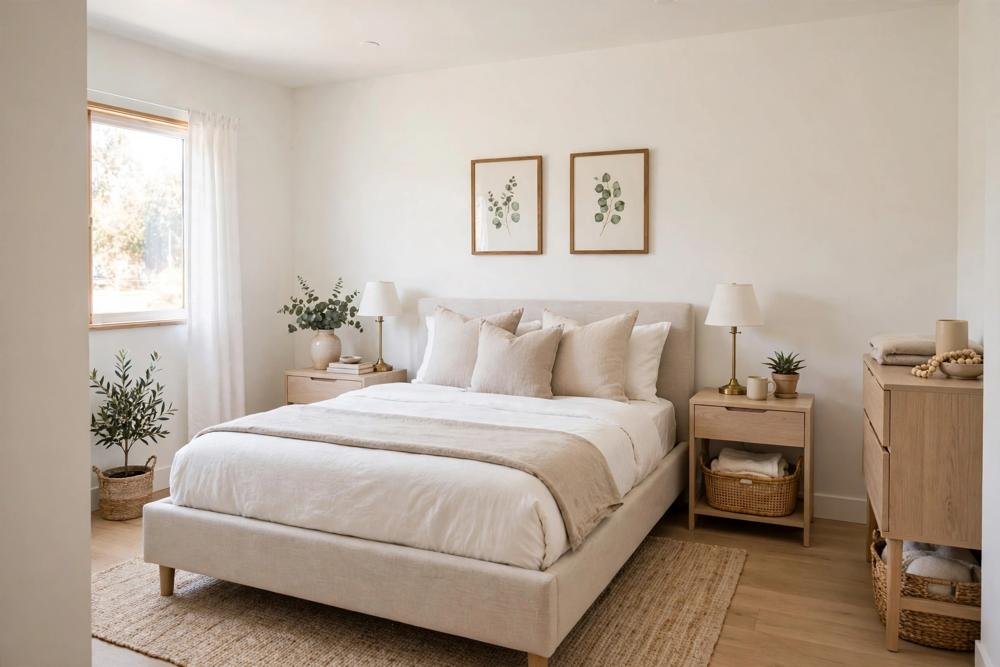
In most small bedrooms the bed should go against the longest uninterrupted wall, with the headboard on that wall and clear space on at least one side. That usually leaves the best walkway, the best view from the door, and the most wall left for storage. If the longest wall has a window, a radiator or a door, test the second-longest wall before settling.
Do not push the bed into a corner unless you have to. A corner bed saves floor space, but the person on the wall side has to climb over the other person, and making the bed becomes a daily struggle. If a corner bed is the only option, keep the wall side for the person who gets up less often, and use a narrow bedside shelf instead of a table on that side.
For a 10 by 10 room, a queen bed plus two narrow bedside tables is possible, but a king bed usually leaves too little walkway. For a long narrow room, put the bed across the short wall if the room is wide enough, or along one long wall with storage on the opposite wall, never storage on both sides. For a room with a sloped ceiling, put the bed under the highest part of the ceiling where you sit up, and use the low part for storage you reach from outside, not for walking.
Door swing matters more than people expect. A door that opens into the room can eat a whole corner. If you cannot change the swing, keep that corner for something shallow, such as a wall shelf or a narrow shoe rack, and do not put a wardrobe there. The detailed layout guides in this cluster cover 10 by 10 rooms, long narrow rooms, small rooms for couples, shared kids rooms and teen rooms with a study area.
Storage: Reach-In Closet, Under-Bed and Vertical Storage
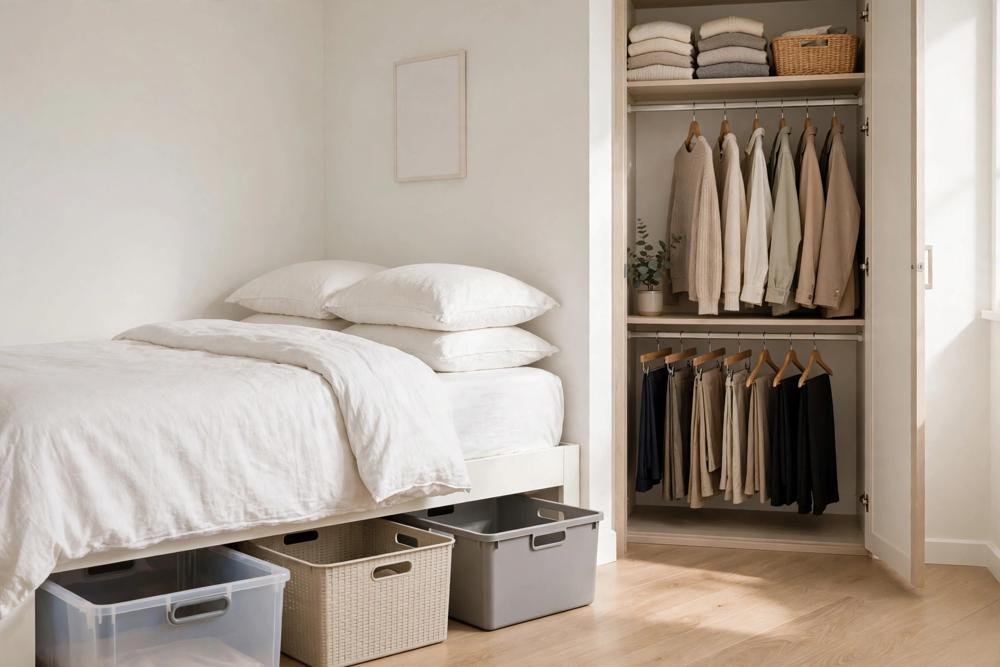
Storage fails in small bedrooms for one reason: everything is stored at the wrong height. Daily clothes should be at arm height, seasonal clothes should be high or under the bed, and shoes should be low and in pairs. When those three zones are clear, the room stays tidy without constant effort.
Start with the closet. A small reach-in closet works best when you measure first, use double hanging for short clothes, keep one long section for dresses and coats, and use the door and floor for light daily items and shoes. Seasonal rotation, twice a year, stops a small closet from holding every season at once. If you have no closet at all, a wardrobe, a clothing rail with a curtain, and under-bed boxes can replace it, as long as daily clothes stay near the front and seasonal clothes stay out of the daily path.
Under-bed storage is the easiest extra storage in a small room, but only if it is easy to reach. Use shallow boxes with handles, one box per category, and label them. Deep boxes that need the bed moved will be ignored. Vertical storage comes next: a tall narrow shelf, hooks on the back of a door, and a shelf above a desk or dresser. Keep the top shelf for things you use weekly, not daily, and do not fill every wall, or the room will feel like a storage unit.
If floor space is truly gone, storage that does not use floor space is the answer: wall shelves, over-door hooks, a headboard with shelves, and a bed with built-in drawers. The guides linked below cover storage without a closet, storage without floor space, reach-in closets, and guest rooms that double as home offices.
Light and Sleep: Curtains, Blackout, Lamps and Quiet
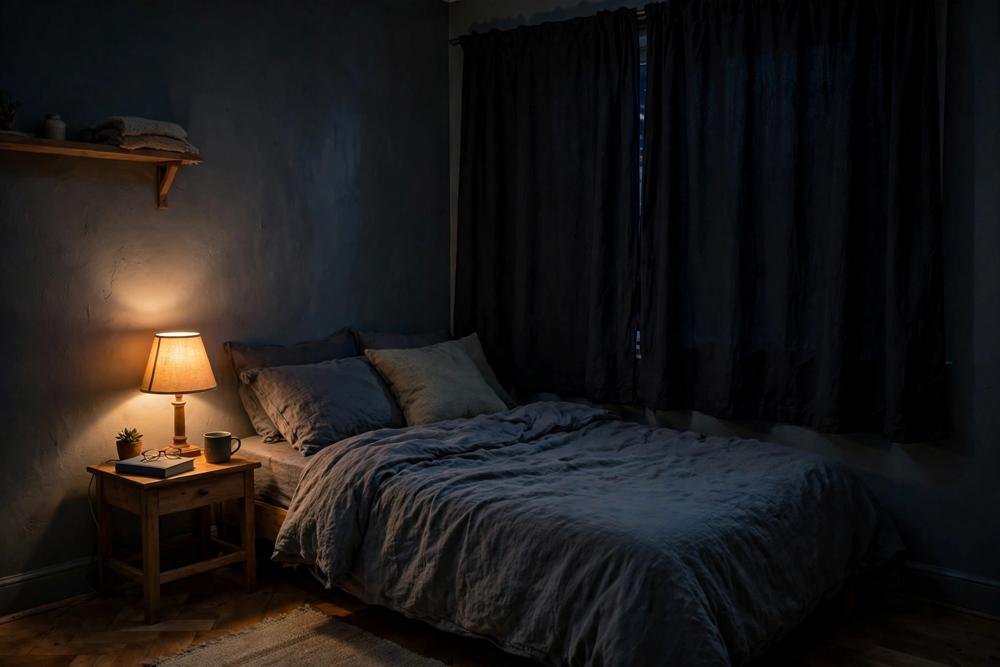
A small bedroom needs at least two kinds of light: a soft general light for getting dressed, and a focused light for reading. One ceiling light alone creates shadows, lights the whole room when you only need one page lit, and makes winding down harder.
Hang curtains high and wide, so the window looks larger and the curtains do not block light when open. A rod that extends 15 to 20 centimetres past each side of the window frame, and sits 10 to 15 centimetres above the frame, is a good starting point. For sleep, add a blackout layer behind the main curtain, seal the sides and top where light leaks, and close the gap under the door. That combination matters more than an expensive curtain alone, especially for shift workers and light sleepers.
For reading, use a warm lamp beside the bed, around 2700K, shining from the side or slightly behind your shoulder. A swing-arm wall light saves bedside table space. For a room that must stay dark and quiet in the day, seal the door, add a thick rug, use soft furnishings to reduce echo, and add steady low white noise near the door or window, not right beside your pillow. Temperature matters too: a slightly cool room, breathable bedding layers, and blackout curtains closed before the sun heats the room will help daytime sleep more than a heavier duvet.
Walls and Focal Point: Headboard Alternatives, Art Above the Bed and Accent Walls
In a small bedroom the wall behind the bed is the focal point, whether you plan it or not. If it is blank, the room feels unfinished. If it is busy, the room feels smaller. One clear focal point, and calm walls elsewhere, is the safest balance.
If you do not want a traditional headboard, there are good alternatives: a painted or wallpapered panel behind the bed, a row of cushions on a rail, a rattan screen, an open shelf, or a fabric panel hung from a slim rod. Each one gives the bed a finished look without the bulk of a tall headboard. Keep the alternative no wider than the bed, and no higher than about 75 centimetres above the mattress, unless the ceiling is very high.
Art above the bed follows a simple rule: hang it so its centre is about 145 to 155 centimetres from the floor, or about 15 to 20 centimetres above the headboard, and keep its width between two-thirds and three-quarters of the bed width. One large piece usually looks calmer than many small pieces in a small room. If you rent, use removable hooks rated for the weight, or a picture ledge that needs only two fixings, and test any adhesive on a hidden patch first.
An accent wall can add depth without shrinking the room, if you keep it to one wall and choose a colour only a little darker than the other walls. Renter friendly options include peel-and-stick wallpaper on one wall, a painted panel, fabric hung from a rod, or removable wall decals. Warm neutrals, sage green and soft beige all work in real light, but test a large swatch on the wall for a full day before committing, because small-room light changes fast.
Bedding and Textiles: Layering, Rugs and Colours
Hotel-style bedding is not about expensive sheets. It is about layers you can adjust: a fitted sheet, a flat sheet or light duvet, a second layer for warmth, and pillows arranged so you can sit up to read and sleep flat without rebuilding the bed each night. In a small room, choose bedding in one calm palette with one texture contrast, such as cotton sheets with a waffle or linen throw, rather than many competing patterns.
Rug size is where small bedrooms go wrong most often. A rug that is too small floats in the middle of the room and makes the bed look larger. A rug that extends about 45 to 60 centimetres beyond each side of the bed, and at least 45 centimetres past the foot, grounds the bed and feels good underfoot. Measure from the bed, not from the room, and use the rug calculator to check bed-size combinations before buying. If budget is tight, a rug that covers the sides where you step out of bed matters more than a rug that runs under the whole bed.
Colour in a small bedroom should stay light to mid-tone on most surfaces, with deeper colour in bedding, art or one accent wall. Sage green, warm beige and greige, soft white and pale blue all work, but the exact paint matters less than the light in your room. North-facing rooms need warmer tones, south-facing rooms can take cooler tones, and every colour should be tested in morning and evening light.
Plants and Finishing Touches
Plants make a small bedroom feel lived in, but only if they survive low light. Snake plants, pothos, ZZ plants and spider plants tolerate low light and irregular watering better than most, and they suit a bedroom because they do not need a bright windowsill. Keep plants to one or two, in pots that match the room, and put them where they will not be knocked over when you make the bed.
Finishing touches should be few and useful: a throw you actually use, a basket for the current book, a small tray for a phone and water, and one piece of art you like. If a decorative item needs dusting, moving or explaining, and you do not love it, it is taking up space a useful item could use. A reading nook, even a single chair with a lamp and a small table, can turn a corner you ignored into the most used spot in the room, as long as the chair fits and the walkway stays clear.
Special Situations: Shared Rooms, Teen Rooms, Renters and Shift Workers
Shared rooms need clear zones more than they need more furniture. For couples in a tiny room, agree on a split of wardrobe, bedside and desk space, use matching hangers and labels, and keep shared items in one spot. For siblings, parallel beds, L-shaped beds or bunks each suit a different room shape, and each child needs a small personal zone, even if it is only a shelf and a lamp. For teens, a study area needs a desk that fits, a chair that supports sitting for homework, and storage that keeps schoolwork out of the bed.
Renters can do almost everything in this guide without drilling or painting: tension rods for curtains, removable hooks, peel-and-stick wallpaper on one wall, freestanding storage, and rugs to define zones. The rule is simple: if you cannot put it back in an afternoon, think twice before doing it. Shift workers need the opposite of a normal bedroom routine: darkness and quiet in the day, a cool room, and a warm dim wind-down light in the hour before sleep, even if that hour is in the morning.
Guest rooms that double as home offices work when the bed and desk have separate zones and the office can be hidden. A daybed, a fold-down desk, or a desk behind a curtain can all work, as long as the guest can sleep without staring at work, and the worker can work without making the bed each morning.
Every Guide in This Cluster
Layout: Small Bedroom Layout Ideas for a 10 by 10 Room; How to Arrange a Long Narrow Bedroom; Small Bedroom Ideas for Couples Who Share a Room; Shared Kids Bedroom Layout Ideas for Siblings; Small Teen Bedroom Ideas With a Study Area; Small Primary Bedroom Refresh Ideas Without Renovating; How to Fit a Desk in a Small Bedroom; Bedroom Furniture Sizes and Clearances You Should Check Before You Buy.
Storage: How to Organise a Bedroom Without a Closet; Small Bedroom Storage Ideas That Do Not Use Floor Space; Small Reach In Closet Organisation Ideas; How to Turn a Spare Room Into a Guest Room and Home Office; Small Guest Bedroom Essentials Checklist.
Light and sleep: How to Hang Bedroom Curtains for Better Sleep and Privacy; Cozy Bedroom Lighting Ideas Without an Overhead Light; How to Make a Bedroom Dark and Quiet for Shift Work and Light Sleepers; How to Create a Reading Nook in a Small Bedroom.
Walls, bed and style: Renter Friendly Bedroom Accent Wall Ideas; Headboard Alternatives for a Bedroom Without a Headboard; How to Hang Wall Decor Above a Bed; Sage Green Bedroom Ideas and Paint Colours That Work in Real Light; Warm Neutral Bedroom Colour Schemes With Beige and Greige; How to Do a Bedroom Makeover for Under 500 Dollars; How to Refresh a Bedroom in One Weekend for Under 100 Dollars.
Bedding, rugs and plants: How to Layer Bedding Like a Hotel Bed; What Size Rug for a Bedroom; Best Bedroom Plants for Low Light Rooms; Cozy Winter Bedroom Ideas for January and February; Feng Shui Bedroom Layout Ideas for a Small Room; How to Decorate a Rental Bedroom Without Drilling Holes.
Tools: Rug Calculator; Curtain Calculator.
FAQs
What is the first thing to fix in a small bedroom?
Measure first, then place the bed. Most small bedrooms feel cramped because the bed blocks a walkway or a door, not because the room is too small for a bed. Once the bed and walkways are right, storage and style become much easier.
How much walkway space do I need beside a bed?
Aim for at least 60 centimetres beside the bed, and at least 75 centimetres where you dress or open drawers. If you cannot reach 60 centimetres on both sides, keep it on the side you use most and use a narrow shelf on the other side.
What size rug should go under a bed?
A rug that extends about 45 to 60 centimetres beyond each side of the bed, and at least 45 centimetres past the foot, usually looks and feels right. Measure from the bed and check the combination in a rug calculator before buying.
Can I make a small bedroom feel bigger without renovating?
Yes. Use light to mid-tone colours, hang curtains high and wide, use one focal wall, keep the floor as clear as possible, and use mirrors opposite a window only if they reflect light, not clutter. The biggest gains come from layout and storage, not paint alone.
What should renters avoid in a small bedroom?
Avoid heavy furniture you cannot move, dark paint on every wall, and storage that needs drilling into every wall. Use tension rods, removable hooks, freestanding storage and rugs first, and test any adhesive or wallpaper on a hidden patch before using it across a wall.
How do I link bedroom posts together for SEO?
Every post should link to this pillar guide, to two or three related posts in the cluster, and to a calculator where the topic involves size. Use descriptive link text, such as the post title, not generic text such as click here.
New guides in this cluster
- Bedroom Layout Ideas When the Bed Is Under a Window
- Small Bedroom With No Window: How to Make It Feel Brighter
- Where to Put a Bed in a Small Room With the Door in the Middle
- Under-Bed Storage Ideas That Are Not Ugly
- Small Bedroom Dresser Alternatives That Save Floor Space
- Nightstand Alternatives for Tiny Bedrooms That Actually Work
- Blackout Curtains Versus Blackout Liners for Bedrooms
- Best Bedroom Lighting for Reading in Bed Without Waking Anyone
- Bedroom Temperature and Bedding for Hot Sleepers
- Peel and Stick Wallpaper Bedroom Ideas for Renters
- Small Nursery Ideas in a Parents Room That Keep Everyone Sleeping
- Bedroom Decor for Renters
- Christmas Bedroom Decor Ideas That Stay Cosy Not Cluttered
Conclusion
A small bedroom does not need a renovation to feel good. It needs a bed in the right place, storage at the right height, light that works for both day and night, and one calm focal point. Work through this guide in order, use the linked guides for the detail on your specific problem, and change one thing at a time. Measure first, fix the layout, then storage, then light, and let style follow. That order is what turns a pile of bedroom posts into a room that actually works, and a cluster that search engines can trust.