If you live in a mobile home and feel like no matter what you do inside, the outside still gives it away the moment someone pulls into the driveway — you are not imagining it, and you are not stuck with it. The things that make a mobile home look like a mobile home from the street are almost entirely surface signals, and almost all of them are changeable without rebuilding anything structural.
Learning how to make a mobile home look like a house is less about disguising what it is and more about upgrading the specific details — the skirting, the roofline, the eave depth, the door width — that carry most of the visual difference between a manufactured home and a site-built one. Some of these are weekend DIY projects costing a few hundred dollars. Some require a contractor. But the sequence matters: the changes that do the most visible work are often not the ones most people do first.
This guide covers them in order of impact, starting with the exterior upgrades that change how the home reads from the street and working through to the interior changes that make it feel genuinely permanent from the inside.
Part 1 — Exterior Changes: Making a Mobile Home Look Permanent From the Outside
The exterior is where the visual difference between a mobile home and a site-built house is most obvious — and where the most impactful changes can be made. These are the upgrades that change what the neighbours see, what visitors notice when they pull up, and what you feel when you come home.
Change 1 — The Skirting: The Single Most Impactful Exterior Change
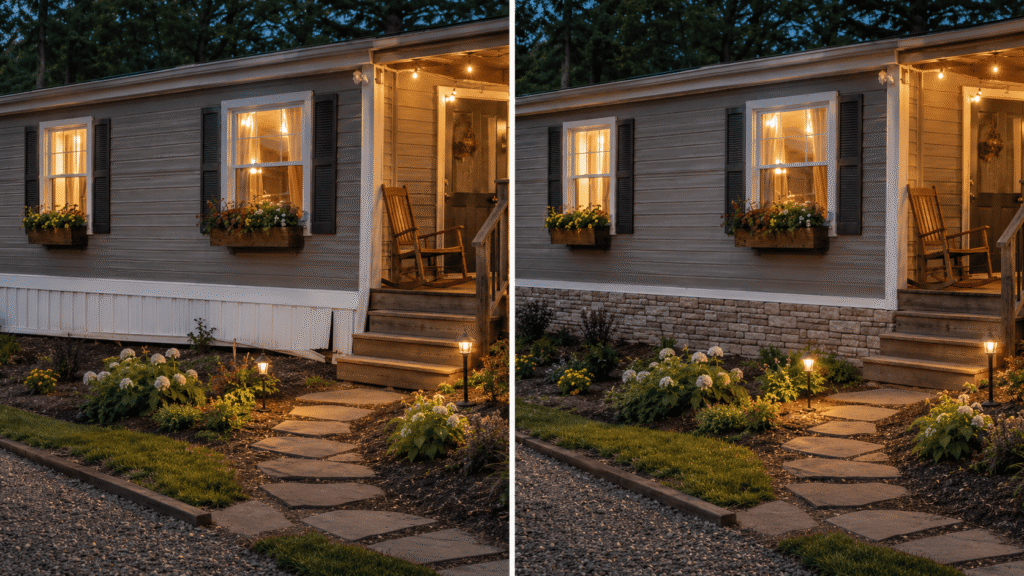
If there is one exterior change that transforms how a mobile home reads from the street, it is the skirting. Standard mobile home skirting is thin metal or vinyl — it flaps in the wind, shows gaps over time, and immediately signals “mobile home” to anyone who looks at it.
Replacing metal skirting with something that looks structural and permanent is the highest-impact exterior change available at almost any budget.
The options from most affordable to most permanent:
Vinyl skirting with a masonry pattern ($200–$600): A significant upgrade from standard metal skirting — still vinyl but designed to look like stacked stone or brick. Installs quickly, looks considerably more permanent, and is available at most home improvement stores.
Concrete block skirting ($800–$2,500): Actual concrete blocks mortared together and painted or stained. Looks completely permanent. Cannot be distinguished from the foundation of a site-built home from street level. A significant DIY weekend project or a modest contractor job.
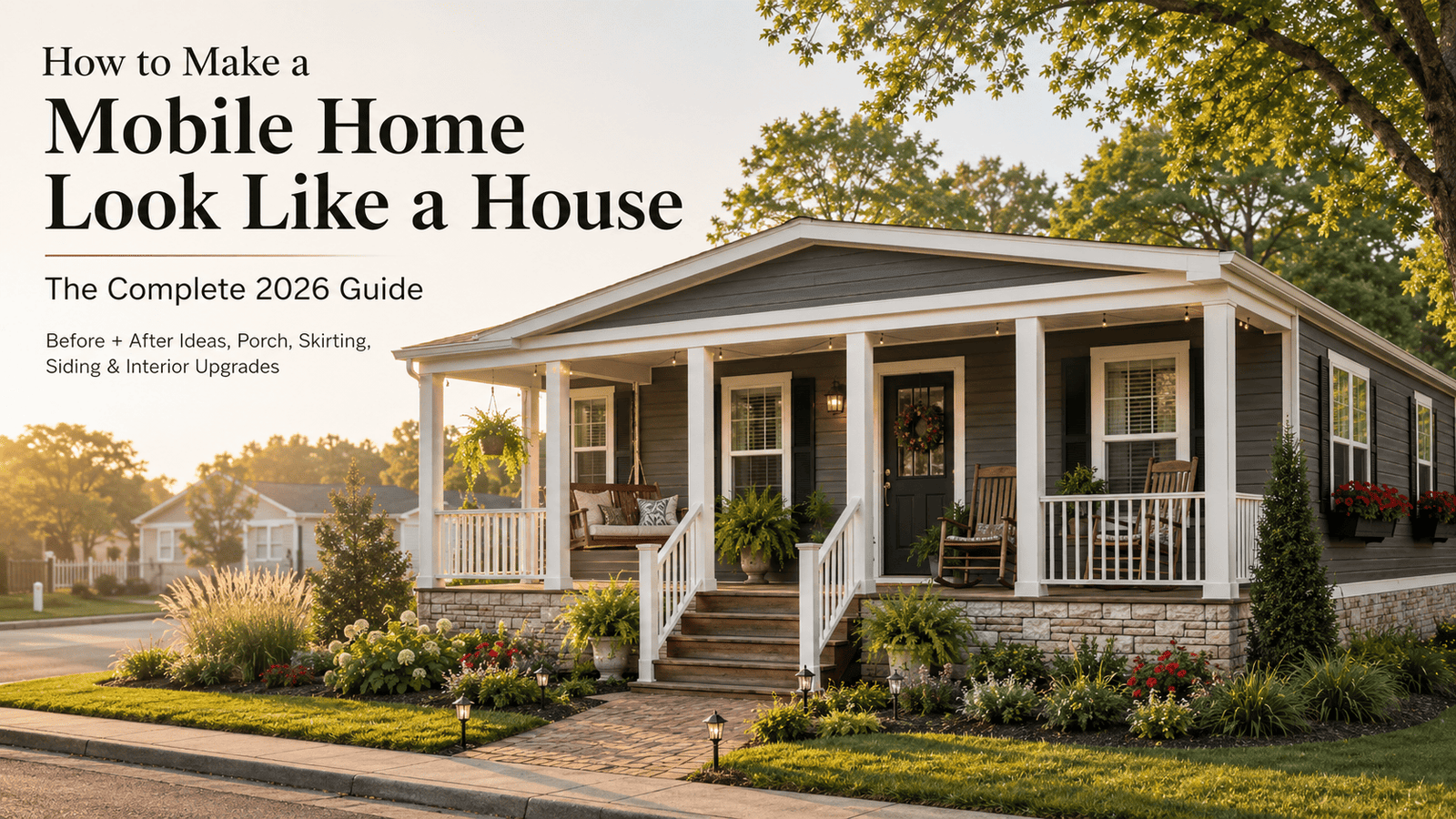
Stone veneer skirting ($1,500–$4,500): Stone veneer panels applied over a concrete block or framed base. The most premium-looking skirting option. Creates the impression of a stone foundation — the single most “house-like” exterior feature available to a mobile home.
Brick skirting ($2,000–$5,000): Real brick laid by a mason around the base of the home. The most expensive but also the most convincing — identical in appearance to the brick foundation of a traditional house.
Pro Tip: Whatever skirting you choose, make sure it is properly vented. Manufactured home foundations require adequate ventilation to prevent moisture buildup under the home. Build ventilation into your skirting design from the start.
Change 2 — The Roof Pitch: Making a Mobile Home Look Taller and More Substantial
The low, flat roofline of a standard mobile home is one of its most recognisable features. The pitch of your mobile home’s roof can be improved in both looks and functionality. Your mobile home will resemble a traditional house more if the roof pitch is higher, and it will also make snow and rain more easily slide off.
A pitched roof addition — adding a new roof structure with a proper pitch over the existing flat roof — is one of the most transformative exterior changes available, and one of the most complex. This is not a DIY project for most homeowners, but for those willing to invest, the result is extraordinary.
Options:
Roof-over (overlay system, $3,000–$8,000): A new pitched roof structure built directly over the existing flat roof. Adds pitch, improves drainage, and changes the entire visual silhouette of the home. The most common approach.
Full tear-off and replacement ($8,000–$20,000): The existing roof is removed and a completely new pitched roof structure is built. The most expensive but the most structurally sound approach.
Wider eaves addition ($500–$2,000): Even without changing the pitch, adding wider eaves in addition to a higher roof pitch can help the outside of your mobile home look more like a house. Site-built homes typically have wide eaves — usually 12 to 16 inches wide — while most mobile homes have smaller eaves, typically 6 inches. Adding wider eaves is significantly less expensive than a full roof-over and adds a visual connection to traditional house construction.
Change 3 — New Siding: Replacing the Thin Mobile Home Exterior
Standard mobile home siding is thin — typically 0.019 inch aluminium or low-grade vinyl — and it flexes, dents, and fades in ways that instantly read as temporary. Replacing it with more substantial materials changes the entire character of the home’s exterior.
Best siding options for making a mobile home look like a house:
Hardie board (fibre cement siding) ($4,000–$12,000 installed): The gold standard for mobile home exterior transformation. Hardie board looks identical to traditional wood siding but is dimensionally stable, fire-resistant, and far more durable than aluminium or vinyl. Available in lap siding, shingle, and panel profiles. Painting hardie board in a thoughtful colour — warm grey, sage green, navy, or warm white — produces a result that is genuinely indistinguishable from a site-built home exterior.
Vinyl siding upgrade ($2,000–$6,000 installed): A thicker, higher-quality vinyl siding is a significant upgrade over original mobile home aluminium. Not as convincing as hardie board but considerably more affordable. Available in a wide range of profiles and colours.
Wood or wood-effect siding ($3,000–$9,000 installed): Board and batten vertical siding creates a farmhouse look that translates beautifully onto mobile homes and reads as highly intentional and permanent. Cedar or pine painted or stained in a farmhouse colour.
Change 4 — New Exterior Doors: The Entrance Matters More Than You Think
Another way to make your mobile home’s exterior look more like a traditional house is to install larger doors. Normally, manufactured home doors are around 32 inches wide, 76 inches tall, and made out of aluminium. Installing 6-panel, insulated exterior doors can make it look more like a traditional house.
A new front door is one of the most cost-effective exterior upgrades available — and one of the most visible. A solid wood or fibre glass 6-panel door in a statement colour immediately reads as “house” rather than “mobile home.”
Best front door choices for mobile homes:
A 6-panel fibre glass door in black, navy, or dark green — the most house-like choice
A craftsman-style door with glass panel inserts — adds architectural character
A solid wood door painted in a bold colour — a signature design statement
Cost: $300–$800 for the door plus $200–$500 for installation
Change 5 — A Porch or Deck: Grounding the Home in Its Site
A porch can, without a doubt, add a touch of grace and class to your mobile home. A front porch does something architecturally important — it creates a transition between the outdoor world and the home’s interior that site-built houses have by design but mobile homes typically lack.
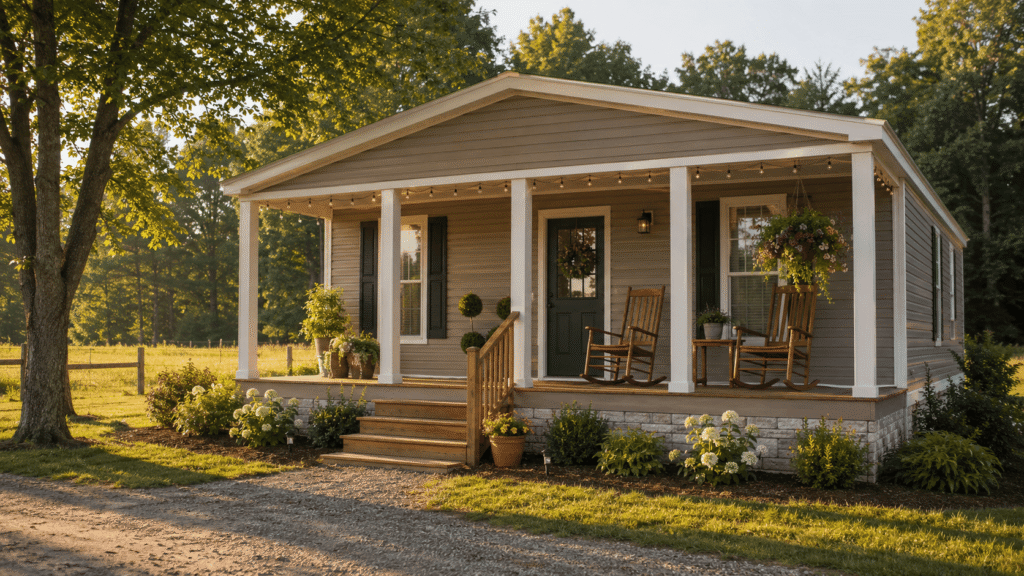
A covered front porch with a proper roof, posts, and railing transforms the entrance of a mobile home more dramatically than almost any other single exterior addition.
Options:
Simple deck with railing ($1,500–$4,000): A pressure-treated deck at the front entrance with a railing system. Covers the front steps, creates a gathering area, and dramatically improves the entrance.
Covered front porch ($4,000–$12,000): A full covered porch with a roof structure, posts, and railing. The most house-like addition available. When the roof pitch of the porch is continued from the main roof, the home gains an entirely different visual profile.
Wraparound porch ($8,000–$25,000): A wrap-around deck turns a mobile home into an indoor-outdoor living space and helps visually ground the structure, making the mobile home feel more permanent without heavy construction.
Although it can be quite expensive, mobile homes can be positioned at ground level. This is the biggest change you can make to your mobile home to look more like a site-built home. This results in your mobile home being at ground level, with a basement giving your mobile home the appearance of being site-built.
Ground-setting — positioning the home at or near ground level rather than elevated on piers — eliminates the visible gap between the bottom of the home and the ground that is one of the most recognisable mobile home features. This must be determined before installation and requires site preparation, retaining walls, and significant earth work.
Cost: $5,000–$20,000 depending on site conditions
Best for: New mobile home installations where the decision can be made before the home is placed
Change 7 — Landscaping and Kerb Appeal
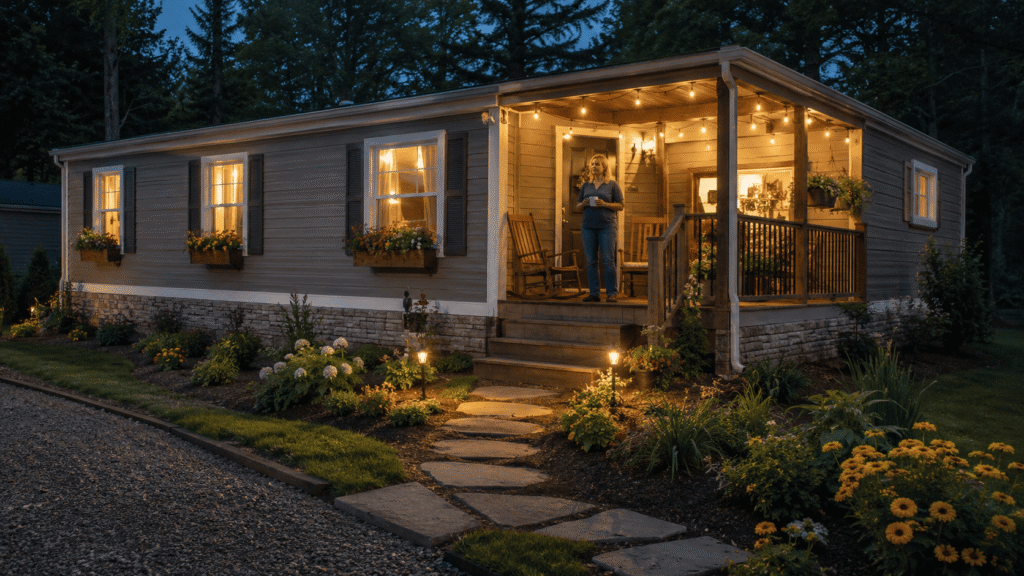
The most affordable exterior transformation available — and the one that is most consistently underestimated. Landscaping does not change the structure but it fundamentally changes the context. A mobile home surrounded by a well-maintained garden, defined paths, and mature plantings looks significantly more permanent and more intentional than the same home sitting on bare earth.
Kerb appeal upgrades for mobile homes:
A defined path from the driveway to the front door — stepping stones, pavers, or a poured concrete path
Foundation plantings — low shrubs, ornamental grasses, and perennials along the base of the home hide the skirting transition and ground the structure in its site
A defined lawn edge — the line between mown grass and planted borders signals care and attention
Window boxes — planted window boxes are one of the most “house-like” details available. They cost $20–$80 per box and transform the visual character of the home’s facade
A mailbox and house number — a proper post-mounted mailbox with a clear house number sounds minor but contributes significantly to the sense that the home is permanent and addressed
Cost: $200–$2,000 depending on scope
Part 2 — Interior Changes: Making a Mobile Home Feel Like a House From the Inside
The exterior is what the neighbours see. The interior is where you actually live. And the interior of a manufactured home often has its own set of visual signals — specific to how it was built — that make it feel like a mobile home rather than a house. These are the changes that address those signals directly.
Change 8 — Replace the VOG Panelling With Drywall
The interior walls of most manufactured homes are finished with VOG (vinyl-on-gypsum) panels — thin panels with visible seams that are one of the most immediately recognisable features of a mobile home interior. By switching these out for panels that are more your taste and style, you quickly add a subtle yet crucial personalized element.
Replacing VOG panels with drywall is the single most impactful interior change available. Drywall can be painted any colour, accepts any texture, and looks identical to the walls of a site-built house. The seams disappear. The rooms feel solid and substantial.
Important consideration: This is a significant project that involves removing existing panels, addressing any insulation or vapour barrier issues behind them, hanging new drywall, taping, mudding, and finishing. It is achievable as a DIY project for a skilled homeowner but most people hire a drywall contractor.
Cost: $1,500–$6,000 depending on room count and size
Alternative for a budget approach: Paint the existing VOG panels and use board and batten trim over the seams. This does not eliminate the seams but covers them effectively and costs a fraction of full drywall replacement.
Original mobile home flooring — thin vinyl sheet in a pattern that peaked in 1992 — is one of the most visually dated elements of a manufactured home interior. Replacing it with luxury vinyl plank (LVP) is one of the highest-impact per-dollar renovations available.
LVP in a warm wood tone throughout the entire home creates visual consistency that makes each room feel like part of a cohesive house rather than a series of separate mobile home compartments. It is waterproof, extremely durable, and installs directly over the existing subfloor in most cases.
Cost: $2–$6 per square foot for material, $1–$3 per square foot for installation. A single-wide mobile home (typically 800–1,200 square feet) costs $2,400–$10,800 for full flooring replacement.
Change 10 — Remove Popcorn Ceilings and Upgrade Ceiling Finishes
Popcorn ceilings — the textured spray finish used in most manufactured homes — are one of the most instantly recognisable signals of a mobile home interior. Removing them and replacing with a smooth painted ceiling immediately changes the feel of every room.
The process: Wet the popcorn texture with a garden sprayer, then scrape it off with a wide drywall knife. Prime and paint the smoothed ceiling. In some older homes, popcorn ceilings may contain asbestos — test before scraping any home built before 1980.
Alternative: Apply a smooth skim coat of joint compound over the existing texture — more work but avoids the scraping process entirely.
Cost: $0.50–$2.00 per square foot for professional removal, or a DIY weekend project with rental tools.
Change 11 — Replace Interior Doors
Standard mobile home interior doors are hollow-core, lightweight, and often fitted with cheap hardware. Installing larger, insulated doors can make a mobile home look significantly more like a traditional house — it also increases ROI in terms of improved comfort, added convenience, and a boost in the home’s value.
Solid-core interior doors — even standard 6-panel hollow-core doors from a home improvement store in 1⅜” thickness — are a substantial upgrade. The sound deadening alone changes the feel of the home significantly.
Cost: $50–$150 per door plus hardware. A single-wide with 6–8 interior doors costs $300–$1,200 for all doors plus hardware.
Site-built houses have architectural detail built into their construction — crown moulding, baseboards, door casings, window trim — that manufactured homes typically lack or have only in minimal form. Adding these details to a mobile home interior is one of the most cost-effective ways to make it feel like a house.
The most impactful trim additions:
Crown moulding — run along the junction of wall and ceiling. Even a simple 3-inch profile completely changes the character of any room
Wider baseboards — replace thin original baseboards with 4–6 inch baseboards. Makes rooms feel more substantial and finished
Door and window casings — build out the frames around doors and windows with proper casing trim. One of the most obvious markers of “this is a mobile home” is minimal or no trim around doors and windows
Board and batten — vertical wood trim in a regular pattern creates a farmhouse feature wall that covers VOG seams and adds enormous visual interest
Cost: $200–$800 for materials depending on room count. Most trim additions are achievable DIY projects.
Change 13 — Kitchen and Bathroom Renovation
The kitchen and bathroom are the two rooms that most clearly define whether a home feels like a house or a mobile home. Both rooms in a standard manufactured home were built to a minimum functional standard — thin cabinet boxes, laminate countertops, basic fixtures — that immediately reads as manufactured rather than built.
The kitchen renovation guide is covered in full detail in our mobile home kitchen remodel ideas guide — but the summary is: replacing cabinet doors (not full boxes), adding new countertops, new backsplash, new tap, and new flooring transforms a mobile home kitchen into a kitchen that could be in any house in the country.
The bathroom benefits from the same approach: new vanity, new tap, new light fixture, new floor tile, and a fresh paint colour. The toilet and tub/shower can often remain — it is the surfaces and fixtures that make the difference.
Kitchen renovation cost: $1,500–$8,000 depending on scope Bathroom renovation cost: $800–$4,000 depending on scope
Change 14 — Lighting Upgrade Throughout
Builder-grade light fixtures — the standard single-bulb globe fixtures found in most mobile homes — are one of the most affordable things to replace and one of the most impactful. Every room in a manufactured home benefits from a lighting upgrade.
The approach:
Replace every overhead fixture with something intentional — a pendant, a flush-mount with genuine design, a chandelier in the dining area
Add floor and table lamps for layered lighting — rooms lit only from overhead feel like a mobile home; rooms with layered light feel like a home
Replace all bulbs with warm white 2700K LEDs — the colour temperature alone changes the atmosphere dramatically
Cost: $30–$200 per fixture. A full single-wide with 8–10 fixtures costs $300–$2,000 depending on choices.
Part 3 — Budget-by-Budget Guide
Not every transformation requires the same investment. Here is exactly what is achievable at each budget level:
Under $1,000 — The Cosmetic Refresh
These changes cost under $1,000 combined and produce immediate visible results:
New front door paint colour: $20–$40
Window boxes with plants: $80–$200
New exterior house numbers and mailbox: $50–$150
New interior light fixtures (3 rooms): $150–$400
New interior door hardware throughout: $100–$300
New tap in kitchen and bathroom: $80–$200
Fresh paint throughout interior: $150–$300
Result: A home that feels cared for, current, and proud. Not transformed — but noticeably better.
$1,000–$5,000 — The Significant Update
At this budget level you can address the most visible mobile home signals:
New vinyl skirting with masonry pattern: $200–$600
New exterior front door (6-panel): $500–$1,200
LVP flooring in main living areas: $800–$2,000
Board and batten trim over VOG seams: $300–$700
Crown moulding throughout: $400–$800
New light fixtures throughout: $300–$600
Kitchen cabinet door replacement: $400–$800
New kitchen countertop: $400–$1,000
Result: The interior no longer reads as a mobile home to most visitors. The exterior is improved but the most dramatic exterior signals remain.
$5,000–$15,000 — The Exterior Transformation
At this budget level the exterior can be transformed completely:
Stone or concrete block skirting: $1,500–$3,500
New hardie board siding: $4,000–$8,000
Covered front porch: $4,000–$8,000
New exterior doors: $800–$1,500
Landscaping and kerb appeal: $500–$2,000
Result: From the street, the home no longer reads as a mobile home. Visitors who do not know will not know.
$15,000–$40,000 — The Full Transformation
The cost to renovate a single-wide mobile home ranges from $8,000 to $25,000 and mostly covers cosmetic upgrades, kitchen and bathroom work, or flooring replacement. Major overhauls trend toward the upper end.
At this level, a full interior and exterior transformation is achievable:
All exterior changes above: $6,000–$15,000
Drywall replacement throughout: $2,000–$5,000
Full LVP flooring: $3,000–$6,000
Full kitchen renovation: $3,000–$8,000
Full bathroom renovation: $2,000–$5,000
Trim and moulding throughout: $800–$2,000
Lighting throughout: $500–$1,500
Popcorn ceiling removal: $500–$1,500
Result: A home that is genuinely indistinguishable from a site-built house in photographs and frequently in person. This is the transformation that gets shared on Pinterest and earns comments like “I had no idea that was a mobile home.”
Part 4 — The Emotional Part Nobody Talks About
There is something worth addressing directly that most renovation guides skip entirely.
Many mobile home owners carry a quiet shame about their home — not because the home is bad or unworthy but because the culture around housing has created a hierarchy that places manufactured homes near the bottom. The mobile home jokes. The assumptions about who lives in them. The word “trailer.”
The people searching “how to make a mobile home look like a house” are not searching because they are ashamed of affordable housing. They are searching because they love their home and they want it to reflect that love back to them. They want to pull into their driveway at the end of a long day and feel proud of what they come home to.
Every change in this guide serves that goal. Not to pretend the home is something it is not — but to make it the best version of what it is. A real home. Lived in by real people. Worth caring about.
We purchased the home for my parents to live in and they loved it just the way it was because it reminded them of their first home. The changes made dramatically improved the look and feel of the space — and that is what a remodel actually is.
Frequently Asked Questions
Q: What is the single most impactful change to make a mobile home look like a house?
A: From the exterior, replacing the metal skirting with stone veneer or concrete block skirting is the single change that most changes how a mobile home reads from the street — it eliminates the visible gap below the home and makes it look anchored and permanent. From the interior, replacing VOG panelling with drywall eliminates the most recognisable interior signal of a mobile home. If budget allows only one change, exterior skirting transforms the kerb appeal most dramatically.
Q: How much does it cost to make a mobile home look like a house?
A: The average cost to renovate a mobile home is $1,000 to $8,000 for cosmetic updates or up to $80,000 for a full gut renovation. A meaningful transformation — new skirting, porch, front door, interior flooring, and trim — typically costs $8,000–$20,000. A complete interior and exterior transformation costs $15,000–$40,000. Individual improvements can be done incrementally over time — start with the highest-impact changes at your current budget and add more as savings allow.
Q: Can I make a mobile home look like a house on the outside without spending a lot?
A: Yes. The most affordable exterior changes that have real visual impact: new front door paint ($20–$40), window boxes with flowers ($80–$200), foundation plantings along the skirting ($200–$500), a defined path from the driveway to the door ($150–$500), and new exterior house numbers and a mailbox ($50–$150). Total: $500–$1,400 for a kerb appeal refresh that makes a genuine difference.
Q: What siding makes a mobile home look most like a house?
A: Hardie board fibre cement siding is the best choice for making a mobile home look like a site-built house. It is dimensionally stable, durable, and looks identical to traditional wood siding. Available in lap siding, shingle, and panel profiles and paintable in any colour. A mobile home sided in Hardie board and painted in a considered colour is genuinely difficult to distinguish from a site-built house exterior.
Q: How do I make my mobile home interior look like a house?
A: The four most impactful interior changes are: replace VOG panelling with drywall (or use board and batten to cover seams), install LVP flooring throughout, add crown moulding and wider baseboards, and upgrade all light fixtures. These four changes together — even without touching the kitchen or bathroom — transform the interior character completely. None of them require touching the plumbing or electrical system.
Q: Does adding a porch to a mobile home add value?
A: Yes — both financially and qualitatively. A covered front porch adds significant kerb appeal and usable living space, both of which contribute to resale value. It also grounds the home visually — a mobile home with a covered porch looks substantially more permanent than one without. A well-built covered porch typically returns 60–80% of its cost in added value while significantly improving daily quality of life.
Q: Can you put drywall in a mobile home?
A: Yes — drywall can absolutely be installed in a mobile home. The process involves removing the existing VOG panels, addressing any insulation or vapour barrier issues behind them, and hanging new drywall in the conventional way. The main consideration specific to mobile homes is the thinner wall framing (typically 2×3 rather than 2×4) — use thinner drywall (⅜ inch rather than ½ inch) to account for this. Most drywall contractors can handle mobile home drywall installation — ask specifically about their experience with manufactured homes.
Q: What is the fastest way to update a mobile home interior?
A: The fastest high-impact interior updates in order of speed: new light fixtures (2 hours per room, no electrical knowledge needed for direct replacement), new door hardware (30 minutes per door), fresh paint (one weekend for the whole home), peel-and-stick backsplash in the kitchen (half a day), new cabinet hardware (one hour for the whole kitchen). These five changes can be completed in a single weekend and cost $400–$1,200 combined.
Q: Will renovating a mobile home increase its value?
A: Yes — strategically chosen renovations increase a mobile home’s value meaningfully. Kitchen and bathroom updates, new flooring, exterior siding, and porch additions consistently return value above their cost in manufactured housing markets. The caveat is that mobile home values are influenced by the land situation — a mobile home on owned land benefits more from renovation investment than one on rented land in a park, where appreciation is limited by the lease structure. If you own the land, renovation investment is generally well-justified.
Meta Title: How to Make a Mobile Home Look Like a House — The Complete 2026 Guide Meta Description: The complete guide to making a mobile home look like a house — exterior upgrades, interior transformations, budget breakdowns from $500 to $40K, before and after ideas, and everything you need in 2026. Slug: /how-to-make-a-mobile-home-look-like-a-house/ Pinterest Description: How to Make a Mobile Home Look Like a House — the complete 2026 guide 🏡 Exterior upgrades, interior transformations, budget breakdowns from $500 to $40K, and before & after ideas. Save this!
Sufian Ahmed
Home decor enthusiast and founder of astheticdecor.com. Passionate about helping people create beautiful, personalised aesthetic rooms on any budget. Covering romantic, dark academia, kawaii, gothic, coquette and every aesthetic in between.
![[IMAGE PROMPT: A cute handmade clay fairy house with round walls, tiny arched door, small windows, mushroom-style roof, soft pastel paint, moss around the base, placed on a craft table, cozy cottagecore DIY photography, realistic clay texture, warm light, high detail, no text.]](https://astheticdecor.com/wp-content/uploads/2026/06/ChatGPT-Image-Jun-12-2026-11_12_11-PM-1024x576.png)
![[IMAGE PROMPT: A cute handmade clay fairy house with round walls, tiny arched door, small windows, mushroom-style roof, soft pastel paint, moss around the base, placed on a craft table, cozy cottagecore DIY photography, realistic clay texture, warm light, high detail, no text.]](https://astheticdecor.com/wp-content/uploads/2026/06/ChatGPT-Image-Jun-12-2026-11_12_15-PM-1024x576.png)