Introduction
Most people searching for vintage nautical home decor already know exactly what they do not want — the oversized anchor wall art, the ceramic lobsters, the rope-wrapped everything that makes a room look like a seaside gift shop rather than a home near the water. What they want is the genuine version of the aesthetic: the feeling of a coastal space that has been quietly accumulated over time rather than deliberately themed in a single afternoon.
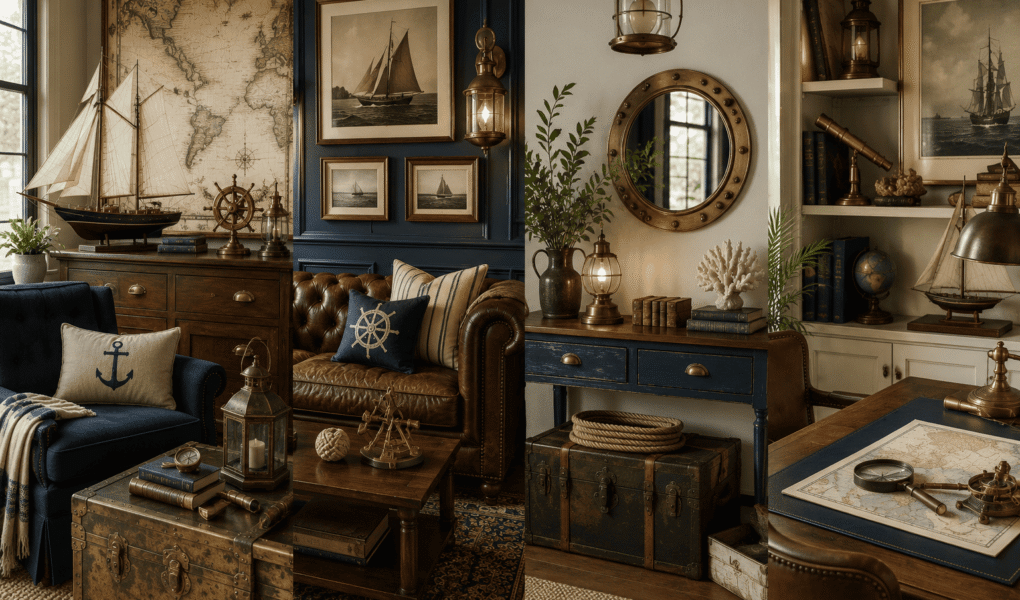
The difference between vintage nautical home decor that works and the version that does not comes down almost entirely to material authenticity and restraint. Weathered teak, aged brass, worn rope used structurally rather than decoratively, sea glass in a simple vessel — these are the materials that deliver the sophisticated coastal feeling precisely because they are the real things rather than representations of them. This guide covers the specific colours, materials, and accent choices that read as genuinely refined, and applies them room by room so the aesthetic develops naturally across the home rather than appearing only in one overly nautical corner.
🔗 Looking for more decorating ideas? Read our economy home decor guide and our Flower Home Decor Ideas for more.
The First Rule — Sophisticated, Not Kitschy
Before any specific ideas, the single most important principle in vintage nautical decor is restraint.
Use understated palettes and focus on natural materials. Skip overused motifs — cartoon anchors, plastic starfish, mass-produced “beach life” signage — and mix in modern or neutral accents for balance. The most successful nautical interiors lean on genuinely aged or authentic materials rather than new items manufactured to look old, and they never attempt to cover every surface in maritime imagery at once.
The practical version of this rule: Choose one or two statement pieces per room and pair them with neutral tones, rather than crowding a space with nautical references. A reclaimed oar repurposed as a bookshelf support, for instance, maximises both utility and style without tipping into theme. A room needs an anchor — whether that is a reclaimed ship wheel, an aged compass, or a weathered trunk passed down through a family — and everything else should support that one anchor rather than compete with it.
Choose materials with genuine seafaring pedigree. Hemp rope, driftwood, brass, aged linen, and weathered wood all carry an inherent maritime association without needing literal nautical imagery printed or carved onto them. A coil of thick hemp rope used as a curtain tieback says “nautical” as clearly as a ship’s wheel does — and considerably more subtly.
Vintage Nautical Decor by Room
Entryway
The entryway is the strongest place to introduce a single statement nautical piece, since it sets the tone for the home without requiring the rest of the house to follow the same theme as intensely.
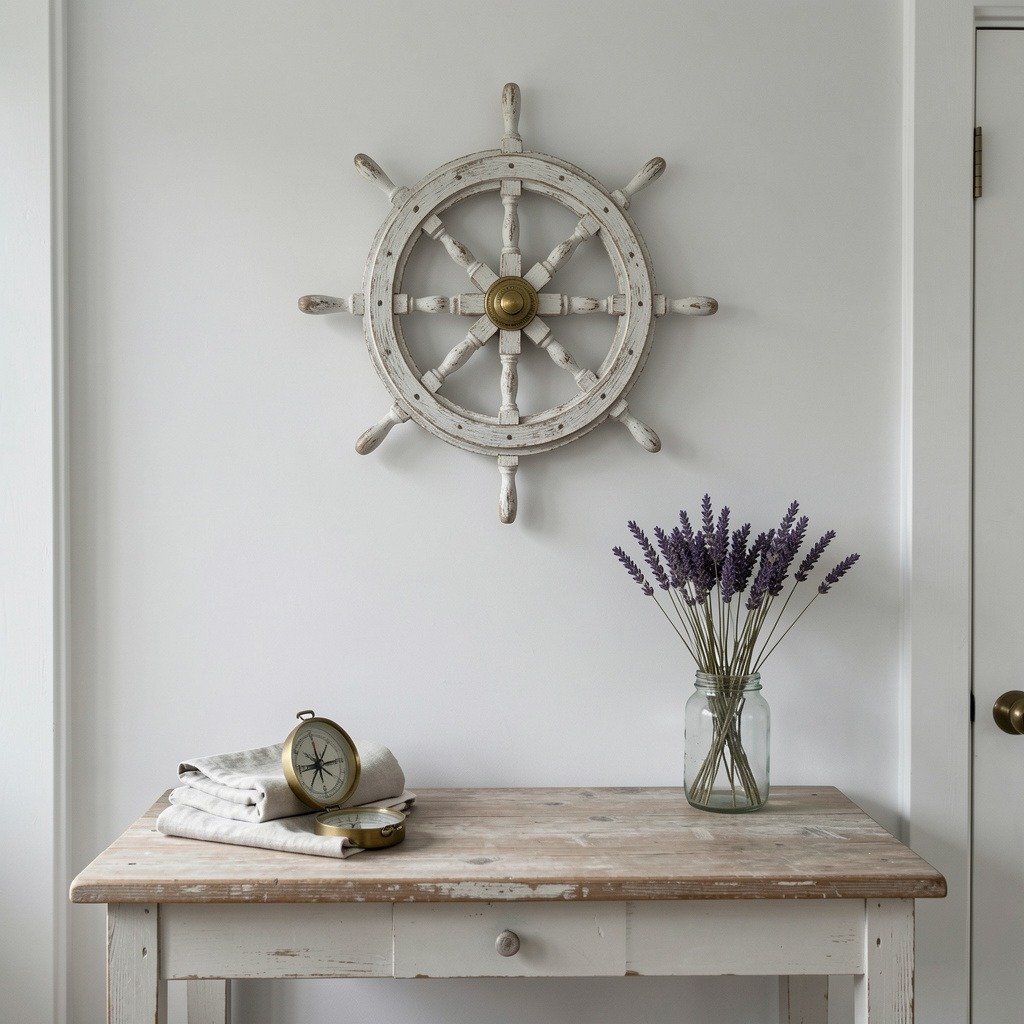
- A weathered ship’s wheel mounted above a console table — the single most recognisable and most effective vintage nautical anchor piece
- An aged brass compass displayed open on a console or shelf, ideally one with visible patina rather than a bright, obviously new finish
- A faded antique sea chart or coastal map, framed simply, hung at eye level
- A coil of thick hemp or jute rope used decoratively — wrapped around a mirror frame, looped over a hook, or simply coiled in a bowl by the door
Living Room
- A glass fishing float or two, in varying sizes, grouped on a shelf or coffee table rather than scattered individually
- A vintage ship’s lantern, electrified or left as a candle holder, placed on a side table or mantel
- Navy and white striped textiles — a single cushion or throw is usually enough; covering an entire sofa in stripe risks tipping into costume territory
- A weathered wooden oar mounted horizontally above a sofa or used vertically as a striking corner accent
- Aged brass nautical instruments — a sextant, a ship’s bell, a brass cleat — displayed on a shelf rather than a wall, since these read more like collected curiosities at eye level than wall-mounted theme decor
Bedroom
The bedroom benefits from the quietest version of this aesthetic — texture and material over literal nautical objects.
- Linen bedding in white, navy, or faded indigo rather than any printed nautical motif
- A single weathered wooden trunk at the foot of the bed, doubling as storage and as the room’s nautical anchor piece
- A small vintage porthole mirror, sized modestly, hung above a dresser
- Driftwood as a simple, sculptural object on a nightstand — no further decoration needed
Bathroom
- Sea glass, collected or purchased, displayed in a simple glass jar on the vanity or windowsill
- A vintage brass porthole-style mirror — genuinely one of the most versatile nautical decor pieces, since it works equally well in a bathroom, hallway, or bedroom
- Rope detailing on a soap dish or towel ring
- Aged ceramic dishes in a coastal majolica style for soap or small toiletries
You can also read Blush Pink & Rose Bedroom Decor: The Complete Romantic Guide
The Best Materials for Vintage Nautical Decor
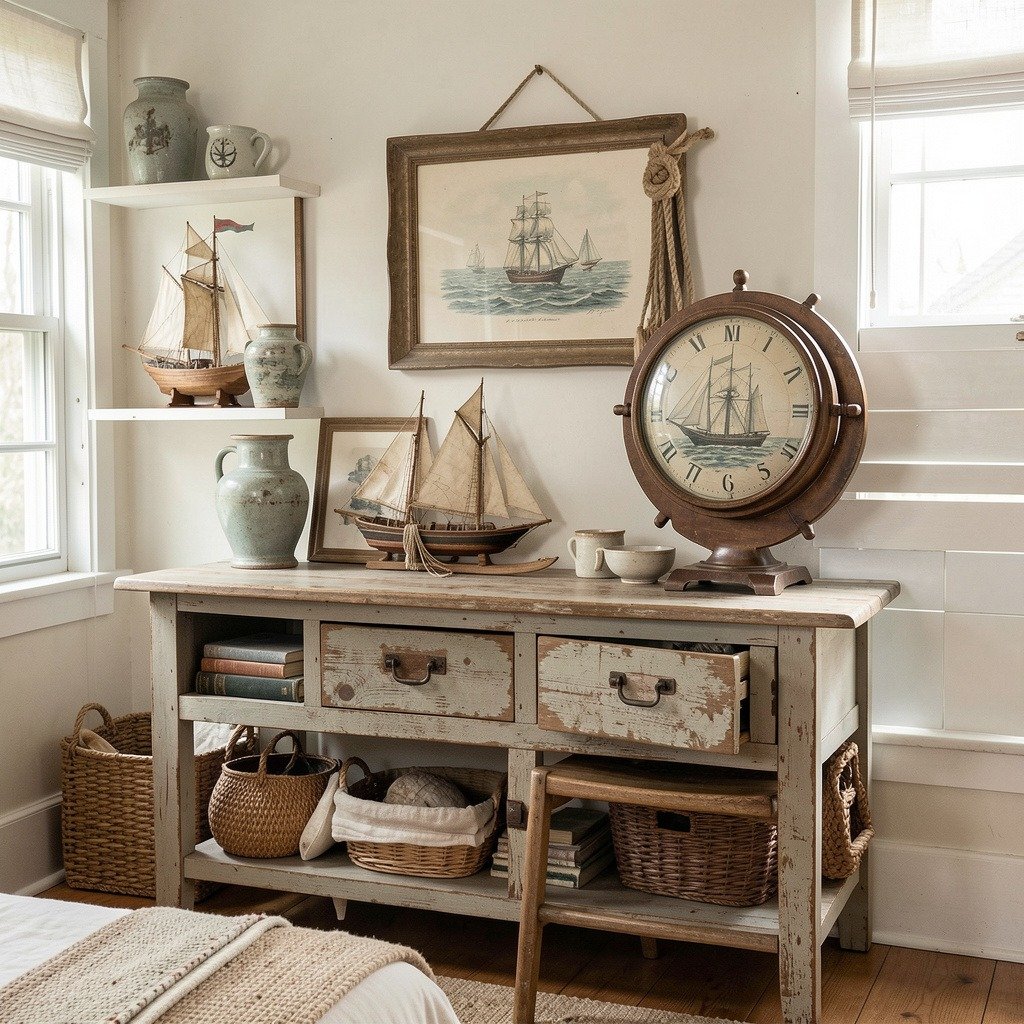
Brass: The single most important material in this aesthetic. Aged, unlacquered brass with visible patina — on compasses, ship’s bells, cleats, portholes, and hardware — carries genuine maritime history in its surface. Avoid bright, polished brass reproductions; the dulled, slightly uneven patina of real age is what reads as authentic rather than costume.
Driftwood and weathered wood: Naturally bleached and textured by salt water and sun, driftwood brings genuine coastal material into a home without any added imagery. A single substantial piece, displayed simply, does more work than a shelf full of small nautical trinkets.
Rope (hemp or jute): Used as a tieback, a wrapped detail on a mirror or lamp base, or simply coiled as an object in its own right. Rope is one of the most versatile and least kitschy nautical materials available, since its texture alone communicates the aesthetic.
Glass: Sea glass and glass fishing floats both carry genuine maritime history when sourced authentically, and their slightly imperfect, hand-blown quality (in the case of vintage floats) is part of their appeal. Reproduction glass floats are widely available and perfectly acceptable, but seek out ones with genuine air bubbles and slight asymmetry rather than perfectly uniform mass-produced versions.
Linen and aged textiles: Sun-softened linen, white canvas, and faded navy ticking fabric bring a coastal, lived-in softness that complements harder nautical objects like brass and wood.
Wrought iron: Ship fittings, old hooks, and iron hardware bring a darker, more industrial note to the aesthetic — particularly effective paired with weathered wood.
Where to Find Authentic Vintage Nautical Decor
Flea markets, marine salvage warehouses, and estate auctions are consistently the most affordable way to source genuine vintage nautical pieces — these venues regularly yield unique lanterns, chests, and brass hardware at reasonable prices, and the hunting itself is part of the appeal for many collectors.
Specialist salvage and antique shops dedicated specifically to nautical and coastal material — including shops that source directly from ship salvage, shipwreck recovery, and wrecking yards — offer the most genuinely authentic pieces: portholes, ship’s lights, anchors, doors, and wheels recovered from real vessels. These pieces carry the highest price point but also the most genuine history.
Online vintage marketplaces such as Chairish and 1stDibs carry an extensive range of vintage nautical decor, from ship’s wheels and signal flags to nautical-themed lamps and tableware, typically with detailed provenance and condition notes. eBay remains a reliable source for smaller items like brass instruments, vintage charts, and hardware at a range of price points.
Specialized antique and reproduction retailers offer both genuine antiques and well-made reproductions for those who want the aesthetic without committing to true vintage sourcing or pricing — useful for larger furniture pieces or items where authenticity matters less than overall look.
You can also read Romantic Living Room Decor: How to Create an Intimate, Luxurious Space

How to Avoid the Kitsch Trap — A Practical Checklist
Use this checklist before adding any new nautical item to a room:
- Does it have genuine texture and age, or is it smooth, bright, and obviously mass-produced? Authentic patina, weathering, and material quality are what separate sophisticated from costume.
- Am I adding this because it is genuinely beautiful, or simply because it has an anchor or ship printed on it? Literal motifs (cartoon anchors, “nautical by nature” type signage) are the fastest route to kitsch.
- Does this room already have a clear nautical anchor piece? If yes, consider whether this new item supports it or competes with it. One strong piece per room beats five competing ones.
- Could this item work just as well in a non-themed coastal or rustic room? If a piece only makes sense surrounded by other obviously nautical objects, it is probably leaning too literal. The best pieces — a weathered oar, an aged brass compass, a coil of rope — work as standalone objects of genuine beauty, with or without other nautical decor nearby.
- Have I left enough negative space around the piece? Crowding is the second fastest route to kitsch after literal motifs. A single ship’s wheel on an otherwise bare wall reads as confident. The same wheel surrounded by six smaller nautical trinkets reads as a theme display.
Vintage Nautical Decor for a Landlocked Home
You do not need to live anywhere near the coast to use this aesthetic successfully. A shore-side look can be recreated almost anywhere with the right vintage nautical pieces — sun-softened textiles in linen, white canvas, and navy ticking; sculpted driftwood; jumbled beach glass; and vintage fishing floats all translate the feeling of the coast into any interior, regardless of geography.
A jute runner underfoot and a small collection of found or purchased seashells add a final, quiet layer of coastal atmosphere without requiring a single literal nautical object in the room.
You can also read Romantic Bedroom Lighting: The Complete Candles, Fairy Lights & Ambience Guide
Frequently Asked Questions
Q: What are some affordable ways to source vintage nautical decor?
A: Check local flea markets, marine salvage warehouses, and estate auctions first — these consistently offer the best prices on genuine vintage pieces. Online platforms like eBay and specialised antique shops can also yield unique lanterns, chests, or brass hardware at reasonable prices, particularly if you are willing to search regularly rather than buying the first item you see. Reproduction pieces from general home decor retailers offer a lower-cost entry point for the overall aesthetic, though they lack the genuine patina and history of true vintage finds.
Q: How do I integrate nautical antiques in a small space without it feeling cluttered?
A: Choose one or two statement pieces and pair them with neutral tones, avoiding the temptation to crowd a small space with multiple nautical references. Functional items — an old oar repurposed as a bookshelf support or coat rack, for instance — maximise both utility and style simultaneously, which is particularly valuable when square footage is limited. In a small room, one genuinely good piece displayed with confidence will always outperform several smaller, competing ones.
Q: How do I keep vintage nautical decor looking sophisticated rather than kitschy?
A: Use understated, neutral palettes and focus on natural materials with genuine texture and age — brass with real patina, weathered wood, hemp rope, aged linen. Skip overused literal motifs like cartoon anchors, plastic starfish, and mass-produced beach-themed signage entirely. Mix in modern or simple neutral accents for balance rather than surrounding every nautical piece with more nautical pieces, and always leave generous negative space around your strongest items rather than crowding a wall or shelf.
Q: Can vintage nautical decor work in a home that’s nowhere near the coast?
A: Yes, and it is one of the most successfully landlocked-friendly vintage decor aesthetics available. The look relies on material and texture — sun-softened linen, driftwood, brass, jute, beach glass — more than it relies on actual proximity to water. A single well-chosen anchor piece (a ship’s wheel, an aged compass, a weathered trunk) combined with natural textiles and a restrained, neutral palette recreates the feeling convincingly in any climate or location.
Q: Is it better to buy genuine vintage nautical pieces or good reproductions?
A: Genuine vintage and salvaged pieces carry real history and a depth of patina that is very difficult to replicate artificially, and many people find that history is a meaningful part of why they enjoy the aesthetic. However, well-made reproductions are a completely valid and often more practical choice — particularly for larger furniture pieces, for budget-conscious decorating, or for items where exact authenticity matters less than the overall visual effect. The most successful rooms in this style often mix both: one or two genuine vintage anchor pieces alongside simpler, reproduction-quality supporting elements like rope, linen, and glass.
Q: What is the single best starter piece for vintage nautical decor?
A: A reclaimed ship’s wheel, an aged brass compass, or a weathered wooden trunk are the three most commonly recommended starting points, since each works as a genuine anchor piece capable of carrying an entire room’s nautical identity on its own. Begin with whichever resonates most personally — many of the most successful nautical interiors start with a single meaningful object, sometimes inherited or connected to a personal story, rather than a deliberately assembled theme.
🔗 Continue decorating your home — read our Retro Console Table Ideas and our feng shui home decorating guide for more.