Introduction
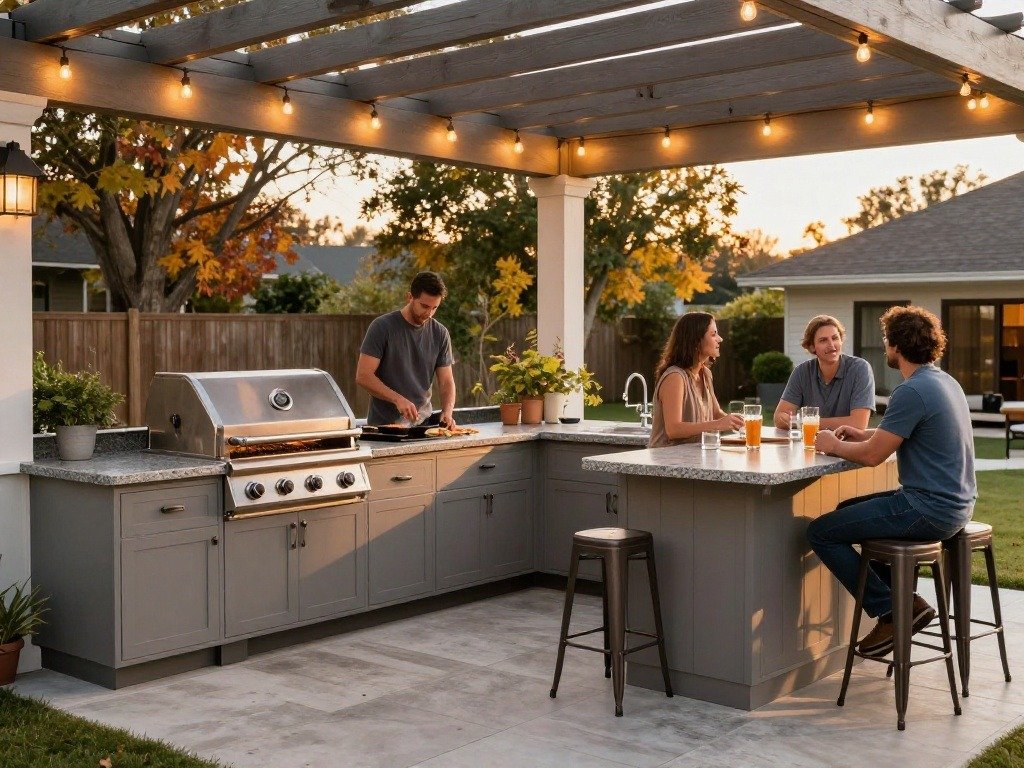
Of all the outdoor kitchen layouts available — straight single-run, U-shaped, island-centred, galley — the L-shaped outdoor kitchen is consistently the most popular choice for backyard builds in 2026. And the reasons are not complicated: it maximises counter space, it creates a natural work triangle between the grill, sink, and refrigerator, it fits corner spaces efficiently, and it creates a defined gathering zone that feels like a real outdoor room rather than an appliance placed in a yard.
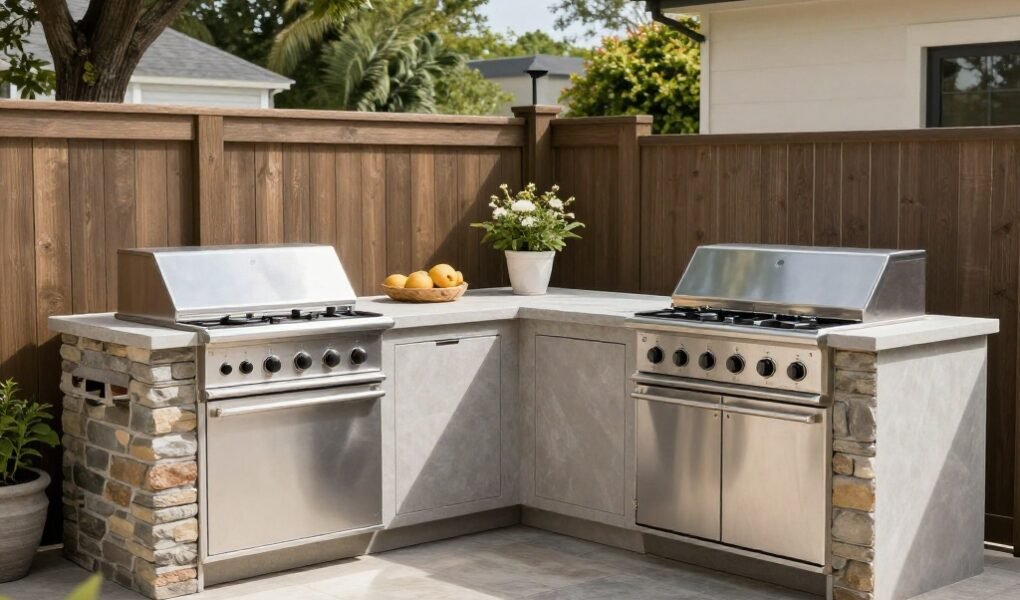
An L-shaped outdoor kitchen is an excellent solution for homeowners looking to combine functionality with style. The layout features two perpendicular countertops which maximise cooking space while offering plenty of room for storage and movement. This design works well for any outdoor space whether small or large and is highly adaptable to various backyard layouts.
But the L-shaped layout is not without its decisions. Where does the grill go — in the corner or at the end of one arm? How long should each arm be? What materials survive your climate? How do you integrate a bar or seating area? How do you cover it? And what does a well-designed L-shaped outdoor kitchen actually cost?
This guide answers all of those questions — with specific design ideas, dimension guidance, material recommendations, appliance placement rules, and 2026 trend updates that make your L-shaped outdoor kitchen the most beautiful and most functional space in your backyard.
🔗 Planning your complete outdoor kitchen? Read our Florida outdoor kitchen ideas guide and our Kitchen Island Size Guide for more.
Why the L-Shaped Layout Is the Best Outdoor Kitchen Design
Before getting into the specific design ideas, it helps to understand exactly why the L-shaped outdoor kitchen outperforms other layouts — because this understanding guides every design decision that follows.
The Work Triangle Advantage
The L-shaped layout creates a natural work triangle between the three core outdoor kitchen workstations — the grill, the sink, and the refrigerator. Positioning the primary cooking station at the corner intersection provides easy access from both legs of the kitchen. The remaining zones — refrigeration and preparation — are placed along the two arms, creating an intuitive flow for meal prep and service.
In practice: the cook stands at the corner working the grill. Everything they need — the sink two steps to the left, the refrigerator two steps to the right — is within immediate reach. They never have to cross the full length of the kitchen to access anything.
The Zone Separation Advantage
The L-shaped outdoor kitchen creates distinct zones for different activities without building walls to separate them. One leg of the L can be dedicated to high-heat cooking with the primary grill and side burners, while the other leg serves as a prep and clean-up station with the sink, cutting board areas, and refrigerator. This separation keeps the workflow organised and allows multiple people to use the kitchen simultaneously without getting in each other’s way.
The Corner Efficiency Advantage
L-shaped outdoor kitchens excel in corner patio spaces — using the corner of a home, fence, or patio structure to anchor the design. This makes them particularly effective for backyards where the outdoor kitchen needs to sit against two perpendicular walls rather than floating freely in the space.
The Entertainment Advantage
The L-shape naturally creates an open face toward the entertaining area — the guests, the dining table, the pool. The cook stands at the corner of the L facing outward into the social space rather than facing a wall. This is one of the most significant practical advantages of the L-shaped layout: the person cooking never feels separated from the gathering.
You can also read Small Kitchen Remodel Ideas: 20 Budget-Friendly Transformations (Before & After)
L-Shaped Outdoor Kitchen Dimensions — The Complete Guide
Getting the dimensions right is the most important planning step for any L-shaped outdoor kitchen.
The Recommended Leg Lengths
For optimal functionality, each leg of the L should be between 8 and 15 feet long. This provides sufficient room for dedicated zones without making the travel distance between them inefficient.
| Kitchen Size | Leg 1 Length | Leg 2 Length | Total Counter Space |
|---|---|---|---|
| Compact L | 6 feet | 6 feet | ~12 linear feet |
| Standard L | 8 feet | 6 feet | ~14 linear feet |
| Comfortable L | 10 feet | 8 feet | ~18 linear feet |
| Large entertaining L | 12 feet | 10 feet | ~22 linear feet |
| Premium L | 15 feet | 12 feet | ~27 linear feet |
The minimum L-shaped outdoor kitchen: Each leg should be at least 5 feet long — the minimum that allows a grill plus some counter space on one arm, and a sink plus refrigerator on the other. Shorter than 5 feet per leg and the kitchen becomes functionally unusable as an L-shape — at that point a single straight run is a better choice.
Counter Height and Depth
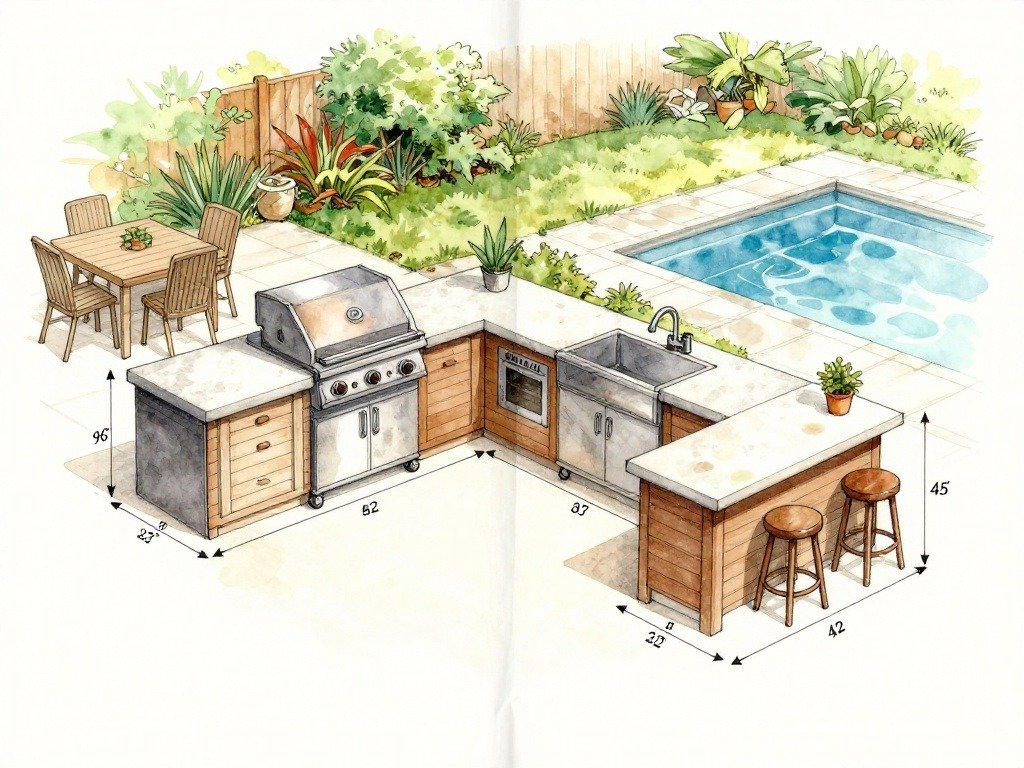
Standard counter height: 36 inches — matches indoor counter height and is the most comfortable for food preparation Bar height: 42 inches — for the bar or seating section, often incorporated as a raised counter on the outer face of one arm Standard counter depth: 24–28 inches — the depth of standard base cabinets Overhang for seating: 10–15 inches beyond the counter face for bar stool knee clearance
Clearance Requirements
The minimum clearance in front of any L-shaped outdoor kitchen counter run is 42 inches. This allows one person to work while another passes behind them. For a kitchen used by multiple cooks simultaneously, 48–54 inches of clearance is preferable.
8 L-Shaped Outdoor Kitchen Design Ideas
Design 1 — The Modern L-Shaped Outdoor Kitchen
The most popular L-shaped outdoor kitchen style in 2026. Clean lines, integrated stainless steel appliances, a dark stone countertop, and minimal visible hardware. The modern L-shaped outdoor kitchen looks like the indoor kitchen has simply extended itself outside — which in 2026 is exactly what the best outdoor kitchens do.
Key elements:
- Stainless steel built-in grill, side burners, and refrigerator
- Porcelain or dark granite countertops — large format, minimal grout lines
- Marine-grade polymer or stainless steel cabinetry
- Handleless or bar-pull cabinet hardware
- A large concrete or porcelain tile floor continuing from the indoor patio
- Recessed LED lighting under the counter overhang
- A pergola or solid roof structure above
Best placement: The grill at the corner intersection, the sink and refrigerator along one arm, a waterfall-edge bar section at the end of the other arm where guests sit.
You can also read Small Kitchen Decor Ideas: 25 Ways to Make Your Tiny Kitchen Look Stunning
Design 2 — The L-Shaped Outdoor Kitchen With Bar
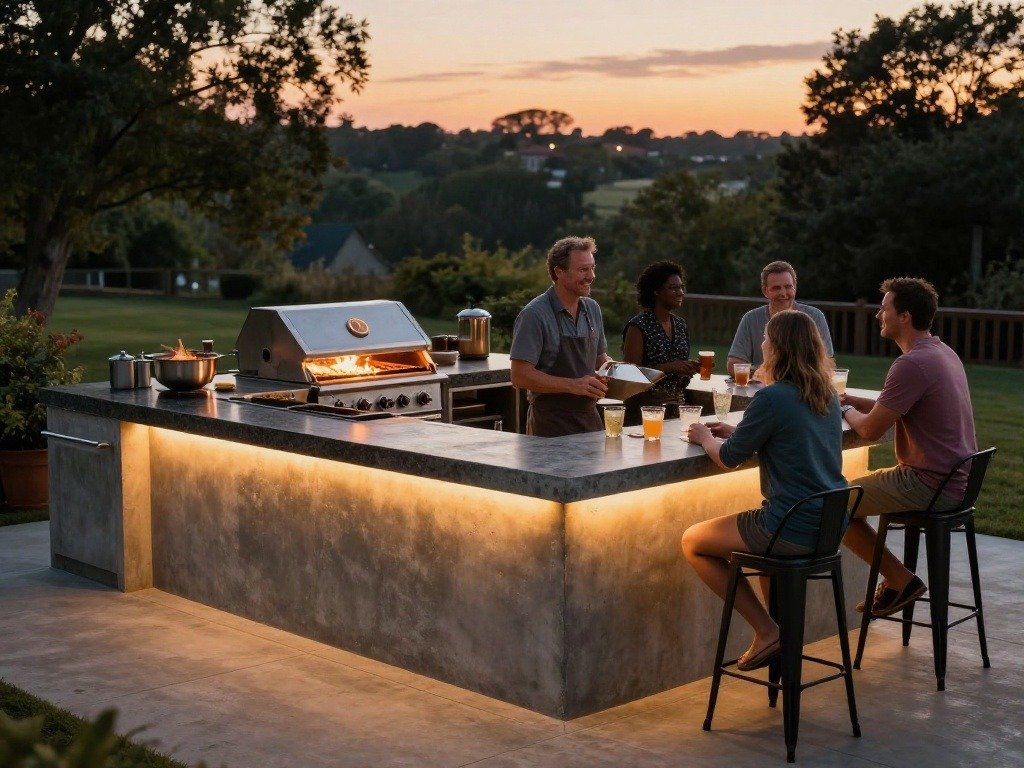
The most requested L-shaped outdoor kitchen configuration — one arm dedicated to cooking and prep, the other arm serving as an outdoor bar with seating along the outer face.
How it works: The cooking arm runs along the back wall or fence. The bar arm extends outward perpendicular — its outer face raised to bar height (42 inches) with stools facing the cooking area. The cook works at the corner grill station and can interact directly with everyone seated at the bar. This is simultaneously the most efficient cooking layout and the most socially connected outdoor kitchen design available.
Bar arm dimensions: A minimum of 6 feet to seat 2–3 people comfortably. 8–10 feet for 3–4 bar stools. The outer bar surface should overhang the cabinet face by 10–15 inches for knee clearance.
Materials for the bar section: Concrete, dark granite, or a contrasting material from the cooking counter — a waterfall edge in quartz or concrete on the bar arm creates a visual distinction between the cooking zone and the social zone.
Design 3 — The L-Shaped Outdoor Kitchen With Pergola
A pergola-covered L-shaped outdoor kitchen is the most complete and most usable outdoor kitchen configuration — providing shade, rain protection, architectural structure, and the specific warmth of a covered outdoor space that feels like a room rather than an appliance placement.
Pergola integration with an L-shaped kitchen: The pergola posts naturally align with the outer corners of the L — one post at each end of each arm, with the structure spanning above. String lights woven through the pergola rafters, a ceiling fan at the centre, and recessed or pendant lighting at the cooking stations complete the covered kitchen room.
Materials for a pergola-covered L-shaped kitchen: Cedar, pressure-treated pine, or powder-coated aluminium for the pergola structure. The L-shaped kitchen itself should be built from materials appropriate for outdoor conditions — marine-grade polymer cabinetry, granite or porcelain countertops, stainless steel appliances.
Cost addition for pergola: A basic pergola over an L-shaped outdoor kitchen adds $3,000–$12,000 to the overall build cost depending on size, material, and whether a retractable shade system is added.
Design 4 — The Small L-Shaped Outdoor Kitchen
The L-shaped layout is one of the most space-efficient outdoor kitchen configurations available — which makes it the best choice for smaller patios and backyards where space is limited.
Compact L-shaped outdoor kitchen (6 feet × 6 feet):
- Arm 1 (6 feet): Built-in grill + 18 inches of prep counter
- Arm 2 (6 feet): Outdoor refrigerator + 18 inches of prep/serving counter
- No sink (or a small prep sink at the corner)
- Counter height: 36 inches throughout
- No bar seating — free-standing chairs or a nearby dining table instead
The apartment patio L-shaped outdoor kitchen: For balconies and small urban patios, an L-shaped modular outdoor kitchen — prefabricated stainless steel or polymer modules assembled in an L configuration — provides the work triangle advantages of an L-shaped layout in a footprint as small as 5 feet × 5 feet.
You can also read Small Kitchen Ideas: 35 Space-Saving Designs That Feel Bigger Than They Are
Design 5 — The L-Shaped Outdoor Kitchen With Pool
The pool-side L-shaped outdoor kitchen is the most popular outdoor kitchen configuration in warm-weather states — particularly Florida, California, Arizona, and Texas.
The L-shape works particularly well beside a pool because one arm can run parallel to the pool edge and the other arm can run perpendicular — creating a defined kitchen space that faces the pool without blocking it. Guests in the pool can interact directly with the cook at the corner grill station.
Key considerations for pool-side L-shaped kitchens:
- Use non-slip outdoor tile rated IP67 for the floor area around the pool
- Position the electrical and gas connections away from the pool edge — minimum 5 feet from the water’s edge
- Consider a wet bar section with an ice maker on the pool-facing arm — the most used feature in any pool-side outdoor kitchen
- Marine-grade stainless steel or polymer cabinetry — pool chemicals in the air accelerate corrosion of standard materials
Design 6 — The L-Shaped Outdoor Kitchen on a Budget
A genuinely functional L-shaped outdoor kitchen can be built for significantly less than the $15,000–$50,000 range of fully custom builds. Here is the honest budget guide:
Under $5,000 — The starter L:
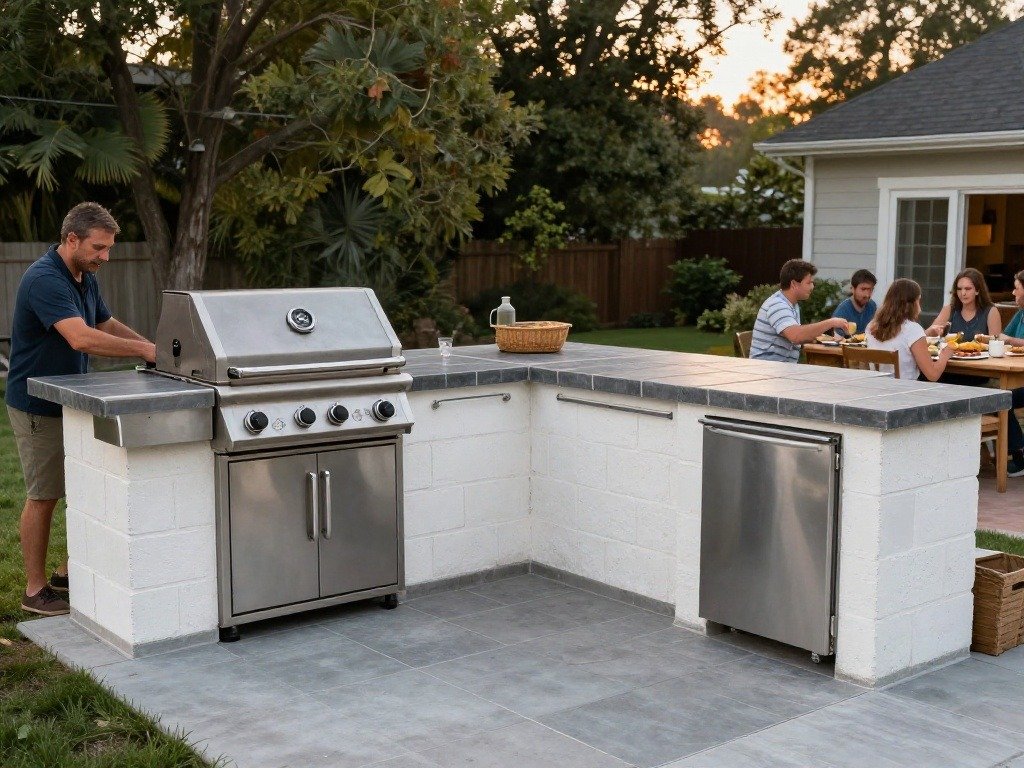
- Prefabricated concrete block base built in L-shape — weekend DIY project with bagged mortar, $400–$800 in materials
- Stucco or tile finish applied over the block: $200–$600
- A freestanding high-quality grill positioned at the corner: $400–$800
- A standard outdoor fridge: $200–$400
- Laminate or tile countertop: $300–$600
- Simple wood overhang above for shade: $500–$1,500
$5,000–$12,000 — The mid-range L:
- Built-in grill and side burner from a reliable brand (Blaze, Summerset, Napoleon): $800–$2,000
- Marine-grade polymer cabinetry: $2,000–$4,000
- Granite or quartz countertops: $1,000–$2,500
- Outdoor refrigerator: $400–$800
- Basic pergola cover: $1,500–$3,000
$12,000–$30,000 — The premium L:
- Custom-built structure with concrete block or stone veneer
- Premium appliances (Hestan, Fire Magic, AOG)
- Natural stone countertops
- Full pergola or solid roof cover
- Outdoor lighting system
- Bar seating section with concrete waterfall edge
You can also use Free Rug Size Calculator
Design 7 — The Rustic L-Shaped Outdoor Kitchen
The rustic L-shaped outdoor kitchen brings the warmth and character of natural materials into an outdoor cooking space — stone, weathered wood, corten steel, and terracotta creating a kitchen that feels like it grew from the garden rather than being placed in it.
Key elements:
- Natural stone or brick structure — limestone, slate, or sandstone cladding over a concrete block base
- A corten steel or copper countertop — develops beautiful patina over time
- A stone or brick wood-fired pizza oven as the cooking centrepiece
- Open storage rather than cabinets — shelves of weathered wood holding cast iron pots, ceramic serving dishes, and bottles of olive oil
- Climbing plants — wisteria, jasmine, or bougainvillea trained along the pergola above
- Terracotta floor tiles
Best for: Rural properties, farmhouses, and backyards with established garden plantings where the outdoor kitchen should look like a feature of the garden rather than a construction placed in it.
Design 8 — The Coastal L-Shaped Outdoor Kitchen
The coastal L-shaped outdoor kitchen references the specific visual language of beach houses and waterfront properties — light materials, fresh colours, and the specific combination of function and leisure that defines outdoor living in coastal environments.
Key elements:
- Marine-grade polymer cabinetry in white, driftwood, or coastal blue
- Light granite or quartz countertops — pale grey or cream
- A large undermount sink — wet bar function is essential in a coastal kitchen
- An outdoor refrigerator with ice maker — the most used appliance in any coastal outdoor kitchen
- White or natural wood pergola above
- String lights in warm white Edison bulbs
- Coastal plants — sea grass, palms, bougainvillea — as natural enclosure
Appliance Placement in an L-Shaped Outdoor Kitchen
This is one of the most practical and most commonly misunderstood aspects of L-shaped outdoor kitchen design.
The Corner Rule
The grill goes at or near the corner — not at the end of one arm. This is the single most important appliance placement rule in an L-shaped outdoor kitchen. Placing the grill at the corner:
- Creates the natural work triangle — sink to the left, fridge to the right, or vice versa
- Allows the cook to face outward toward the entertaining area from the most active station
- Places the grill in the most ergonomically central position in the kitchen
What goes where:
| Position | Appliance | Why |
|---|---|---|
| Corner intersection | Built-in grill | Central to both arms — work triangle hub |
| Corner (end of one arm) | Side burner | Adjacent to grill, stays in cooking zone |
| Along cooking arm | Counter prep space | Between grill and the end of the arm |
| End of cooking arm | Storage / waste area | Far end from the grill |
| Start of service arm | Sink | Close to grill for rinsing, seasoning, washing |
| Middle of service arm | Refrigerator or ice maker | Central service area |
| End of service arm | Bar / serving counter | Furthest from heat, closest to guests |
Ventilation for the Corner Grill
A grill positioned at the corner of an L-shaped outdoor kitchen needs adequate ventilation above. If the kitchen is covered by a pergola or solid roof:
- Ensure the corner opening above the grill is at least 24 inches to allow smoke to escape
- Or install an outdoor range hood above the grill — sized to cover the full grill width plus 3 inches each side
- Minimum 24 inches of clearance between the grill grates and any overhead structure
You can also Free Renovation Tool
Materials for L-Shaped Outdoor Kitchens — The Best Choices
Countertops
Granite: The most popular outdoor kitchen countertop material. Heat resistant, UV stable, and sealed properly against moisture. Dark granite works best in L-shaped kitchens with substantial cooking activity — it hides the marks of heavy use better than lighter stones.
Porcelain tile: Excellent UV resistance, completely waterproof, and available in large-format options that minimise grout lines. The most practical outdoor countertop for climates with extreme temperature variation.
Concrete: Beautiful in rustic and modern L-shaped outdoor kitchens. Requires annual sealing in outdoor conditions. Can be poured on-site to exactly match the L-shaped layout — no seams at the corner.
Avoid: Marble (etches from food acids), laminate (delaminates in outdoor humidity), engineered wood (warps and swells).
Cabinetry
Marine-grade polymer: The best material for outdoor kitchen cabinetry in any climate. Completely waterproof, UV stable, insect-resistant, and available in a range of colours and door profiles. More expensive than other options but genuinely maintenance-free.
Stainless steel (304 grade, 316 for coastal areas): Extremely durable and the most professional-looking option. Can feel industrial in rustic or farmhouse L-shaped kitchens. Use 316 marine-grade stainless within 5 miles of the ocean.
Concrete block with stucco or tile finish: The most affordable structural option. Extremely durable and hurricane-resistant. Limited to fixed configurations — cannot be moved or reconfigured.
Flooring
Porcelain tile (anti-slip rated R11 or higher): The best all-round outdoor kitchen flooring. UV stable, waterproof, and non-slip when wet.
Natural stone: Travertine, slate, or limestone. Beautiful and durable — seal annually in wet climates.
Concrete: Poured concrete with a non-slip finish or exposed aggregate. Very durable and integrates well with modern and rustic L-shaped kitchen designs.
L-Shaped Outdoor Kitchen Cost — Honest 2026 Estimates
| Build Level | What Is Included | Estimated Cost |
|---|---|---|
| DIY concrete block | Block structure, basic grill, tile countertop, freestanding appliances | $3,000–$6,000 |
| Prefab modular | Modular polymer modules in L-configuration, built-in grill, fridge | $5,000–$12,000 |
| Mid-range custom | Custom polymer cabinetry, granite countertop, built-in appliances, pergola | $12,000–$25,000 |
| Premium custom | Stone or stainless structure, premium appliances, solid roof, bar, lighting | $25,000–$60,000 |
| Luxury | Full custom outdoor room, smart appliances, outdoor TV, sound, pizza oven | $60,000–$150,000+ |
2026 L-Shaped Outdoor Kitchen Trends
Trend 1 — Seamless indoor-outdoor integration. The 2026 direction is outdoor kitchens that feel like a genuine continuation of the indoor kitchen — matching or complementary materials, consistent flooring, and the same design language. The L-shaped layout enables this integration better than any other outdoor kitchen configuration because it creates a defined space that references indoor kitchen organisation.
Trend 2 — Smart technology integration. App-controlled grills, integrated outdoor speaker systems, smart lighting, and wireless charging surfaces on bar counters are increasingly standard in 2026 L-shaped outdoor kitchens.
Trend 3 — Sustainable materials. Energy-efficient cooking technologies and eco-friendly materials are at the forefront of outdoor kitchen development in 2026. Corten steel (which requires no paint or treatment), natural stone (long-lasting with minimal processing), and recycled composite materials are all gaining traction.
Trend 4 — The bar arm as social centrepiece. The raised bar section of an L-shaped outdoor kitchen has become the most socially important feature — it is where guests sit, where drinks are poured, and where conversations happen while the cook works at the corner grill. In 2026 this bar section is receiving as much design attention as the cooking station itself.
Trend 5 — Pizza ovens at the corner. The placement of a wood-fired or gas pizza oven at the corner intersection of the L — where the grill traditionally sits — is an increasingly popular design choice in 2026. The pizza oven becomes the kitchen’s statement piece and social centrepiece simultaneously.
You can also read Gothic Kitchen & Dining Room Decor: The Complete Dark Elegance Guide
Frequently Asked Questions — L-Shaped Outdoor Kitchens
Q: What is an L-shaped outdoor kitchen?
A: An L-shaped outdoor kitchen is an outdoor cooking space configured in an L-shape — two runs of countertop, cabinetry, and appliances arranged at right angles to each other. The configuration creates a natural work triangle between the grill, sink, and refrigerator, maximises counter space compared to a straight single-run layout, and creates a defined outdoor kitchen zone that faces outward toward the entertaining area. It is consistently the most popular outdoor kitchen layout for residential backyard builds.
Q: Where should the grill go in an L-shaped outdoor kitchen?
A: The grill should be positioned at or near the corner intersection of the two arms — not at the end of one arm. This is the most important appliance placement rule in an L-shaped outdoor kitchen. Positioning the primary cooking station at the corner intersection provides easy access from both legs of the kitchen and places the cook in the most ergonomically central position — with the sink within arm’s reach to the left and the refrigerator to the right (or vice versa). The cook also faces outward toward the entertaining area from the corner position rather than facing a wall.
Q: How long should each arm of an L-shaped outdoor kitchen be?
A: For optimal functionality each leg of an L-shaped outdoor kitchen should be between 8 and 15 feet long. This provides sufficient room for dedicated cooking, prep, and service zones without making the travel distance between them inefficient. The minimum functional arm length is 5 feet — shorter than this and the arm cannot accommodate a grill or sink plus adequate counter space. A common practical configuration is 10 feet on the cooking arm and 8 feet on the service arm — providing approximately 18 linear feet of total counter space.
Q: What is the best material for an L-shaped outdoor kitchen?
A: Marine-grade polymer cabinetry with granite or porcelain tile countertops is the most broadly recommended material combination for L-shaped outdoor kitchens. Marine-grade polymer is completely waterproof, UV stable, insect-resistant, and maintenance-free — genuinely the best cabinet material for any outdoor kitchen in any climate. Granite countertops are heat resistant, UV stable, and seal well against moisture. For coastal properties within 5 miles of the ocean, use 316 marine-grade stainless steel for all metal components rather than standard 304 grade.
Q: How much does an L-shaped outdoor kitchen cost?
A: A DIY concrete block L-shaped outdoor kitchen with basic appliances can be built for $3,000–$6,000. A mid-range custom L-shaped outdoor kitchen with marine-grade polymer cabinetry, granite countertops, built-in grill and refrigerator, and a basic pergola cover typically costs $12,000–$25,000. A premium L-shaped outdoor kitchen with stone structure, premium appliances, solid roof, bar seating, and full lighting system runs $25,000–$60,000. Luxury builds with smart technology, outdoor TV, sound systems, and pizza ovens can exceed $100,000.
Q: Can you build an L-shaped outdoor kitchen in a small backyard?
A: Yes — the L-shaped layout is actually one of the most space-efficient outdoor kitchen configurations for small backyards because it uses a corner space rather than taking up open floor area. A compact L-shaped outdoor kitchen with arms of 5–6 feet each provides functional cooking, prep, and refrigeration in a footprint of approximately 5×5 feet at the corner, with counter runs extending outward. For very small spaces, prefabricated modular outdoor kitchen units can be assembled in an L-configuration with a minimum total footprint of approximately 25–30 square feet.
Q: Do I need a permit for an L-shaped outdoor kitchen?
A: For any permanent L-shaped outdoor kitchen with gas line connections, plumbing, or electrical work — yes, in most jurisdictions. Permit requirements vary significantly by state, county, and municipality. A freestanding grill with no permanent connections typically does not require a permit. A built-in gas grill with a permanent gas line always requires a permit and licensed contractor for the gas connection. Always check with your local building department before beginning any outdoor kitchen construction.