Introduction
The kitchen and dining room are the rooms where gothic home decor faces its greatest challenge — and offers its greatest reward.
These are functional spaces. They need to work. Food gets prepared, meals get eaten, dishes get washed. The demands of daily domestic life are harder to romanticise than a candlelit bedroom or a velvet-draped living room. And yet when a gothic kitchen or dining room succeeds, it succeeds completely — because there is something deeply compelling about a space where the most ordinary human rituals of cooking and eating happen in an atmosphere of dark, dramatic beauty.
A gothic kitchen does not mean a kitchen you are afraid to cook in. A gothic dining room does not mean a room that makes guests uncomfortable at dinner. Done well, both spaces feel atmospheric and dramatic while remaining entirely functional — the darkness and the ornate details making the everyday feel somehow more significant, more intentional, more alive.
This guide covers everything: the colour palette, the cabinetry, the countertops, the hardware, the lighting, the dining furniture, the table styling, the accessories, and the specific details that make a kitchen or dining room feel authentically gothic rather than just dark. It covers both permanent changes and renter-friendly approaches, so the guide works regardless of whether you own or rent your home.
🔗 Building a fully gothic home? Start with our goth home decorating guide and our gothic living room decor guide for the full picture.
What Makes a Kitchen or Dining Room Feel Gothic?
The gothic kitchen and dining room face a specific design challenge that the bedroom and living room do not — they contain fixed elements that are expensive or impossible to change: the cabinetry, the appliances, the countertops, and the flooring. This means the gothic transformation of these spaces requires a more strategic approach than simply painting walls dark and adding candles.
The most effective gothic kitchens and dining rooms work on three levels simultaneously:
Permanent architectural elements — wall colour, cabinetry colour and style, countertops, flooring, and light fittings. These have the highest impact but also the highest cost and commitment.
Semi-permanent changes — hardware replacement, open shelving additions, pendant light upgrades, and cabinet paint. These can be changed with moderate effort and cost.
Fully reversible changes — accessories, tableware, textiles, plants, candles, and decorative objects. These work for renters and for anyone who wants to test the aesthetic before committing to permanent changes.
The guide covers all three levels for both the kitchen and the dining room.
Gothic Kitchen Decor: The Colour Palette
Wall Colours
Dark walls are the foundation of a gothic kitchen but they require more careful handling than in a living room or bedroom — because kitchens need to feel clean and functional as well as atmospheric.
Charcoal and near-black — the most dramatically gothic kitchen wall colour. Works best in kitchens with good natural light or strong task lighting. Matte finish rather than gloss.
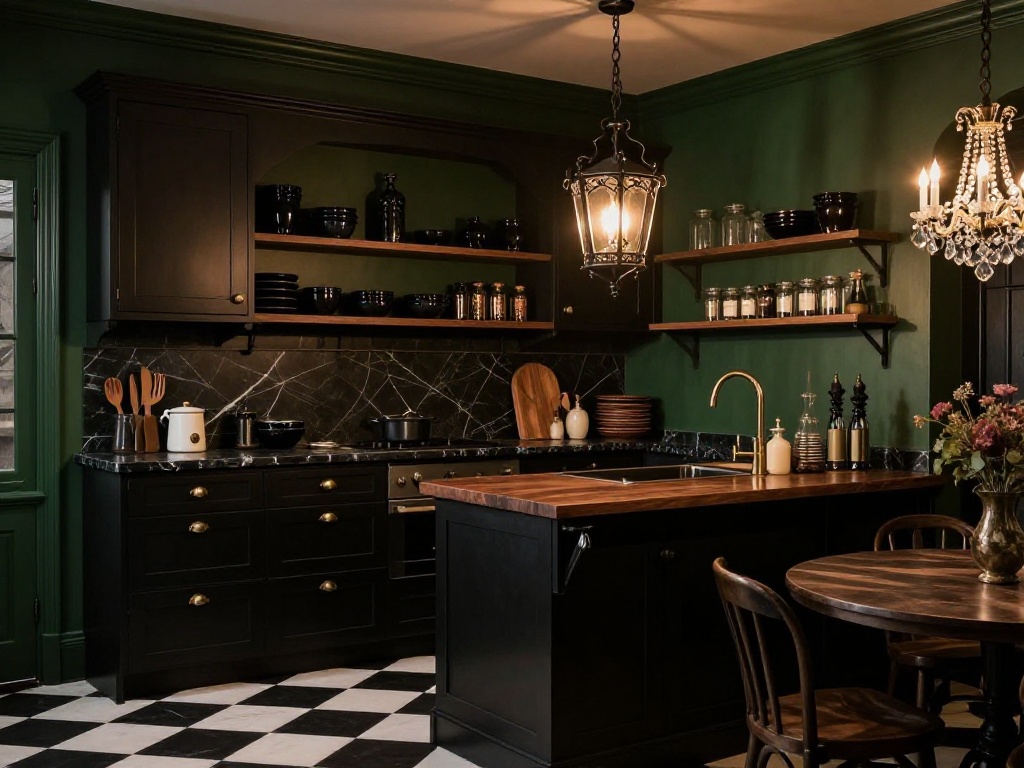
Deep forest green — perhaps the single most effective gothic kitchen wall colour. It reads as dramatic and unusual without feeling as stark as black. Against dark wood or black cabinetry it creates a richly gothic atmosphere; against lighter cabinetry it creates a more unexpected, sophisticated effect.
Deep navy — a slightly warmer and more liveable alternative to black that still achieves significant dark atmosphere. Works particularly well in kitchens with gold or brass hardware.
Deep burgundy — the most romantic gothic kitchen wall colour, referencing Victorian interiors directly. Works best in smaller kitchens where the warmth of the colour prevents it from feeling oppressive.
Cabinetry Colours
If your budget allows for cabinet painting or replacement, the cabinetry colour is the single most impactful change in a gothic kitchen.
Black — the most dramatic gothic cabinet choice. Flat or satin finish rather than gloss. Pairs with almost any countertop material and immediately establishes the aesthetic.
Dark forest green — one of the most sophisticated gothic kitchen choices. Green cabinets with black ironwork hardware create a richly Victorian atmosphere.
Deep navy — increasingly popular in contemporary gothic kitchen design. Navy cabinetry with brass hardware creates a warm, layered effect.
Dark charcoal grey — slightly softer than pure black but still dramatic. Works well as a more versatile starting point if you are uncertain about committing to full black cabinetry.
You can also read Minimalist Room Ideas That Feel Cozy, Calm & Beautiful in 2026
Gothic Kitchen: Permanent and Semi-Permanent Elements
Countertops
Black granite or dark marble — the most gothic countertop material. The natural veining of dark marble (particularly black marquina marble with white veining) creates a surface that feels both luxurious and slightly geological.
Soapstone — a dark, slightly matte natural stone with a quality of genuine age and depth. Develops a patina over time that makes it feel more authentically gothic with every passing year.
Dark slate — the most architecturally gothic countertop material, referencing the stone of medieval buildings directly. Works particularly well in cottage-style gothic kitchens.
Butcher block in dark walnut — for kitchens that lean toward the boho goth or vintage goth sub-styles, a dark walnut butcher block countertop adds warmth and organic quality.
You can use our Free Renovation Tool for your styling and decoration.
Hardware
Cabinet hardware is one of the most cost-effective and impactful gothic kitchen upgrades — a complete hardware replacement typically costs £30–£100 and transforms the feel of existing cabinets entirely.
Black iron — the most medieval and most dramatic hardware choice. Simple black iron cup pulls, ring pulls, and bar handles.
Antique brass — warm, aged brass hardware works beautifully in Victorian gothic and vintage goth kitchens. The slightly tarnished quality is part of the appeal.
Wrought iron with ornate details — hardware with gothic arch details, gargoyle-shaped pulls, or ornate scrollwork designs. These are available from specialist hardware retailers and on Etsy.
Aged bronze — a middle ground between brass and iron, with a warm brown-toned finish that works in most gothic kitchen sub-styles.
Flooring
Black and white chequerboard tile — the most theatrical gothic kitchen floor treatment. References Victorian and Edwardian tile traditions directly and creates an immediately period-appropriate atmosphere.
Dark slate or stone tile — the most genuinely gothic flooring option, referencing the stone floors of medieval buildings.
Dark hardwood — ebony-stained or very dark walnut hardwood floors add warmth and organic quality to a gothic kitchen.
Encaustic cement tiles — Victorian-pattern encaustic tiles in dark colour combinations (black and terracotta, navy and cream, forest green and white) are one of the most distinctly historical flooring choices available.
You can also read 80s Room Aesthetic Ideas
Lighting
Lighting in a gothic kitchen needs to serve two functions simultaneously — providing adequate task lighting for cooking and creating the atmospheric, layered quality that gothic design requires.
Wrought iron chandeliers or pendant lights above the island or dining table. These provide ambient light with a period-appropriate silhouette. Pair with warm-toned bulbs (2700K or lower) rather than cool white.
Sconce lights on walls in black metal or aged brass with flame-style bulbs. These provide supplementary ambient light with a candle-like quality.
Under-cabinet LED strips in warm white for task lighting. These are purely functional but keep the countertop workspace bright without affecting the atmospheric overhead lighting.
A dramatic range hood — a large, black or dark metal range hood with ornate detailing can become a statement piece in a gothic kitchen in the way that a chandelier is in a living room.
Gothic Kitchen: Renter-Friendly Transformations
If you rent or cannot make permanent changes, these reversible approaches create significant gothic atmosphere without touching the structure of the kitchen.
Paint the walls — in most rental agreements, walls can be repainted as long as they are returned to their original colour on leaving. A single tin of deep forest green or charcoal paint on one kitchen wall costs £15–£25 and creates immediate atmosphere.
Replace hardware — cabinet hardware can almost always be replaced and the originals stored for reinstallation when you leave. This is the highest-impact low-cost change available in any rental kitchen.
Add open shelving — freestanding shelving units placed against a wall (rather than wall-mounted) require no fixing and can display gothic accessories, dark ceramics, and apothecary-style storage beautifully.
Change the light fitting — in most rentals, pendant lights and ceiling fixtures can be switched for gothic alternatives (stored safely and reinstalled on departure). A single wrought iron pendant light above the kitchen table costs £20–£60 and transforms the atmosphere entirely.
Cover appliances with accessories — toasters, kettles, and small appliances in black or dark finishes are widely available and replace standard white or chrome appliances for very little cost.
Use dark accessories throughout — dark ceramic dishes on open display, gothic-style storage jars, black or dark copper cookware hung on a rail, and a collection of gothic-themed herbs and botanicals in dark ceramic pots all work within any rental kitchen.
You can also use our Free Tool for Styling and Decorating Tips
Gothic Dining Room Decor
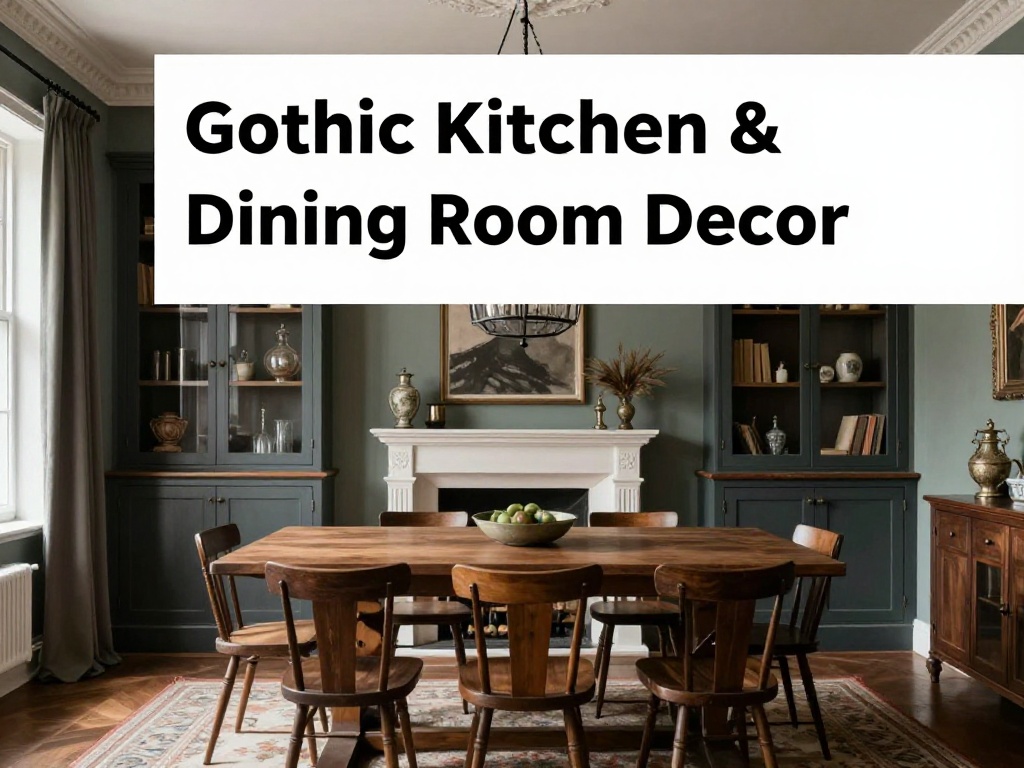
The dining room is arguably the most naturally gothic of all domestic spaces — because it is built around ritual. The gathering, the table setting, the lighting, the sharing of food and drink. All of these have a ceremonial quality that the gothic aesthetic celebrates rather than suppresses.
The Gothic Dining Table
The dining table is the centrepiece of the gothic dining room and deserves the most careful attention.
A long dark wood refectory table — referencing the great hall tables of medieval monasteries and manor houses, a long, dark-stained oak or walnut table with simple turned or carved legs is the most dramatically gothic dining furniture choice. These are available new from specialist furniture retailers and increasingly widely available second-hand.
A round dark wood table — for smaller dining rooms, a round table in dark walnut or ebony with carved or ornate leg details creates an intimate, slightly witchy atmosphere. The round table also has the advantage of feeling more inclusive and less hierarchical than a rectangular one.
A dark marble or stone-topped table — a table with a dark marble or slate top and a dark metal or ornate wood base. These are more contemporary in their design language but fit within the modern gothic sub-style.
A glass-topped table with a dark ornate base — the transparency of the glass creates a floating quality that contrasts interestingly with a dramatically ornate dark metal or carved wood base.
Gothic Dining Chairs
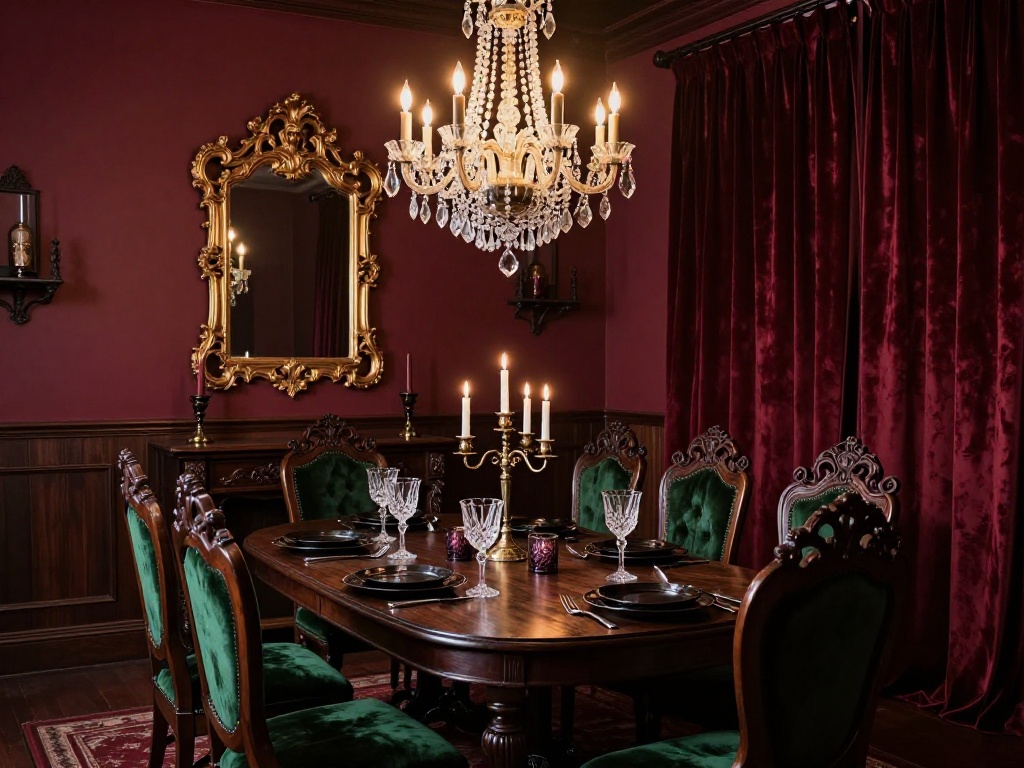
High-backed carved wood chairs with velvet upholstered seats in deep jewel tones — burgundy, forest green, midnight navy, or black. These reference gothic throne furniture directly and create an immediately theatrical dining room atmosphere.
Velvet upholstered dining chairs in deep colours — without the carved wood element, a set of velvet dining chairs in a jewel tone creates a richly gothic dining atmosphere that is also genuinely comfortable.
Black metal chairs with leather or velvet seats — for a more modern gothic dining room, black metal frame chairs with dark leather or velvet seats combine period-appropriate materials in a cleaner contemporary silhouette.
Mixed chairs — deliberately mixing chair styles (some carved wood, some velvet, perhaps a velvet bench on one side) creates an eclectic, accumulated quality that fits the boho goth and vintage goth sub-styles particularly well.
You can also read Pastel Goth, Boho Goth, Glam Goth & Vintage Goth Home Decor: The Complete Sub-Style Guide
Gothic Dining Room Wall Decor
A large ornate mirror above a sideboard or fireplace — the single most impactful gothic dining room wall piece. Dark gold or carved black frame. The larger the better.
Dark oil painting reproductions — a large landscape or figurative painting in a heavy gilded frame on the main wall creates the atmosphere of a manor house dining room immediately.
A gallery wall of mirrors and dark art — mixing ornate mirrors, dark art prints, and architectural drawings on one wall creates a richly layered visual backdrop for the dining table.
Gothic wallpaper on one feature wall — a damask, floral, or gothic architectural pattern in deep tones on the wall behind the dining table creates an instant dining room transformation.
Antlers and natural history displays — a set of antlers mounted on a wall, a collection of framed botanical or entomological specimens, or a taxidermy piece displayed in a prominent position adds the natural history quality that appears throughout gothic dining room design.
Gothic Table Setting: The Dining Experience
The gothic dining room is not just about how the room looks when empty — it is about how the table looks when set. The table setting is where the gothic dining aesthetic achieves its most directly theatrical quality.
Gothic Tableware
Dark ceramic plates — matte black, deep midnight blue, or dark forest green ceramic dinner plates. These are available from independent ceramicists on Etsy and from several mainstream retailers including H&M Home, Zara Home, and Amazon.
Crystal glassware — cut crystal wine glasses, goblets, and water glasses that catch candlelight and create the slightly theatrical quality of a formal gothic dinner. Coloured crystal — deep red, amethyst, or midnight blue — is particularly effective.
Gothic-styled cutlery — antique-effect silver cutlery with ornate handle details, or matte black cutlery for a more modern gothic aesthetic.
Black linen napkins — or deep jewel-toned linen in burgundy, forest green, or midnight navy. Napkin rings in antique brass or black iron.
Dark serving pieces — black cast iron serving dishes, dark ceramic serving bowls, and gothic-styled serving utensils.
Candles and Table Centrepieces
Candles are the single most transformative element of a gothic table setting. They provide the warm, flickering light that changes the quality of every meal.
A candelabra centrepiece — a tall wrought iron or brass candelabra with multiple arms, holding black, burgundy, or cream taper candles, placed at the centre of the table.
A cluster of pillar candles — different heights of pillar candles in black, dark burgundy, or cream arranged in a grouping on a dark slate or wooden board. Place crystals, dried rose petals, or small decorative skulls between them.
Dried floral centrepieces — dried black roses, dried dark dahlias, preserved eucalyptus, and dried pampas grass in a dark ceramic or glass vase alongside the candles.
Gothic seasonal centrepieces — pomegranates, dark apples, and exotic fruits arranged on a dark board with candles for autumn and winter. Trailing dark botanical displays for spring and summer.
The Gothic Drinks Situation
The gothic dining room takes its drinks as seriously as its decor. A collection of decanters in dark glass or cut crystal displayed on a sideboard. Gothic-styled wine glasses with black stems. A carved wooden wine rack as a decorative and functional piece. Apothecary-style decanters for spirits. These details are small but they contribute significantly to the sense that the gothic dining room is a complete world.
Gothic Kitchen Accessories: The Details That Matter
Beyond the structural elements, these accessories transform an ordinary kitchen into a gothic one regardless of the cabinetry or countertop colour.
Apothecary jars and storage — tall clear glass jars with dark labels and cork lids for storing dry goods (pasta, grains, tea, coffee, herbs). These reference the apothecary tradition that appears throughout gothic and witchy aesthetics and transform functional kitchen storage into decorative displays.
Dark cookware on display — a collection of black cast iron or dark copper cookware hung on a wall rail or displayed on open shelving. Le Creuset in black, cast iron skillets, and dark copper pots all look genuinely beautiful on display.
Gothic herb collection — small ceramic or glass pots of growing herbs displayed on a windowsill, ideally in dark or terracotta pots with handwritten labels. Rosemary, lavender, sage, and thyme all have associations with gothic and witchy traditions that add to the atmosphere.
A gothic clock — a large, ornate wall clock in black metal or dark bronze as a kitchen or dining room wall feature. The clock references the gothic preoccupation with the passage of time and adds a strong decorative element.
Dark botanical prints — framed Victorian botanical illustrations, dark floral prints, or mushroom and fungi illustrations in black frames on the kitchen or dining room walls.
Skull accessories — a ceramic skull used as a kitchen accessory (as a garlic holder, a pot plant, or a display object) adds a direct gothic motif without overwhelming the space.
Where to Shop
Amazon — dark ceramic tableware, black cast iron cookware, gothic candelabras, wrought iron hardware, apothecary jars, black LED candles, dark pendant lights, and gothic wall clocks.
Etsy — handmade dark ceramic plates and serving pieces, custom gothic tableware, ornate hardware in unusual designs, gothic botanical prints, crystal glassware, and handmade candelabras.
eBay and antique markets — genuine Victorian and antique dining furniture, crystal glassware, antique cutlery sets, ornate mirrors, and decanters at much lower prices than reproductions.
H&M Home and Zara Home — regularly stock dark ceramic tableware, matte black accessories, and gothic-influenced homeware at accessible prices.
Wayfair — gothic dining room furniture, dark kitchen cabinetry, chandeliers, and pendant lighting in appropriate styles.
Specialist hardware retailers — for ornate black iron and antique brass cabinet hardware. Etsy is also excellent for unusual hardware designs.
Final Thoughts
The gothic kitchen and dining room are the rooms where the aesthetic proves its depth — because they have to work as hard as they look. The kitchen where you cook every night and the dining table where you eat every meal cannot be purely theatrical. They have to be genuinely functional.
The best gothic kitchens and dining rooms achieve both without compromise. The dark cabinetry is as practical as any other. The cast iron cookware works better than most alternatives. The crystal glasses hold wine just as well as any other glasses. The candelabra centrepiece is as good at illuminating a table as any other light source.
Start with the hardware — it costs almost nothing and has an immediate impact. Then the wall colour. Then the lighting. Build from there. The gothic kitchen and dining room are not destinations you arrive at in a single weekend. They accumulate over time, like the best gothic spaces always do.
🔗 Continue building your gothic home with our gothic living room decor guide, and our complete goth home decorating guide.