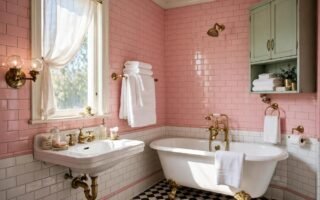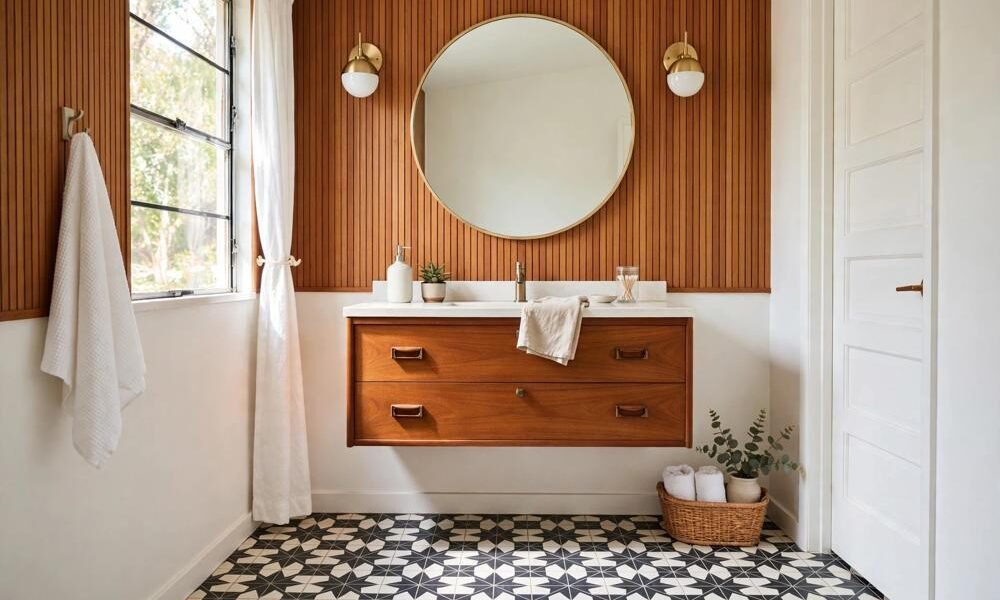
Mid-century modern style, clean lines, warm wood, simple shapes and a little geometric pattern, suits a small bathroom beautifully. It adds character without clutter, and it works on a budget, because the look is about simple, well-chosen pieces, not about expensive period fixtures. Here is how to get a mid-century modern bathroom in a small space.
Key takeaways
- True mid-century features: floating vanities, warm wood tones, simple lines, geometric tile, and clean, uncluttered surfaces.
- In a small bathroom, a floating vanity is the best mid-century hero, because it shows more floor and makes the room feel bigger.
- Keep the palette warm and simple: warm wood, white, cream, and one accent, such as teal, mustard or terracotta.
- Geometric tile is a mid-century signature, but use it on one surface only, floor or one wall, not everywhere.
- Budget mid-century is about simple pieces, a wooden vanity, a round mirror, a geometric rug, rather than a full renovation.
1. What Makes a Bathroom Mid-Century Modern?
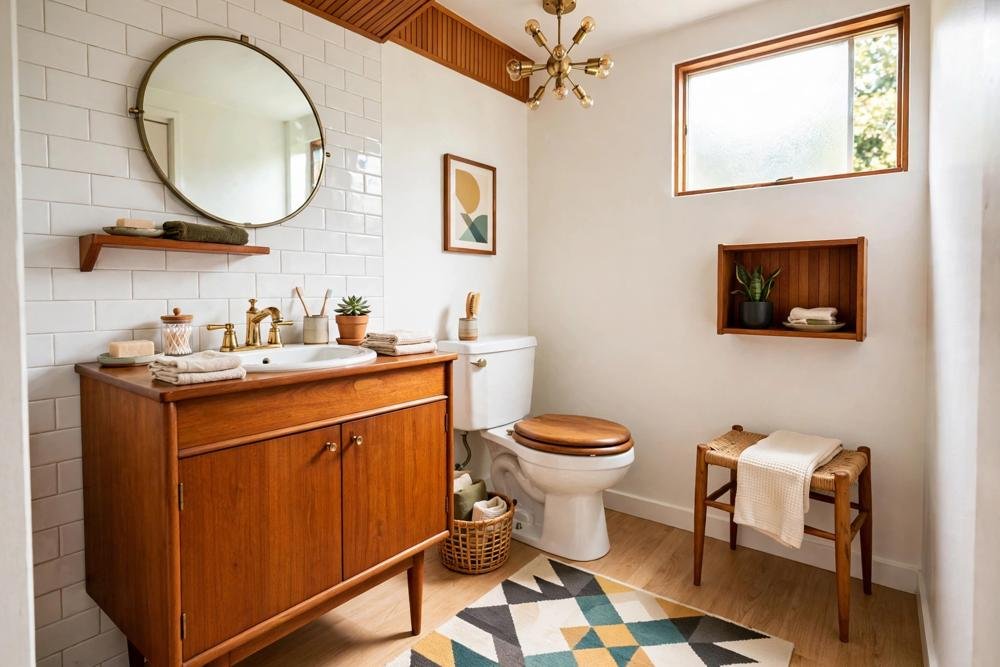
Mid-century modern design, from roughly the middle of the twentieth century, is known for simple lines, organic shapes, warm wood, and a connection to nature, with large windows and natural materials where possible. In a bathroom, that translates to a floating or simple wooden vanity, clean-lined fixtures, geometric tile, a round or oval mirror, and warm wood accents, rather than ornate or fussy details.
It is different from other retro styles. It is not the pastel fixtures of the 1950s, the florals of grandmillennial style, or the dark colours of a moody vintage bathroom. Mid-century is calmer, cleaner and more modern-feeling, which is why it suits a small bathroom so well: it adds style without adding visual weight.
2. The Floating Vanity: The Best Small-Bathroom Hero
A floating vanity, a vanity that hangs on the wall without legs reaching the floor, is the signature mid-century bathroom piece, and it is perfect for a small bathroom, because it shows more floor, which makes the room feel bigger and easier to clean.
Choose a simple wooden vanity, teak or a warm wood-look, with clean lines and simple handles, rather than ornate carving or fussy details. A single drawer or two, plus a simple open shelf underneath, gives storage without bulk. Pair it with a simple white sink, either a countertop basin or an undermount sink, and a simple modern tap in chrome or brushed brass.
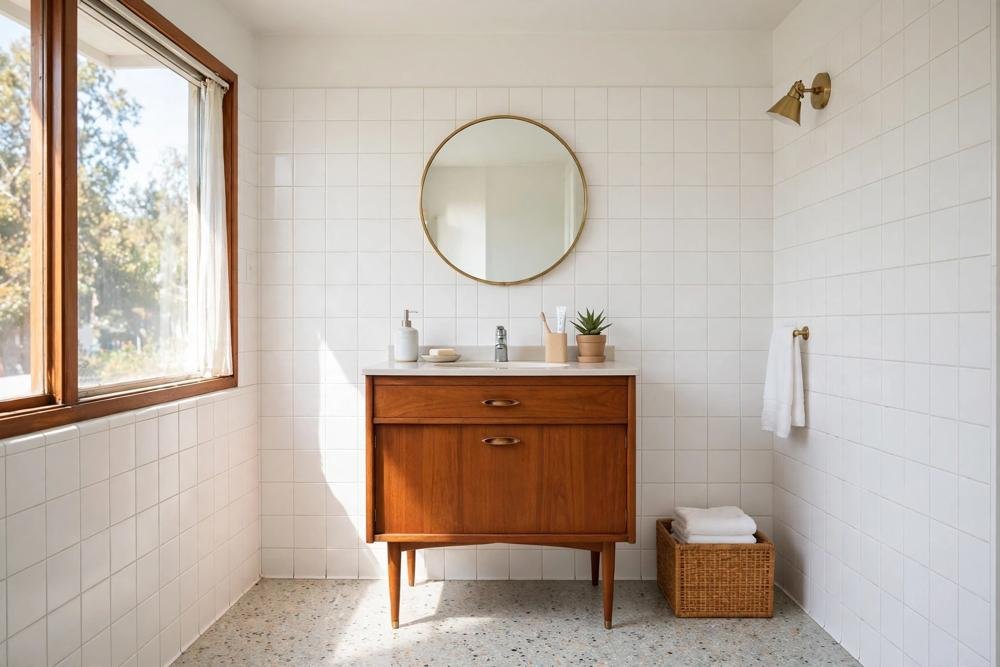
If a floating vanity is not possible, because of plumbing or wall strength, a simple wooden vanity with slim, tapered legs gives a similar feeling, with the floor still partly visible. Check the wall and plumbing before you buy a floating vanity, because it needs a strong wall fixing and plumbing that fits the wall-hung design.
3. Wood Tones: Warm, Not Dark
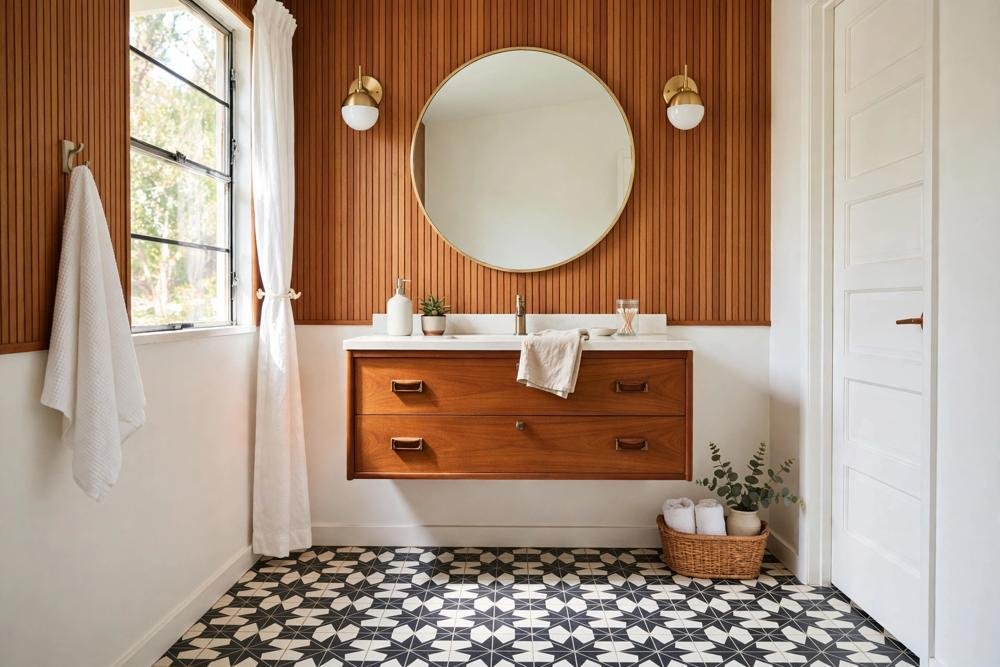
Warm wood is essential to mid-century style. Teak, walnut, and warm oak are the classic choices, used for the vanity, a mirror frame, a shelf, or a small stool. The wood should be warm and medium-toned, not very dark and not pale and washed out.
Use wood in one or two places only, so it reads as an accent, not as a wood-panelled room. A teak vanity plus a wooden mirror frame is enough. A teak vanity plus wooden walls plus a wooden floor plus wooden accessories is too much, especially in a small bathroom.
If real teak is out of budget, a warm wood-look vanity, a wooden mirror frame, or a small wooden shelf gives the same warmth for less. And if you have a wooden vanity, keep the rest of the room simple, white tile, plain towels, simple fixtures, so the wood can lead.
4. Geometric Tile: One Surface Only
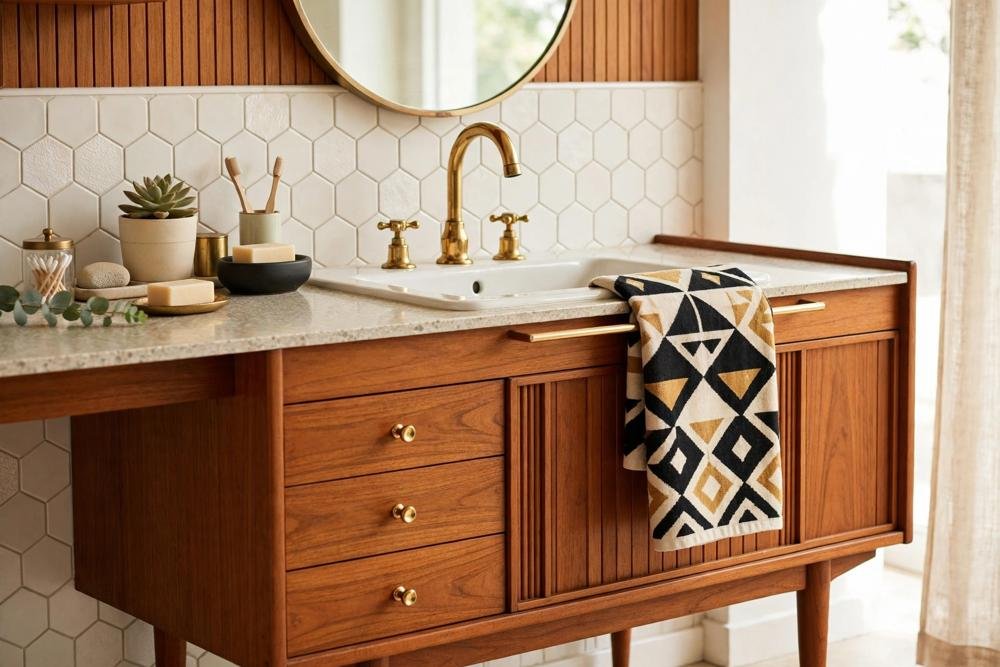
Geometric tile, hexagons, small squares, or simple patterned tile, is a mid-century signature. It adds pattern and energy without needing a lot of colour, and it suits a small bathroom because it can be used on the floor, where it does not overwhelm the walls.
Use geometric tile on one surface only: the floor, or one accent wall, not both. A hex floor tile with plain white wall tile is classic mid-century. A patterned wall tile with a plain floor is also good. A patterned floor plus a patterned wall plus a patterned curtain is too much.
For a budget version, peel-and-stick geometric tile on the floor, or a geometric rug over plain flooring, gives the mid-century pattern without real tile work. And for renters, a geometric shower curtain or a geometric towel set can carry the pattern reversibly.
5. Simple Lines and Clean Surfaces
Mid-century style is about simple lines and clean surfaces, not about many small accessories. Keep the counter tidy, with only everyday items out, and store the rest in the vanity or on a simple shelf. A round or oval mirror, with a simple wooden or brass frame, suits mid-century better than a very ornate or very modern frameless mirror.
Lighting should be simple too: a pair of simple wall lights, a simple pendant, or a round globe light, with warm bulbs. Avoid very fussy light fittings, because they fight the clean mid-century lines.
Towels should be plain or in one simple accent colour, teal, mustard, terracotta or soft green, rather than patterned or floral, so the geometric tile and the wood can lead. And the shower curtain, if you have one, should be plain or geometric, not floral, to keep the mid-century feeling.
6. Small-Bathroom Layouts That Work
Mid-century style helps a small bathroom feel bigger, if the layout is kept simple. A floating vanity, a large mirror, and a light palette, white, cream and warm wood, make a small room feel open. Keep the floor as clear as possible, and avoid bulky furniture that blocks the floor.
If your bathroom is very small, choose a compact floating vanity, a round mirror, and a single geometric accent, such as the floor tile, and keep everything else white and simple. If your bathroom is a little larger, you can add a small wooden stool, a simple shelf, and a plant, but keep the surfaces tidy, because mid-century style is about calm, not clutter.
A walk-in shower with simple glass, rather than a bulky curtain or a heavy frame, also helps a small mid-century bathroom feel open. And a light, warm palette, rather than a dark one, keeps a small room bright.
7. Budget Mid-Century: Simple Pieces, Big Effect
Mid-century style does not need a renovation. Here is a budget version that gives the look with simple pieces.
A wooden vanity or a wooden mirror frame, a round mirror, a geometric rug or shower curtain, plain towels in one accent colour, and a simple plant, give the mid-century feeling for a modest spend. A floating vanity is the biggest single spend, but a wooden shelf, a wooden stool, or a wooden mirror frame can give the warm wood feeling for less.
Save the bigger spends, real tile work, a new vanity, or a fixture swap, for later, once you know you love the style. The budget version is also a good test: if you enjoy living with the simple lines and warm wood, the fuller version will suit you.
8. Colour: Warm Wood, White, and One Accent
The mid-century palette is warm and simple: warm wood, white, cream, and one accent colour. Good accents are teal, mustard, terracotta, soft green, or warm orange, used on towels, a rug, or a small accessory, not on every surface.
If your hero is geometric tile, keep the accent colour from the tile, and keep towels and curtains plain. If your hero is a teak vanity, keep the tile plain and use one accent on towels or a rug. One accent, plus warm wood and white, is the mid-century palette. Three accents plus wood plus pattern is too much.
Avoid very cool white with warm wood, because it can look harsh. A warm white or cream works better with teak and walnut, and it keeps a small bathroom feeling warm rather than clinical.
What to Avoid
- Do not use ornate or fussy details. Mid-century is about simple lines, not carving, ruffles or heavy ornament.
- Do not use geometric tile on every surface. One surface, floor or one wall, is the rule.
- Do not use three accent colours at once. One accent, plus warm wood and white, is balance.
- Do not crowd a small bathroom with many accessories. Mid-century style is calm, not cluttered.
- Do not buy a floating vanity without checking wall strength and plumbing first.
- Do not mix mid-century with five other retro styles at full strength. One style as the lead, with simple modern basics, is the way.
Costs: Three Mid-Century Budgets
Prices are estimates only and vary by location and product choice. Check current prices before you buy.
Under $150: a round mirror, a geometric rug or shower curtain, plain towels in one accent colour, and a small wooden accessory. This gives the mid-century feeling with no renovation.
Under $500: add a wooden vanity or a wooden mirror frame, a simple shelf, and peel-and-stick geometric tile if you want it. This is where the room starts to look planned in mid-century style.
Over $500: add a floating vanity, real geometric tile, or a fixture swap, with professional help where needed. This is a renovation, and it needs wall, plumbing and floor checks before you start.
Conclusion
A mid-century modern bathroom works in a small space because it is simple, warm and uncluttered: a floating or simple wooden vanity, warm wood tones, simple lines, geometric tile on one surface, and a calm palette of wood, white and one accent. Keep the counter tidy, use a round mirror and simple lighting, and let the wood and the geometry lead. Start with a wooden mirror frame, a geometric rug and plain towels in one accent colour, live with them for a few weeks, and only add the bigger pieces once you know the style suits your room. The result is a bathroom that feels timeless, calm and genuinely modern, not a period set.
FAQs
What is a mid-century modern bathroom?
A mid-century modern bathroom uses simple lines, warm wood, floating vanities, geometric tile and clean surfaces, in a warm palette of wood, white and one accent colour. It is calmer and cleaner than other retro styles, which makes it well suited to small bathrooms.
Is mid-century style good for a small bathroom?
Yes. A floating vanity shows more floor and makes the room feel bigger, simple lines keep the room calm, and geometric tile on one surface adds character without taking up space. Keep the palette light and the surfaces tidy for the best small-room effect.
What is a floating vanity, and is it practical?
A floating vanity hangs on the wall without legs reaching the floor, which shows more floor and makes cleaning easier. It needs a strong wall fixing and plumbing that fits the wall-hung design, so check the wall and plumbing before you buy one.
What colours suit a mid-century bathroom?
Warm wood, white and cream, plus one accent, such as teal, mustard, terracotta or soft green. Use the accent on towels, a rug or a small accessory, not on every surface, and use a warm white rather than a very cool white with warm wood.
Can I do a mid-century bathroom on a budget?
Yes. A round mirror, a geometric rug or shower curtain, plain towels in one accent colour, and a small wooden accessory give the mid-century feeling for a modest spend. A wooden mirror frame or shelf gives warm wood for less than a full vanity.
What tile suits a mid-century bathroom?
Geometric tile, hexagons, small squares or simple patterns, on one surface only, the floor or one wall, with plain tile elsewhere. For a budget or rental version, peel-and-stick geometric tile, a geometric rug, or a geometric shower curtain gives the pattern reversibly.