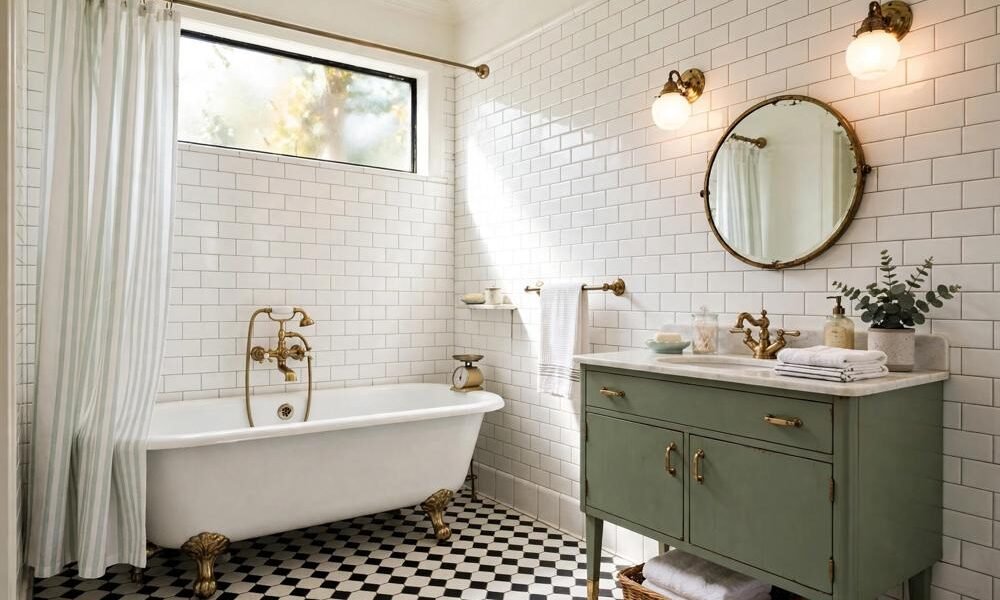
Tile is what makes a bathroom feel retro, more than any other single feature. The pattern, the size, and the colour of the tile tell you the era at a glance, from white subway tile in the 1920s to patterned floors in the 1970s. Here are the retro bathroom tile patterns by era, the budget alternatives, and an honest look at peel-and-stick tile in wet areas, plus where to buy.
Key takeaways
- Each retro tile pattern belongs to an era: subway and hex in the 1920s, penny and basketweave in the 1930s, pastel in the 1950s, pattern in the 1960s and 1970s.
- Use one tile pattern as the lead, and keep the other surfaces plain, so the room does not feel busy.
- Peel-and-stick tile is a good budget and rental option for floors and dry walls, but it is not a long-term solution in direct wet areas, such as inside a shower.
- Real tile lasts longer in wet areas, but it costs more and usually needs a professional, especially on floors.
- Before you buy tile, measure, order a sample, and check the grout colour, because grout changes how tile looks more than most people expect.
1. How to Choose a Retro Tile Pattern
Start with the era you love, then choose the pattern that belongs to it. A 1920s bathroom with 1970s patterned tile will look mixed up, while a 1920s bathroom with white subway tile and a black-and-white hex floor will look intentional.
Next, consider where the tile will go. Floors can handle pattern and colour well, because they are seen from above and they ground the room. Walls should usually be calmer, with one patterned wall at most, because patterned walls on every side can overwhelm a small bathroom.
Finally, consider cleaning. Small tiles, penny and hex, have more grout lines, which means more cleaning and more grout to seal. Larger tiles, subway and square, have fewer grout lines and are easier to keep clean. If you love small tile, choose a grout colour close to the tile colour, so dirt shows less, and seal the grout well.
2. Subway Tile: The 1920s Classic
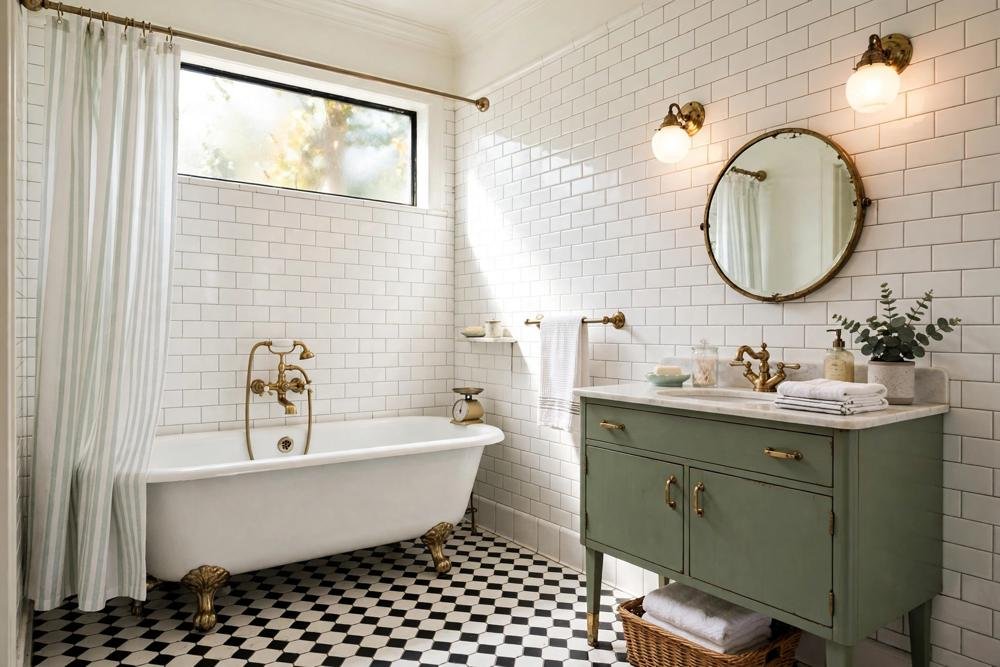
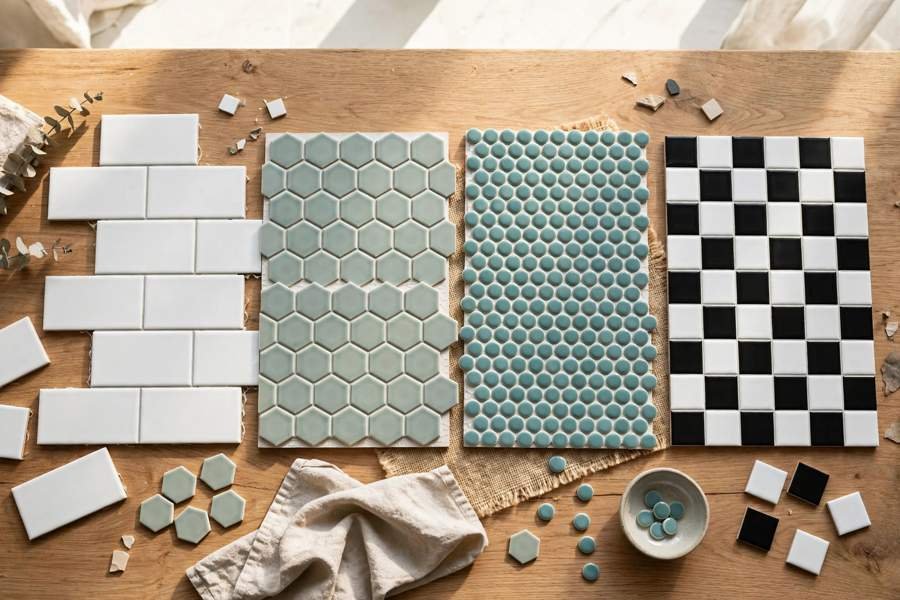
Subway tile, a rectangular tile, usually white, laid in a brick pattern, is the classic 1920s bathroom tile. It is clean, bright, and it suits almost any bathroom today, because it is simple and timeless.
Use subway tile on walls, especially in a shower or around a tub, with a contrasting grout, dark grey or black, for a classic look, or a matching grout, white, for a calmer look. Pair it with a hex or checkerboard floor, white fixtures, and nickel fittings for a full 1920s feeling.
Subway tile is widely available, in real ceramic and in peel-and-stick versions, and it is usually affordable, which makes it a good choice for a budget retro bathroom. It is also easy to clean, because it has fewer grout lines than small mosaic tile.
3. Hex and Penny Tile: Small, Classic, and Textured
Hex tile, small six-sided tiles, and penny tile, small round tiles, are classic retro floor tiles, from the 1920s and 1930s. They add texture and pattern to a floor, without needing colour, because the small shapes themselves create the pattern.
Use hex tile in white, black, or a black-and-white mix, for a classic floor. Use penny tile in white, or in a soft pastel, for a softer, more playful floor. Both work well in small bathrooms, because small tile suits small floors and does not need to be cut as much as large tile.
The trade-off is grout. Small tiles have many grout lines, which need sealing and regular cleaning. Choose a grout colour close to the tile, seal it well, and use a grout cleaner regularly, so the floor stays fresh. For a budget version, peel-and-stick hex tile exists, but it is best on a dry floor area, not inside a shower, as explained in section 6.
4. Checkerboard and Basketweave: Bold Pattern, Simple Colours
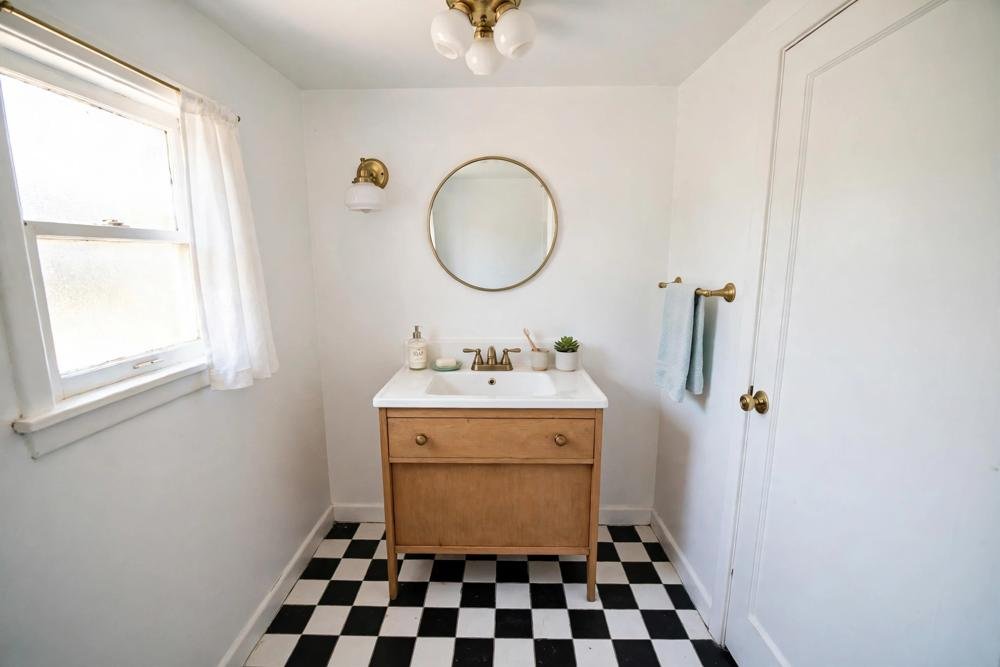
Checkerboard tile, alternating black and white squares, is a bold retro floor pattern, from the 1920s and again in later decades. It is dramatic, graphic, and it suits a bathroom with plain walls and simple fixtures, because the floor is the pattern.
Basketweave tile, small rectangles woven in a basket pattern, is a softer retro pattern, from the 1920s and 1930s. It adds texture without a bold colour contrast, and it suits a bathroom where you want pattern but not drama.
Use checkerboard on the floor with plain white walls, or basketweave on the floor with plain subway walls. Do not use checkerboard on the floor plus a patterned wall plus a patterned curtain, because that is too much pattern at once. One bold pattern, and the rest plain, is the rule.
5. Pastel and Patterned Tile: 1950s to 1970s
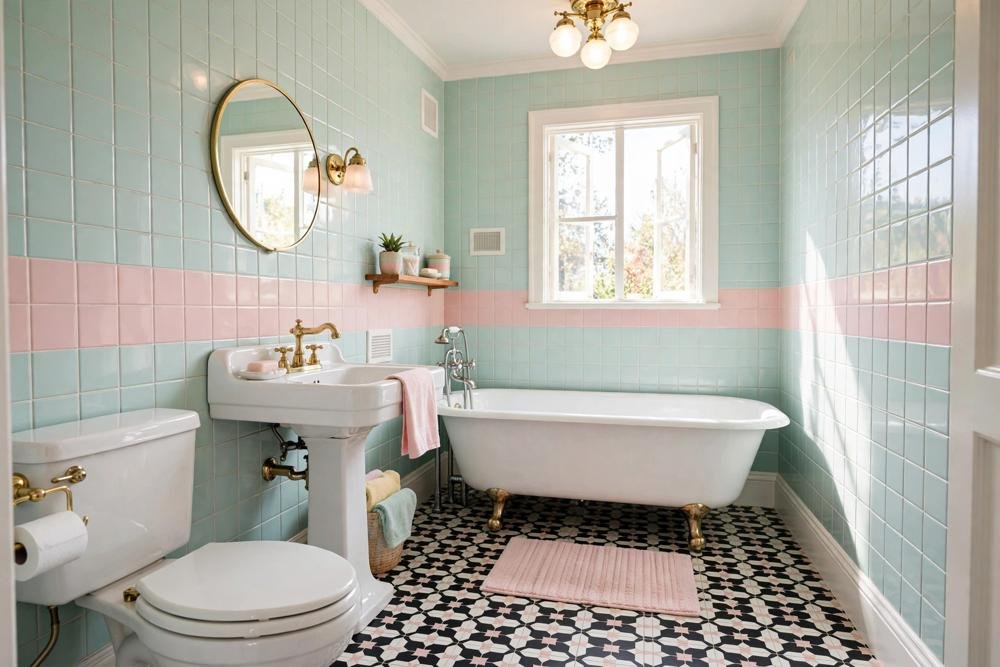
Pastel tile, pink, mint and aqua, is the 1950s retro tile, used on walls and sometimes on fixtures. Patterned tile, bold geometric or floral patterns, is the 1960s and 1970s retro tile, used on floors and sometimes on one wall.
If you have original pastel tile, keep it and match your paint and towels to it, rather than replacing it, because original pastel tile is hard to recreate and it gives the room its character. If you are choosing new tile, use pastel tile on one wall or as an accent, with plain white tile elsewhere, so the pastel does not overwhelm the room.
Patterned tile should also be used on one surface only: the floor, or one wall, not both. A patterned floor with plain walls is classic. A patterned wall with a plain floor is also good. A patterned floor plus a patterned wall is too much, especially in a small bathroom.
6. Peel-and-Stick Tile: Honest Advice for Wet Areas
Peel-and-stick tile is a popular budget and rental option, because it is cheap, easy to apply, and reversible. It works well on floors in dry areas, on walls away from direct water, and as a temporary refresh, for example in a rental bathroom.
It does not work as well in direct wet areas, and it is important to be honest about that. Inside a shower, around a tub where water splashes constantly, or on a floor that stays wet, peel-and-stick tile can peel, lift at the edges, trap moisture underneath, and need replacing sooner than real tile. It can last a few months to a couple of years in a dry area, but in a wet area it may last weeks to months, depending on the product, the surface preparation, and how much water it gets.
To make peel-and-stick last longer, clean and dry the surface well before applying, press firmly and seal the edges, keep it away from direct shower spray, and wipe up standing water quickly. For a shower wall or a shower floor, real tile, properly grouted and sealed, is the better long-term choice, even though it costs more.
For renters, peel-and-stick tile is still useful, because it is reversible and it does not damage the underlying tile if applied and removed carefully. Just use it where it will last, floors and dry walls, and accept that it is a temporary refresh, not a permanent renovation.
7. Where to Buy Retro Tile
Retro tile is available from several types of shops, and the best choice depends on your budget and whether you need real tile or peel-and-stick.
Tile shops and home improvement stores carry real subway, hex, penny, checkerboard and pastel tile, in a range of sizes and colours, and they usually have samples you can take home. Online tile shops carry a wider range, including vintage patterns and colours, and they often sell samples by post, which is useful if your local shop has a limited range.
Peel-and-stick tile is available from home improvement stores and online marketplaces, in subway, hex, checkerboard and patterned designs. Check the size, the material, the reviews, and the return policy before you buy, because peel-and-stick quality varies a lot.
For original vintage tile, salvage shops, architectural salvage yards, and online second-hand marketplaces sometimes have original tile, but quantities are limited, colours vary, and matching an existing floor can be hard. If you need a lot of tile, new tile in a vintage pattern is usually more practical than salvage.
No specific shop or product is recommended here, because stock, prices and quality change often. Compare samples, check the size and colour in your bathroom light, and buy from a shop with clear returns, especially for online orders.
8. Grout, Sealing and Maintenance
Grout colour changes how tile looks. A dark grout on white subway tile gives a classic, graphic look. A matching grout gives a calmer, more seamless look. A light grout on a dark floor shows dirt more, while a grout close to the tile colour hides it better.
Seal grout well, especially on floors and in wet areas, and re-seal it periodically, because sealed grout resists stains and moisture better. Clean grout regularly with a grout cleaner, and avoid harsh chemicals that can damage the seal.
For peel-and-stick tile, there is no grout, but the edges need attention. Press edges firmly, seal them if the product allows it, and replace any tile that lifts, before moisture gets underneath. For real tile, check for cracked grout or loose tiles regularly, and repair them promptly, because a small crack can let water underneath and cause bigger problems.
What to Avoid
- Do not use two bold tile patterns at once. One pattern as the lead, and the rest plain, is the rule.
- Do not use peel-and-stick tile inside a shower or on a floor that stays wet, and expect it to last like real tile. It is a temporary, dry-area solution.
- Do not buy tile without a sample. Colour and size look different in your bathroom light than on a screen or in a shop.
- Do not forget grout. Grout colour, sealing and cleaning matter as much as the tile itself.
- Do not mix five decades of tile at once. Pick one era as your lead, and use its pattern.
- Do not buy a large quantity of tile without measuring first, including cuts and waste. Measure, add a little extra for cuts, and order a sample first.
Costs: Three Retro Tile Budgets
Prices are estimates only and vary by location, product choice, room size and labour. Check current prices before you buy.
Under $100: peel-and-stick tile for a floor or a dry wall, or a patterned rug over plain flooring, plus grout cleaner and sealant if needed. This gives a retro tile look with no professional labour.
Under $500: real tile for a small floor or one wall, with grout and sealant, if you can tile yourself or with help, or peel-and-stick tile plus a vanity or mirror update. This is where the room starts to look like a real retro tile bathroom.
Over $500: real tile for floors and walls, with professional tiling labour, grout, sealant and any floor preparation. This is a renovation, and it needs measuring, samples, and a quote before you start.
Conclusion
Retro bathroom tile is about choosing one pattern from one era, subway and hex for the 1920s, penny and basketweave for the 1930s, pastel for the 1950s, and bold pattern for the 1960s and 1970s, and using it on one surface, with plain surfaces around it. Peel-and-stick tile is a good budget and rental option for dry areas, but it is not a long-term solution in direct wet areas, where real tile, properly grouted and sealed, lasts longer. Measure, order a sample, check the grout colour, and buy from a shop with clear returns. The result is a bathroom floor or wall that feels retro on purpose, and that lasts.
FAQs
What is the most classic retro bathroom tile?
White subway tile on walls, with a black-and-white hex or checkerboard floor, is the most classic retro bathroom tile, from the 1920s. It is clean, bright, and it suits almost any bathroom today.
Does peel-and-stick tile work in a bathroom?
It works well on floors in dry areas and on walls away from direct water, as a budget or rental refresh. It does not last like real tile inside a shower or on a floor that stays wet, where it can peel and trap moisture. For wet areas, real tile is the better long-term choice.
What tile pattern suits a small bathroom?
Small tile, hex or penny, suits a small bathroom floor well, because it does not need much cutting, and it adds texture without a bold pattern. For walls, plain subway tile keeps a small bathroom bright, with one patterned surface at most.
How do I choose a grout colour for retro tile?
A dark grout on white subway tile gives a classic, graphic look. A matching grout gives a calmer look. A grout close to the tile colour hides dirt better on floors. Test a small area first, because grout colour changes how tile looks more than most people expect.
Where can I buy retro bathroom tile?
Tile shops and home improvement stores carry real subway, hex, penny and checkerboard tile, with samples to take home. Online tile shops carry a wider vintage range, with samples by post. Peel-and-stick tile is available from home improvement stores and online marketplaces. Compare samples and check returns before you buy.
Can I keep original vintage tile?
Yes, if it is in good condition. Keep original pastel or patterned tile, match your paint and towels to it, and repair grout rather than replacing the tile. Original tile is hard to recreate, and it gives the room its character.
RELATED READING:
- Retro Bathroom Ideas: 15 Ways to Get the Look in a Small Space: https://astheticdecor.com/retro-bathroom-ideas-small-space/
- How to Decorate Around Pink, Green or Yellow Vintage Bathroom Tile: https://astheticdecor.com/decorate-around-pink-green-yellow-vintage-tile/
- Retro Bathroom Colors: Palettes by Decade From the 1920s to the 1980s: https://astheticdecor.com/retro-bathroom-colors-palettes-by-decade/