A forest wall can change a whole room, in a day, without new furniture. A forest wallpaper, a mural or a painted forest scene, on one wall, will give depth, colour and a woodland feeling, while the rest of the room stays calm in cream, green and warm wood. The secret is to use one wall, not four, and to choose a pattern that suits the room size, light and furniture, rather than the biggest, darkest forest you can find.
Key takeaways
- Use forest wallpaper or a mural on one feature wall, not on all four walls, in most rooms.
- Light, airy forest patterns suit small, dark and north-facing rooms better than dark, dense forests.
- Peel-and-stick wallpaper is the best renter option, but only after a test patch and landlord permission where needed.
- A painted mural or a hand-painted forest scene suits a home you own, with time, skill and a clear plan.
- Match the wallpaper to furniture and textiles, with one green family, not a new green that fights the room.
- Keep the rest of the room calm, with plain bedding, curtains and rugs, so the wall can be the hero.
- Test any wallpaper or mural in daylight and in lamplight, on a large sample, before committing.
- A forest wall should be easy to live with, easy to clean and easy to remove or change, if tastes change.
1. One Wall, Not Four: How to Choose the Feature Wall
The feature wall should be the wall you see first, or the wall behind the main furniture, such as the wall behind a bed, a sofa or a dining table. A forest wall behind a bed, with cream bedding and a wooden headboard, will feel like a woodland bedroom, while a forest wall behind a sofa, with cream cushions and a wooden table, will feel like a woodland living room. A forest wall on a wall with a door, a window or a radiator will be broken up and hard to enjoy, so choose a plain, unbroken wall if you can.
In a small room, one forest wall is enough, and it should be the wall that is furthest from the window, so light can bounce off it, rather than the wall next to the window, which will be in shadow. In a large room, one forest wall can be balanced by cream walls, a light rug and warm lamps, so the room does not feel like a forest set. A forest wall should be a wall you enjoy looking at every day, not a wall that only suits a photo, so choose a wall that is part of everyday life, not a wall that is hidden.
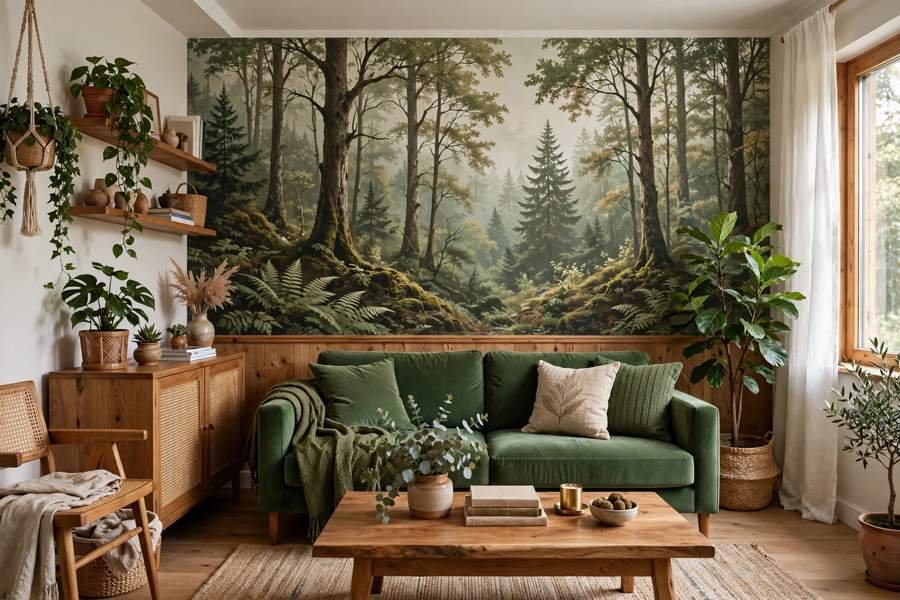
A forest wall should also suit furniture. A bed, a sofa or a table in front of a forest wall should be plain, in cream, green or warm wood, so the wall can be the hero, without fighting the furniture. A patterned sofa, patterned bedding and a forest wall together will fight each other, especially if the patterns are different scales. A plain sofa, plain bedding and a forest wall will feel layered, even if the colours are close.
2. Forest Wallpaper Patterns: Light, Dark and Scale
Forest wallpaper comes in many patterns, from light, airy leaves to dark, dense forests, and the pattern scale matters as much as the colour. A small, light leaf pattern, in sage, cream and soft green, will suit a small room, a bedroom and a north-facing room, because it does not close the room in. A large, dark forest pattern, in deep green and brown, will suit a large, bright room, with high ceilings and plain furniture, because it can take the drama without feeling heavy.
Pattern scale should match room size. A large pattern in a small room will feel too big and will be cut off by furniture, while a small pattern in a large room will feel too busy and will disappear from a distance. A medium pattern, with leaves or trees that are roughly hand-sized, suits most rooms, because it can be seen from a distance and enjoyed up close, without feeling too big or too busy. A pattern with a lot of white or cream space between leaves will feel lighter than a pattern with leaves edge to edge, even if the colours are the same.
Colour should match the room palette, not introduce a new green. A forest wallpaper in sage, moss or deep green, with cream and warm wood, will suit a forest home, while a forest wallpaper in bright, artificial green will fight with a soft, natural palette. Test a large sample, at least a metre wide, on the wall, in daylight and in lamplight, before committing, because wallpaper colours change a lot between the two, and a small sample will not show the pattern scale.
3. Peel-and-Stick Wallpaper: The Renter-Friendly Forest Wall
Peel-and-stick wallpaper is the best forest wall for renters, because it can be applied without paste, removed without damage, and changed easily, if it is applied correctly. A peel-and-stick forest wallpaper, on one wall, in a light, airy pattern, can give a renter a forest room, with no paint or drilling, and it can move with you, if it is removed carefully. A peel-and-stick wallpaper should be tested first, on a small patch, for at least a week, to check that it sticks, removes cleanly and does not damage paint.
Apply peel-and-stick wallpaper slowly, from the top, with a smooth tool, to avoid bubbles and wrinkles, and trim carefully at the edges, with a sharp knife and a straight edge. A wall should be clean, dry and smooth before applying, because dust, damp or rough paint will stop it sticking. A peel-and-stick wallpaper on a textured wall, a damp wall or a wall with peeling paint will not stick well, and it may damage the wall further when removed, so check the wall first.
Landlord permission is needed where required, even for peel-and-stick wallpaper, because some landlords do not allow any wallpaper, even removable, and some walls, such as freshly painted walls, need time to cure before wallpaper is applied. A test patch, landlord permission where needed, and a careful removal, with no damage, will make peel-and-stick wallpaper a good renter buy, while a rushed application, on a bad wall, without permission, will cost more to fix than it saved.
4. Painted Murals and Hand-Painted Forest Scenes
A painted mural, or a hand-painted forest scene, is the most personal forest wall, because it can be made to suit the exact room, furniture and light, rather than a bought pattern. A mural with trees, leaves, ferns and a soft sky, in the same green family as the room, can give a woodland feeling that no wallpaper can match, because it can be scaled, coloured and placed exactly where it suits the room. A mural suits a home you own, with time, skill and a clear plan, rather than a rented home, where it cannot be removed easily.
A mural needs a plan, not just paint. Sketch the design on paper, at the right scale, choose colours that match the room palette, and test colours on the wall, in daylight and in lamplight, before painting. A mural should be painted in stages, with a base coat, then large shapes, then details, with drying time between each stage, so the room is never left unsafe or cluttered. A mural that is planned, tested and painted in stages will look better than a mural that is painted in a rush, without a plan.
If painting is new to you, start with a simple mural, such as a few trees, a fern or a leaf border, rather than a whole forest scene, and enjoy finishing one wall well, rather than starting a complex mural that cannot be finished. A simple mural, in soft, natural colours, with a clear focal point, will suit a forest home better than a complex mural, with many colours and details, that feels busy. A mural should be a wall you enjoy every day, not a wall that only suits a photo.
5. Forest Murals by Room: Living Room, Bedroom and Hallway
In a living room, a forest wallpaper or mural should be on the wall behind the sofa, with cream cushions, a wooden table and plants, so the wall can be the hero, without fighting furniture. A living room forest wall in a light, airy pattern, with sage, cream and warm wood, will feel woodland, while a dark, dense forest wall, with dark furniture and dark curtains, will feel heavy. A living room forest wall should be balanced by cream walls, a light rug and warm lamps, so the room does not feel like a forest set.
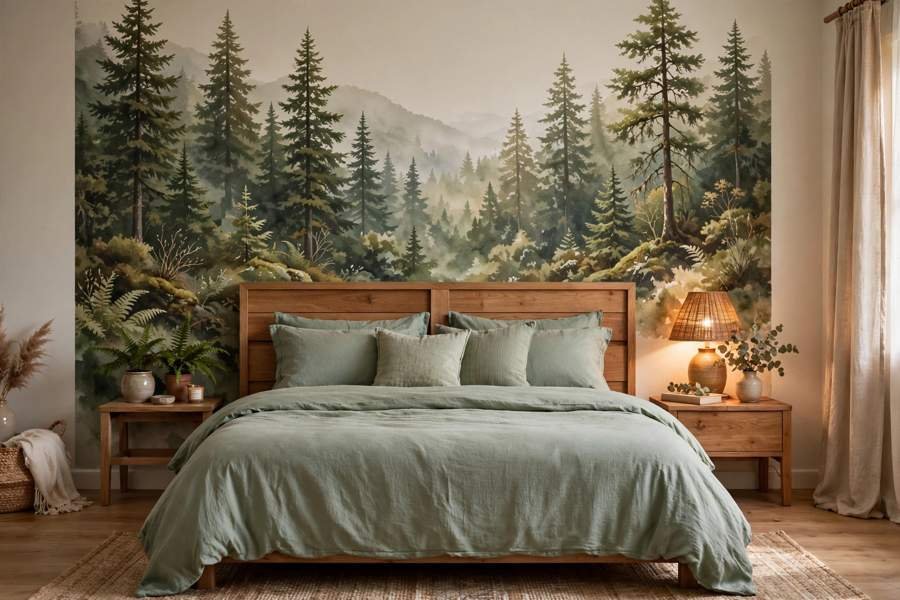
In a bedroom, a forest wallpaper or mural should be on the wall behind the bed, with cream or sage bedding, a wooden headboard and a warm lamp, so the bedroom feels restful, not busy. A bedroom forest wall in a soft, light pattern, with sage, cream and soft green, will feel calm in the morning, while a dark, dense forest wall, with dark bedding and dark curtains, will feel heavy and hard to wake up in. A bedroom forest wall should be the one strong pattern in the room, with the rest plain, so the room feels calm, not busy.
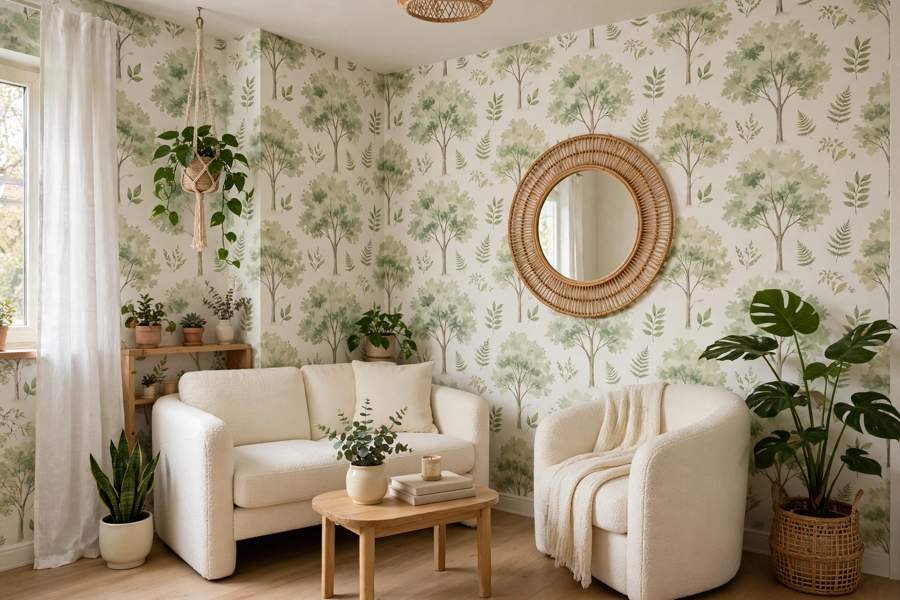
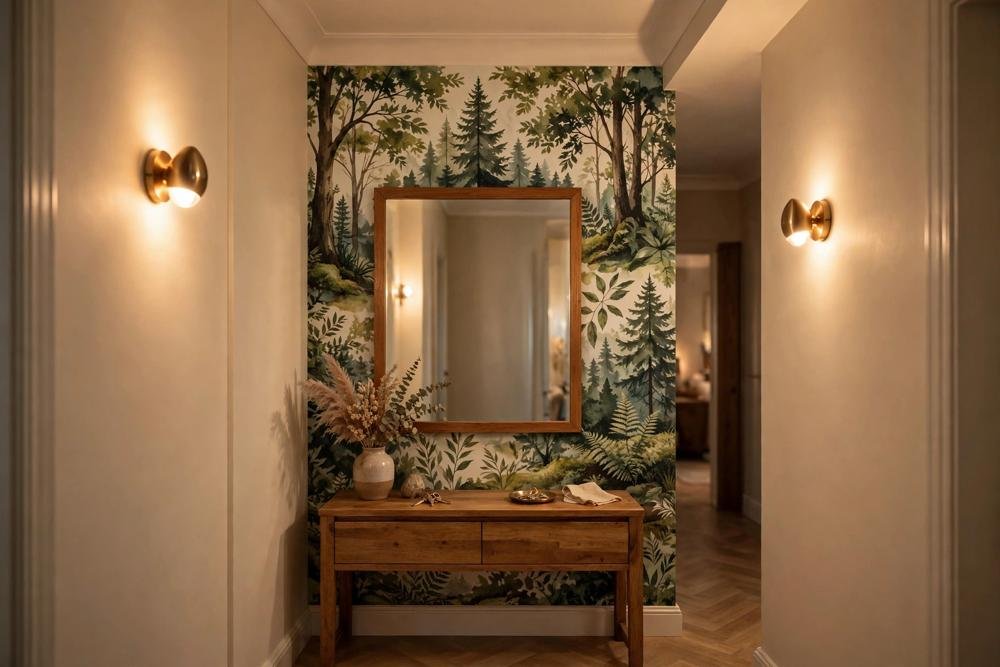
In a hallway or a small space, a forest wallpaper or mural should be light and airy, with a small pattern and a lot of cream space, because a hallway is narrow, dark and hard to light. A hallway forest wall in a light leaf pattern, with a mirror, a warm lamp and a plant, will feel woodland, while a dark, dense forest wall in a hallway will feel closed in. A hallway forest wall should be easy to clean, because hallways get knocked and scuffed, so choose a wallpaper that can be wiped, or a mural with a protective finish, if it suits the wall type.
6. Matching Furniture, Textiles and Light to a Forest Wall
A forest wall should be matched to furniture, textiles and light, not left to fight them. Furniture in front of a forest wall should be plain, in cream, green or warm wood, with visible legs in a small room, so the room feels open. A plain sofa, plain bedding and a plain rug, in the same green family as the wall, will feel layered, even if the colours are close, while patterned furniture, patterned bedding and a forest wall together will fight each other.
Textiles should be plain or small-patterned, in cream, green or natural linen, with one accent, such as a leaf cushion or a floral cushion, in soft, natural colours. A forest wall, a green throw, a cream curtain and a wooden table will feel woodland, while a forest wall, a patterned sofa, patterned curtains and a patterned rug together will feel busy. Curtains should be hung high and wide, so they frame the window rather than covering it, and they should be in cream, sage or a small pattern, so they do not fight the wall.
Light should be warm and layered, with lamps, not one bright ceiling light, so the forest wall glows in the evening, without looking cold. A warm lamp, a floor lamp in a corner and a string light on a shelf, used together, will give layered, warm light, which is what makes a forest wall glow. A forest wall in daylight, with good light, clear walkways and one calm focal point, will already feel more woodland than a dark, cluttered room, however much was spent on the wall.
7. Small Rooms, Renters and Shared Homes
A small room can have a forest wall, but it needs the light version. Keep the forest wall light and airy, with a small pattern and a lot of cream space, choose plain furniture with visible legs, and use a mirror opposite the window to bounce light back into the room. A small room with a light forest wall, a light rug and warm lamps will feel open, even if the window is small, while a small room with a dark, dense forest wall, dark furniture and dark curtains will feel closed in.
Renters can do almost all forest walls without paint or drilling, with peel-and-stick wallpaper, a large forest print, or a forest tapestry, hung with adhesive hooks within the maker weight limit, and with landlord permission where needed. A large forest print, a forest tapestry or a peel-and-stick wallpaper, on one wall, can anchor a room like a painted wall, and everything can move with you. A forest wall that is rented should be a wall that can be removed cleanly, with no damage, so test first, get permission where needed, and remove carefully.
In a shared home, agree on the forest wall before buying, because one person may love a dark forest, while another may find it too busy or too dark. A compromise, such as a light leaf wallpaper, with cream walls and green textiles, usually works better than a wall that one person loves and another avoids. Keep shared surfaces clear, agree on one wall for the forest pattern, and keep the rest of the room calm. A forest wall should be a wall everyone wants to live with, not a wall that only one person enjoys.
8. What to Avoid
A forest wall fails most often by being too much, too dark, or too themed. Avoid forest wallpaper or a mural on all four walls, in most rooms, because it will feel like a forest set, not a home, and it will be hard to live with, clean and change. Choose one feature wall, in a light, airy pattern, and let the rest be calm.
Avoid a dark, dense forest wall in a small, dark or north-facing room, because it will make the room feel smaller and gloomier, however beautiful the pattern is on its own. If you love a dark forest, balance it with cream walls, a light rug and warm lamps, or use it in a large, bright room, with plain furniture. Avoid a forest wall that fights furniture, textiles and light, with a new green, a new pattern or a new colour that does not match the room palette.
Avoid ignoring practical life. A wallpaper that cannot be cleaned, in a hallway or a home with pets or children, a mural that cannot be removed, in a rented home, or a wallpaper applied to a damp, textured or peeling wall, without a test patch, will cause more trouble than beauty. Choose a wallpaper that can be wiped, a mural with a protective finish where needed, and a wall that is clean, dry and smooth, with landlord permission where needed. A forest wall should be easy to live with, easy to clean and easy to change, not a wall you are afraid to use.
Conclusion
A forest wall works best as one feature wall, in a light, airy pattern, matched to furniture, textiles and light, in the same green family as the rest of the room. Start with the feature wall, choose a pattern that suits room size and light, test a large sample in daylight and in lamplight, and keep the rest of the room calm, with plain bedding, curtains and rugs. Use peel-and-stick wallpaper for renters, with a test patch and landlord permission where needed, and use a painted mural for a home you own, with a clear plan and stages. Done that way, a forest wall will give a room depth, colour and a woodland feeling, without making it cluttered, dark or hard to live in. With this guide, the Forest series is complete, room by room, from pillar to palettes, lighting, DIY, cottage, budget, mushrooms and walls.
Related reading
- Forest Home Decor: The Complete Guide to Bringing the Woods Indoors
- Forest Themed Bedroom Ideas for Adults
- Forest Kitchen Decor Ideas Without a Remodel
- Forestcore vs Cottagecore vs Cabincore vs Goblincore vs Mushroomcore
- Forest Living Room Ideas for a Calm Woodland Home
- Forest Green and Moss Colour Palettes for Every Room
- Forest Lighting Ideas for a Warm Woodland Glow
- Easy Forest DIY Decor Ideas for a Woodland Home
- Forest Cottage Decor Ideas for a Cosy Woodland Home
- Forest Decor on a Budget: Affordable Woodland Finds
- Mushroom Decor Ideas for a Whimsical Forest Home
Frequently Asked Questions
Should forest wallpaper go on one wall or all four walls?
One feature wall is best in most rooms, such as the wall behind a bed, a sofa or a dining table, with the rest of the room calm in cream, green and warm wood. Four forest walls will feel like a forest set, not a home, and will be hard to live with, clean and change.
Is peel-and-stick wallpaper safe for renters?
Yes, if it is tested first, on a small patch for at least a week, and used with landlord permission where needed, on a clean, dry, smooth wall. Peel-and-stick wallpaper can be removed cleanly, if applied and removed carefully, but it will not stick well to a textured, damp or peeling wall, and it may damage the wall if removed badly.
What forest wallpaper pattern suits a small room?
A light, airy pattern, with a small or medium leaf pattern and a lot of cream space, suits a small room best, because it does not close the room in. A dark, dense forest pattern, with large trees edge to edge, will make a small room feel smaller and gloomier, however beautiful it is on its own.
Can I paint a forest mural myself?
Yes, if you plan it, sketch it at the right scale, test colours on the wall in daylight and in lamplight, and paint it in stages, with drying time between each stage. Start with a simple mural, such as a few trees, a fern or a leaf border, rather than a whole forest scene, if painting is new to you.
How do I match furniture to a forest wall?
Choose plain furniture, in cream, green or warm wood, with visible legs in a small room, so the room feels open. A plain sofa, plain bedding and a plain rug, in the same green family as the wall, will feel layered, while patterned furniture, patterned bedding and a forest wall together will fight each other.
How do I clean forest wallpaper?
Choose a wallpaper that can be wiped, especially in a hallway or a home with pets or children, and follow the maker instructions for cleaning, because some wallpapers cannot be washed. A mural should have a protective finish where needed, if it is in a place that gets knocked or scuffed, and it should be cleaned gently, without harsh chemicals.