Introduction
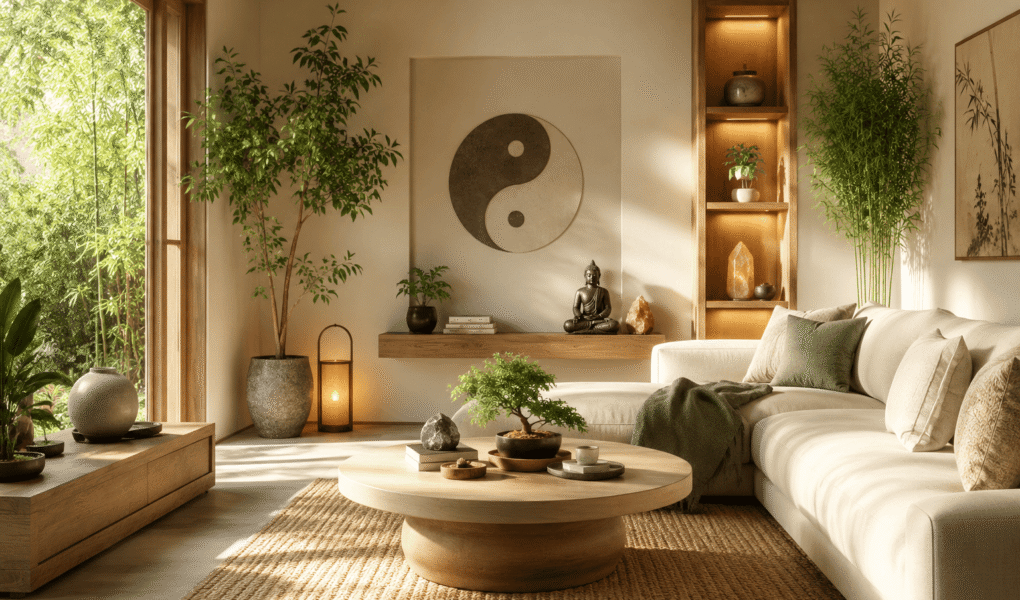
If you have ever walked into a room that looked perfectly fine on paper but felt immediately wrong to be in — too cluttered, too closed, too restless — you have already experienced the problem that feng shui home decorating exists to solve. The practice is not primarily about specific objects or lucky directions. It is a coherent system for understanding how the arrangement, material, and colour composition of a space affects the people living in it, which is something any thoughtful designer would recognise as simply good spatial thinking.
The reason feng shui home decorating gets dismissed is that it is usually explained badly — reduced to crystal placement and mirror rules that sound arbitrary rather than the underlying principles of energy flow, natural element balance, and spatial proportion that give those rules their actual logic. This guide explains those principles first, then applies them room by room in a way that produces tangible, visible changes rather than theoretical ones. The Bagua map, the five elements, and the specific 2026 Fire Horse year considerations are all here — but as tools, not as superstitions.
🔗 Want to find your room aesthetic first? Take our free decor style quiz and read our romantic bedroom ideas guide for more.
What Is Feng Shui? The Foundation
Feng shui is an interior design philosophy that organises living spaces in a way that promotes balance and harmony with the natural environment. The Chinese term feng translates to wind, while shui translates to water. Together they describe the flow of wind and water — highlighting the connection between human life and nature.
Feng shui views chi as the essential life force that flows through all things — through your home, through your furniture, through you. When chi flows freely and smoothly, a home feels welcoming, energising, and calm. When chi is blocked — by clutter, by sharp corners pointed at seating areas, by furniture crammed against walls, by dark stagnant corners — the home feels draining, uncomfortable, and somehow wrong without it being easy to identify why.
Feng shui home decorating is the practice of arranging your home to support the free and beneficial flow of chi.
The 4 Core Feng Shui Principles
Principle 1 — Chi (Energy Flow)
Chi is the life force that flows through every space. Good feng shui creates clear pathways for chi to flow — avoiding clutter, ensuring furniture does not block doorways or windows, keeping corners from becoming dark and stagnant.
The practical implication: Before any other feng shui home decorating decision, walk through your home and identify the places where you instinctively feel stuck, uncomfortable, or drained. These are the energy blocks that feng shui addresses first.
Principle 2 — The Five Elements
Earth, fire, water, wood, and metal comprise the five elements of feng shui. Each has different characteristics and colour associations. Balance these elements throughout your home — not in equal measure, but in the proportions that support what you want each room to do.
The five elements and their colours:
- Wood — green, brown. Growth, vitality, new beginnings
- Fire — red, orange, purple, pink. Passion, fame, recognition
- Earth — yellow, beige, sandy tones. Stability, grounding, nourishment
- Metal — white, grey, gold, silver. Clarity, precision, focus
- Water — black, dark blue, navy. Wisdom, flow, depth, career
Principle 3 — Yin and Yang
Yin is calm, dark, cool, quiet. Yang is bright, active, warm, energetic. Different rooms benefit from different yin-yang balances. Bedrooms should lean yin — calm, restful, dimly lit. Home offices and kitchens should lean yang — bright, active, energising.
The practical implication for home decorating: Adjust the lighting, colour, and amount of decorative activity in each room to match its intended purpose. A yin bedroom has soft lighting, cool or muted colours, and minimal stimulation. A yang kitchen has bright lighting, warm and energetic colours, and functional organisation.
Principle 4 — The Bagua Map
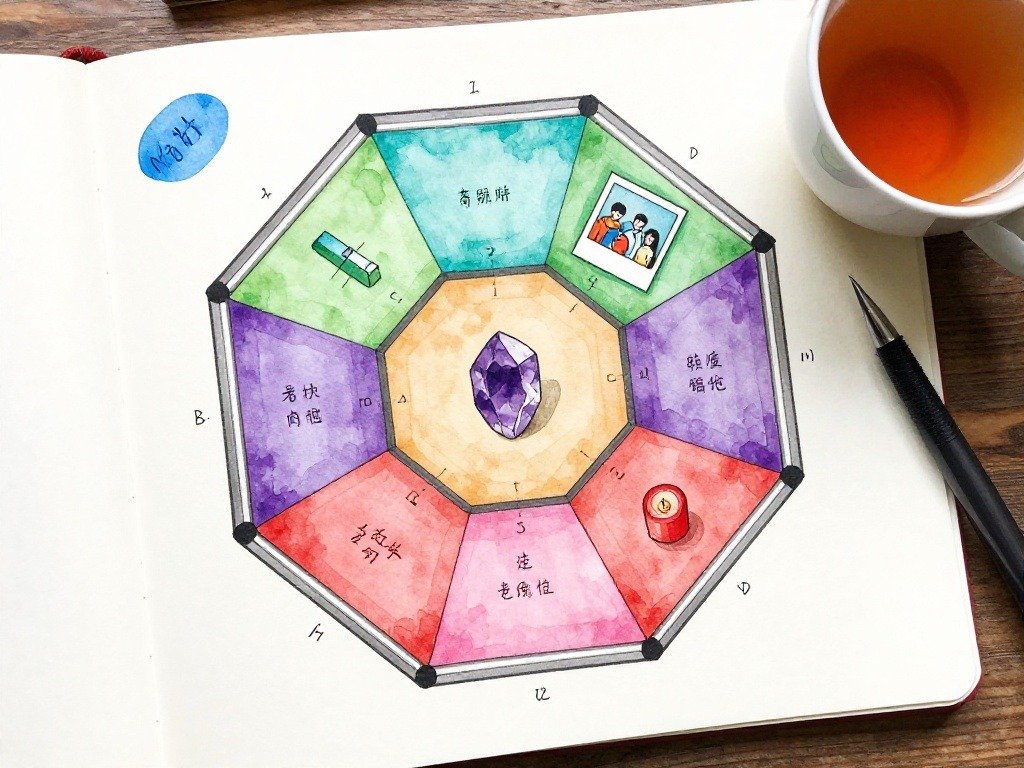
The Bagua is the feng shui energy map of your home — a grid that divides your floor plan into nine areas, each governing a specific life area:
| Area | Life Aspect | Element | Colour |
|---|---|---|---|
| North | Career and life path | Water | Black, dark blue |
| Northeast | Knowledge and wisdom | Earth | Blues, greens |
| East | Health and family | Wood | Green, brown |
| Southeast | Wealth and abundance | Wood | Purple, green |
| South | Fame and reputation | Fire | Red |
| Southwest | Love and relationships | Earth | Pink, red, white |
| West | Creativity and children | Metal | White, grey |
| Northwest | Helpful people and travel | Metal | Grey, white, black |
| Centre | Overall wellbeing | Earth | Yellow, earthy tones |
How to use the Bagua: Stand at your front door facing in. The area directly ahead and to the centre is the Career area (North). Work outward from there. Place decor items and colours associated with each life area in the corresponding zone of your home.
You can also read Economy Home decor Ideas
The Five Feng Shui Elements in Home Decorating — The Complete Guide
Wood Element — Growth and Vitality
Colours: Green, brown, teal Shapes: Tall, columnar, rectangular Materials: Natural wood, bamboo, rattan, wicker, plants Rooms to emphasise: Living room, home office, children’s rooms
How to bring wood element into your decorating:
- Live plants — the most direct and most powerful wood element addition
- Wooden furniture with visible grain — not painted or laminated, but natural
- Green accent colours — throw pillows, curtains, a feature wall
- Botanical prints and artwork
- Bamboo accessories — placemats, baskets, blinds
Too much wood: A home with overwhelming wood element can feel cluttered, overgrown, or overwhelming. Balance with metal element (whites, greys, metallic accents) to provide clarity and contrast.
Fire Element — Passion and Recognition
Colours: Red, orange, purple, pink, bright yellow Shapes: Triangular, pointed, star-shaped Materials: Candles, lighting, sunlight Rooms to emphasise: Kitchen, home office (for career fire), living room accent
How to bring fire element into your decorating:
- Candles — the most direct fire element addition and the most affordable
- Red or orange accent pieces — a cushion, a vase, a throw
- Good lighting — bright, warm lighting is fire energy
- A fireplace or fire feature — the most powerful fire element in any home
- Artwork featuring sunsets, fire, or warm-toned landscapes
Important 2026 note: In 2026 — the Year of the Fire Horse — fire energy dominates. This means fire element is particularly powerful and particularly present this year. A single red candle in your home’s south area (fame and recognition corner) is especially potent in 2026.
Earth Element — Stability and Grounding
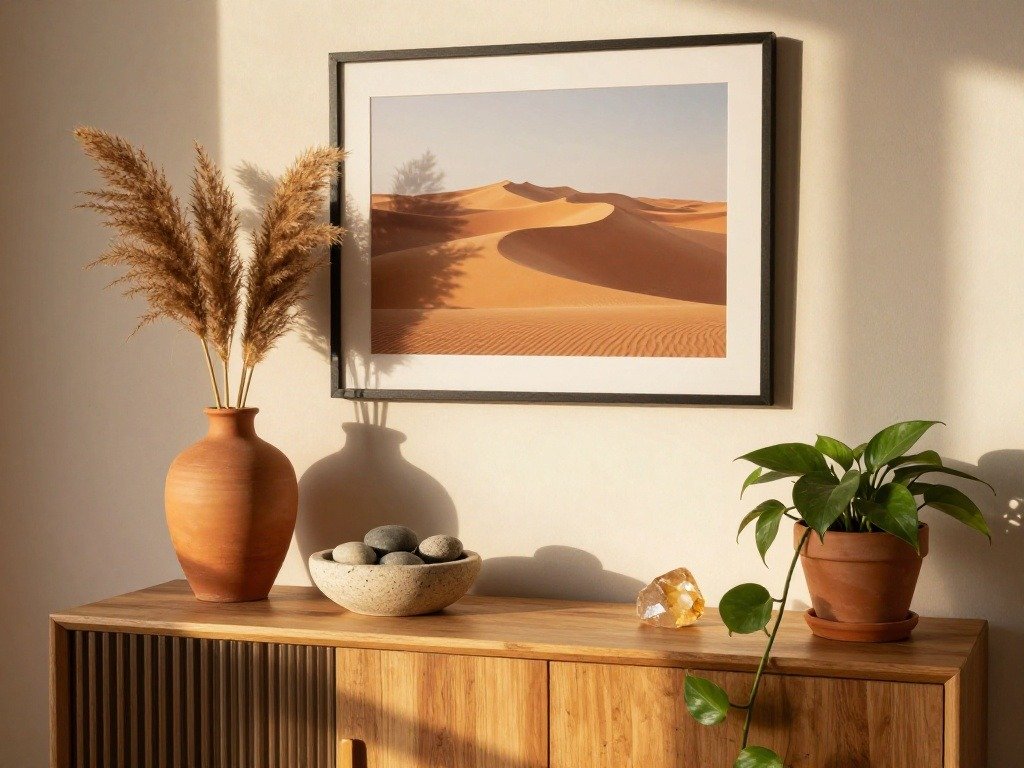
Colours: Yellow, beige, sandy, terracotta, ochre Shapes: Square, flat, low Materials: Ceramic, clay, stone, crystal Rooms to emphasise: Bedroom (for stability in relationships), centre of the home
How to bring earth element into your decorating:
- Terracotta plant pots and ceramic accessories
- Sandy and earthy colour palettes — the most grounding feng shui colour choice
- Crystals — amethyst, citrine, rose quartz all carry earth energy
- Square coffee tables and low, grounded furniture
- Natural stone accents — stone coasters, a stone bowl, a marble tray
You can also read Decorative Metal Panels Ideas
Metal Element — Clarity and Focus
Colours: White, grey, silver, gold Shapes: Round, circular, arch-shaped Materials: Metal, stone, glass Rooms to emphasise: Home office (for mental clarity), bathroom, bedroom (for clarity in relationships)
How to bring metal element into your decorating:
- Metallic accents — brass, silver, or gold hardware, frames, and accessories
- Round mirrors — the most feng shui-appropriate mirror shape
- White walls or surfaces — the most direct metal element colour
- Metal light fixtures — pendant lights in brushed brass or matte black
- Crystals with metallic quality — clear quartz, white selenite
Water Element — Wisdom and Flow
Colours: Black, dark blue, navy, dark grey Shapes: Flowing, asymmetrical, wavy Materials: Water features, glass, mirrors, reflective surfaces Rooms to emphasise: Career area (north zone), bathroom, home office
How to bring water element into your decorating:
- A small water feature — the most powerful water element addition
- Dark blue or navy accents — cushions, curtains, a feature wall
- Mirrors — mirrors carry water energy and double the light in any room
- Artwork featuring water — rivers, ocean, rain, reflections
- Dark glass accessories — black vases, dark ceramic vessels
2026 Feng Shui — The Year of the Fire Horse
In 2026, fire dominates, bringing passion and heightened energy. The Year of the Fire Horse carries specific feng shui energy patterns that affect every home.
The lucky feng shui colours for 2026:
- Red — the colour of fire, the dominant element of the Fire Horse year. Attracts money, attention, and recognition. Protective energy.
- Green and jade — the colours of the Wood element, which feeds the Fire. Symbolise growth and vitality.
- Pink and coral — warm fire-adjacent colours that strengthen relationships and career energy.
- Orange — the colour of both fire and earth, brings vitality and grounding simultaneously.
What to avoid in 2026:
- Excessive black and dark blue (water weakens fire)
- Cool grey and silver in high-traffic areas (metal controls fire)
- South-facing rooms for renovation or loud activity — the south sector carries the most challenging star energy in 2026
2026 feng shui home decorating additions to make:
- A red accent in the south area of your home — a candle, a cushion, a piece of artwork
- Fresh plants in the east and southeast areas — wood feeds the Fire Horse year
- A water feature or dark blue accent in the north area to balance fire energy
- Clear the clutter from the south sector of your home before any other area
You can also read How to Make a Mobile Home Look Like a House: The Complete 2026 Guide
Room-by-Room Feng Shui Home Decorating Guide
Bedroom Feng Shui Decorating
The bedroom is the most important room for feng shui home decorating because it is where you spend approximately one third of your life — and the quality of that rest determines the quality of everything else.
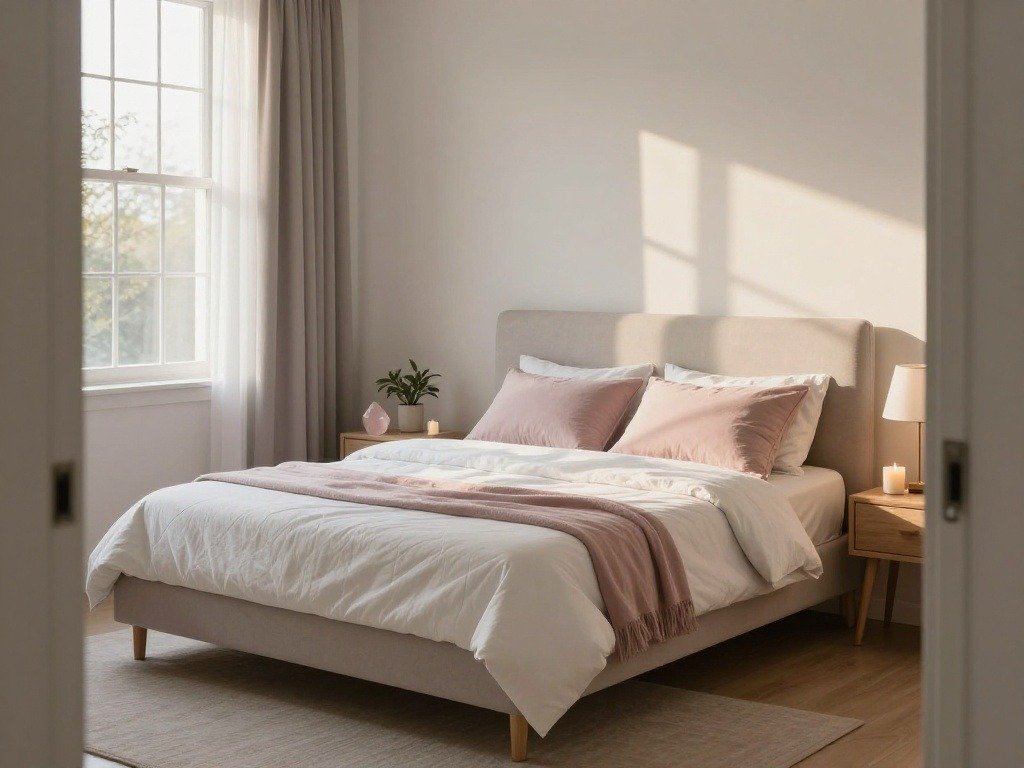
The command position: Position your bed so you can see the bedroom door without being directly in line with it. This is the single most important feng shui bedroom principle. In the command position you feel safe and supported — you can see what is coming without being directly in the path of energy flowing through the door.
Colours for a feng shui bedroom:
- Soft, muted tones — sage green, dusty rose, warm cream, gentle blue
- Avoid bright red in the bedroom — too much fire energy disrupts sleep
- Avoid black or very dark walls — too much water element creates heaviness
What to remove from a feng shui bedroom:
- Mirrors facing the bed — mirrors are active, yang energy and disrupt rest. Move or cover bedroom mirrors
- Electronics — phones, televisions, and computers bring yang energy into a yin space. Remove from the bedroom or cover overnight
- Work items — a desk or work materials in the bedroom blur the boundary between rest and work. Separate these spaces if possible
- Plants directly beside the bed — plants are active wood energy. Keep on the windowsill or across the room rather than immediately beside the sleeping area
- Clutter under the bed — stuck energy under where you sleep affects the quality of your rest. Clear the space under the bed or use flat, organised storage
Feng shui bedroom decor items to add:
- Pairs of objects on each side of the bed — two candles, two lamps, two plants (one each side) — to invite relationship energy
- Soft, natural textiles — linen, cotton, silk in gentle colours
- Artwork that depicts restful, gentle imagery — never conflict, violence, or solitary figures
- Rose quartz crystal — the feng shui crystal most associated with love and relationship energy
- Fresh flowers or a single plant on the windowsill
Feng shui bedroom by aesthetic:
- Romantic aesthetic: Blush pink, rose quartz crystal on the bedside table, dried peonies, soft candlelight, pairs of everything — the most feng shui-aligned aesthetic on this site
- Dark academia: Deep green or navy accent, a single lamp casting warm light, books displayed with intention, earth element crystals — grounded and supported
- Kawaii: Pastel fire colours (pink, soft orange) activate joyful energy — a feng shui-aligned aesthetic naturally
- Gothic: Dark walls are water element — powerful but need balancing with wood (plants) and fire (candles) to prevent heaviness
- Danish pastel: Metal element colours (white, grey, soft blue) create mental clarity and calm — deeply feng shui-aligned
You can also use Free Rug Size Calculator
Living Room Feng Shui Decorating
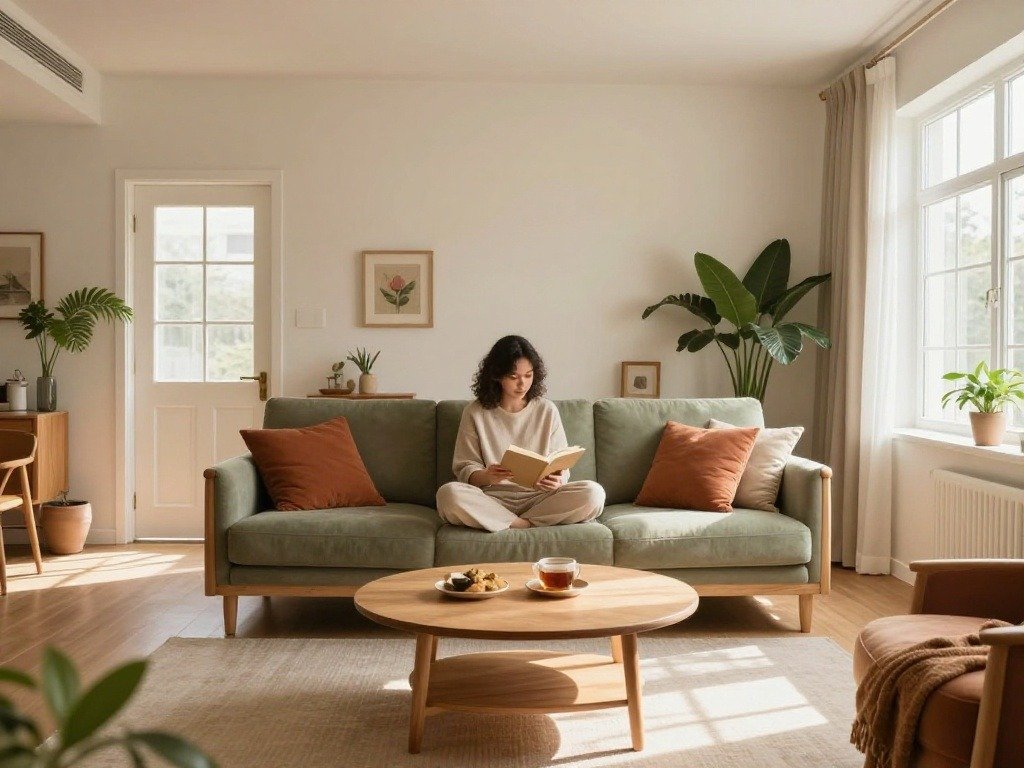
The living room is the social heart of the home — the room where chi should flow freely, conversation should feel easy, and the energy should support both activity and rest depending on what is needed.
Furniture arrangement for feng shui living room:
- Sofas and chairs should face each other to encourage conversation — not all facing the television
- The main sofa should be in the command position — able to see the room’s entrance without being directly in line with the door
- Avoid pushing furniture against the walls — furniture floating in the space (with 6–12 inches from the wall) allows chi to circulate behind and between pieces
- Round coffee tables are preferred over square — sharp corners are considered sha chi (cutting energy) in feng shui and are particularly problematic when pointed at seating
Living room feng shui colours by element:
- Wood room (family, health focus): Greens, browns, natural wood, plants
- Fire room (social, energetic focus): Warm reds, oranges, bright lighting, candles
- Earth room (stable, grounding focus): Terracotta, cream, sandy tones, ceramic accessories
- Metal room (clear, focused): White, grey, metallic accents, round shapes
- Water room (reflective, wisdom focus): Navy, dark blue, black accents, mirrors, water features
Plants for feng shui living room:
- Money plant (Pothos) — the most widely recommended feng shui living room plant. Place in the southeast wealth corner.
- Peace lily — purifies air and carries peaceful energy. Ideal in the east family area.
- Bamboo — wood element, growth, and good fortune. North or east corner.
- Avoid cacti and spiky plants in the living room — their pointed energy is considered sha chi.
Kitchen Feng Shui Decorating
The kitchen represents wealth and nourishment in feng shui — it is where food (sustenance and abundance) is prepared. Kitchen feng shui focuses on keeping this room clean, organised, and energetically positive.
Key kitchen feng shui principles:
- Keep the stove clean — the stove represents wealth in feng shui. A dirty, neglected stove symbolises neglected abundance.
- Use all burners on the stove — using only one or two burners symbolises limiting your sources of income. Rotate which burners you use.
- Keep knives stored out of sight — knives displayed on countertops carry cutting energy. Store in a knife block or drawer.
- Fix leaking taps immediately — leaking water symbolises wealth draining away. This is one of the most urgent feng shui kitchen corrections.
- Add plants and natural light — both bring vibrant, nourishing energy to the kitchen
Feng shui kitchen colours:
- Avoid black kitchen cabinets — water element controls fire, and the kitchen is a fire element room. Black cabinets can suppress the kitchen’s natural energy.
- Green is particularly good — wood element feeds fire, supporting the kitchen’s cooking energy
- Warm cream and sage green are the most broadly feng shui-appropriate kitchen cabinet colours
Home Office Feng Shui Decorating
The home office is the career and focus room — it benefits from commanding position for the desk, metal element for clarity and precision, and wood element for growth.
Desk position: Place your desk in the command position — facing the room entrance, with a solid wall behind you rather than a window. This gives the subconscious mind a sense of safety and support that dramatically improves focus and productivity.
Home office feng shui decor:
- A plant to the left of the desk — green wood element supports growth
- A small water feature to the north of the desk — water element governs career
- Crystals: clear quartz for clarity, black tourmaline for protection, citrine for abundance
- Good overhead lighting — yang energy supports active work
- Remove clutter ruthlessly — clutter is the most significant feng shui problem in any home office
Entrance and Hallway Feng Shui
The entrance is where chi enters your home. It is the most important feng shui area in the house because it sets the energy tone for everything that follows.
Entrance feng shui principles:
- Keep it clear and welcoming — the entrance should never be blocked with clutter, shoes, or furniture that impedes entry
- Add a mirror — but not directly facing the front door (this bounces energy out of the home before it can enter). Place to the side.
- Good lighting — a bright, welcoming entrance invites positive chi
- A plant or flowers — living energy at the entrance attracts vitality
- Your house number clearly visible — sounds basic but is a significant feng shui principle. Energy needs to be able to find your home.
You can also explore Living Room Ideas
Feng Shui Lucky Home Decor Items — The Complete Guide
Lucky Feng Shui Decor Items for 2026
Plants:
- Lucky bamboo — the most universally recognised feng shui lucky plant. Three stalks for happiness, five for wealth, six for health. Place in the east or southeast area.
- Money plant (Pothos) — trailing plant believed to attract prosperity. Southeast wealth corner.
- Jade plant — succulent with round, coin-like leaves associated with wealth. East or southeast.
- Peace lily — white flowers carry peace and purification energy. Bathroom or bedroom.
Crystals:
- Rose quartz — the crystal of love and relationships. Southwest corner of bedroom or home.
- Citrine — the crystal of abundance and joy. Southeast wealth corner.
- Amethyst — the crystal of calm and wisdom. Bedroom or meditation space.
- Clear quartz — amplifies the energy of any room. Place near other crystals or in natural light.
- Black tourmaline — protective energy. Near the front door or home office.
Other lucky feng shui decor items:
- Round mirrors — the most feng shui-appropriate mirror shape. Expand chi and bring light.
- Wind chimes — metal element, activate chi in stagnant areas. Near the front door or in a window.
- Water features — a small indoor fountain activates water element energy and is particularly powerful in the north career area.
- Laughing Buddha — when placed facing the door, believed to bring joy and good fortune into the home.
- Coins — Chinese coins tied with red ribbon placed in the southeast wealth corner are a classic feng shui wealth activation.
Feng Shui and Mirrors — The Rules Everyone Gets Wrong
Mirrors are simultaneously the most powerful and most misused feng shui home decorating tool. Called the aspirin of feng shui, mirrors can bring really good energy when used wisely — but they can also create significant problems in the wrong positions.
Good feng shui mirror placement:
- Entrance hallway — to the side of the front door, not facing it
- Dining room — a mirror facing the dining table doubles the food and abundance represented there
- Small rooms — to expand the perceived size and allow chi to circulate
- Dark corners — to bring light into stagnant areas
Bad feng shui mirror placement:
- Directly facing the front door — bounces incoming chi back out of the home
- Facing the bed — mirrors are yang (active) energy and disrupt sleep. Move or cover bedroom mirrors.
- Facing another mirror — creates an endless loop of energy with no clear direction
- In the kitchen facing the stove — doubles fire element energy uncomfortably
You can also explore Bedroom Decor Ideas
Feng Shui Colours for Every Room — 2026 Guide
| Room | Primary Purpose | Best Feng Shui Colours 2026 | Avoid |
|---|---|---|---|
| Bedroom | Rest and relationships | Sage green, dusty rose, warm cream, soft blue | Bright red, black walls, pure white |
| Living room | Social connection | Warm cream, terracotta, green, warm wood tones | Cold grey, harsh white |
| Kitchen | Nourishment and abundance | Green, warm yellow, cream, sage | Black, dark blue |
| Home office | Focus and career | White, grey, green, wood tones | Bright red (overstimulating), black |
| Bathroom | Release and cleansing | White, soft blue, pale green | Red (too much fire near water) |
| Entrance | Welcome and invitation | Warm colours — terracotta, gold, warm cream | Dark, cold, unwelcoming tones |
| Dining room | Nourishment and abundance | Warm earth tones, red accents for appetite | Cold blues and greys |
Feng Shui for Renters — What You Can Do Without Changing the Walls
Many people assume feng shui requires painting walls and making structural changes. It does not. The most powerful feng shui home decorating changes are arrangement, light, plants, and crystals — all of which are completely renter-friendly.
Renter-friendly feng shui changes:
- Rearrange furniture into command positions
- Add plants to stagnant corners
- Place crystals in their Bagua-appropriate areas
- Use throw pillow colours to introduce the right element in each room
- Add mirrors to expand light (with command — not facing beds or front doors)
- Use candles for fire element without any permanent changes
- Add a small portable water feature for career or wealth activation
- Use peel-and-stick wallpaper in element-appropriate colours for a removable feature wall
Decluttering — The Most Important Feng Shui Principle of All
Before any crystal, any plant, any colour or arrangement change — clear the clutter.
Clutter is stagnant, blocked energy. It represents unfinished business, delayed decisions, and accumulated weight from the past. No feng shui decoration placed in a cluttered room will work effectively because the chi cannot flow freely enough to carry the energy of your intentions.
The feng shui decluttering approach:
- Go room by room — do not try to do the whole home at once
- In each room, ask of every object: does this serve my life right now? Is it useful, beautiful, or meaningful?
- If the answer is no to all three — it leaves
- Pay particular attention to the areas under beds, inside wardrobes, and on the tops of high shelves — these are where stagnant energy concentrates
- The front door area and the path from the front door through the home is the chi highway — keep it completely clear always
Frequently Asked Questions — Feng Shui Home Decorating
Q: What is feng shui home decorating and how does it work?
A: Feng shui home decorating is the practice of arranging your home to support the free flow of chi — life force energy — through your living space. It uses furniture placement, colour, natural materials, plants, crystals, and light to create rooms that support specific life goals: rest and relationships in the bedroom, clarity and focus in the home office, social connection in the living room. Modern feng shui focuses on intentionality, elemental balance, and creating spaces that feel as good as they look.
Q: Where should my bed be placed for good feng shui?
A: The command position — where you can see the bedroom door from your bed without being directly in line with it, with a solid wall behind the headboard. This is the most important single feng shui bedroom principle. The command position gives the subconscious mind a sense of safety (you can see what is coming) and support (the wall behind you is solid). Most sleep quality issues that people attribute to mattress or curtains are actually related to the anxiety created by being unable to see the door from the bed.
Q: What colours are good feng shui for the bedroom?
A: Soft, muted, yin colours support rest and relationship energy in the bedroom — sage green (wood element, growth and vitality), dusty rose and soft pink (fire element in its softer form, relationship energy), warm cream and sandy tones (earth element, stability and grounding), and pale sky blue (water element, calm and depth). Avoid bright red (too much fire disrupts sleep), black walls (too much water creates heaviness), and pure cold white (too much metal, too stimulating).
Q: What should you not have in your bedroom according to feng shui?
A: The five things most commonly identified as bad feng shui in a bedroom are: mirrors facing the bed (active yang energy that disrupts sleep), electronics including phones and televisions (yang energy that keeps the mind active), work items like a desk or laptop (blurs the rest-work boundary), clutter under the bed (stagnant energy directly beneath you while sleeping), and plants immediately beside the bed (active wood energy better placed on the windowsill or across the room).
Q: How do I decorate the centre of my home for feng shui?
A: The centre of your home in the Bagua map corresponds to overall wellbeing and health — it is governed by the earth element. Decorate this area with earth element colours (yellow, terracotta, sandy beige), square or low furniture shapes, ceramic and crystal accessories, and keep it open and uncluttered. The centre of the home should never be used for storage — stagnant energy in the health centre of the Bagua affects wellbeing throughout the whole home. If your staircase or bathroom is in the centre of the home, use earth element crystals (citrine, amethyst) and plants to keep the energy uplifted.
Q: How do I feng shui my home office?
A: Place your desk in the command position — facing the room entrance, with a solid wall behind your chair. Add a plant to the left of the desk (wood element, growth). Place a small water feature or dark blue accent to the north of your desk (water element governs career). Use clear quartz crystal for mental clarity. Ensure excellent overhead lighting (yang energy supports active work). Remove all clutter — clutter in a home office blocks career chi more than in any other room. Avoid sitting with your back to the door or window.
Q: Are mirrors bad feng shui in the bedroom?
A: Not necessarily bad feng shui — but specifically bad feng shui in certain positions. A mirror facing the bed is the most problematic feng shui mirror position — it creates active yang energy that disrupts rest. A mirror directly facing the bedroom door bounces incoming chi out before it can settle. However a mirror on the inside of a wardrobe door, a mirror on a wall at 90 degrees to the bed, or a small mirror on a dressing table are all acceptable feng shui positions. If you have a mirror facing the bed and cannot move it, cover it with a cloth or a curtain at night.
Q: What plants are good feng shui for the home?
A: Lucky bamboo (three stalks for happiness, five for wealth) is the most iconic feng shui plant. Money plant (pothos) is the most practically recommended — easy to grow and powerful wealth-corner plant. Jade plant brings wealth energy with its coin-like leaves. Peace lily purifies air and brings peaceful energy. Avoid cacti, thorny plants, and plants with very sharp-pointed leaves in living and sleeping areas — their sha chi (cutting energy) is considered disruptive in feng shui. All round-leaved plants are preferred over pointed-leaved ones.
Q: How do I feng shui a small apartment?
A: Small apartments benefit enormously from feng shui because every square foot matters more when there is less of it. The most important principles for small apartments: ensure the front door can open fully without hitting anything (maximum chi entry), use mirrors strategically to double light and perceived space, keep the area under the bed completely clear, use multifunctional furniture to prevent clutter accumulation, and prioritise live plants over artificial ones — living energy in a small space is particularly powerful. Even a single well-placed plant in the wealth corner and a small water feature in the career corner can shift the energy of a studio apartment noticeably.
Q: What are the feng shui colours for 2026?
A: In 2026, the Year of the Fire Horse, the lucky feng shui colours are those associated with the Fire, Earth, and Wood elements — the dominant and supportive elements of the year. Red is the primary lucky colour for 2026 — the colour of fire, which attracts money, attention, and protection. Green and jade represent the Wood element that feeds the Fire, symbolising growth and vitality. Pink, coral, and scarlet strengthen career and relationship energy. Warm oranges and terracottas combine fire and earth energy effectively. Avoid excessive black and dark blue (water weakens fire) and cool silver-grey (metal controls fire) in 2026.
🔗 Explore the aesthetics that align most naturally with feng shui principles — read our romantic bedroom ideas guide, our dark academia bedroom guide, our danish pastel bedroom guide, and our boho room decor guide for more.
Meta Title: Feng Shui Home Decorating — The Complete 2026 Guide to Every Room Meta Description: The complete guide to feng shui home decorating — the five elements, room-by-room tips, 2026 Fire Horse colours, lucky decor items, plants, crystals, mirrors, and every FAQ answered. Slug: /feng-shui-home-decorating/ Pinterest Description: Feng Shui Home Decorating — the complete 2026 guide 🌿 The five elements, room-by-room tips, 2026 lucky colours, best plants and crystals, mirror rules and every FAQ answered. Save this!