Winter entryway organization works when wet things have one place to land, dry things have one place to wait, and nothing you need every day is buried under yesterday’s snow, mud, or rain. In a small corner, that means a boot tray by the door, drying hooks on the wall, a basket for gloves and hats, an umbrella stand that does not block the door, and a washable runner under it all, set up so the corner can be cleaned in a few minutes and the walkway stays clear.
Key takeaways
- Make a wet zone first: a boot tray with a raised edge and a washable runner, placed where wet boots land before they reach the rest of the floor.
- Give every wet coat a drying hook with air around it, not a hook crammed behind three other coats.
- Keep one pair of boots and one coat per person in the corner, and rotate everything else out.
- Use a glove basket, not a drawer, for the small things that get lost: gloves, hats, scarves, and hand warmers.
- Keep the umbrella stand beside the door, not in the walkway, and empty it when umbrellas are dry.
- Set the whole corner up in one weekend, then keep it working with a five minute reset each evening and a weekly tray clean.
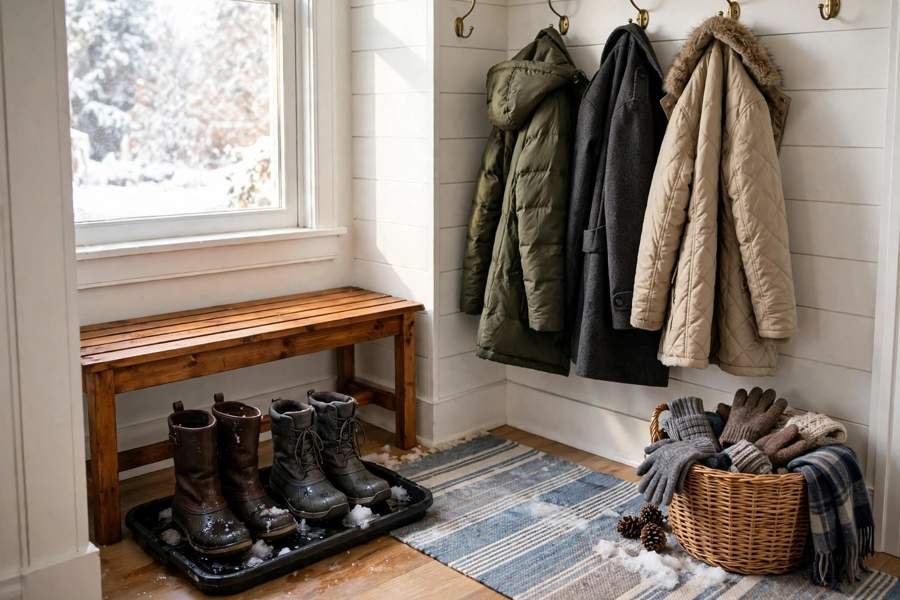
Why Winter Breaks a Normal Entryway
A normal entryway is built for dry shoes and a light jacket. Winter brings a different load, and it brings it all at once: heavy coats, wet boots, gloves that come off in pairs and then separate, hats, scarves, umbrellas, school bags, and shopping bags, often carried in by two or three people at the same time, in the dark, with wet hands. If the corner has no wet zone, that load spreads. Wet boots go on the floor by the wall, then on the rug, then into the next room. Coats go on the nearest chair, then on the bench, then on top of each other. Gloves go into a coat pocket, then into a different coat pocket, and one glove is lost by February.
The fix is not more furniture. It is a smaller, clearer set of places, each with one job, and a rule about what lives in the corner in winter and what lives somewhere else. A corner that holds one coat, one pair of boots, and one set of gloves per person will stay tidy far longer than a corner that tries to hold every coat and every pair of shoes the household owns. The rest belongs in a wardrobe, a cupboard, or a storage box elsewhere, and it comes into the corner only when it is needed that day.
Winter also changes the floor. Snow, rain, grit, and salt from pavements come in on boots, and they do not stay where boots are taken off unless something catches them. A boot tray with a raised edge catches water and grit, a washable runner protects the floor between the door and the rest of the home, and a mat by the door gives boots a first wipe. None of these need to be expensive or permanent, and all of them need to be easy to clean, because a tray that is never emptied becomes a puddle, and a runner that is never washed becomes a source of dirt rather than a guard against it.
Start With the Wet Zone
The wet zone is the area where wet things land, dry, and are cleaned, and it should be the first thing you set up and the last thing you let spread. Start at the door and work inwards. The door opens, you step in, you take off wet boots, and those boots go straight onto a tray. That tray should sit where you naturally stand when you take boots off, not across the room, and not behind a bench you have to climb over.
Choose a boot tray with a raised edge, deep enough to hold water from wet boots without spilling when the tray is lifted, and large enough for the boots that actually live there in winter, not just for one pair. If two people come in together, the tray needs room for two pairs, and if boots are tall, the tray needs to be long enough for them to sit flat or upright without hanging over the edge. A tray that is too small will be ignored, and boots will go beside it, which defeats the purpose. Measure the boots you wear most, add a little room around them, and choose a tray to that size, approximately, rather than guessing from a photograph.
Under and around the tray, put a washable runner. The runner does two jobs: it protects the floor from grit and salt that escapes the tray, and it gives wet feet a dry place to step while boots are taken off. Choose a runner that can go in the washing machine, or at least be shaken out and wiped down easily, and choose a length that covers the path from the door to where you step into the next room, without bunching up or curling at the edges. If the runner is too long, it will be walked on and moved; if it is too short, wet footprints will go past it. Measure the path, then choose a runner to fit it, and check the size with the rug size guide on this site if you are unsure about length and width for your space.
Keep the wet zone clear of anything that should stay dry. Do not put a glove basket on the floor inside the wet zone, where it will get splashed, and do not put shoes you want to keep clean on the tray with wet boots. The wet zone is for wet things only, and it works because it is easy to see when it needs cleaning: empty the tray, wipe it, shake or wash the runner, and the zone is ready again. A weekly clean, plus a quick wipe when the tray fills, is usually enough, and it takes far less time than cleaning mud and salt from the rest of the floor.
Safety and practical notes for the wet zone: keep the walkway and the door swing clear, so the tray and runner never block the exit route. Do not put a tray where it creates a trip step in a dark hallway, and keep the runner flat, with no curled corners. If you use a mat with a rubber backing, check that it does not trap moisture on a wooden floor for weeks without being lifted and aired. Wet things dry faster, and floors last longer, when the tray and runner are lifted, cleaned, and allowed to dry from time to time.
Drying Hooks That Actually Dry Coats
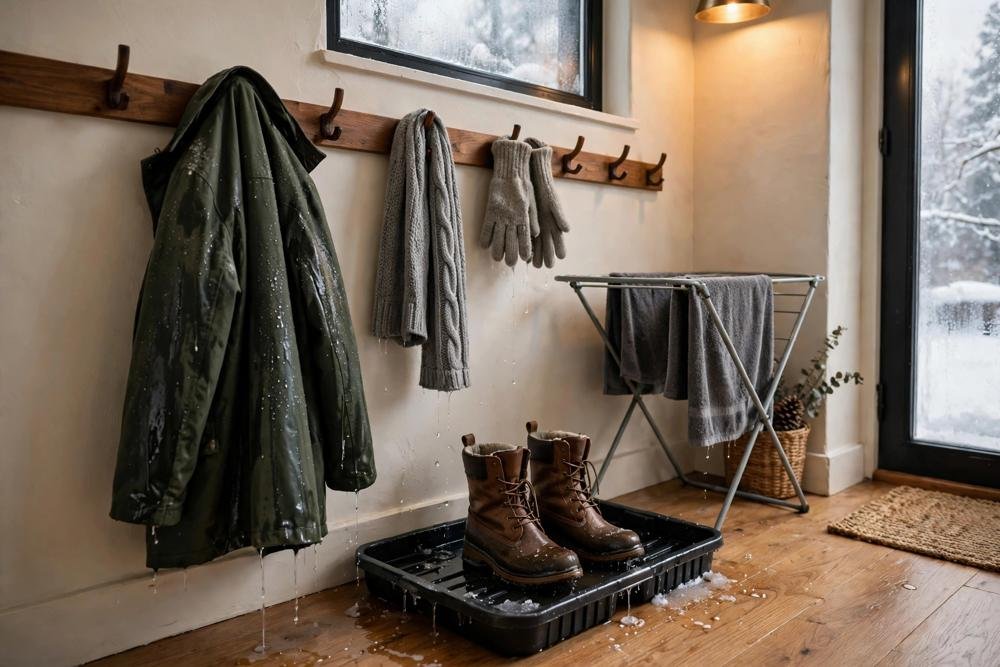
A coat that is hung wet and then buried under two more coats will still be damp in the morning, and it will smell damp by the end of the week. Drying hooks work when each coat has air around it, when the hook is strong enough for a heavy wet coat, and when the hook is placed where air can move and water can drip without landing on something that should stay dry.
Put drying hooks on the wall beside the door, not behind the door, where the door swing will knock coats off, and not over the bench, where drips will land on the cushion. A hook rail, or a row of separate hooks, works well in a corner, because it uses wall space that a bench cannot use. For most adults, hooks at approximately 165 to 175 cm are a comfortable height, with a lower hook for children if children use the corner, so children can hang their own coats and actually use the system. Check the weight limit on adhesive hooks before you hang a heavy wet coat on them, and get landlord permission before drilling if you rent, as with any wall fixing in this series.
Space the hooks further apart than you think you need. A wet coat needs room to hang straight, with the sleeves free, and with air moving around it, not pressed flat against another coat. If you have three coats to dry, you need three hooks with space between them, not one hook with three coats on it. If wall space is tight, use a second row of hooks lower down for lighter items, like scarves and bags, and keep the top row for coats only. A small drying rack, or a freestanding coat stand, can help if wall space is very tight, but only if it does not block the walkway or the door swing, and only if it is stable enough not to tip when a heavy coat is hung on one side.
Drying takes time, and it needs air. Open a door or a window for a short time when you can, or leave the corner door open to the next room, so damp air does not sit in a closed hallway. Do not hang wet coats over a radiator, or over an electrical heater, and do not put wet gloves or hats directly on a hot surface. Radiators and heaters are not drying racks, and wet fabric on a hot surface can damage the fabric and, in a small corner, can be a fire risk if it falls or is forgotten. Let coats drip onto the tray or runner below, or onto a washable mat, and move them to a wardrobe or cupboard once they are dry, so the drying hooks are free for the next wet coat.
Gloves, Hats, Scarves, and the Small Things
Small winter things cause the most morning stress, because they are small, they come in pairs, and they are taken off with wet hands and put down wherever is nearest. A glove basket solves this, but only if it is in the right place, at the right height, and used for one thing only.
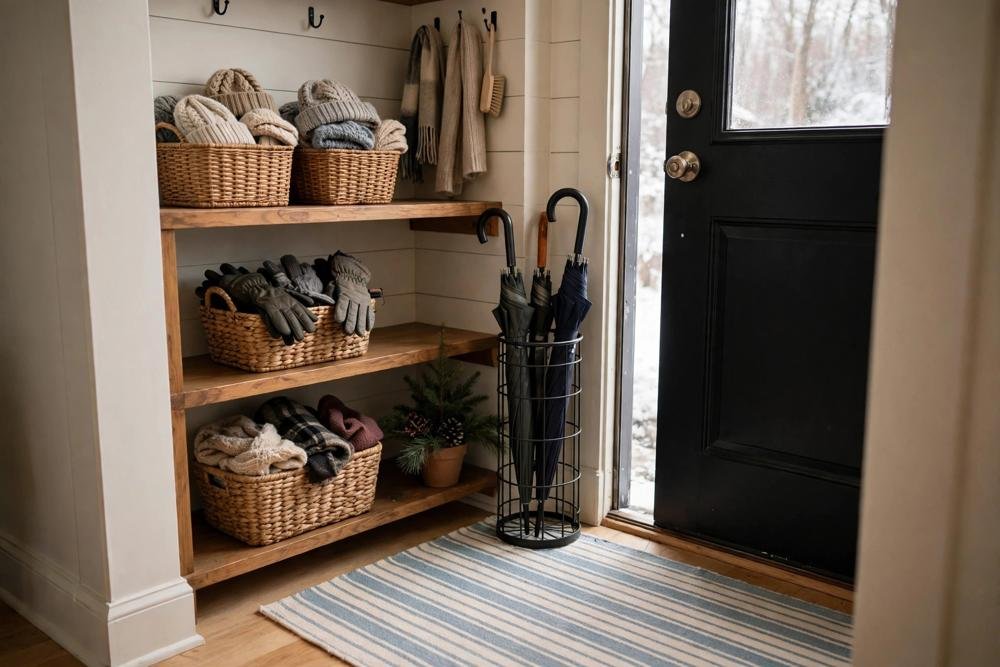
Put the glove basket on a shelf, on the bench, or on a small table beside the hooks, at a height you can reach without bending down to the floor, and without reaching over wet boots. The basket should be open, so you can see what is in it and drop gloves in with one hand, and it should be large enough for the gloves, hats, and scarves that are actually used that week, but not so large that it becomes a dumping ground for everything else. One basket per household, or one small basket per person in a larger household, works better than a deep box where gloves sink to the bottom and are never found.
Keep pairs together by habit, not by hope. When gloves come off, they go straight into the basket, as a pair, not into a coat pocket, not onto the bench, and not into a different basket. The same rule works for hats and scarves: they go into the basket, or onto a hook beside it, every time, so the morning search is a quick look in one place, not a search through coats, bags, and rooms. If a glove is lost, check the basket first, then the coat pockets, then the car or bag, in that order, and the lost glove will usually be in the first place you looked.
Scarves need a little more room than gloves, because they are longer and they tangle. A hook beside the basket, or a small shelf above it, gives scarves a place to hang without tangling with gloves, and it keeps them dry and easy to grab. Hand warmers, lip balm, and other small winter items can go in a small tray inside the basket, or in a small pouch beside it, so they do not sink to the bottom. The point is not to buy more containers. It is to give every small thing one place, in one basket, by the door, so the corner does not fill with small things left in different places.
Umbrella Stand, Bags, and the Door Itself
An umbrella stand is a small piece of furniture that causes a large amount of annoyance when it is in the wrong place. Put it beside the door, on the side where you naturally put an umbrella down when you come in, and where it does not block the door swing, the walkway, or the boot tray. A tall, narrow stand works well in a corner, because it uses vertical space, but it must be stable, so it does not tip when a wet umbrella is dropped into it, and it must have a drip tray or a waterproof base, so water does not run onto the floor.
Empty the umbrella stand when umbrellas are dry. A stand that holds three wet umbrellas, two dry umbrellas, and a walking stick that has not been used for months is not an umbrella stand, it is a cupboard, and it will block the door and collect dust. Keep one umbrella per person in the stand in winter, plus one spare if you have room, and store the rest elsewhere. When an umbrella is dry, it can go back to a cupboard or a hook, and the stand is free for the next wet umbrella.
Bags need the same treatment. A school bag, a work bag, or a shopping bag that is left on the bench will block the bench, and a bag left on the floor will block the walkway and get wet. Give bags a hook, or a place on a shelf, beside the drying hooks, at a height that is easy to reach, and keep the bench clear for sitting down to change boots. If bags are heavy, use a hook that is fixed to the wall, with landlord permission if you drill, rather than an adhesive hook that may fail under a heavy bag, and check the weight limit before you rely on it.
The door itself is part of winter organization, because a door that is hard to open, or that lets in a draught, will make the corner harder to use. Check that the door opens fully without hitting the boot tray, the umbrella stand, or a bench, and that the walkway from the door to the next room is clear, approximately 75 to 90 cm as a general comfort guide, not a building code. If the door sticks in damp weather, or if a draught comes in under it, a draught strip or a door sweep can help, and it will also keep cold air out of the corner, which helps coats and boots dry more comfortably. Keep the exit route clear at all times, and do not let winter storage, however tidy, block the way out.
Rotation Plan: What Stays, What Goes
Winter rotation is the habit that keeps a small corner working all season, and it is simple: what you wear this week stays in the corner, what you do not wear this week goes elsewhere, and the corner is checked once a week, or once a month, to see what has crept in.
Start the season by clearing the corner completely. Take everything out, clean the tray, wash the runner, wipe the hooks and shelves, and then put back only what you will wear in the next week or two: one heavy coat per person, one pair of winter boots per person, one set of gloves, hat, and scarf per person, and one umbrella per person. Everything else, including lighter jackets, summer shoes, and coats that are not needed yet, goes to a wardrobe, a cupboard, or a storage box elsewhere. That first clear out is the hardest part, and it is also the part that makes the rest of the season easy, because the corner starts empty and only fills with things that are actually used.
During the season, rotate when the weather changes, not when the corner overflows. When a cold snap ends, or when a coat is no longer needed every day, move it out and bring in the lighter coat that is needed instead. When boots are no longer wet every day, move the boot tray to a smaller tray, or move the boots to a shoe rack and keep the tray for rainy days only. When gloves wear out, or when a hat is no longer used, take it out of the basket, rather than leaving it there to take up room. A weekly five minute check, on the same day each week, is enough to catch the things that have crept in: a second coat, a pair of shoes that should be elsewhere, a bag that should be in another room, or a scarf that has been left on the bench.
At the end of winter, do the same clear out in reverse. Wash the runner, clean the tray, wipe the hooks, and put winter coats, boots, and accessories into storage elsewhere, so the corner is ready for lighter spring gear. A corner that is cleared at the end of winter will be easy to set up again next winter, because the tray, hooks, and basket are already there, and the habit of rotating is already in place. The corner does not need to hold winter all year, and it should not, because a corner that holds winter gear in summer is a corner that has no room for summer gear.
One Weekend Setup Plan
You can set up a winter corner entryway in one weekend, without buying a full mudroom, and without a renovation, by working in order: clear, measure, place, and then live with it for a week before you buy anything else.
On Saturday morning, clear the corner completely and clean it. Take everything out, sweep or vacuum the floor, wipe the walls and shelves, and wash or shake out any existing mat or runner. Then measure the corner, as in the corner storage guide: width along both walls at floor, bench, and hook height, depth from the wall into the room, and the door swing arc, marked on the floor with masking tape. Check the walkway you must keep clear, and check skirting boards, switches, and sockets, so you do not place a hook over a switch or a tray over a socket.
On Saturday afternoon, place the wet zone first. Put the boot tray where boots naturally land, put the washable runner from the door to the next room, and put a mat by the door if you use one. Then place the drying hooks, at adult height and, if needed, at child height, with space between them for air, and with landlord permission if you drill, or with adhesive hooks checked for weight limits if you do not drill. Put the glove basket on a shelf or bench beside the hooks, and put the umbrella stand beside the door, where it does not block the walkway or the door swing.
On Sunday, put back only the winter things you will wear that week, one coat, one pair of boots, and one set of gloves, hat, and scarf per person, plus one umbrella per person. Then live with that setup for a week, and notice what works and what does not: is the tray large enough, are the hooks far enough apart, is the basket easy to reach, does the runner stay flat, does anything block the door or the walkway. After a week, adjust one thing at a time, rather than buying a new piece of furniture for every small problem. Most winter corners need a small adjustment, like moving a hook, or a larger tray, not a new unit.
Keep the setup simple, and keep the safety notes from this series in mind throughout: anchor any tall unit to the wall, check adhesive hook weight limits, keep the exit route and door swing clear, and get landlord permission before drilling. A winter corner that is safe, clear, and easy to clean will be used every day, and a winter corner that is crammed, blocked, or hard to clean will be avoided, however good it looks in a photograph.
Small Corners, Shared Homes, and Pets
A very small corner needs the same system, just smaller. One boot tray, one row of hooks, one glove basket, and one umbrella stand, all in miniature, will work in a corner that is only a metre wide, provided the walkway stays clear and the door swing is not blocked. Use wall space, not floor space, for hooks and shelves, and use a bench that is also storage, or a stool that can be moved, rather than a large hall tree that fills the corner. If a hall tree would block the walkway, a hook rail plus a shoe tray will serve you better, as in the corner storage guide.
In a shared home, the system needs to be clear enough for everyone to use without a daily reminder. One hook per person, one basket section per person, and one pair of boots per person, with names or colours for children if that helps, will keep the corner fair and easy to use. Put hooks at a height children can reach, or children will not use them, and keep the glove basket where children can reach it too, so gloves go into the basket and not onto the floor. A weekly check, shared between household members, will catch the things that have crept in, and it will keep the corner from becoming one person’s job alone.
Pets add a towel, a lead hook, and a place for a wet coat to drip, near the door, but not in the wet zone where it will get splashed by boots. A towel on a hook beside the drying hooks, a lead on a small hook by the door, and a tray or mat for a wet pet coat, will keep pets comfortable and the corner clean, without taking up much room. Keep pet items out of the glove basket, and keep the glove basket out of reach of pets that like to chew, if that is a problem in your home. A stroller, if it lives by the door, needs its own clear space, not a space borrowed from the walkway, and it must not block the exit route, as in the earlier guides in this series.
What to Skip in Winter
Skip a full wardrobe in the corner, because it will dominate the space, block light, and make the corner feel like a cupboard, and because winter coats need air to dry, not a closed door. Skip a row of cubbies for every family member if the corner is only a metre wide, because cubbies need depth and width that a small corner does not have, and because cubbies fill with things that are not used every day. Skip a tall unit that cannot be anchored safely, and skip a unit that covers a plug socket, a radiator, or a light switch, because you will regret that placement every day.
Avoid overloading hooks, especially adhesive hooks, with heavy wet coats, because a hook that fails will drop a wet coat onto the floor and onto clean shoes, and it will damage the wall. Check weight limits, and use fixed hooks for heavy coats if you can, with landlord permission if you drill. Avoid placing a drying rack where it blocks the walkway, or where wet coats drip onto electrical items, and avoid letting a boot tray, a bench, or a basket narrow the walkway below a comfortable pass. If the walkway feels tight when you carry a bag or a child through it, the winter storage is too deep, even if it fits on paper.
Avoid buying winter storage before you have measured, and avoid buying a complete set before you have lived with a simpler layout for a week. A boot tray, a hook rail, a glove basket, and a washable runner will teach you more about your winter corner in a week than a photograph of a full mudroom will teach you in a month. If a basket is full, remove something before you buy another basket. If a tray is full, clean it and rotate boots out before you buy a larger tray. Most overflowing winter corners are not short of furniture. They are holding too many non daily items in a daily space.
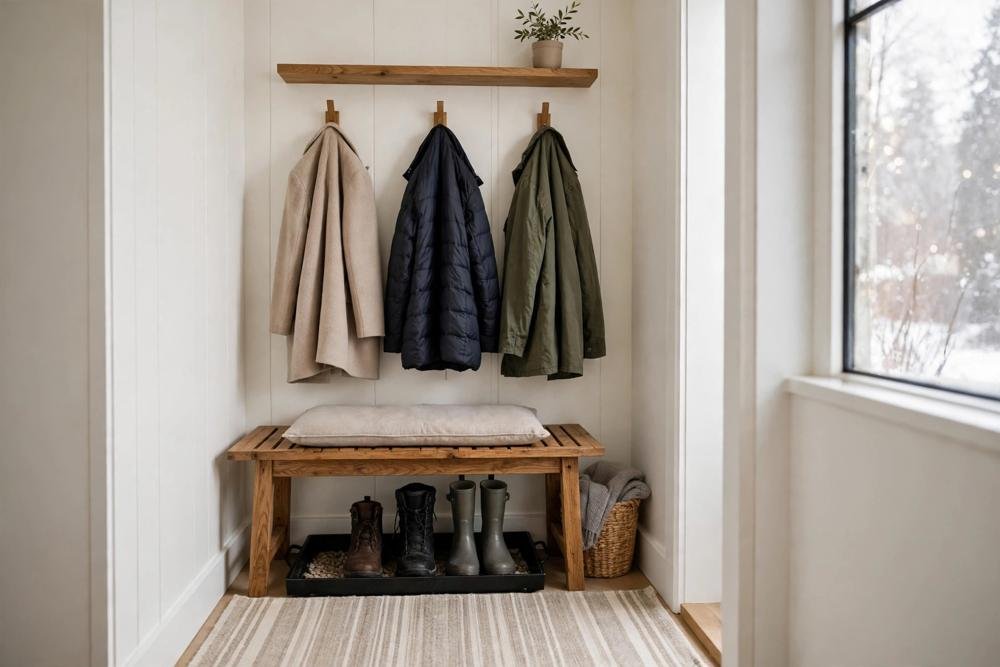
Checklist: Winter Corner in One Weekend
- Clear the corner completely, clean the floor, walls, tray, and runner, and measure width, depth, and door swing.
- Place the wet zone first: boot tray where boots land, washable runner from door to next room, mat by the door if you use one.
- Place drying hooks with air between them, at adult height and child height if needed, checking weight limits and landlord permission.
- Place the glove basket at easy reach beside the hooks, and the umbrella stand beside the door, clear of the walkway and door swing.
- Put back only one coat, one pair of boots, and one set of gloves, hat, and scarf per person, plus one umbrella per person.
- Live with the setup for a week, then adjust one thing at a time, rather than buying a new unit for every small problem.
- Keep the exit route and door swing clear, anchor tall units, and clean the tray and runner weekly, with a five minute reset each evening.
- Rotate out of season items to a wardrobe or storage box elsewhere, and check the corner weekly for things that have crept in.
Conclusion
Winter entryway organization is not about buying a mudroom. It is about giving wet things a place to land, dry things a place to wait, and small things a place to be found, in a corner that stays clear, safe, and easy to clean. A boot tray with a raised edge, drying hooks with air around them, a glove basket by the hooks, an umbrella stand beside the door, and a washable runner under it all, set up in one weekend and kept working with a weekly check and a daily five minute reset, will keep a small corner tidy through the coldest months, without blocking the door, the walkway, or the exit route.
Measure first, place the wet zone first, keep one coat and one pair of boots per person in the corner, and rotate everything else out. Done that way, winter will still be wet and cold outside, but coming home will be easier, leaving home will be faster, and the corner by the door will stay a place you use every day, not a place you avoid until spring.
Related reading
- Corner Entryway Ideas for a Tight Corner
- Mini Mudroom Entryway Ideas for Apartments and Small Homes
- Corner Storage Ideas for Entryways
- Rug Calculator
Hallway Corner Ideas, Renter-Friendly Corner Entryway, Bench and Hall Tree Size Guide, Budget Entryway Makeover, Open Entryway Ideas, Functional Entryway Zones, Entryway Corner Decor, and Entryway Storage for Kids and Pets, in this series, to follow.
Frequently Asked Questions
How do I stop wet boots from ruining the floor in a small entryway?
Put a boot tray with a raised edge where boots land, and a washable runner from the door to the next room, and keep both clean. The tray catches water and grit, the runner protects the floor between the door and the rest of the home, and a weekly clean, plus a wipe when the tray fills, will keep mud and salt from spreading.
How many coats should I keep in a winter entryway?
Keep one coat per person in the corner, plus one drying hook free for a wet coat that is drying. Store other coats in a wardrobe or cupboard elsewhere, and rotate them in when the weather changes. A corner that holds every coat will be crammed, and coats that are crammed together will not dry properly.
How do I dry wet coats in a small corner without them smelling damp?
Give each coat its own hook with air around it, let it drip onto a tray or washable mat, and let air move through the corner, by leaving a door open when you can. Do not hang wet coats over a radiator or heater, and move coats to a wardrobe once they are dry, so the drying hooks are free for the next wet coat.
What is the best way to store gloves, hats, and scarves by the door?
Use an open glove basket on a shelf or bench beside the hooks, at easy reach, and put gloves in as a pair every time, not into a coat pocket. Give scarves a hook beside the basket, so they do not tangle with gloves, and keep small items like hand warmers in a small tray inside the basket, so they do not sink to the bottom.
Do I need a mudroom for winter entryway organization?
No. A small corner with a boot tray, drying hooks, a glove basket, an umbrella stand, and a washable runner will work, provided the walkway and door swing stay clear and the corner is rotated weekly. A full mudroom is helpful if you have room for it, but it is not needed for a tidy winter corner.
How often should I clean a winter entryway?
Do a five minute reset each evening, putting gloves in the basket, coats on hooks, and boots on the tray, and a fuller clean once a week, emptying and wiping the tray, washing or shaking out the runner, and removing anything that has crept into the corner and should live elsewhere. That routine will keep the corner working all winter, without a large clean up at the end of the season.