Adire and mudcloth are two handmade textiles, with rich patterns and a long craft history, that can add warmth, pattern, and character to a home. They look similar at a glance, both are patterned, earthy, and handmade, but they come from different traditions, and they suit different uses. Here is where and how to use Adire and mudcloth fabric in your home, with respect for the makers behind them.
Key takeaways
- Adire is a Yoruba resist-dyed textile from Nigeria, usually indigo, with patterns made by tying, stitching, or painting resist before dyeing.
- Mudcloth, or bogolan, is a Malian textile, traditionally made with mud dye on handwoven cotton, in earth tones and geometric patterns.
- Both textiles suit cushions, throws, wall hangings, and table runners, best, where they can be seen and touched, without heavy wear.
- Buy from makers, fair-trade shops, and Black-owned businesses where you can, and ask about origin and making, rather than buying mass-produced copies presented as authentic.
- Do not use a textile whose pattern has a specific cultural or ceremonial meaning, as mere decoration, without learning about it, and do not copy a specific community’s pattern without understanding it.
1. What Adire Is
Adire is a Yoruba textile tradition from Nigeria, made by resist dyeing: a pattern is made on cloth by tying, stitching, folding, or painting a resist, such as starch, before the cloth is dyed, usually in indigo. When the resist is removed, the pattern appears, in white or light blue, against the deep indigo background.
Adire patterns vary widely, from simple geometric shapes to detailed scenes, and they are made by hand, so each piece is unique, with small variations that show the maker’s hand. Modern Adire is also made in other colours, not only indigo, and it is used for clothing, cushions, throws, and wall hangings, as well as traditional dress.
Adire is not a generic “African print.” It is a specific Yoruba craft, with a history and a technique, and it deserves to be named and credited as such, when you buy and display it. Ask the seller about the maker, the technique, and the origin, if you can, and choose pieces made by Yoruba makers or workshops, where possible.
2. What Mudcloth Is
Mudcloth, also called bogolan or bogolanfini, is a Malian textile tradition, made by dyeing handwoven cotton with mud, after patterns are painted with a resist. The result is usually earth tones, black, brown, cream, and rust, with bold geometric patterns, such as lines, dots, triangles, and symbols.
Traditionally, mudcloth patterns could carry meanings, and different patterns and motifs could be associated with different stories, life stages, or communities. Modern mudcloth, made for home decor, often uses general geometric patterns, rather than specific ceremonial motifs, but it is still important to learn about a piece, and to avoid using a pattern with a specific meaning, as mere decoration, without understanding it.
Mudcloth is usually heavier than Adire, because it is made on handwoven cotton, and it suits cushions, throws, wall hangings, and table runners, where its texture and pattern can be seen. It is less suited to heavy upholstery, unless it is made for that purpose, because handwoven cotton can wear with heavy daily use.

3. Where to Use Adire in Your Home
Adire suits a home where indigo and white, or indigo and cream, will work with your existing colours. It is a strong pattern, so use it as an accent, not on every surface, in a small room.
Cushions: Adire cushion covers, in indigo, on a plain sofa, are the easiest Adire use, because they add pattern and colour, without committing to a whole room. Throws: an Adire throw, over a sofa or a bed, adds indigo and pattern, and it can be moved seasonally. Wall hangings: a framed Adire panel, or a hanging Adire cloth, on one wall, makes a statement, without needing a whole wall of pattern.
Table runners: an Adire table runner, on a wooden dining table, adds indigo and pattern to a dining room, and it can be removed for cleaning. Bedding: an Adire duvet cover or pillow set, in a bedroom, gives a bold, calm indigo feeling, especially with white walls and wooden furniture.
Avoid using Adire on very heavy wear surfaces, such as a dining chair seat that is used daily, unless the textile is made for upholstery, because handmade Adire can fade and wear with heavy use and frequent washing. Wash Adire gently, in cold water, and dry it away from strong sun, so the indigo does not fade quickly.
4. Where to Use Mudcloth in Your Home
Mudcloth suits a home where earth tones, black, brown, cream, and rust, will work with warm wood, rattan, and plants. It is a bold geometric pattern, so use it as an accent, in the same way as Adire, not on every surface.
Cushions: mudcloth cushion covers, in black and cream, or brown and cream, on a plain sofa, are the easiest mudcloth use, and they pair well with Adire cushions, if you keep the colours calm. Throws: a mudcloth throw, over a sofa or a chair, adds texture and pattern, and it can be layered with a plain throw, so the room does not feel too patterned.
Wall hangings: a mudcloth wall hanging, on one wall, makes a bold statement, especially in a living room or bedroom, with plain walls and wooden furniture. Table runners and placemats: mudcloth table runners, in earth tones, suit a wooden dining table well, and they can be wiped or washed, depending on the textile, so check the care label.
Avoid using mudcloth on surfaces that get very wet, such as a bathroom, or on very heavy wear surfaces, unless it is made for that purpose, because handwoven cotton can wear and stain with heavy use. Clean mudcloth gently, following the maker’s care instructions, and avoid harsh chemicals that can damage the mud dye.
5. Using Adire and Mudcloth Together
Adire and mudcloth can be used together, if you keep the palette calm and the patterns balanced. Indigo Adire and black-and-cream mudcloth, for example, work well together, because both are bold patterns, but in a limited palette, with cream as the common colour.
Use one textile as the lead, and the other as an accent: Adire cushions, with one mudcloth throw, or mudcloth cushions, with one Adire wall hanging, so the room does not feel like two competing patterns. Keep the rest of the room plain, cream walls, simple furniture, and wooden accents, so the textiles stand out.
Do not mix Adire and mudcloth with many other bold patterns at once, because the room will feel busy, rather than curated. One or two patterned textiles, in a calm palette, with plain furniture and plants, is the rule for using these textiles well in a small room.

6. Buying Respectfully: Makers, Fair Trade, and Copies
Buying Adire and mudcloth respectfully matters, because these are handmade crafts, with makers who deserve credit and fair pay, and because mass-produced copies can undercut makers.
Where you can, buy from makers, fair-trade shops, and Black-owned businesses, and ask about the origin, the technique, and the maker, if you can. A handmade Adire or mudcloth piece, made by a named maker or workshop, carries a story and a skill, and it supports the maker directly. A mass-produced copy, presented as authentic Adire or mudcloth, does not, and it can undercut makers.
Avoid shops that present mass-produced prints as handmade Adire or mudcloth, or that use a community’s name or pattern without credit or context. If a listing does not say who made a piece, where it was made, or how it was made, ask, or choose a different piece, from a seller who does.
Keep a note of where each piece came from, especially for textiles and art, so you can tell visitors about it honestly, and so you can buy from the same maker again. A home built this way grows over time, with pieces that have a story, rather than a home bought in one shopping trip, with pieces that look the same in every home.
7. Care: Washing, Sun, and Wear
Handmade textiles need gentle care, so they last. Wash Adire and mudcloth gently, in cold water, with a mild detergent, and dry them away from strong sun, so colours do not fade quickly. Do not use bleach or harsh chemicals, because they can damage indigo dye and mud dye.
Keep Adire and mudcloth away from very strong, direct sunlight for long periods, if you can, because sun can fade indigo and earth tones over time. Rotate cushions and throws occasionally, so wear is even, and store textiles clean and dry, when not in use, so they do not mildew.
If a textile gets stained, treat it promptly, with a gentle cleaner, following the maker’s instructions, rather than scrubbing harshly, because scrubbing can damage handmade dye and weave. For a valuable or very old piece, a textile cleaner, or a maker, is a better choice than a home remedy.
8. Small-Room Plan for Adire and Mudcloth
Here is a simple plan for using Adire and mudcloth in a small living room.
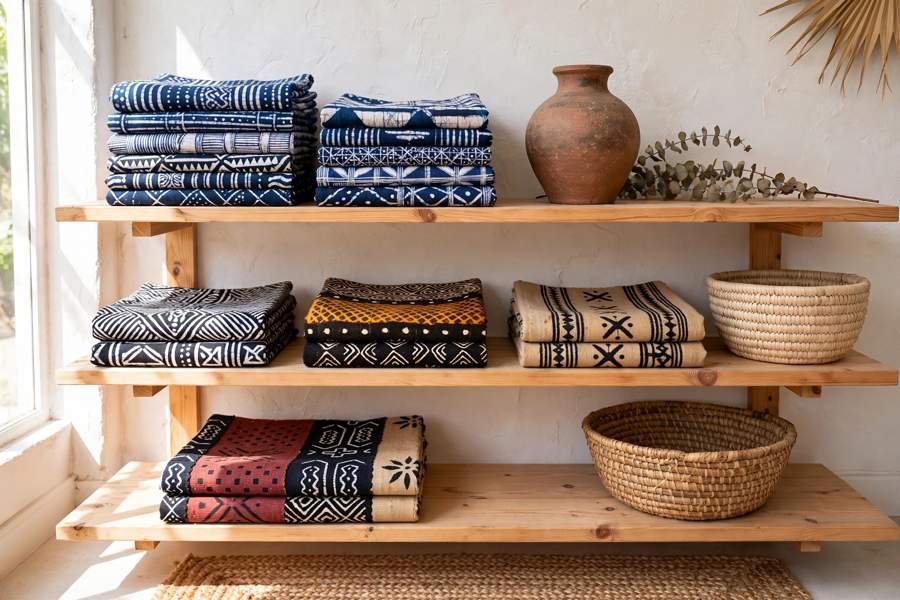
Base: cream or white walls, a simple sofa in a plain fabric, and a wooden coffee table. Textiles: two Adire cushion covers, in indigo, and one mudcloth throw, in black and cream, or the reverse, mudcloth cushions and one Adire throw, so one textile leads and the other accents.
Wall: one framed Adire or mudcloth panel, on one wall, at eye level, with space around it. Accessories: a clay vase, a woven basket, and a plant, in earth tones, so the room feels warm and natural, not just patterned.
This plan uses one or two patterned textiles, in a calm palette, with plain furniture and plants, so the room feels rich and personal, without feeling crowded or copied.

What to Avoid
- Do not buy mass-produced copies presented as handmade Adire or mudcloth, when a maker-made piece is available.
- Do not use a textile whose pattern has a specific cultural or ceremonial meaning, as mere decoration, without learning about it.
- Do not copy a specific community’s pattern without understanding it, and do not present a general geometric print as a specific traditional textile.
- Do not use Adire and mudcloth on every surface at once. One lead textile, and one accent, with a calm base, is the rule.
- Do not wash handmade textiles harshly, with bleach or hot water, or dry them in strong sun, because dye and weave can be damaged.
- Do not use mudcloth or Adire on very wet or very heavy wear surfaces, unless the textile is made for that purpose.
Conclusion
Adire and mudcloth are beautiful, handmade textiles, with different traditions, Adire as Yoruba resist-dyed indigo from Nigeria, and mudcloth as Malian mud-dyed handwoven cotton, and they suit a home best as accents, cushions, throws, wall hangings, and table runners, where they can be seen and touched, without heavy wear. Use one as the lead and the other as an accent, in a calm palette, with plain furniture and plants, so the room feels rich, not crowded. Buy from makers, fair-trade shops, and Black-owned businesses where you can, ask about origin and making, keep a note of where each piece came from, and care for textiles gently, so they last. The result is a home that honours the makers and traditions behind these textiles, not just their patterns.
FAQs
What is the difference between Adire and mudcloth?
Adire is a Yoruba resist-dyed textile from Nigeria, usually indigo, made by tying, stitching, or painting resist before dyeing. Mudcloth, or bogolan, is a Malian textile, made by dyeing handwoven cotton with mud, in earth tones and geometric patterns. They come from different traditions, and they suit different colour palettes.
Where can I use Adire in my home?
Adire suits cushions, throws, wall hangings, table runners, and bedding, where indigo and white or cream will work with your existing colours. Use it as an accent, not on every surface, and wash it gently in cold water, away from strong sun, so the indigo does not fade quickly.
Where can I use mudcloth in my home?
Mudcloth suits cushions, throws, wall hangings, table runners, and placemats, where earth tones, black, brown, cream, and rust, will work with warm wood, rattan, and plants. Use it as an accent, and clean it gently, following the maker’s care instructions, so the mud dye is not damaged.
Can I use Adire and mudcloth together?
Yes, if you keep the palette calm and the patterns balanced. Use one textile as the lead, and the other as an accent, for example Adire cushions with one mudcloth throw, and keep the rest of the room plain, so the textiles stand out without competing.
How do I buy Adire and mudcloth respectfully?
Buy from makers, fair-trade shops, and Black-owned businesses where you can, and ask about the origin, technique, and maker. Avoid mass-produced copies presented as authentic, and avoid shops that use a community’s name or pattern without credit or context.
How do I care for Adire and mudcloth?
Wash gently in cold water with a mild detergent, dry away from strong sun, and avoid bleach or harsh chemicals, because they can damage indigo and mud dye. Rotate cushions and throws occasionally, so wear is even, and store textiles clean and dry, when not in use.