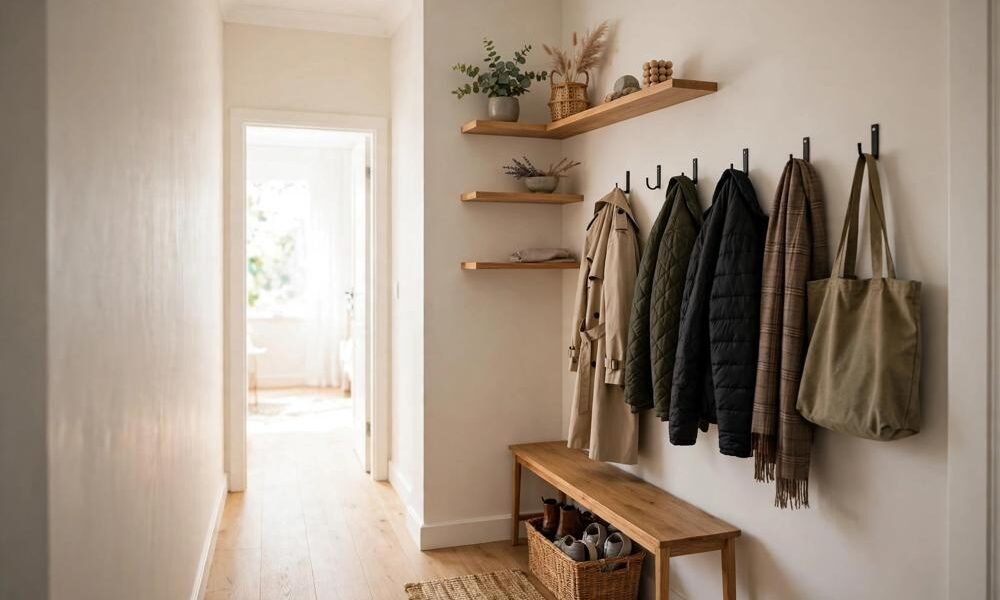
A hallway corner is the hardest corner in a home to furnish well, because it has to do two jobs at once: it has to hold coats, shoes, keys, and bags, and it has to stay a clear path for everyone who walks through it, often carrying bags, children, or a laundry basket, and often in a hurry. Hallway corner ideas work when the furniture is slim, the storage is on the wall where possible, the walkway is measured and protected, and nothing in the corner forces people to turn sideways to get past.
Key takeaways
- Measure the hallway first: total width, door swing arcs, and the walkway you must keep clear, approximately 75 to 90 cm as a general comfort guide, not a building code.
- Use wall storage first in a narrow hallway: slim shelves and wall hooks take no floor space, while a deep bench or cabinet can block the path.
- Keep depth shallow: shelves approximately 15 to 25 cm deep, a bench approximately 30 to 40 cm deep, and a shoe rack approximately 25 to 35 cm deep, approximately, checking each product listing.
- Put the bench where you can sit without blocking the path, and put shoe storage under it, not beside it in the walkway.
- Light the corner well, especially a dark hallway corner, with a small wall light or a light that does not stick far out from the wall.
- Keep one coat, one pair of shoes, and one bag per person in the hallway corner, and store the rest elsewhere.
Measure the Hallway Before You Buy Anything
A hallway corner fails when a piece of furniture is bought for the corner, rather than for the hallway it sits in. Start by measuring the hallway itself, not just the corner. Measure the total width of the hallway at the corner, and at a few points along it, because hallways are not always the same width all the way along, and a hallway that is wide at one end can be narrow where a door frame, a radiator, or a cupboard door sticks out.
Next, measure the door swing arcs. Every door that opens into the hallway, including the front door, bedroom doors, and cupboard doors, has an arc, and nothing fixed should sit inside that arc, or the door will hit it, or will not open fully. Mark each arc on the floor with masking tape, then walk through the hallway, open each door fully, and check that the path stays comfortable. A bench, a shoe rack, or a cabinet that sits inside a door arc will be hit every day, and it will make the hallway feel blocked, even if it fits on paper.
Then measure the walkway you must keep clear. In this series, approximately 75 to 90 cm is used as a general comfort guide for a walkway, not a building code, and it is a useful guide for a hallway too, because it is wide enough for most people to walk through comfortably, carrying a bag, without turning sideways. If the hallway itself is only 90 cm wide, you cannot add floor furniture that sticks out into it without narrowing the walkway below a comfortable width, and in that case, wall storage is the right answer, not floor furniture. If the hallway is wider, you have room for a narrow bench, but only if the bench depth, plus the walkway, still fits comfortably within the hallway width.
Also check the walls at several heights, as in the corner storage guide. A hallway corner may be wide at floor level and narrow at hook height, where a door frame or a light switch sits, or it may have a skirting board that pushes a flat-back unit away from the wall at the bottom. Note any plug socket, radiator, switch, or thermostat on either wall, because a tall unit that covers one of those will be a daily annoyance, and a hook rail over a switch will be hit every time someone reaches for a coat.
Draw a simple diagram on paper, described here in words: two lines for the hallway walls, a shaded strip for the walkway you must keep clear, curved arcs for each door swing, and a rectangle for each piece of furniture you are considering, with its width and depth marked. That sketch, even if it is rough, will show you, before you buy, whether a bench will block a door, whether a shelf will sit over a switch, and whether a shoe rack will narrow the walkway too much.
Slim Shelves: The Best First Step in a Narrow Hallway
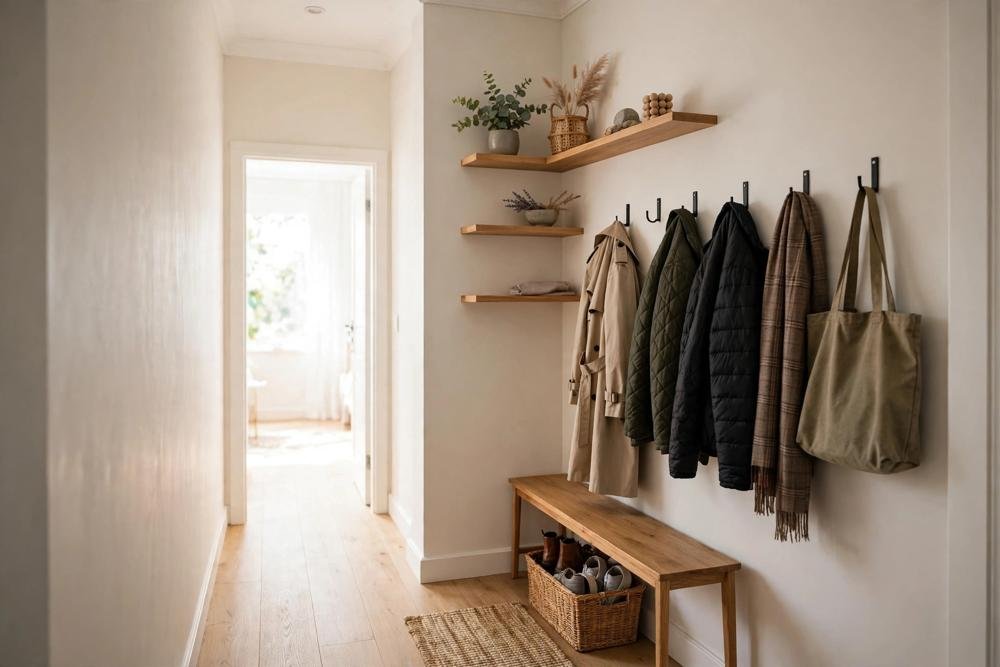
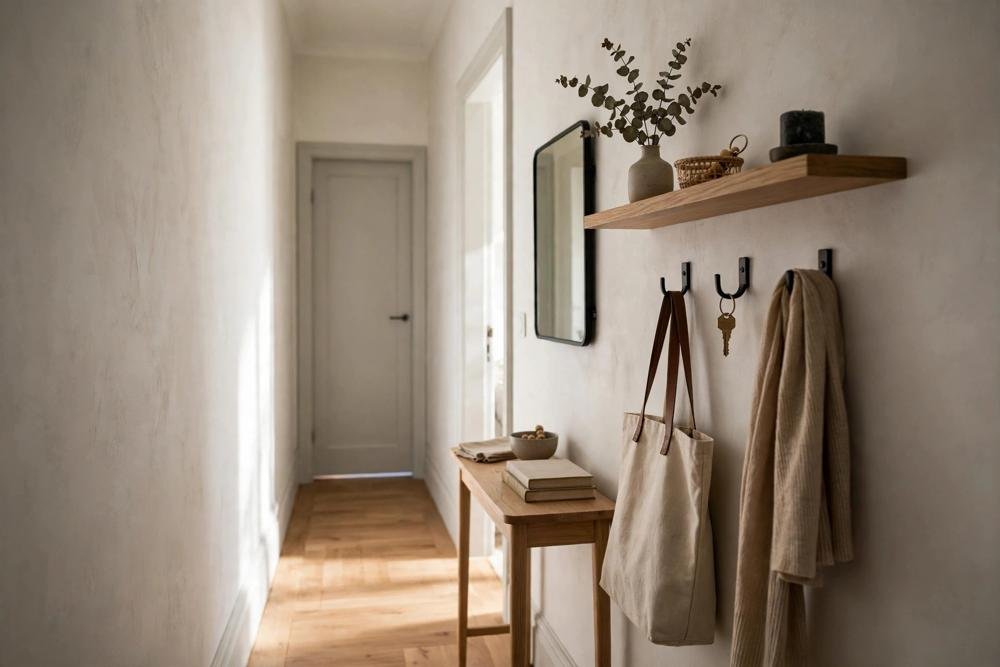
Slim shelves are the best first step in a narrow hallway corner, because they use wall space, not floor space, and they can hold the small things that otherwise end up on the floor or on a bench: keys, a small tray, a plant, a book, or a hat. A shelf that is approximately 15 to 25 cm deep is usually enough for those items, and it will not stick out far enough to catch a shoulder or a bag as someone walks past, provided it is placed above shoulder height, or above the height where bags swing.
Place slim shelves in the corner itself, where the two walls meet, or along one wall just past the corner, where they are easy to reach when you come in, but not where they block a door or a light switch. A triangular corner shelf, as in the corner storage guide, fits into the corner itself and takes very little wall length, while a straight shelf along one wall gives you more length, but needs more wall space. Choose the shape that fits your measurements, not the shape that looks best in a photograph of a wider hallway.
Use shelves for light items only, and check weight limits before you load them. A shelf that holds keys, a small tray, and a plant will stay up for years, while a shelf loaded with books, bags, and boots will fail, and a falling shelf in a hallway is a safety problem, not just a mess. Fix shelves with fixings suited to your wall type, and get landlord permission before drilling if you rent, as with any wall fixing in this series. If you cannot drill, a freestanding slim shelf unit, or a leaning shelf, can work, but only if it is stable, anchored if it is tall, and does not block the walkway.
Do not put a shelf where it will be hit by a door, or where it will block a light, and do not put a shelf so low that it becomes a place to dump bags and coats, rather than a place for small items. Shelves work best when they have one job: a key shelf by the door, a small shelf for a plant and a tray in the corner, and a higher shelf for hats or bags that are not needed every day. Keep the shelf clear, and the hallway will feel wider, because the eye can see the wall, rather than a pile of things.
Wall Hooks and a Narrow Bench
Wall hooks are the second wall storage step, after shelves, and they are the step that solves coats and bags in a narrow hallway, without taking floor space. A hook rail, or a row of separate hooks, on the wall beside the door, or along one wall of the hallway, gives each coat and bag a place, and it keeps them off the bench and off the floor, where they would block the walkway.
For most adults, hooks at approximately 165 to 175 cm are a comfortable height, with a lower hook for children if children use the hallway, so children can hang their own coats and use the system. Space hooks further apart than you think you need, so coats have air around them and do not press against each other, and so bags do not swing into the walkway. If wall space is tight, use a second row of hooks lower down for lighter items, like scarves and bags, and keep the top row for coats only, as in the winter entryway guide.
Check weight limits on adhesive hooks before you hang a heavy coat or bag on them, and use fixed hooks, with landlord permission if you drill, for heavy items. A hook that fails will drop a coat onto the floor, into the walkway, and it will damage the wall. A hook rail fixed to the wall, with several fixings, will hold more weight than a single adhesive hook, and it will spread the load across the wall, which is safer in a hallway where coats are hung and taken down every day.
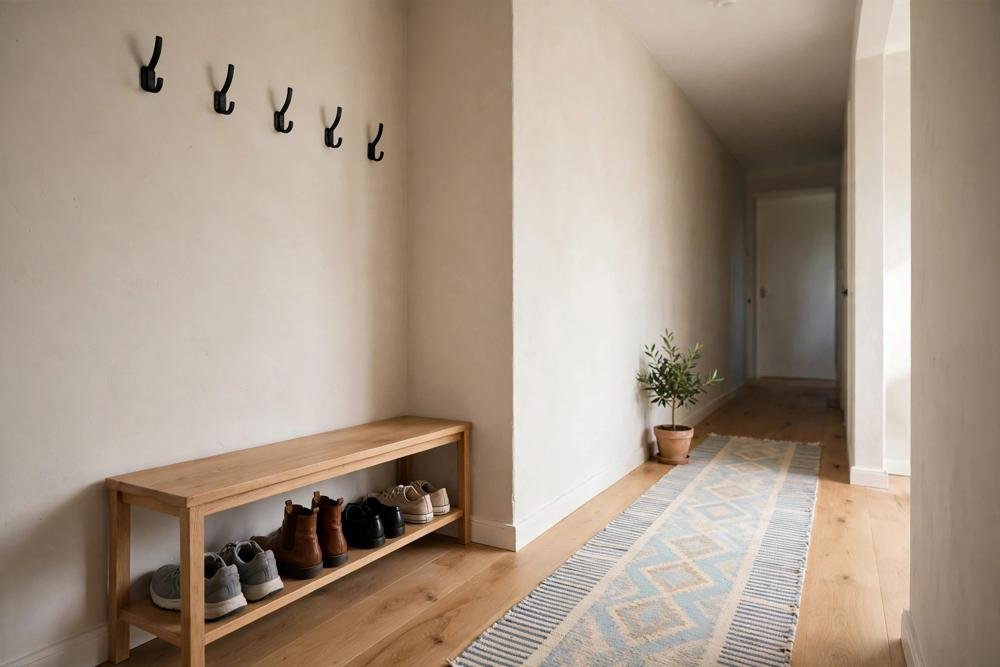
A narrow bench is the floor furniture that works in a hallway, but only if it is truly narrow, and only if it is placed where sitting down does not block the path. A bench approximately 30 to 40 cm deep is a typical range, but check the product listing, and, more importantly, check that the walkway stays comfortable once the bench is in place. A bench that is 40 cm deep in a hallway that is 120 cm wide will leave approximately 80 cm of walkway, which is comfortable by the guide above, while the same bench in a hallway that is 90 cm wide will leave only approximately 50 cm, which is not comfortable, and in that case, a stool that can be moved, or no bench at all, is better than a bench that blocks the path.
Put shoe storage under the bench, not beside it, so shoes do not spill into the walkway. Baskets, a shoe rack, or a tray under the bench will hold one pair of shoes per person, and they will keep shoes out of the path, while still being easy to reach when you sit down. Keep the bench top clear, except for a small tray for keys if you do not have a shelf for them, and do not let the bench become a place to dump bags, coats, and parcels, or it will stop being a place to sit and will become another obstacle in the hallway.
Lighting, Mirrors, and Dark Hallway Corners
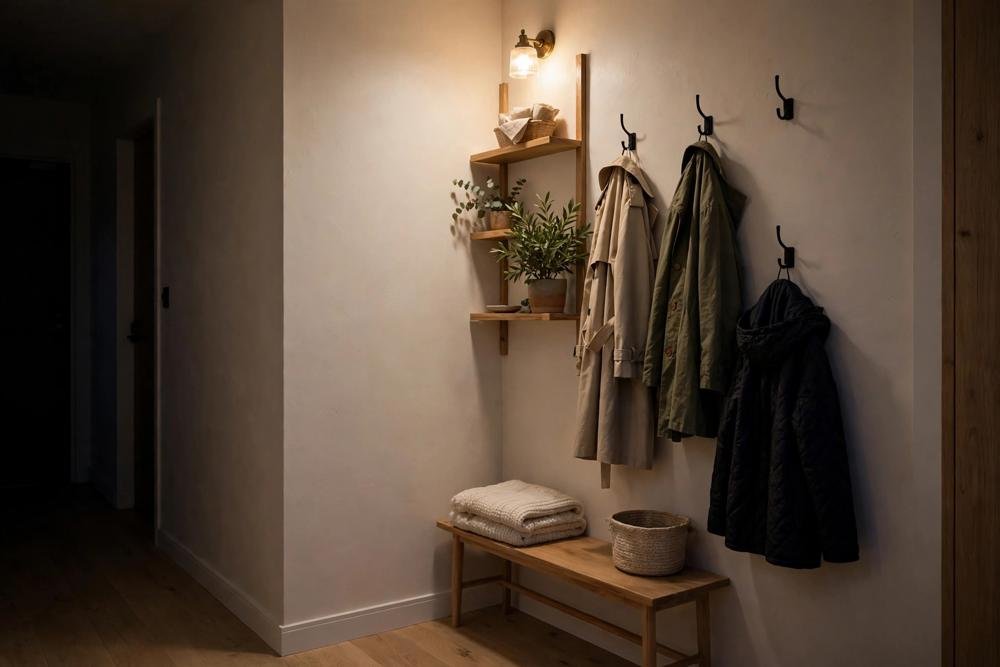
Hallway corners are often dark, because they are away from windows, and because a tall unit or a closed door blocks light. A dark corner feels narrower than it is, and it makes it harder to find coats, shoes, and keys, especially in winter, when people come home in the dark. Lighting the corner well will make the hallway feel wider, safer, and easier to use, without adding furniture.
Use a small wall light, or a ceiling light, that does not stick far out from the wall, so it does not catch a shoulder or a bag as someone walks past. A wall light with a slim profile, or a light that is recessed into the ceiling, will light the corner without narrowing the hallway, while a large pendant light, or a light that hangs low, will block the path and will be hit by tall people or by coats on hooks. If you cannot change the lighting, a small plug in light, or a battery light, on a shelf, can help, but keep it away from fabric and from anything that could fall onto it, and do not use a light that gets hot near coats or scarves.
A mirror in a hallway corner can make the space feel wider and brighter, because it reflects light and the view down the hallway, but only if it is placed where it does not block the walkway or a door, and only if it is fixed safely to the wall. A small mirror above a slim shelf, or above a narrow console table, works well, while a large leaning mirror in a narrow hallway will block the path and will be a tipping risk, especially in a home with children or pets. Fix a mirror with fixings suited to its weight and your wall type, and get landlord permission before drilling if you rent.
Keep the corner light in colour as well as in lighting. Light walls, a light runner, and a light bench will make a narrow hallway feel wider, while dark furniture and dark walls will make it feel narrower, even if the measurements are the same. That does not mean a hallway must be white, but it does mean that a dark, tall unit in a narrow, dark hallway will make the hallway feel cramped, while a light, slim shelf and a light bench will make the same hallway feel open. Choose light, slim pieces for a narrow hallway, and save dark, tall pieces for a wider room.
Turning Corners, Doors, and Shared Hallways
A hallway corner is not just a corner, it is a turning point, where people change direction, and where doors open and close. That turning point needs more clear space than a straight hallway, because people need room to turn without hitting furniture, and because bags, children, and pets need room to turn too. Keep the corner itself clear, with no furniture that sticks out into the turning space, and put storage on the walls just past the corner, rather than in the corner itself, if the corner is very tight.
Doors are the other turning point problem. A door that opens into a hallway corner will hit furniture, or will not open fully, if furniture is placed inside its arc, and a door that is hard to open will make the hallway harder to use every day. Check every door arc, as above, and place furniture outside those arcs, even if that means the furniture is a little further from the front door than you would like. A bench that is a step further along the hallway, but outside a door arc, will be used every day, while a bench inside a door arc will be hit every day and will be moved, or will damage the door.
In a shared hallway, or a hallway used by several people at once, the system needs to be clear enough for everyone to use without a daily reminder. One hook per person, one basket section per person, and one pair of shoes per person, with hooks at a height children can reach, will keep the hallway fair and easy to use. A weekly check, shared between household members, will catch the things that have crept in: a second coat, a pair of shoes that should be elsewhere, a bag that should be in another room, or a parcel that has been left in the hallway.
Pets and strollers add the same turning point problem, in miniature. A pet that runs around a corner needs room to turn, and a stroller that is parked in a hallway corner needs its own clear space, not a space borrowed from the walkway, and it must not block the exit route, as in the earlier guides in this series. If a stroller lives in the hallway, storage may need to be smaller, not larger, to leave room for the stroller to stand safely without blocking the door swing or the walkway.
What Fits a Hallway Corner, and What Does Not
A hallway corner fits slim, wall based storage, a narrow bench, and a small amount of floor storage under that bench, provided the walkway stays clear and the door arcs stay clear. It fits one coat, one pair of shoes, and one bag per person, plus a small tray for keys, and it fits a light, a mirror, and a plant, if those do not block the path. It does not fit a full wardrobe, a deep cabinet, a large hall tree, or a row of cubbies, because those pieces need depth and width that a narrow hallway does not have, and because they will block the walkway, the door arcs, or both.
A hallway corner also does not fit storage that is not used every day. A hallway is a daily space, not a storage room, and a hallway corner that holds out of season coats, spare shoes, and bags that are not used that week will fill up quickly, and will stop being a useful entryway. Rotate out of season items to a wardrobe or a storage box elsewhere, as in the winter entryway guide, and keep the hallway corner for daily items only. A weekly check, on the same day each week, will catch the things that have crept in, and it will keep the hallway working all year, without a large clean up.
Prices and sizes for hallway furniture vary by product, shop, and country, so check the listing before you buy, and check every size against your measurements, including depth, height, and door swing for cabinets, and weight limits for shelves and hooks. A piece that fits on paper, but does not fit your hallway once the door arcs and walkway are marked, is not a good buy, however good it looks in a photograph. Measure first, choose slim wall storage first, add a narrow bench only if the walkway stays comfortable, and live with that layout for a few weeks before you add more.
Checklist: Hallway Corner Without Blocking the Path
- Measure hallway width at several points, door swing arcs, and the walkway you must keep clear, approximately 75 to 90 cm as a comfort guide.
- Check skirting boards, door trim, switches, sockets, radiators, and thermostats on both walls, at several heights.
- Place slim shelves first, approximately 15 to 25 cm deep, for keys, a tray, a plant, or a hat, above shoulder height where possible.
- Place wall hooks next, at adult height and child height if needed, with space between them, checking weight limits and landlord permission.
- Add a narrow bench only if the walkway stays comfortable, approximately 30 to 40 cm deep, with shoe storage underneath, not beside it.
- Light the corner with a slim wall or ceiling light, and add a small mirror above a shelf or console if it does not block the path.
- Keep the corner itself clear for turning, keep all door arcs clear, and keep the exit route clear at all times.
- Keep one coat, one pair of shoes, and one bag per person in the hallway corner, and rotate everything else out weekly.
Conclusion
Hallway corner ideas work when the hallway is measured first, the storage is slim and wall based where possible, and the walkway is protected, not borrowed. Slim shelves for small things, wall hooks for coats and bags, and a narrow bench with shoe storage underneath, if the hallway is wide enough for it, will give a narrow hallway corner everything it needs, without turning it into an obstacle. Light the corner well, keep the turning space and door arcs clear, anchor tall units if you use them, and rotate out of season items weekly, and the hallway corner will stay a clear, useful path, not a place where coats, shoes, and bags pile up.
Measure the hallway, choose slim pieces, protect the walkway, and live with the layout for a few weeks before you add more. Done that way, a hallway corner will make coming home and leaving home easier, without making the hallway harder to walk through, which is the whole point of a hallway in the first place.
Related reading
- Corner Entryway Ideas for a Tight Corner
- Mini Mudroom Entryway Ideas for Apartments and Small Homes
- Corner Storage Ideas for Entryways
- Winter Entryway Organization Ideas for a Tidy Corner
- Rug Calculator
- Renter-Friendly Corner Entryway, Bench and Hall Tree Size Guide, Budget Entryway Makeover, Open Entryway Ideas, Functional Entryway Zones, Entryway Corner Decor, and Entryway Storage for Kids and Pets, in this series, to follow.
Frequently Asked Questions
How much walkway should I leave in a narrow hallway?
Keep approximately 75 to 90 cm clear as a general comfort guide, not a building code, so most people can walk through comfortably carrying a bag, without turning sideways. Measure the hallway width, subtract the depth of any bench or cabinet, and check that the remaining walkway is still comfortable, and that no door arc blocks it.
What is the best storage for a very narrow hallway?
Wall storage first: slim shelves approximately 15 to 25 cm deep for small items, and wall hooks for coats and bags. Wall storage takes no floor space, so it does not narrow the walkway, while a deep bench or cabinet in a very narrow hallway will block the path and should be avoided, or replaced with a movable stool.
How deep should a hallway bench be?
A hallway bench is typically approximately 30 to 40 cm deep, but check the product listing and, more importantly, check that the walkway stays comfortable once the bench is in place. In a hallway that is only 90 cm wide, even a 30 cm bench may narrow the walkway too much, and in that case, no bench, or a movable stool, is better than a bench that blocks the path.
Where should I put hooks in a hallway corner?
Put hooks on the wall beside the door, or along one wall just past the corner, outside any door swing arc, at approximately 165 to 175 cm for most adults, with a lower hook for children if needed. Space hooks apart so coats have air around them, check weight limits, and get landlord permission before drilling if you rent.
How do I light a dark hallway corner?
Use a slim wall light or a ceiling light that does not stick far out from the wall, so it does not catch a shoulder or a bag, and add a small mirror above a shelf or console to reflect light, if it does not block the path. Light walls and light furniture will also make a narrow hallway feel wider and brighter.
Can I put a shoe rack in a hallway corner?
Yes, if it is shallow, approximately 25 to 35 cm deep, and if it sits under a bench or against a wall, outside door arcs, with the walkway still clear. Keep one pair of shoes per person in the hallway, and store other shoes elsewhere, or even a shallow rack will overflow and spill into the walkway.