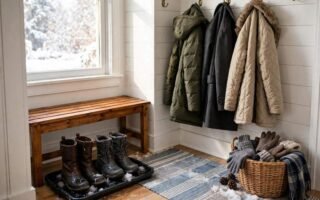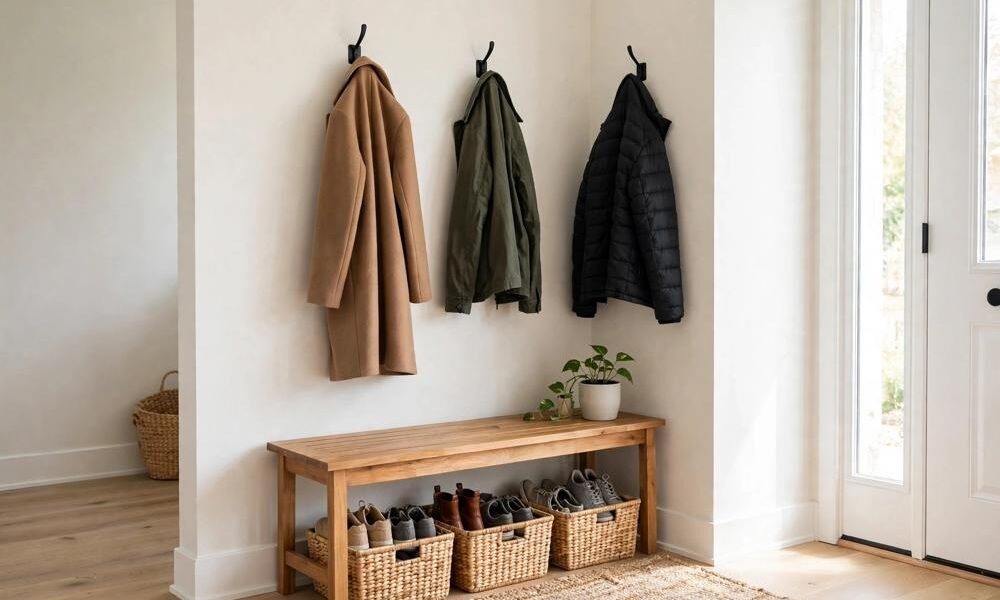
Renter friendly entryway ideas work when nothing you put up leaves a hole, a stain, or a repair bill behind, and when everything you use can be taken down, packed, and used again in the next home. In a corner entryway, that means adhesive hooks used within their weight limits, over door hooks that do not damage the door, tension and freestanding pieces that stand on their own, and leaning shelves that are stable without being screwed to the wall, all arranged so the walkway and door swing stay clear.
Key takeaways
- Check your lease and ask your landlord before you drill, and choose no drill options first, even if drilling is allowed, because no drill pieces move with you.
- Adhesive hooks are for light items only: check the weight limit on the packaging, clean the wall first, and do not overload them with heavy wet coats.
- Over door hooks work well for coats and bags, but check that the door still closes fully and that hooks do not scratch the door or frame.
- Freestanding benches, shoe racks, and coat stands are the safest renter choices, because they need no fixing at all and can be moved in minutes.
- Leaning shelves must be stable, low, and not overloaded at the top, especially in a home with children or pets.
- Removal is part of the plan: remove adhesive strips slowly, as directed, clean marks, and check the wall and door before you move out.
First, Check What Your Home Allows
Before you buy anything, check what your lease says about fixing things to walls and doors, and ask your landlord if you are unsure. Some leases allow small holes, some allow only adhesive fixings, and some allow nothing at all, and the rules can be different for different walls, for example, a tiled wall, a plasterboard wall, and a painted wall may all be treated differently. Getting permission in writing, even in a short message, will save a dispute at the end of a tenancy, and it will tell you whether a fixed hook rail is an option at all, or whether you should stick to no drill options from the start.
Even if drilling is allowed, no drill options are often better for a renter, because they move with you. A fixed hook rail stays behind, or leaves holes to fill, while an adhesive hook, an over door rack, and a freestanding bench can be packed and used in the next home, often in a different corner, with a different layout. That flexibility is worth more than a slightly stronger fixing, especially if you move often, or if you are not sure how long you will stay in the current home.
Also check the walls themselves. Adhesive hooks stick well to smooth, clean, painted walls and to tiles, but they stick poorly to rough, textured, or dusty walls, and they may not stick at all to wallpaper that is loose, or to a wall that is damp. Test one hook in a hidden spot first, leave it for a day with a light item on it, and see if it holds, before you hang a coat on it. If the test hook fails, that wall is not suitable for adhesive hooks, and you should use a freestanding or over door option instead, rather than buying stronger adhesive and hoping it will hold.
Keep the same safety notes as in the rest of this series, even for no drill pieces: keep the exit route and door swing clear, keep the walkway comfortable, approximately 75 to 90 cm as a general comfort guide, not a building code, and do not let a freestanding piece block a door, a radiator, or a light switch. A renter friendly entryway is not just a no drill entryway, it is an entryway that is safe, clear, and easy to remove.
No Drill Options Compared
There are five main no drill options for a corner entryway, and they differ in what they hold, how much floor space they need, how easy they are to remove, and what they cost, approximately. Prices vary by product, shop, and country, so check the listing before you buy, and check weight limits on the packaging, not just in a photograph.
Comparison table:
- Adhesive hooks: capacity light, for keys, scarves, light bags, and a light jacket, not for a heavy wet coat; footprint none, they stick to the wall; price typically low; best for small items and for renters who want a quick, reversible fix, provided the wall is smooth and clean, and the weight limit is respected.
- Over door hooks: capacity medium, for coats and bags, with several hooks on one rack; footprint none on the wall, but the rack sits over the door, so the door must still close fully; price typically low to mid range; best for coats in a home where wall hooks are not allowed, provided the door closes, the rack does not scratch the door, and the door is not a fire door that must not be altered.
- Tension rods and tension shelves: capacity light to medium, for a small shelf or a hanging rail in a narrow space, held by pressure between two walls; footprint small, they fit in a narrow gap; price typically low to mid range; best for a narrow hallway corner where a rod or shelf can be tensioned between walls, provided the walls are strong and the rod is checked regularly, so it does not slip.
- Freestanding bench, shoe rack, and coat stand: capacity medium to high, for coats, shoes, and sitting down, with no fixing at all; footprint largest, they stand on the floor, so they need floor space and a clear walkway; price typically mid range; best for most renters, because they are safe, movable, and easy to remove, provided they are stable and do not block the walkway or door swing.
- Leaning shelves and leaning coat racks: capacity medium, for hats, plants, baskets, and light coats, leaning against the wall; footprint small to medium, they lean, so they need a wall to lean on and a stable floor; price typically mid range; best for a corner where a leaning piece can use vertical space without drilling, provided it is low, stable, not overloaded at the top, and, in a home with children or pets, secured in a way that does not require drilling, or replaced with a lower freestanding piece if it cannot be made stable.
Do not choose an option just because it holds the most. Choose the option that fits your wall, your door, your floor space, and your daily list, and that you can remove cleanly. A freestanding bench plus a row of adhesive hooks for light items will serve most renters better than a large leaning shelf that is overloaded and unstable, or a tension rod that slips every week.
Adhesive Hooks: How to Use Them Well
Adhesive hooks fail for three reasons: the wall was not clean, the hook was overloaded, or the hook was put on a wall it cannot stick to. Avoid all three, and adhesive hooks will work well for light items, for a long time.
Clean the wall first, with a dry cloth, or with a mild cleaner if the wall is dirty, and let it dry completely before you stick the hook on. Do not stick a hook on a dusty, greasy, or damp wall, and do not stick it on wallpaper that is peeling, or on a wall that has just been painted and is still curing. Press the hook firmly for the time directed on the packaging, usually about 30 seconds, and then wait the time directed, often an hour or more, before you hang anything on it. A hook that is loaded immediately will fail, even if it would have held after waiting.
Check the weight limit, and respect it. A hook rated for 1 kg will not hold a heavy wet coat that weighs more than that, and a hook rated for 3 kg will not hold three coats that together weigh more than that. Use adhesive hooks for keys, scarves, a light bag, a hat, or a light jacket, and use a freestanding coat stand or an over door rack for heavy coats. If you are unsure how heavy a coat is, weigh it on a bathroom scale, or hold it and compare it to a bag of sugar, approximately 1 kg, to get a sense of its weight, rather than guessing.
Place adhesive hooks where they will not be knocked by a door, and where they will not block a light switch or a socket. A hook beside the door, at approximately 165 to 175 cm for most adults, with a lower hook for children if needed, works well, as in the earlier guides, provided the wall is suitable and the hook is within its limit. Space hooks apart, so coats and bags do not press against each other, and so a hook that fails does not drop a coat onto another hook and overload it.
Over Door, Tension, and Freestanding Options
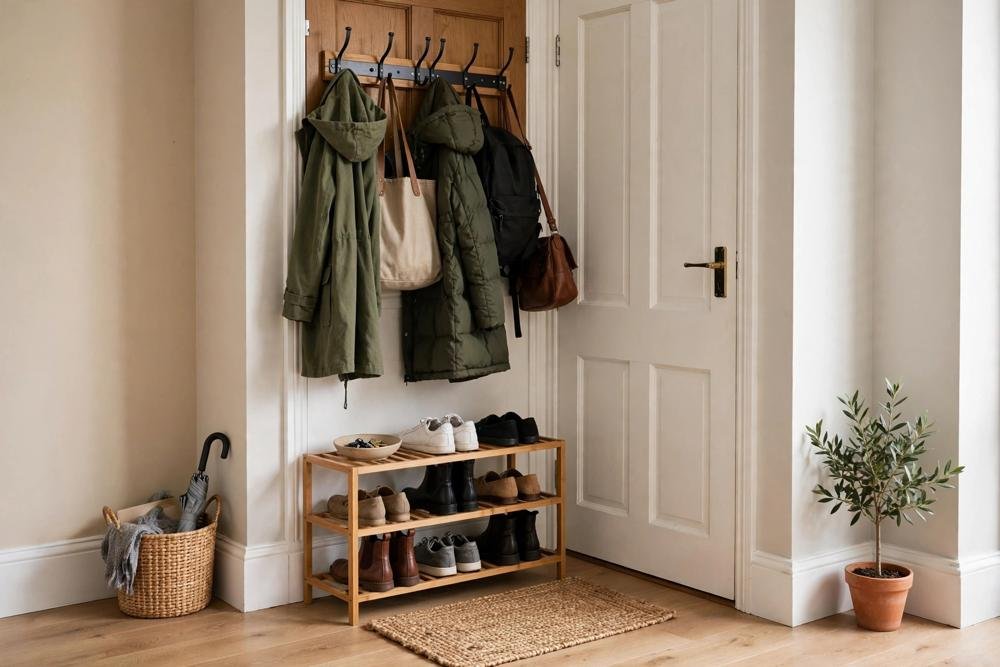
Over door hooks are a simple, effective renter option, because they need no fixing and they can hold several coats and bags at once. Check three things before you use one: the door still closes fully, with the rack on it, without forcing it; the rack does not scratch the door or the frame, especially if the door is painted or varnished; and the door is not a fire door, or a door that must not be altered, in a shared building, where adding a rack could be a safety issue. If the door does not close, or if the rack scratches the door, use a different door, or a freestanding coat stand instead.
Put a small felt pad, or a piece of soft cloth, between the rack and the door if the rack is metal and the door is painted, to prevent scratches, and check the door and frame regularly for marks, especially in the first week. Remove the rack when you move out, wipe the door and frame, and check for any marks that need cleaning, before you hand the keys back.
Tension rods and tension shelves work in a narrow gap between two walls, held by pressure, with no screws. They are useful for a small shelf in a hallway corner, or for a hanging rail for coats in a narrow space, but they need walls that are strong and parallel, and they need to be checked regularly, because a rod that slips will drop everything on it. Do not use a tension rod for heavy coats, and do not use it where a falling rod could hit someone, or block an exit route. If the walls are not parallel, or if the rod slips repeatedly, use a freestanding piece instead.
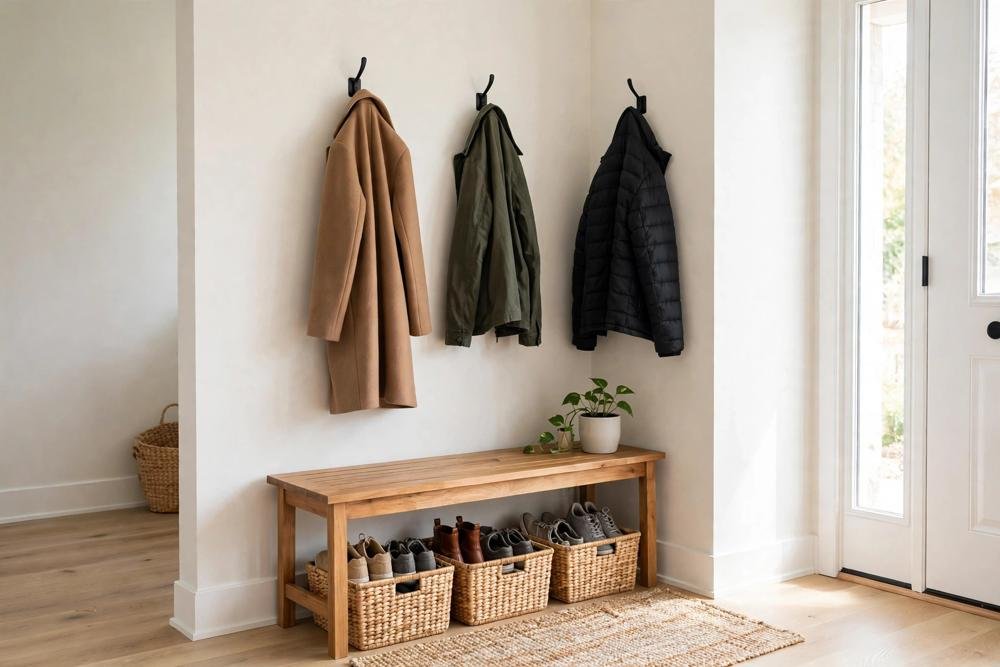
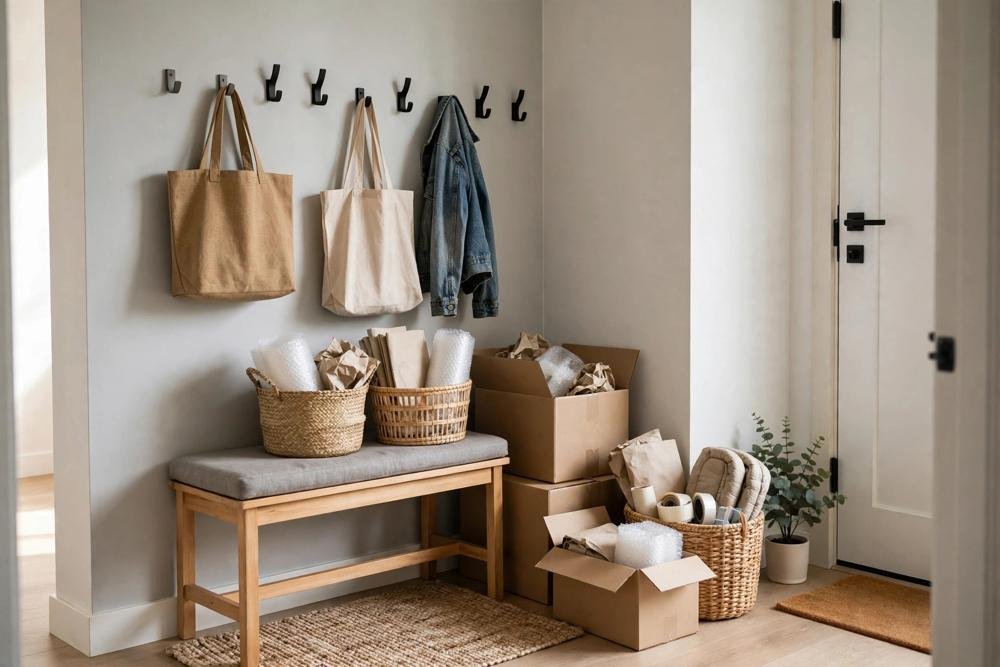
Freestanding benches, shoe racks, and coat stands are the safest renter choices, because they need no fixing, no adhesive, and no door alteration, and they can be moved in minutes. A freestanding bench approximately 30 to 40 cm deep, with shoe storage underneath, as in the hallway guide, will work in most corners, provided the walkway stays comfortable and the door swing stays clear. A freestanding coat stand will hold coats without a wall hook, but it must be stable, with a wide base, so it does not tip when a heavy coat is hung on one side, and it must not block the walkway. A freestanding shoe rack, approximately 25 to 35 cm deep, will hold shoes without a wall fixing, and it can be moved to clean under it, which is a practical advantage in a rented home.
Leaning Shelves and What to Avoid
Leaning shelves use vertical space without drilling, by leaning against the wall, with the bottom on the floor and the top resting against the wall. They work well for light items: hats, plants, baskets, and books, on lower shelves, and they can make a corner look tidy, because they use height that a bench cannot use. They do not work well for heavy items on high shelves, because a leaning shelf that is top heavy can tip forward, especially if it is bumped, or if a child or pet pulls on it.
Keep a leaning shelf low, if you can, and keep heavy items on the lowest shelves, with light items on the highest shelves, so the shelf is bottom heavy and stable. Do not put a leaning shelf where it blocks a door, a radiator, or an exit route, and do not put it on an uneven floor where it wobbles. If the shelf wobbles, move it to a flat part of the floor, or use a freestanding shelf with a wider base instead. In a home with children or pets, a leaning shelf that cannot be made stable should be replaced with a lower, freestanding piece, rather than risking a tip, and tall leaning pieces should never be used as a substitute for a fixed, anchored unit if anchoring is needed for safety.
Avoid adhesive hooks on a wall that is not suitable, even if the packaging says the hook will stick to any surface, because a hook that fails will damage the wall when it falls, and it will drop a coat onto the floor. Avoid over door racks on a fire door, or on a door that does not close with the rack on it, because a door that does not close is a safety and security problem, not just an inconvenience. Avoid tension rods for heavy loads, and avoid freestanding pieces that are unstable, or that block the walkway, even if they look good in a photograph. A renter friendly entryway that is unsafe, or that blocks the exit, is not renter friendly at all.
Avoid buying a complete no drill set before you have tested one piece. Buy one adhesive hook, or one over door rack, test it for a week, and see if it holds, if the door still closes, and if the piece fits your daily routine, before you buy a full set. That test will save money and wall damage, and it will tell you whether adhesive, over door, or freestanding is the right main option for your home, rather than a guess from a photograph.
Removal Steps: Leave the Home as You Found It
Removal is part of a renter friendly entryway, not an afterthought, and it should be planned from the start, so moving out is easy, not stressful. For adhesive hooks, follow the removal directions on the packaging, usually to pull the strip slowly downwards, at a low angle, rather than pulling it outwards, which can damage paint. Remove the hook slowly, with one hand holding the wall, and clean any mark with a damp cloth, or with a mild cleaner, as directed for your wall type. If a mark remains, note it, and check whether it can be cleaned, or whether it needs a touch up, before you hand the keys back.
For over door racks, lift the rack off the door, wipe the door and frame, and check for scratches or marks, especially where the rack sat on the top of the door and on the frame. Clean any marks, and note any damage that cannot be cleaned, so you can tell your landlord honestly, rather than leaving it to be found later. For tension rods and shelves, release the tension slowly, with a hand on the rod, so it does not spring out and hit the wall or a person, and wipe the walls where the rod sat, to remove any marks.
For freestanding and leaning pieces, simply move them out, sweep or vacuum under them, and wipe the floor and wall where they sat, to remove dust and marks. Check the floor for scratches from a bench or shoe rack that was dragged, rather than lifted, and lift pieces when you move them, rather than dragging them, to avoid floor damage. Take photographs of the corner before you move in, and again after you move out, so you have a record of the condition, and so any dispute about damage can be checked against the photographs.

Small Corners, Shared Homes, and Moving Day
A very small rented corner needs the same system, just smaller: one freestanding bench or shoe rack, one over door rack or a few adhesive hooks for light items, and one basket for gloves and keys, all in miniature, provided the walkway stays clear and the door swing is not blocked. Use wall space for light items, and floor space only for a narrow bench or rack, and keep the corner itself clear for turning, as in the hallway guide.
In a shared rented home, the system needs to be clear enough for everyone to use without a daily reminder, and easy to remove when one person moves out. One hook per person, one basket section per person, and one pair of shoes per person, with hooks at a height children can reach if children live there, will keep the corner fair and easy to use, and will make moving out simpler, because each person can take their own hooks and baskets with them, without leaving holes or marks behind.
On moving day, pack the entryway first, or last, depending on your plan, but pack it in order: remove adhesive hooks slowly, lift over door racks off doors, release tension rods slowly, and lift freestanding pieces out, rather than dragging them. Clean the corner, check the walls, doors, and floor, take photographs, and leave the corner as you found it, or better, with the floor swept and the walls wiped. That final clean, and those photographs, will make the end of a tenancy smoother, and will leave a good record for your next landlord, as well as for yourself.
What to Skip as a Renter
Skip a fixed hook rail if you are not allowed to drill, and skip it even if you are allowed, if you plan to move soon, because a fixed rail leaves holes, or stays behind, while a freestanding or over door option moves with you. Skip adhesive hooks for heavy coats, skip over door racks on a door that does not close, skip tension rods for heavy loads, and skip leaning shelves that are top heavy or unstable, because each of those will fail, damage a wall or door, or create a safety problem, however good it looks in a photograph.
Skip a large hall tree, or a tall unit, in a rented corner, unless it can be used freestanding, safely, without anchoring, and without blocking the walkway, because a tall unit that needs anchoring is not a renter friendly unit, and a tall unit that cannot be anchored safely should not be used in a home with children or pets. Skip a unit that covers a plug socket, a radiator, or a light switch, because you will regret that placement every day, and because it may be a safety issue in a rented home where you cannot move the socket or radiator.
Checklist: Renter Friendly Corner Without Damage
- Check your lease and ask your landlord in writing before you drill, and choose no drill options first.
- Test one adhesive hook in a hidden spot, on a clean, dry, smooth wall, and wait the directed time before loading it.
- Check weight limits on adhesive hooks, and use them for light items only, not heavy wet coats.
- Check that an over door rack lets the door close fully, does not scratch the door, and is not on a fire door.
- Choose freestanding benches, shoe racks, and coat stands where possible, with a stable base and a clear walkway.
- Keep leaning shelves low, bottom heavy, and stable, and replace them with a lower freestanding piece if they wobble or tip.
- Keep the exit route, door swing, and walkway clear, approximately 75 to 90 cm as a comfort guide.
- Remove adhesive strips slowly as directed, clean walls, doors, and floors, and photograph the corner before and after.
Conclusion
Renter friendly entryway ideas are not about doing less, they are about doing it in a way that leaves no damage behind. Adhesive hooks for light items, over door racks for coats, tension pieces for narrow gaps, and, most safely, freestanding benches, shoe racks, and coat stands, plus leaning shelves kept low and stable, will give a rented corner entryway everything it needs, without drilling, without holes, and without a repair bill at the end of a tenancy. Check your lease, test one hook first, respect weight limits, keep the walkway and exit clear, and plan removal from the start, and the corner will work every day, and will move with you when you move, which is the whole point of a renter friendly home.
Measure the corner, choose no drill options that fit your wall, door, and floor space, live with them for a week, and adjust one thing at a time. Done that way, a rented entryway will be tidy, safe, and easy to leave behind, in good condition, when the time comes to move on.
Related reading
- Corner Entryway Ideas for a Tight Corner
- Mini Mudroom Entryway Ideas for Apartments and Small Homes
- Corner Storage Ideas for Entryways
- Winter Entryway Organization Ideas for a Tidy Corner
- Hallway Corner Ideas for Narrow Hallways
- Rug Calculator
- Bench and Hall Tree Size Guide, Budget Entryway Makeover, Open Entryway Ideas, Functional Entryway Zones, Entryway Corner Decor, and Entryway Storage for Kids and Pets, in this series, to follow.
Frequently Asked Questions
Can I use adhesive hooks for heavy winter coats?
No, adhesive hooks are for light items only, like keys, scarves, a light bag, or a light jacket. Check the weight limit on the packaging, clean the wall first, and wait the directed time before loading the hook. Use a freestanding coat stand or an over door rack for heavy wet coats, which weigh more than most adhesive hooks are rated for.
Will over door hooks damage my door?
An over door rack should not damage a door if the door still closes fully and the rack does not scratch the door or frame, but check regularly, especially in the first week, and use a felt pad between a metal rack and a painted door if needed. Do not use an over door rack on a fire door, or on a door that does not close with the rack on it.
How do I remove adhesive hooks without damaging paint?
Follow the removal directions on the packaging, usually to pull the strip slowly downwards, at a low angle, with one hand holding the wall, rather than pulling outwards. Remove the hook slowly, clean any mark with a damp cloth or mild cleaner, and check the wall before you move out, so any remaining mark can be cleaned or touched up.
What is the safest entryway storage for a renter?
Freestanding benches, shoe racks, and coat stands, because they need no fixing, no adhesive, and no door alteration, and they can be moved in minutes. Choose pieces with a stable, wide base, keep the walkway and door swing clear, and lift, not drag, pieces when you move them, to avoid floor damage.
Can I use a leaning shelf in a rented home?
Yes, if it is low, bottom heavy, and stable, with light items on high shelves and heavy items on low shelves, and if it does not block a door, a radiator, or an exit route. If a leaning shelf wobbles, is top heavy, or cannot be made stable, replace it with a lower freestanding piece, especially in a home with children or pets.
Do I need landlord permission for adhesive hooks?
Check your lease first, and ask your landlord if you are unsure, even for adhesive hooks, because some leases restrict all fixings, including adhesive ones, and because a hook that fails can damage paint. Getting permission in writing, even in a short message, will save a dispute at the end of a tenancy.