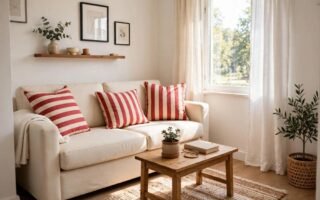
A corner bookshelf turns an empty, awkward corner into a reading nook, a display spot, and a storage zone, without taking up floor space that is needed for walking, sitting, or dining, because it uses vertical space, in a triangular, L shaped, or slim shape, that fits the corner, not the room. Choose a corner bookshelf that fits your corner measurements, with shelves at the right depth for books, approximately 8 to 10 inches, 20 to 25 cm, for most books, and approximately 10 to 12 inches, 25 to 30 cm, for larger books, anchor it safely to the wall, and style it simply, with books in groups, a plant, and empty space, so it feels intentional, not crammed. All measurements in this guide are in inches and cm, as approximate ranges only, and sizes vary by product, so check listings before you buy, and measure your corner first, as in the measuring guide in this series.
Key takeaways
- A corner bookshelf uses vertical space, so it turns an awkward corner into a reading, display, and storage zone, without blocking a walkway.
- Measure first: width at floor, at seat height, and at shelf height, depth, height, door arcs, and walkway, in inches and cm, before you buy.
- Shelf depth approximately 8 to 10 inches, 20 to 25 cm, for most books, and approximately 10 to 12 inches, 25 to 30 cm, for larger books, works best.
- Anchor a tall bookshelf to the wall, using manufacturer hardware and weight limits, with studs or rated anchors, and with landlord permission before drilling.
- Keep heavy books low, light items high, and display items at eye level, so the shelf is stable, easy to use, and good looking.
- Style simply: books in groups, a plant, a vase, or a small object on some shelves, and empty space on others, so the shelf feels intentional, not crammed.
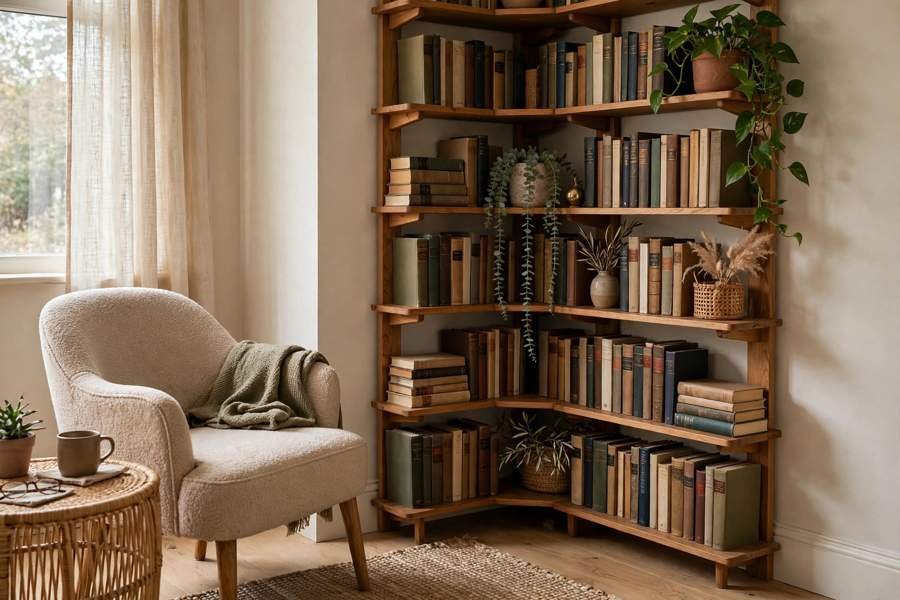
Types of Corner Bookshelves: Triangular, L Shaped, and Slim
Corner bookshelves come in three main types, each with a different shape, and each works best for a different corner, so choose the type that matches your corner measurements, your wall type, and your job, rather than the type that looks best in a photograph, but does not fit your corner. Triangular bookshelves, with a triangular footprint, fit a true corner, where two walls meet at 90 degrees, and they use the corner fully, with shelves that run from wall to wall, in a triangular shape, so they hold more books than a slim shelf, but they need a true corner, with a width and depth that are equal, or close to equal, and they will not fit a corner that is not 90 degrees, or a corner with a door, a window, or a radiator, that blocks one wall.
L shaped bookshelves, with an L footprint, fit a corner where one wall is longer than the other, or where a corner is beside a window, a door, or a sofa, and they use one wall more than the other, with shelves that run along the longer wall, and a shorter return along the shorter wall, so they hold books along a wall, plus a corner display, and they work in a living room, a bedroom, or a hallway, where a full triangular shelf would be too deep, or too wide, for the corner. Slim bookshelves, with a narrow depth, approximately 8 to 10 inches, 20 to 25 cm, fit a hallway corner, a bedroom corner, or a small apartment corner, where space is tight, and where a wide unit would block a walkway, a door, or a window, and they hold books, plants, and display items, in a slim unit that does not push far into the room, but they hold fewer books than a triangular or L shaped shelf, and they need anchoring, because they are tall and narrow, and they can tip over, if not anchored.
Choose a type that fits your corner, with a width, depth, and height that leaves a walkway clear, approximately 30 to 36 inches, 75 to 90 cm, as a comfort guide, not a building code, and with a height that you can reach, without climbing, for daily books, and with higher shelves for display items you do not use every day. Avoid a type that is too large, too deep, or too tall, for the corner, because it will block a walkway, a door, or a window, and it will make the room feel cramped, even if it is tidy, and avoid a type that is not anchored, because it is a safety risk, not just a wobble, and it must be anchored, following its instructions. For a general awkward corner overview, see the awkward corner pillar in this series, which links to this guide, and to the other Furniture guides, as they go live.
Measuring and Fitting: Width, Depth, Height, and Walkway
Measuring a corner bookshelf starts with the corner itself, not the bookshelf, because a bookshelf that fits on paper, but does not fit in the room, with doors open, chairs pulled out, and walkways clear, will not work, and it will need to be moved, returned, or replaced. Measure width at floor, at seat height, and at shelf height, because walls are not always straight, and a bookshelf that fits at floor level may not fit at shelf height, if a wall bulges, a skirting board sticks out, or a socket sits at shelf height. Measure depth from the corner to the walkway, and height from floor to ceiling, or to a window sill, a picture rail, or a light switch, that the bookshelf must not block, in inches and cm, with tape on the floor for the bookshelf footprint, and walk through it, open doors, and check at night and in daylight, before you buy, as in the measuring guide.
Use a walkway of approximately 30 to 36 inches, 75 to 90 cm, as a comfort guide, not a building code, so you can walk past the bookshelf easily, even when carrying books, bags, or a child, and so you can get out easily, even in the dark, and so a door can open fully, without hitting the bookshelf. Use a shelf depth of approximately 8 to 10 inches, 20 to 25 cm, for most books, and approximately 10 to 12 inches, 25 to 30 cm, for larger books, so books sit fully on a shelf, without sticking out, and without falling off, and so a shelf that is too shallow will not hold books, and a shelf that is too deep will waste space, and will make books hard to find, because they will be pushed back, behind other books.
Check sockets, switches, radiators, and skirting boards, before you buy, because a bookshelf that blocks a socket will need an extension cord, which will become a trip hazard, a bookshelf that blocks a switch will be moved, or ignored, rather than used, and a bookshelf that blocks a radiator will block heat, and will make the room cold, however tidy it looks. Avoid a bookshelf that is too tall for the corner, because it will block a window, a picture, or a light, and it will make the room feel dark, and avoid a bookshelf that is too wide, because it will block a walkway, a door, or a seating area, and it will make the room feel cramped. Measure first, in inches and cm, with tape on the floor, and live with the footprint for a day, before you buy, so you can see what fits, what does not, and what you actually need.
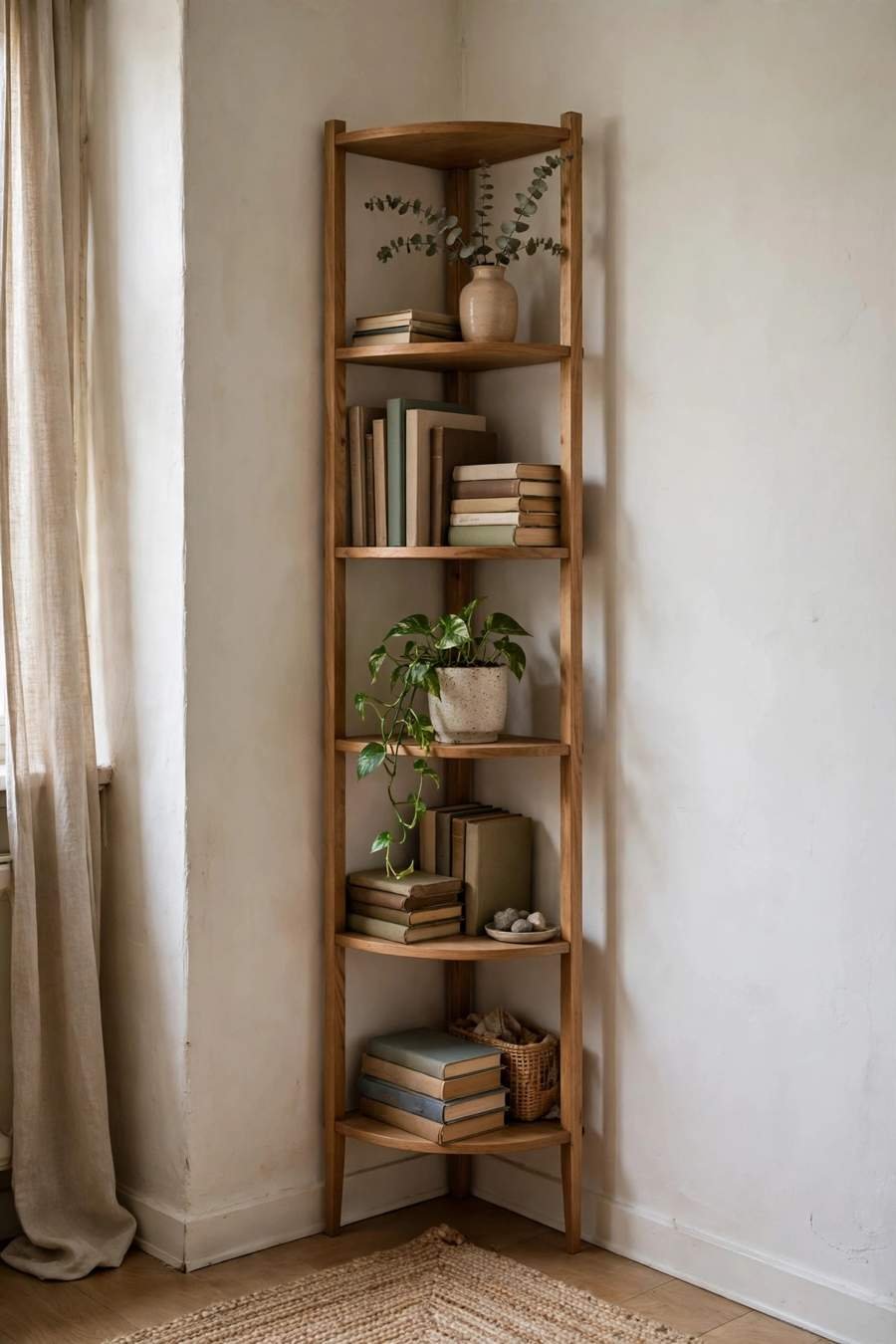
Styling a Corner Bookshelf: Groups, Plants, and Empty Space
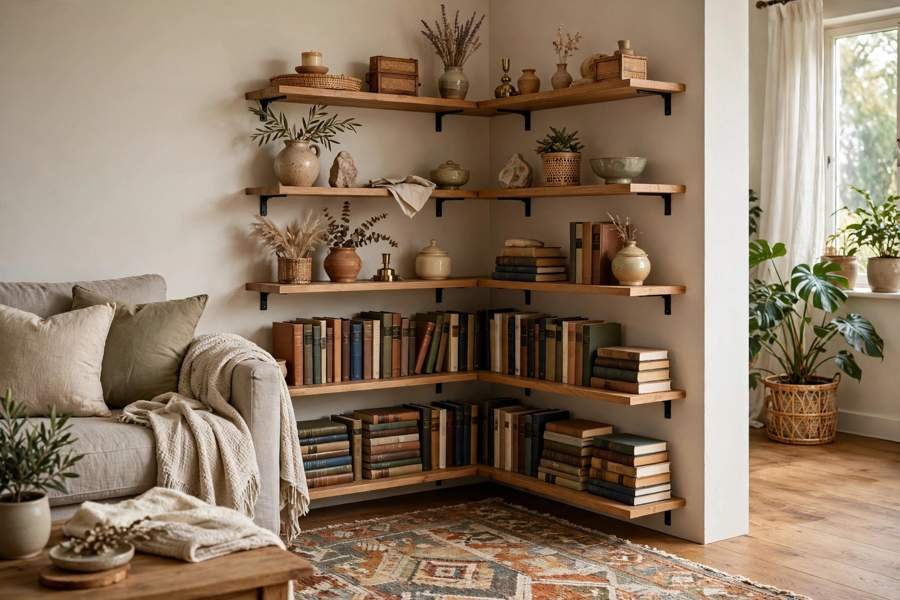
Styling a corner bookshelf simply, as in the shelf styling guide, makes it feel intentional, not crammed, and it makes books easy to find, without pulling out a whole shelf, and it makes the corner feel like a reading nook, not just a storage unit. Start with books in groups, by size, by colour, or by subject, with a group of books standing upright, a group lying flat, and a group with a plant, a vase, or a small object, on top, so the shelf has rhythm, not a solid wall of books, and so each group can be found, without searching, and so the shelf can be changed, without moving every book, when you add a new book, or remove an old one.
Use plants, vases, and small objects, on some shelves, and empty space on others, so the shelf breathes, and so a plant, a vase, or a small object, can be seen, rather than hidden behind books, and so the shelf does not feel like a warehouse, with every shelf full, from wall to wall. Keep heavy books low, light items high, and display items at eye level, so the shelf is stable, easy to use, and good looking, and so a shelf that is top heavy does not become a tipping risk, and so books that are heavy do not need to be lifted high, when they are taken down, or put back. Use baskets, on low shelves, for small items, such as notebooks, magazines, or children’s books, labelled, so each basket has a job, and so small items do not end up in a pile, on a shelf, where they will be forgotten.
Avoid a bookshelf that is full, from wall to wall, on every shelf, because it will feel crammed, it will be hard to find books, and it will be hard to add a new book, without moving many books, and it will make the corner feel dark, and cluttered, however stylish the books look. Avoid a bookshelf that is styled with only display items, and no books, because it will not hold books, and it will become a display unit, not a bookshelf, and books will end up elsewhere, on a table, a sofa, or a floor, where they will be forgotten. Style simply, with books in groups, a plant, and empty space, and live with it for a week, before you add more, so you can see what you actually need, rather than filling every shelf on day one.
Anchoring and Safety: Tall, Narrow, and Top Heavy
Anchoring a corner bookshelf is the most important safety step, because a tall, narrow bookshelf, that is not anchored, can tip over if a child pulls on it, a pet jumps on it, or an adult leans on it, and it can hurt a child, a pet, or an adult, however sturdy it looks, and it must be anchored safely, following manufacturer instructions, as in the anchoring guide. Use manufacturer hardware and weight limits, with studs or rated anchors, and with landlord permission before drilling, because a bookshelf that is anchored with the wrong hardware, or with a weight limit that is guessed, will fail, damage the wall, and fall, and a bookshelf that is anchored safely, with the right hardware, will stay upright, even if a child climbs it, or a pet pulls on it.
Check weight limits for each shelf, not just the whole unit, because a shelf that is overloaded with heavy books will sag, bow, or fail, and books that are overloaded will fall, when a shelf is pulled, and a shelf that is overloaded will make the unit top heavy, and it will become a tipping risk, even if the unit is anchored, because the anchor will be stressed, and it may fail, over time. Keep heavy books low, light items high, and check anchoring regularly, especially after moving furniture, because a unit that was anchored safely may become loose, and a loose unit is a risk, not just a wobble, and it must be fixed, before it is used again.
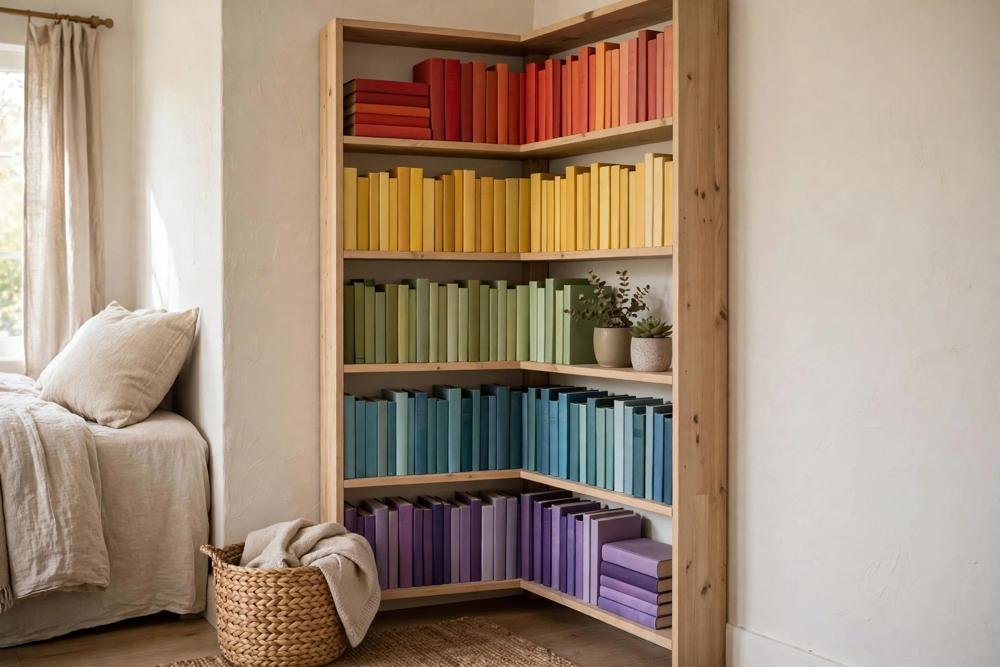
Keep exits, door swings, and walkways clear at all times, with a comfortable walkway of approximately 30 to 36 inches, 75 to 90 cm, as a comfort guide, and with a door swing that is clear, so a door can open fully, without hitting the bookshelf, and so you can get out easily, even in the dark, and even when carrying books, bags, or a child. Avoid a bookshelf that blocks a radiator, a socket, or a switch, because it will block heat, need an extension cord, or be moved, rather than used, and avoid a bookshelf that is placed in a corner where a child can climb it, to reach a window, a shelf, or a light, without supervision, because a bookshelf that can be climbed is a risk, not just a storage unit, and it must be anchored, and placed, with climbing in mind, especially in a family home.
Corner Bookshelves Compared: Corner, Floating, and Cube
Comparing corner bookshelves with floating shelves and cube storage, as in the floating shelves versus bookcases guide, and the cube layouts guide, helps you choose the right type for your corner job, your wall type, and your landlord permission, rather than the type that is cheapest, or that looks best in a photograph. Corner bookshelves use floor space, but hold more books, and are more stable, if anchored, than floating shelves, which use no floor space, but hold less weight, and need anchoring, and which are best for display items, and light books, rather than heavy books, and which need a wall that can hold a shelf, with studs or rated anchors, and with landlord permission before drilling.
Cube storage uses floor space, but can be rearranged, and holds items in baskets, so it is flexible, but it takes up more floor space than floating shelves, and it holds fewer books per square foot, than a corner bookshelf, because cubes are square, and books are rectangular, and cubes waste space, at the top of each cube, where a book does not fill the cube fully. Floating shelves use no floor space, but hold less weight, and need anchoring, and they are best for a corner where floor space is needed, such as a corner by a door, or a corner in a small room, where a floor unit would block a walkway, and they hold books, plants, and display items, at eye level, without taking up floor space.
Choose a corner bookshelf, if you have many books, and a corner that can hold a floor unit, without blocking a walkway, a door, or a window, and if you want a stable, anchored unit, that holds heavy books low, and display items high, and that can be styled simply, with books in groups, a plant, and empty space. Choose floating shelves, if you have few books, and a corner where floor space is needed, and if you have a wall that can hold a shelf, with studs or rated anchors, and with landlord permission before drilling. Choose cube storage, if you have items that can be grouped in baskets, such as children’s books, magazines, or small items, and if you want a flexible unit, that can be rearranged, without moving a whole unit, and that can be labelled, so each person, or each type of item, has a place. Avoid a type that does not match your job, wall, or permission, because it will fail, or be ignored, rather than used.
Corner Bookshelves in Each Room: Living, Bedroom, and Hallway
Corner bookshelves work in a living room, a bedroom, and a hallway, each with a different job, a different size, and a different styling, so a living room bookshelf, a bedroom bookshelf, and a hallway bookshelf, each need a different approach, rather than the same unit, in every room. Living room corner bookshelf: a triangular, or L shaped, bookshelf, with a job of reading, displaying, and storing, and with a size that leaves a walkway clear, and a seating area that still works, and with a reading chair nearby, if you have space, so the corner becomes a reading nook, not just a storage unit, and so books are read, not just stored, and so the living room feels intentional, not crammed.
Bedroom corner bookshelf: a slim, or narrow, bookshelf, with a job of storing, displaying, and reading, and with a size that does not block a bed, a wardrobe, or a walkway, and with a height that you can reach, without climbing, for daily books, and with higher shelves for display items you do not use every day, and with a small lamp, if you have space, so the corner becomes a bedtime reading spot, not just a storage unit, and so books are read, before bed, without getting out of bed, to find a book, in another room. Hallway corner bookshelf: a slim, or narrow, bookshelf, with a job of storing, and displaying, and with a size that does not block a walkway, a door, or an exit route, and with a depth approximately 8 to 10 inches, 20 to 25 cm, so it does not push far into the hallway, and with a height that leaves a walkway clear, and a door swing clear, so the hallway stays safe, and easy to walk through, even in the dark, and even when carrying bags, or a child.
Avoid a bookshelf that is too large, too deep, or too tall, for a bedroom, or a hallway, because it will block a bed, a wardrobe, a walkway, or a door, and it will make the room feel cramped, and dark, however tidy it looks, and avoid a bookshelf that is not anchored, in any room, because it is a safety risk, not just a wobble, and it must be anchored, following its instructions, with landlord permission before drilling, if you rent. Choose a bookshelf per room, with a job, a size, and a styling that matches that room, and live with it for a week, before you furnish the next room, so you can see what works, what does not, and what you actually need, as in the corner storage per room guide.
What to Avoid With a Corner Bookshelf
Avoid a bookshelf that is too large, too deep, or too tall, for the corner, because it will block a walkway, a door, or a window, and it will make the room feel cramped, and dark, however tidy it looks, and it must be moved, returned, or replaced, however much you like it, because a bookshelf that does not fit, will not be used, and it will become a pile, or a display unit, rather than a bookshelf. Avoid a bookshelf that is not anchored, because it can tip over, and hurt a child, a pet, or an adult, however sturdy it looks, and it must be anchored safely, following manufacturer instructions, using manufacturer hardware and weight limits, with studs or rated anchors, and with landlord permission before drilling.
Avoid a bookshelf that is overloaded, because shelves that are overloaded will sag, bow, or fail, and books that are overloaded will fall, when a shelf is pulled, and a bookshelf that is overloaded will become top heavy, and it will become a tipping risk, even if the unit is anchored, because the anchor will be stressed, and it may fail, over time. Avoid a bookshelf that is full, from wall to wall, on every shelf, because it will feel crammed, it will be hard to find books, and it will be hard to add a new book, without moving many books, and it will make the corner feel dark, and cluttered, however stylish the books look. Avoid a bookshelf that blocks a radiator, a socket, a switch, a walkway, a door swing, or an exit route, because it is a safety problem, not just a tidy problem, and it must be moved, however tidy it looks, and however much you want it in that corner.
Avoid a bookshelf that is styled with only display items, and no books, because it will not hold books, and it will become a display unit, not a bookshelf, and books will end up elsewhere, on a table, a sofa, or a floor, where they will be forgotten, and avoid a bookshelf that is placed in a corner where a child can climb it, to reach a window, a shelf, or a light, without supervision, because a bookshelf that can be climbed is a risk, not just a storage unit, and it must be anchored, and placed, with climbing in mind, especially in a family home.
Checklist: Corner Bookshelf Without Waste
- Measure the corner, width at floor, at seat height, and at shelf height, depth, height, door arcs, sockets, switches, radiators, and walkway, in inches and cm, with tape on the floor for the bookshelf footprint.
- Choose one job for the bookshelf, reading, displaying, or storing, before you buy, and choose a type, triangular, L shaped, or slim, that matches your corner measurements, wall type, and job.
- Choose a shelf depth approximately 8 to 10 inches, 20 to 25 cm, for most books, and approximately 10 to 12 inches, 25 to 30 cm, for larger books, so books sit fully on a shelf, without sticking out, and without falling off.
- Anchor the bookshelf safely, using manufacturer hardware and weight limits, with studs or rated anchors, and with landlord permission before drilling, and check anchoring regularly, especially after moving furniture.
- Keep heavy books low, light items high, and display items at eye level, so the shelf is stable, easy to use, and good looking, and so a top heavy shelf does not become a tipping risk.
- Style simply, with books in groups, a plant, a vase, or a small object on some shelves, and empty space on others, so the shelf feels intentional, not crammed, and so books are easy to find.
- Keep exits, door swings, and walkways clear at all times, with a comfortable walkway of approximately 30 to 36 inches, 75 to 90 cm, as a comfort guide, and check at night and in daylight, with doors open and chairs pulled out.
- Live with the bookshelf for a week, then adjust one thing at a time, rather than furnishing every corner at once, and avoid a unit that is too large, too deep, or too tall, for the corner.
Conclusion
A corner bookshelf turns an awkward corner into a reading nook, a display spot, and a storage zone, when you choose a type that fits, triangular, L shaped, or slim, measure first in inches and cm, with tape on the floor for the bookshelf footprint, anchor it safely to the wall, using manufacturer hardware and weight limits, with studs or rated anchors, and with landlord permission before drilling, and style it simply, with books in groups, a plant, and empty space, so it feels intentional, not crammed. Keep heavy books low, light items high, and display items at eye level, so the shelf is stable, easy to use, and good looking, and keep exits, door swings, and walkways clear at all times, so the corner stays safe, and easy to walk through, even in the dark.
Use the guides in this series for each type and job: awkward corner pillar, corner shelf styling, measuring a corner, anchoring bookshelves, floating shelves versus bookcases, cube layouts, and corner storage per room, each with its own measurements, safety, and styling, so you can choose the right type for each corner, rather than forcing one type into every corner. Done that way, a corner bookshelf will feel intentional, tidy, and easy to use, in a living room, a bedroom, or a hallway, without waste, damage, or a large piece that does not fit.
Related reading
- Awkward Corner Ideas for Every Room in a Small Home
- Corner Entryway Ideas for a Tight Corner
- Rug Calculator
- Corner Shelf Styling, How to Measure a Corner, How to Anchor Bookshelves Safely, Floating Shelves vs Bookcases, Cube Storage Layouts, and Corner Storage for Each Room, in this series, to follow.
Frequently Asked Questions
What depth should a corner bookshelf be?
Use a shelf depth approximately 8 to 10 inches, 20 to 25 cm, for most books, and approximately 10 to 12 inches, 25 to 30 cm, for larger books, so books sit fully on a shelf, without sticking out, and without falling off. A shelf that is too shallow will not hold books, and a shelf that is too deep will waste space, and will make books hard to find, because they will be pushed back, behind other books.
How do I anchor a tall corner bookshelf safely?
Anchor a tall bookshelf following manufacturer instructions, using manufacturer hardware and weight limits, with studs or rated anchors, and with landlord permission before drilling, as in the anchoring guide. Check anchoring regularly, especially after moving furniture, because a loose unit is a risk, not just a wobble, and it must be fixed, before it is used again, and keep heavy books low, so the shelf is stable, not top heavy.
What is the best type of corner bookshelf for a small space?
Use a slim bookshelf, with a narrow depth, approximately 8 to 10 inches, 20 to 25 cm, for a hallway, bedroom, or small apartment corner, where space is tight, and where a wide unit would block a walkway, a door, or a window. For a true corner, with two walls at 90 degrees, a triangular bookshelf uses the corner fully, and for a corner beside a window, door, or sofa, an L shaped bookshelf uses one wall more than the other, so it fits better.
How do I style a corner bookshelf so it does not look crammed?
Style simply, with books in groups, by size, colour, or subject, with a group standing upright, a group lying flat, and a group with a plant, vase, or small object, on top, and with empty space on some shelves, so the shelf breathes, and so books are easy to find, as in the shelf styling guide. Avoid filling every shelf, from wall to wall, because it will feel crammed, and it will be hard to find books, and hard to add a new book, without moving many books.
Can I put a corner bookshelf in a hallway?
Yes, use a slim bookshelf, with a depth approximately 8 to 10 inches, 20 to 25 cm, so it does not push far into the hallway, and with a height that leaves a walkway clear, approximately 30 to 36 inches, 75 to 90 cm, as a comfort guide, and a door swing clear, so the hallway stays safe, and easy to walk through, even in the dark. Anchor it safely, and keep heavy books low, so it is stable, not top heavy.
What should I avoid with a corner bookshelf?
Avoid a bookshelf that is too large, too deep, or too tall, for the corner, because it will block a walkway, a door, or a window, and it will make the room feel cramped, and dark, however tidy it looks. Avoid a bookshelf that is not anchored, overloaded, or full, from wall to wall, on every shelf, because it will be a safety risk, it will sag, bow, or fail, and it will feel crammed, and hard to use, however stylish the books look.