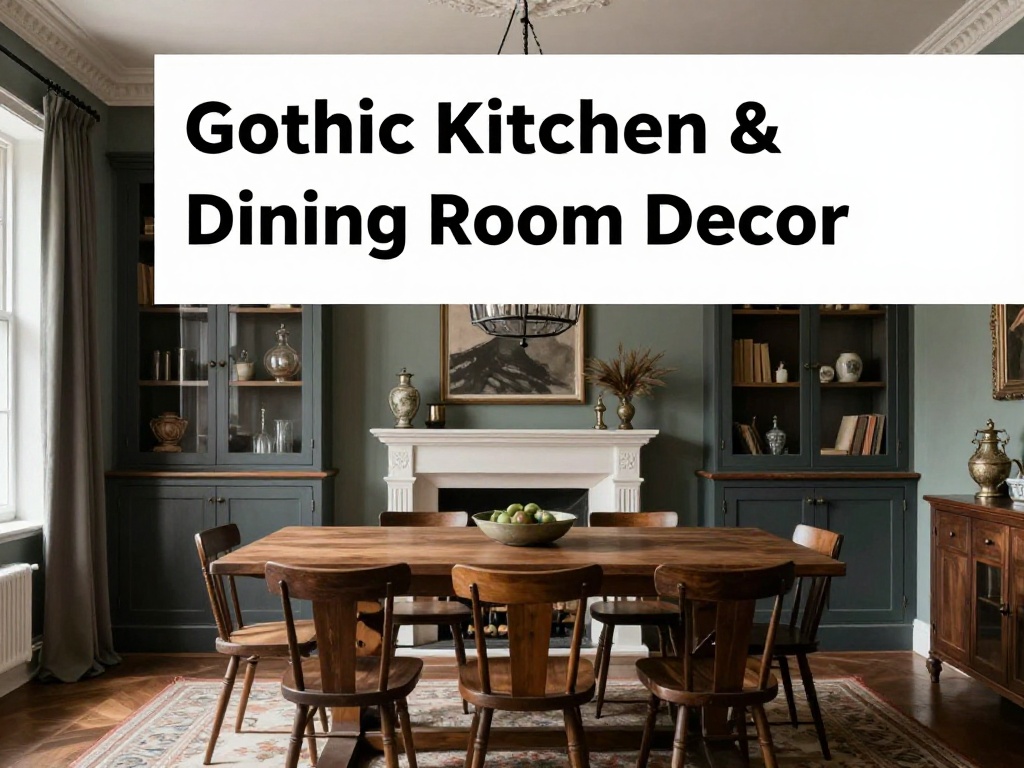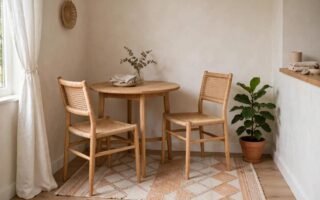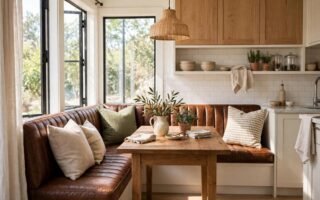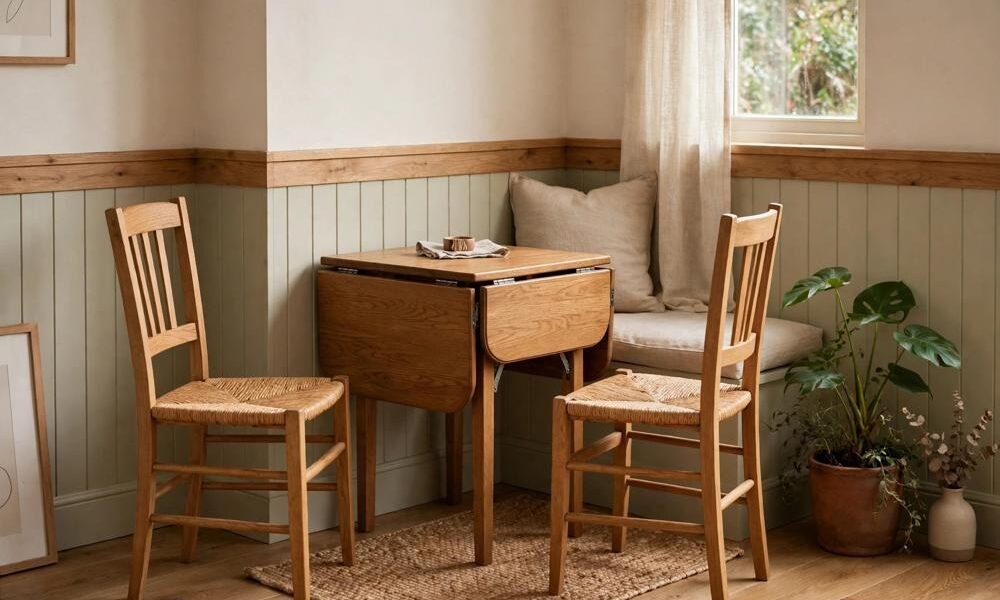
An expandable dining table is a table that is small for daily use, and larger for hosting, with a mechanism that adds a leaf, a drop leaf, or an extension, so a small home, or a corner dining nook, can seat two people every day, and four, six, or eight people, when guests come, without a large table that blocks the room every day. Choose an expandable table that fits your corner, or dining area, folded and expanded, with chairs that can be pulled out without hitting a wall, a door, or a walkway, and with a mechanism that is easy to use, stable when expanded, and stable when folded, so it does not wobble, or tip, when it is used. All measurements in this guide are in inches and cm, as approximate ranges only, and sizes vary by product, so check listings before you buy, and measure your space first, as in the measuring guide in this series.
Key takeaways
- An expandable table is small daily, larger for hosting, so a small home can seat guests, without a large table blocking the room every day.
- Measure folded and expanded, width, depth, height, chair pull out, and walkway, in inches and cm, with tape on the floor, before you buy.
- Table height approximately 29 to 30 inches, 74 to 76 cm, for most dining tables, chair height approximately 17 to 19 inches, 43 to 48 cm, for most dining chairs, works best.
- Chair pull out approximately 24 inches, 60 cm, behind each chair, as a comfort guide, so chairs can be pulled out, without hitting a wall, or a walkway.
- Choose a mechanism that is easy to use, stable when expanded, and stable when folded, and check weight limits, and manufacturer instructions, before you buy.
- Keep exits, door swings, and walkways clear at all times, with a comfortable walkway of approximately 30 to 36 inches, 75 to 90 cm, as a comfort guide, not a building code.
Types of Expandable Tables: Leaf, Drop Leaf, and Butterfly
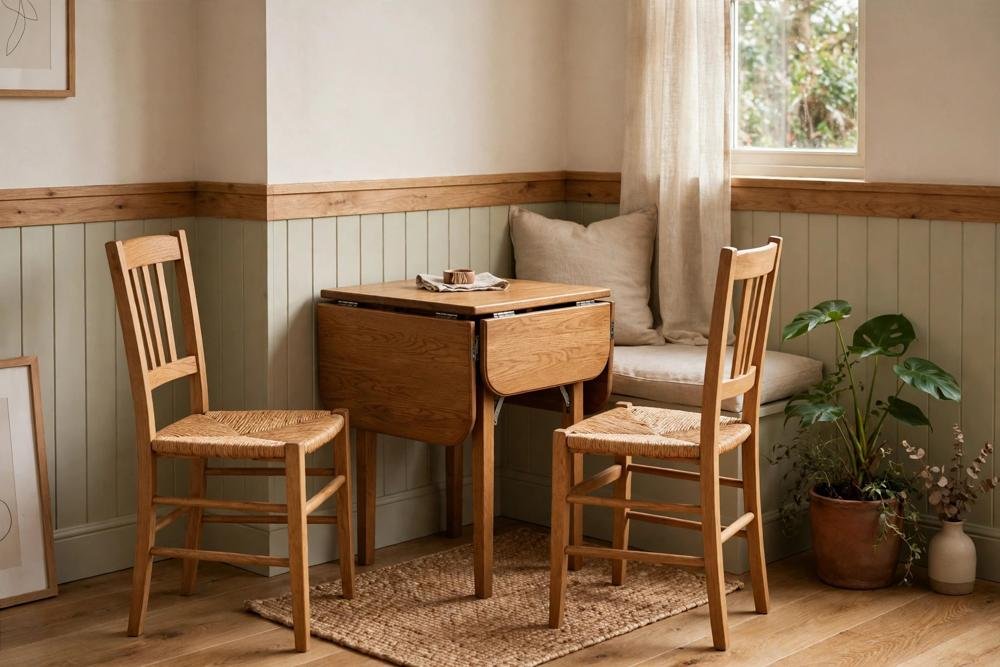
Expandable tables come in three main types, each with a different mechanism, and each works best for a different space, so choose the type that matches your space, your hosting needs, and your ability to use the mechanism, rather than the type that looks best in a photograph, but does not fit your space, or your needs. Leaf tables, with a leaf that is inserted, or removed, from the centre, or from the ends, expand from a small size, to a larger size, by adding a leaf, approximately 12 to 18 inches, 30 to 45 cm, wide, for most leaves, and they seat more people, when expanded, but they need storage for the leaf, when it is not used, and they need a mechanism that is easy to use, so a leaf can be added, without help, and without tools, if possible, and so a leaf can be removed, without damaging the table.
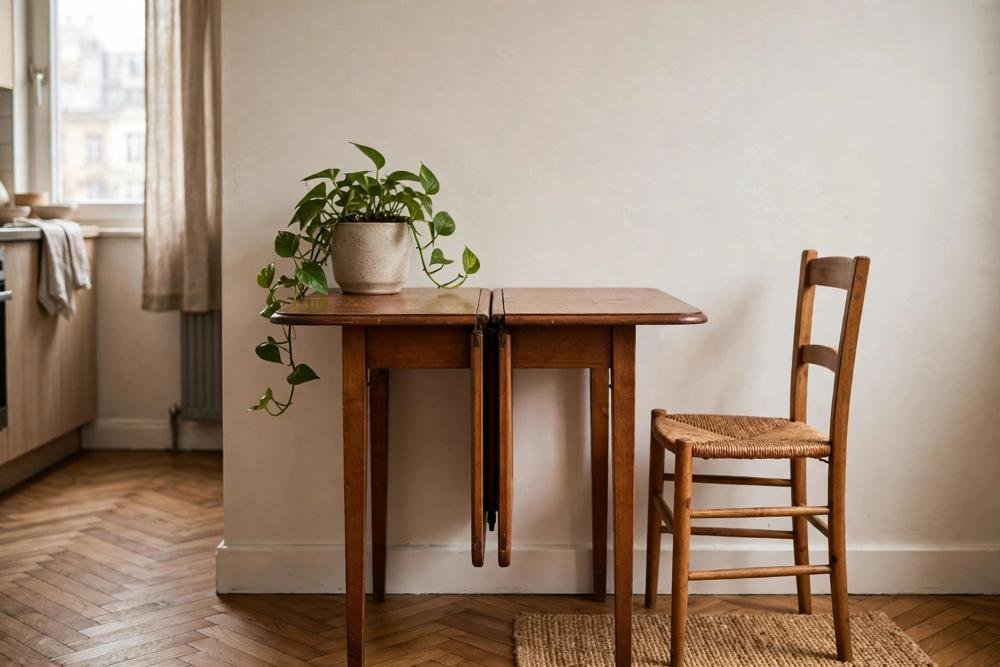
Drop leaf tables, with a leaf that folds down, on one side, or both sides, expand from a narrow console, or a small table, to a larger table, by lifting a leaf, and locking it, and they work in a corner, or against a wall, where a table can be folded down, when not used, and lifted, when needed, so a small apartment, or a corner dining nook, can have a table, without a large table blocking the room every day. Butterfly tables, with a leaf that folds inside the table, expand by pulling the table apart, unfolding a leaf, and pushing the table together, and they store the leaf inside the table, so no separate storage is needed, and they work in a small home, where storage is tight, and where a leaf that is stored separately would be lost, or damaged, but they need a mechanism that is smooth, and easy to use, so a leaf can be unfolded, without help, and without force, if possible.
Choose a type that fits your space, folded and expanded, with a width, depth, and height that leaves a walkway clear, and with chairs that can be pulled out, without hitting a wall, a door, or a walkway, and with a mechanism that you can use, without help, and without tools, if possible, so the table will be expanded, when guests come, rather than left folded, because the mechanism is hard, or heavy, to use. Avoid a type that is too large, folded, for the space, because it will block the room every day, not just when hosting, and avoid a type that is too small, expanded, for hosting, because it will not seat guests, and guests will end up at a coffee table, or a kitchen counter, instead of at the table. For a general awkward corner overview, see the awkward corner pillar in this series, which links to this guide, and to the other Furniture guides, as they go live.
Measuring Folded and Expanded: Table, Chairs, and Walkway
Measuring an expandable table starts with the space, folded and expanded, not just the table, because a table that fits folded, but does not fit expanded, will not work for hosting, and a table that fits expanded, but is too large folded, will block the space every day, not just when hosting. Measure width, depth, and height, folded and expanded, in inches and cm, with tape on the floor for the folded footprint, and for the expanded footprint, and walk through both, pull out chairs, open doors, and check at night and in daylight, before you buy, as in the measuring guide, because a table that fits on paper, but does not fit in the room, with doors open, and chairs pulled out, will not work, and it will need to be moved, returned, or replaced.
Use a chair pull out of approximately 24 inches, 60 cm, behind each chair, as a comfort guide, so chairs can be pulled out, without hitting a wall, a door, or a walkway, and so a person can sit down, and stand up, without moving the table, or pushing a chair into a wall, and use a walkway of approximately 30 to 36 inches, 75 to 90 cm, as a comfort guide, not a building code, so you can walk past the table easily, even when chairs are pulled out, and so you can get out easily, even in the dark, and so a door can open fully, without hitting the table, or a chair. Use a table height of approximately 29 to 30 inches, 74 to 76 cm, for most dining tables, and a chair height of approximately 17 to 19 inches, 43 to 48 cm, for most dining chairs, so a person can sit comfortably, with knees under the table, and with feet on the floor, without the table being too high, or too low, for the chair.
Check sockets, switches, radiators, and skirting boards, before you buy, because a table that blocks a socket will need an extension cord, which will become a trip hazard, a table that blocks a switch will be moved, or ignored, rather than used, and a table that blocks a radiator will block heat, and will make the room cold, however tidy it looks. Avoid a table that is too large, expanded, for the space, because it will block a walkway, a door, or a window, when hosting, and guests will be cramped, even if the table is tidy, and avoid a table that is too small, folded, for daily use, because it will not hold plates, glasses, and food for two people, and it will be ignored, and meals will end up elsewhere, on a coffee table, or a sofa, instead of at the table.
Seating: Daily, Hosting, and Chair Storage
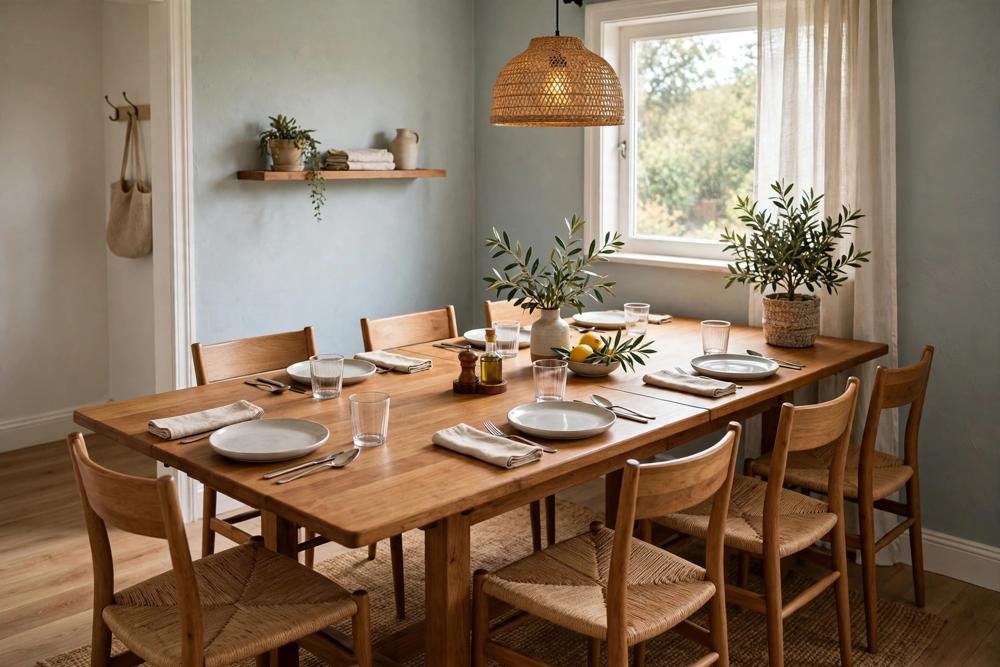
Seating for an expandable table needs two plans, daily seating, and hosting seating, because a table that seats two people daily, and six people when hosting, needs chairs for two people daily, and chairs for six people when hosting, and chairs that are stored, when not used, must be stored somewhere, without blocking a walkway, a door, or a room. Daily seating: two chairs, or four chairs, if you have a family of four, with a chair pull out of approximately 24 inches, 60 cm, behind each chair, and with a walkway clear, so daily meals can be eaten, without moving chairs, or pushing a chair into a wall, and so a person can sit down, and stand up, without help, and without moving the table.
Hosting seating: extra chairs, stored in a bedroom, a cupboard, a hallway, or a garage, if you have one, with a chair that is light, easy to carry, and easy to stack, or fold, so extra chairs can be brought out, when guests come, and stored again, when guests leave, without blocking a room, and without damaging a chair, or a wall, when it is carried. Use chairs that match the table height, approximately 29 to 30 inches, 74 to 76 cm, for the table, and approximately 17 to 19 inches, 43 to 48 cm, for the chair, so guests can sit comfortably, with knees under the table, and with feet on the floor, without the table being too high, or too low, for the chair, and without a chair that is too high, or too low, for the table.
Avoid extra chairs that are stored in the dining area, blocking a walkway, a door, or a window, because they will make the room feel cramped, even when not hosting, and they will be moved, or ignored, rather than used, and avoid extra chairs that are too heavy, too large, or too hard to carry, because they will not be brought out, when guests come, and guests will end up standing, or sitting on a sofa, instead of at the table. Avoid a table that seats guests, but does not seat them comfortably, because a table that is too small, expanded, for the number of guests, will be cramped, with elbows bumping, plates overlapping, and glasses spilling, and it will make hosting feel stressful, rather than enjoyable, however good the food looks. Choose a table that seats guests comfortably, expanded, with chairs that can be pulled out, and stored, without blocking a room, and live with it for a week, before you add more chairs, so you can see what you actually need, rather than buying a full dining set on day one.
Mechanisms, Stability, and Weight Limits
Mechanisms for an expandable table must be easy to use, stable when expanded, and stable when folded, because a mechanism that is hard, heavy, or stiff, will not be used, and a table that is left folded, when guests come, will not seat guests, and a mechanism that is unstable, when expanded, will wobble, tip, or fail, and it can spill food, glasses, or hot drinks, and hurt a person, a pet, or a child, however good the table looks. Test a mechanism, if you can, in a shop, or by reading reviews, with a leaf that is added, removed, folded, or unfolded, without help, and without tools, if possible, and with a lock that holds the leaf, when expanded, and when folded, so the table does not collapse, when it is leaned on, or when a child pulls on it, or a pet jumps on it.
Check weight limits, and manufacturer instructions, before you buy, because a table that is overloaded with heavy plates, glasses, food, and a centrepiece, will sag, bow, or fail, and a table that is overloaded will wobble, even if it is stable when empty, and a table that is used for hosting, with many plates, glasses, and food, needs a weight limit that matches hosting, not just daily use, and a table that is used for work, or study, with a laptop, books, and papers, needs a weight limit that matches work, not just dining. Use a table that is stable, with legs that are sturdy, and with a mechanism that locks, when expanded, and when folded, so the table does not move, when it is used, and so a leaf does not slip, when it is added, or removed.
Avoid a mechanism that is stiff, heavy, or hard to use, because it will not be used, and a table that is left folded, when guests come, will not seat guests, and avoid a mechanism that does not lock, because a leaf that does not lock will slip, collapse, or fall, and it can spill food, glasses, or hot drinks, and hurt a person, however good the table looks. Avoid a table that is unstable, when expanded, because it will wobble, tip, or fail, when it is used, and it must be fixed, returned, or replaced, before it is used again, however much you like it, because an unstable table is a safety risk, not just a wobble, and it must be stable, before it is used, especially with hot food, or hot drinks, on it.
Expandable Tables in a Corner: Nooks, Walls, and Windows
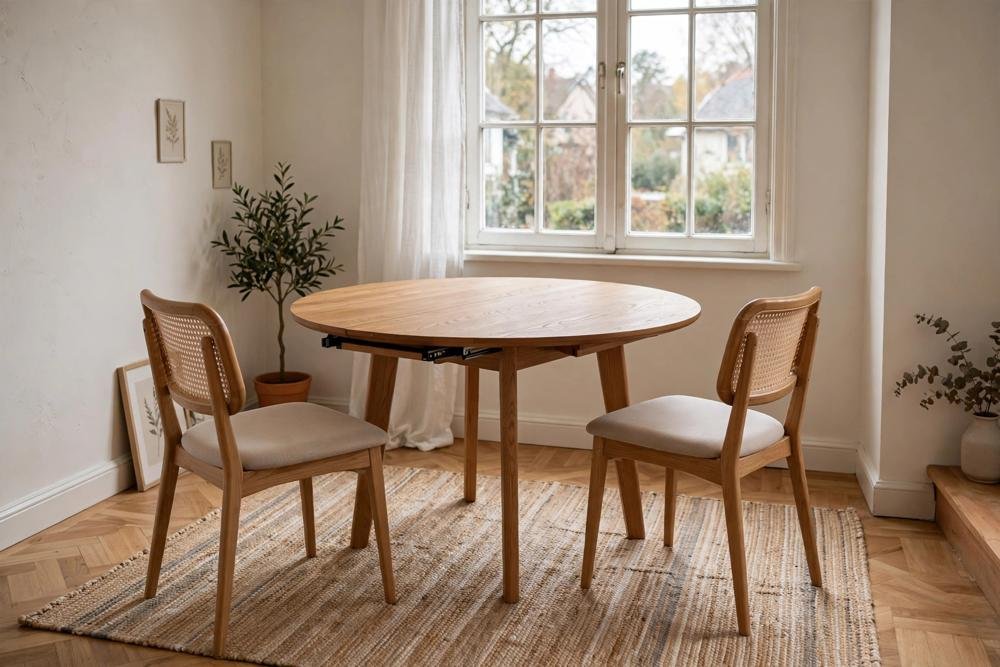
Expandable tables in a corner work best as a dining nook, with a small round table, or a drop leaf table, against a wall, or in a corner, with two chairs, daily, and extra chairs, when hosting, so a corner that was empty, or awkward, becomes a dining spot, without taking up a whole dining room, or a whole wall, and without a large table that blocks the room every day. Use a round table, if space is tight, because a round table has no corners to bump into, and it seats more people in a small corner, than a square table, which has corners that stick out, and which need more space to pull out chairs, and use a drop leaf table, against a wall, if space is very tight, because a drop leaf table can be folded down, when not used, and lifted, when needed, so a corner can be a dining spot, when needed, and a walkway, when not needed.
Place a corner dining table near a window, if you have one, with light, and a view, so meals feel pleasant, not cramped, and with a window that can still be opened, and cleaned, without moving the table, and with a chair that can be pulled out, without hitting a window sill, a radiator, or a wall, and with a walkway clear, so a person can sit down, and stand up, without moving the table, or pushing a chair into a wall. Use a rug, under a corner dining table, if you have space, with a rug that is large enough for chairs, pulled out, approximately 24 inches, 60 cm, beyond the table, on each side, as a comfort guide, so chairs do not catch on a rug edge, when they are pulled out, and so a rug does not become a trip hazard, when it is too small, for the table, and chairs, pulled out.
Avoid a corner dining table that blocks a window, a door, or a walkway, because it will make the room feel dark, cramped, and unsafe, however tidy it looks, and it must be moved, however much you want it in that corner, because a table that blocks a path is a safety problem, not just a tidy problem, and avoid a corner dining table that is too large, for the corner, because it will block a walkway, a door, or a window, and it will make the room feel cramped, even if it is tidy, and avoid a corner dining table that cannot be expanded, when guests come, because it will not seat guests, and guests will end up elsewhere, on a coffee table, or a kitchen counter, instead of at the table.
What to Avoid With an Expandable Table
Avoid a table that is too large, folded, for the space, because it will block the room every day, not just when hosting, and it must be moved, returned, or replaced, however much you like it, because a table that does not fit, will not be used, and it will become a pile, or a display unit, rather than a dining table. Avoid a table that is too small, expanded, for hosting, because it will not seat guests, and guests will end up elsewhere, on a coffee table, or a kitchen counter, instead of at the table, and hosting will feel stressful, rather than enjoyable, however good the food looks.
Avoid a mechanism that is stiff, heavy, or hard to use, because it will not be used, and a table that is left folded, when guests come, will not seat guests, and avoid a mechanism that does not lock, because a leaf that does not lock will slip, collapse, or fall, and it can spill food, glasses, or hot drinks, and hurt a person, however good the table looks. Avoid a table that is unstable, when expanded, or when folded, because it will wobble, tip, or fail, when it is used, and it must be fixed, returned, or replaced, before it is used again, however much you like it, because an unstable table is a safety risk, not just a wobble.
Avoid extra chairs that are stored in the dining area, blocking a walkway, a door, or a window, because they will make the room feel cramped, even when not hosting, and they will be moved, or ignored, rather than used, and avoid a table that blocks a walkway, a door swing, or an exit route, when expanded, because it is a safety problem, not just a tidy problem, and it must be moved, however tidy it looks, and however much you want it in that space, when hosting. Avoid a table that is overloaded, because a table that is overloaded will sag, bow, or fail, and food, glasses, or hot drinks, will spill, when a table is pulled, or leaned on, and a table that is overloaded will become unstable, even if it was stable when empty.
Checklist: Expandable Table Without Waste
- Measure the space, folded and expanded, width, depth, height, chair pull out, and walkway, in inches and cm, with tape on the floor for the folded footprint, and for the expanded footprint.
- Choose one type, leaf, drop leaf, or butterfly, that matches your space, hosting needs, and ability to use the mechanism, without help, and without tools, if possible.
- Choose a table height approximately 29 to 30 inches, 74 to 76 cm, and a chair height approximately 17 to 19 inches, 43 to 48 cm, so a person can sit comfortably, with knees under the table, and with feet on the floor.
- Use a chair pull out of approximately 24 inches, 60 cm, behind each chair, as a comfort guide, and a walkway of approximately 30 to 36 inches, 75 to 90 cm, as a comfort guide, not a building code.
- Test a mechanism, if you can, with a leaf that is added, removed, folded, or unfolded, without help, and with a lock that holds the leaf, when expanded, and when folded.
- Check weight limits, and manufacturer instructions, before you buy, with a weight limit that matches hosting, not just daily use, and with a table that is stable, when expanded, and when folded.
- Plan daily seating, and hosting seating, with extra chairs stored elsewhere, in a bedroom, cupboard, hallway, or garage, if you have one, with a chair that is light, easy to carry, and easy to stack, or fold.
- Keep exits, door swings, and walkways clear at all times, with a door swing that is clear, so a door can open fully, without hitting the table, or a chair, and check at night and in daylight, with doors open and chairs pulled out.
- Live with the table for a week, then adjust one thing at a time, rather than buying a full dining set on day one, and avoid a table that is too large, folded, or too small, expanded, for the space.
Conclusion
An expandable dining table turns a small home, or a corner dining nook, into a place that seats two people every day, and four, six, or eight people, when guests come, without a large table that blocks the room every day, when you choose a type that fits, leaf, drop leaf, or butterfly, measure folded and expanded, in inches and cm, with tape on the floor for both footprints, choose a mechanism that is easy to use, stable when expanded, and stable when folded, with a lock that holds the leaf, and check weight limits, and manufacturer instructions, before you buy. Use a table height approximately 29 to 30 inches, 74 to 76 cm, and a chair height approximately 17 to 19 inches, 43 to 48 cm, with a chair pull out approximately 24 inches, 60 cm, behind each chair, and a walkway approximately 30 to 36 inches, 75 to 90 cm, as a comfort guide, so chairs can be pulled out, without hitting a wall, and so you can walk past the table easily, even when chairs are pulled out.
Use the guides in this series for each type and job: awkward corner pillar, corner bookshelf, measuring a corner, tables compared, narrow storage, anchoring, floating shelves versus bookcases, cube layouts, corner desk, and corner storage per room, each with its own measurements, safety, and styling, so you can choose the right type for each corner, rather than forcing one type into every corner. Done that way, an expandable dining table will feel intentional, tidy, and easy to use, daily, and when hosting, without waste, damage, or a large piece that does not fit.
Related reading
- Awkward Corner Ideas for Every Room in a Small Home
- Corner Bookshelf Ideas for Small Spaces and Awkward Corners
- Corner Entryway Ideas for a Tight Corner
- Rug Calculator
- How to Measure a Corner, Corner Shelf Styling, Space-Saving Tables Compared, Narrow and Slim Storage, How to Anchor Bookshelves Safely, Floating Shelves vs Bookcases, Cube Storage Layouts, Corner Desk and Work Nook, and Corner Storage for Each Room, in this series, to follow.
Frequently Asked Questions
What size expandable table do I need for a small space?
Measure folded and expanded, width, depth, height, chair pull out, and walkway, in inches and cm, with tape on the floor for both footprints, and walk through both, pull out chairs, open doors, and check at night and in daylight, before you buy, as in the measuring guide. Use a table height approximately 29 to 30 inches, 74 to 76 cm, a chair height approximately 17 to 19 inches, 43 to 48 cm, a chair pull out approximately 24 inches, 60 cm, behind each chair, and a walkway approximately 30 to 36 inches, 75 to 90 cm, as a comfort guide, so chairs can be pulled out, without hitting a wall, and so you can walk past the table easily.
What is the best type of expandable table for a corner?
Use a round table, if space is tight, because a round table has no corners to bump into, and it seats more people in a small corner, than a square table, which has corners that stick out, and which need more space to pull out chairs. Use a drop leaf table, against a wall, if space is very tight, because a drop leaf table can be folded down, when not used, and lifted, when needed, so a corner can be a dining spot, when needed, and a walkway, when not needed.
How do I store extra chairs for hosting?
Store extra chairs in a bedroom, cupboard, hallway, or garage, if you have one, with a chair that is light, easy to carry, and easy to stack, or fold, so extra chairs can be brought out, when guests come, and stored again, when guests leave, without blocking a room, and without damaging a chair, or a wall, when it is carried. Avoid extra chairs stored in the dining area, blocking a walkway, a door, or a window, because they will make the room feel cramped, even when not hosting.
How do I know if an expandable table mechanism is good?
Test a mechanism, if you can, with a leaf that is added, removed, folded, or unfolded, without help, and without tools, if possible, and with a lock that holds the leaf, when expanded, and when folded, so the table does not collapse, when it is leaned on, or when a child pulls on it, or a pet jumps on it. Avoid a mechanism that is stiff, heavy, or hard to use, because it will not be used, and a table that is left folded, when guests come, will not seat guests.
Can an expandable table seat six people in a small room?
Yes, if the table, expanded, fits the space, with chairs that can be pulled out, approximately 24 inches, 60 cm, behind each chair, and with a walkway clear, approximately 30 to 36 inches, 75 to 90 cm, as a comfort guide, and with extra chairs stored elsewhere, and brought out, when guests come. Measure expanded, with tape on the floor for the expanded footprint, and walk through it, pull out chairs, and check at night and in daylight, before you buy, because a table that fits folded, but does not fit expanded, will not work for hosting.
What should I avoid with an expandable table?
Avoid a table that is too large, folded, for the space, because it will block the room every day, not just when hosting, and avoid a table that is too small, expanded, for hosting, because it will not seat guests, and guests will end up elsewhere, on a coffee table, or a kitchen counter, instead of at the table. Avoid a mechanism that is stiff, heavy, hard to use, or that does not lock, and avoid a table that is unstable, when expanded, or when folded, because it will wobble, tip, or fail, when it is used, and it must be fixed, returned, or replaced, before it is used again.