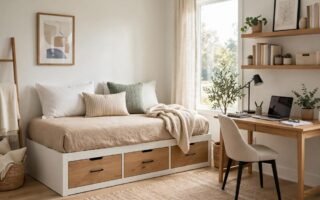
A nightstand does only three jobs: it holds a lamp, a phone and a book, and it keeps a glass of water within reach. A full nightstand with drawers is overkill for those jobs in a tiny bedroom, and it can block a door, crowd a bed, or eat the only walkway. You do not need to give up bedside storage. You need a smaller, smarter surface, or a surface that uses the wall instead of the floor.
This guide covers four alternatives that work in real tiny rooms: wall shelves, rolling carts, stools, and headboard storage. For each one, you will find what it holds, what it costs in space, and what to watch out for, so you can choose one that fits your bed, your wall, and how you actually use the bedside.
Key takeaways: use the wall when you have no floor; keep the bedside surface at mattress height or slightly above; keep only nightly items beside the bed; use a cart when you need to move it for cleaning; and anchor anything wall-mounted into a stud or a proper wall fixing.
Idea 1: A Wall-Mounted Shelf Beside the Bed
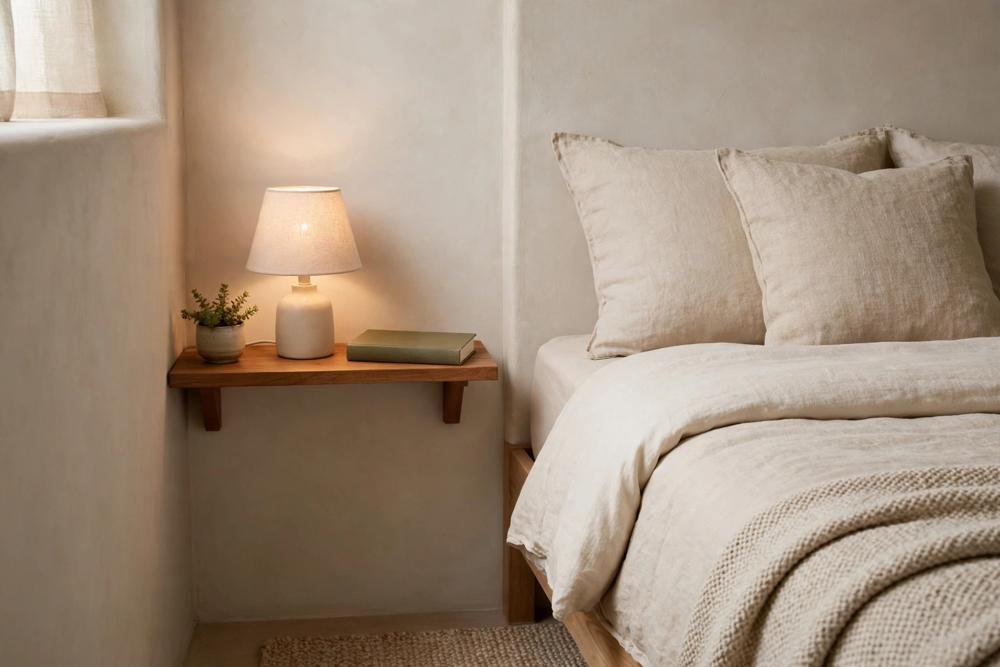
A wall shelf is the best nightstand alternative when floor space is zero, because it uses no floor at all. A shelf 30 to 45 centimetres wide and 20 to 25 centimetres deep, fixed at mattress height or 5 to 10 centimetres above it, holds a small lamp, a phone, a book and a glass of water. It works beside a bed pushed against a wall, in a gap between a bed and a wardrobe, or above a radiator that cannot hold furniture.
Fix the shelf properly. Use a stud finder, or wall fixings rated for the shelf plus the lamp, especially in plasterboard walls. A shelf that holds a lamp and a book needs to hold at least 5 to 10 kilograms safely, and it should not wobble when you reach for your phone in the dark. If you rent, use a shelf with removable fixings rated for the weight, or a clamp-on bedside shelf that attaches to the bed frame, rather than drilling, and check your tenancy rules first.
Keep the shelf shallow and tidy. A deep shelf will stick out into the walkway and bump your elbow, and a cluttered shelf will look messy because it is at eye level when you lie down. Keep nightly items only: lamp, phone charger, book, water. Keep everything else, such as medicines, chargers for other devices, and spare books, in a drawer or a box elsewhere. Use a small tray or a cable clip to keep the charger cable from falling behind the bed.
A wall shelf also works well for a reading light. Use a clip-on or wall-mounted reading light instead of a table lamp, to free the shelf surface, and keep the light at a height that does not shine in your eyes when you lie down.
Idea 2: A Slim Rolling Cart
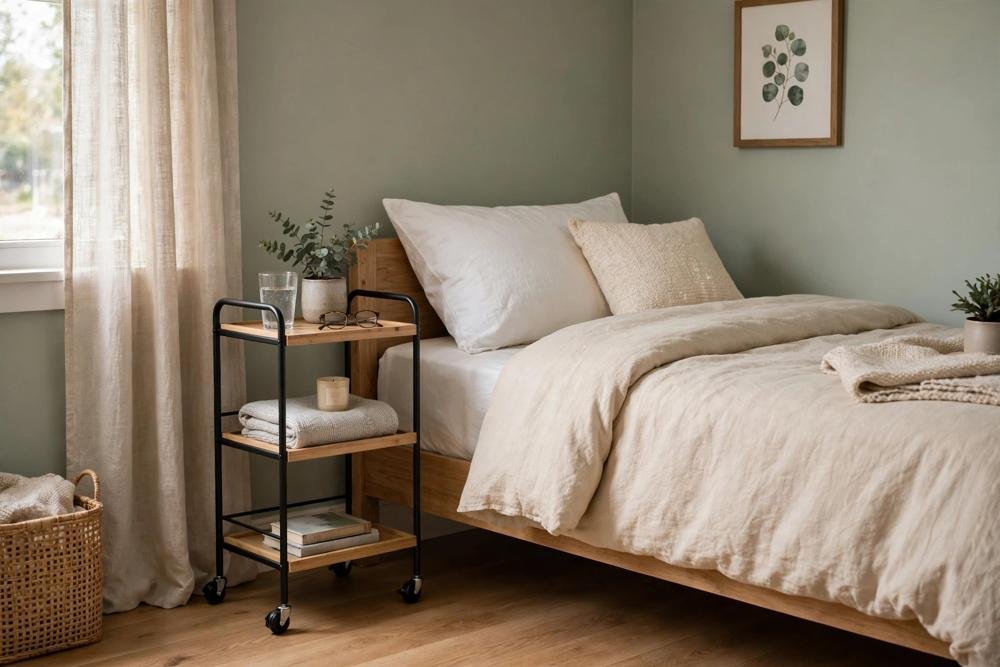
A slim rolling cart, 25 to 35 centimetres wide with two or three tiers, fits in a gap too narrow for a nightstand, and it can be rolled out for cleaning or when you need more room. It holds more than a shelf, because it has tiers: top tier for lamp, phone and book; middle tier for a spare book, hand cream and tissues; bottom tier for a spare blanket or a charging station. It works well in a rented room, because it needs no fixing, and it can move to another room later.
Choose a cart with lockable wheels, so it does not roll when you lean on it or reach for a glass of water. Lock the wheels at night, and unlock them only for cleaning. Check the cart height: the top tier should be at mattress height or slightly above, so you can reach your phone without sitting up fully. If the cart is too low, you will strain to reach it; if it is too high, it will block the view and feel bulky.
Keep the cart tidy, because open tiers show everything. Use a small basket on one tier for small items, and keep the top tier for nightly items only. Do not use a cart for heavy items, such as a stack of books, because it can tip if the wheels are unlocked or the floor is uneven. Keep the cart away from a heater, and do not run a charger cable across the walkway from the cart.
A rolling cart is also useful in a shared room, because each person can have their own cart on their side of the bed, even when the bed is against a wall on one side.
Idea 3: A Stool, Chair or Small Side Table
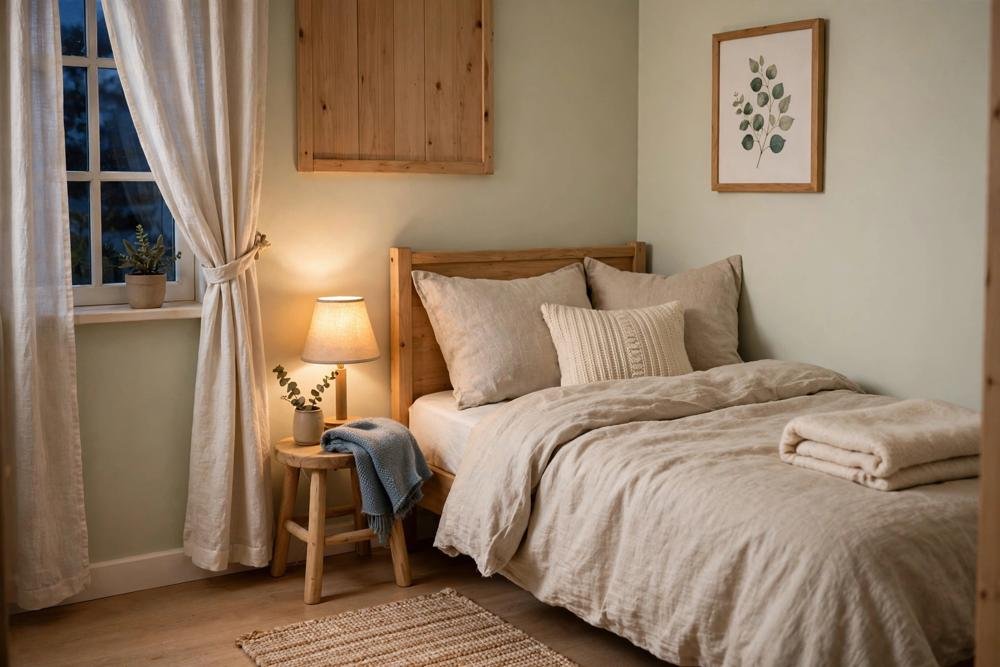
A stool, a small chair, or a tiny side table can be a nightstand when you already own one, or when you want a piece that can do double duty. A stool beside the bed holds a lamp and a book, and it can be used as extra seating when friends visit, or as a step to reach a high shelf. A small side table with one drawer holds a phone charger and small items out of sight, which a stool cannot do.
Choose a stool or table that is stable and the right height. A stool with three legs can wobble on an uneven floor, so use a four-legged stool or a table with a solid base. The top should be at mattress height or slightly above, and large enough for a lamp base plus a phone, usually at least 30 centimetres across. If the top is too small, the lamp will crowd the phone, and you will knock things off in the dark.
Use a stool only for nightly items, not for storage, because it has no drawer and no shelf. Keep a small basket under the stool, or on the floor beside it, for a spare book or a charger, but do not let the basket block the walkway. If you use a chair, hang a small pocket organiser on the back for a phone and a book, to keep the seat clear for sitting.
A stool or small table is a good temporary option while you decide on a permanent wall shelf, and it is easy to move if you rearrange the room.
Idea 4: Headboard Storage and a Bedside Caddy
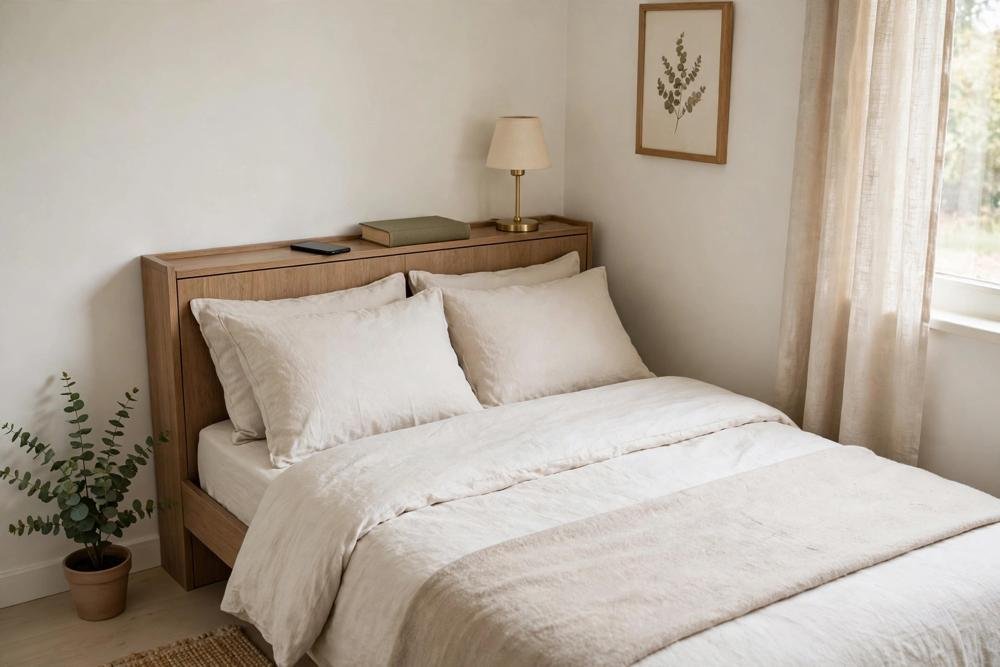
If there is literally no space beside the bed, use the headboard itself. A headboard with a shelf on top, a headboard with built-in cubbies, or a fabric bedside caddy that hangs over the mattress, can hold a phone, a book, glasses and a charger, with no floor and no wall space needed. This works when the bed is pushed into a corner, against two walls, or in a room where the bed fills the width.
A headboard shelf should be deep enough for a phone and a book, usually 15 to 20 centimetres, and it should have a small lip or rail, so items do not fall behind the bed when you move. Keep the shelf tidy, because it is at eye level and visible from the door. Use a small tray for a phone and glasses, so they do not slide.
A bedside caddy, a fabric pocket that slips between the mattress and the bed frame, is the cheapest option and needs no fixing. It holds a phone, a book, a remote and a charger, and it can be removed for washing. It does not hold a lamp or a glass of water safely, so pair it with a wall-mounted reading light or a clip-on light, and keep water on a shelf or a cart elsewhere, or use a bottle with a lid in the caddy.
Check that a headboard shelf or caddy does not make the bed uncomfortable. The shelf should not press against your head when you sit up, and the caddy should not bunch under the mattress or slip. If you share a bed, use a caddy on each side, so neither person has to reach across.
What to Avoid
Do not use a full nightstand in a room where it blocks a door, a walkway, or a wardrobe door, because you will bump into it daily. Do not use a wall shelf fixed only with weak adhesive when it holds a lamp, because it can fall. Do not use a rolling cart with unlocked wheels beside a bed, because it can roll away when you reach for it. Do not clutter a tiny bedside surface with items you do not use nightly, because a small surface clutters fast. And do not put a glass of water on a surface that is not stable, or above electronics, because a spill at night is a common cause of phone damage.
FAQs
What can I use instead of a nightstand in a tiny bedroom?
A wall-mounted shelf, a slim rolling cart, a stool or small side table, or headboard storage with a bedside caddy. Choose by space: wall shelf for zero floor, cart for a narrow gap, stool for a temporary fix, headboard for a corner bed.
How high should a nightstand alternative be?
At mattress height or 5 to 10 centimetres above it, so you can reach a phone, book or glass without sitting up fully. Too low strains your back, too high blocks the view and feels bulky.
Is a wall shelf safe as a nightstand?
Yes, if it is fixed into a stud or with wall fixings rated for the shelf plus a lamp, at least 5 to 10 kilograms, and it does not wobble. For renters, use removable fixings rated for the weight, or a clamp-on bedside shelf.
Can a rolling cart work as a nightstand?
Yes, if it is slim, 25 to 35 centimetres wide, with lockable wheels, and the top tier is at mattress height. Lock the wheels at night, keep nightly items on top, and do not overload it with heavy books.
What if there is no space beside the bed at all?
Use headboard storage: a headboard shelf, built-in cubbies, or a fabric bedside caddy, plus a wall-mounted or clip-on reading light. Keep water in a lidded bottle in the caddy, or on a shelf elsewhere.
Do I need a nightstand on both sides of the bed?
No. In a tiny bedroom, one side is enough, especially if the bed is against a wall. Use the side you sleep on, and let the other side use a wall shelf or caddy if needed.
Conclusion
A tiny bedroom does not need a full nightstand to work at night. A wall shelf uses no floor, a rolling cart fits a narrow gap and moves for cleaning, a stool or small table does double duty, and headboard storage works when there is no side space at all. Keep the surface at mattress height, keep only nightly items on it, fix wall pieces properly, and lock cart wheels at night. Choose the option that fits your wall, your bed, and how you actually use the bedside, and the room will feel larger, without giving up a lamp, a phone, or a book within reach.