Introduction
When a bedroom is already full, the usual storage advice stops being useful. Another dresser or basket on the floor will only make the room harder to move around in, even if it technically holds more things. Often the problem is not that you own too much. It is that the storage you have is using the one resource a small bedroom cannot spare: floor space.
This guide looks instead for volume that is already in the room but is not used well: under the bed, above doors and wardrobes, behind the door, high on the walls, and inside furniture you already own. For layout, light and style as well as storage, see Small Bedroom Ideas: The Complete Guide to Layout, Storage, Light and Style.
The key rule is simple. Store by frequency. Things you use every day stay within easy reach at waist to shoulder height. Things you use weekly stay close but out of the way. Things you use once a season go high, low, or behind something. In most rooms, two or three well chosen ideas will make a bigger difference than ten small baskets on the floor.
Key takeaways
- Add storage without using floor space by going under the bed, up the wall, and behind the door.
- Store inside furniture you already own before buying anything new.
- Measure your room and under-bed height first, so bought storage actually fits.
- Store by frequency: daily items within reach, seasonal items up high or under the bed.
Idea 1: Use the Space Under the Bed Properly
The space under the bed is often the largest unused storage area in a small bedroom, and it is also the easiest to get wrong. Start by measuring the clearance from the floor to the underside of the bed frame, not the top of the mattress. Measure at several points, because floors and frames are not always level. If clearance is under 15 centimetres, shallow rolling trays or flat zip bags are usually the only realistic option. With 25 to 30 centimetres, deeper rolling bins can work, but you still need room in front of the bed to pull them out.
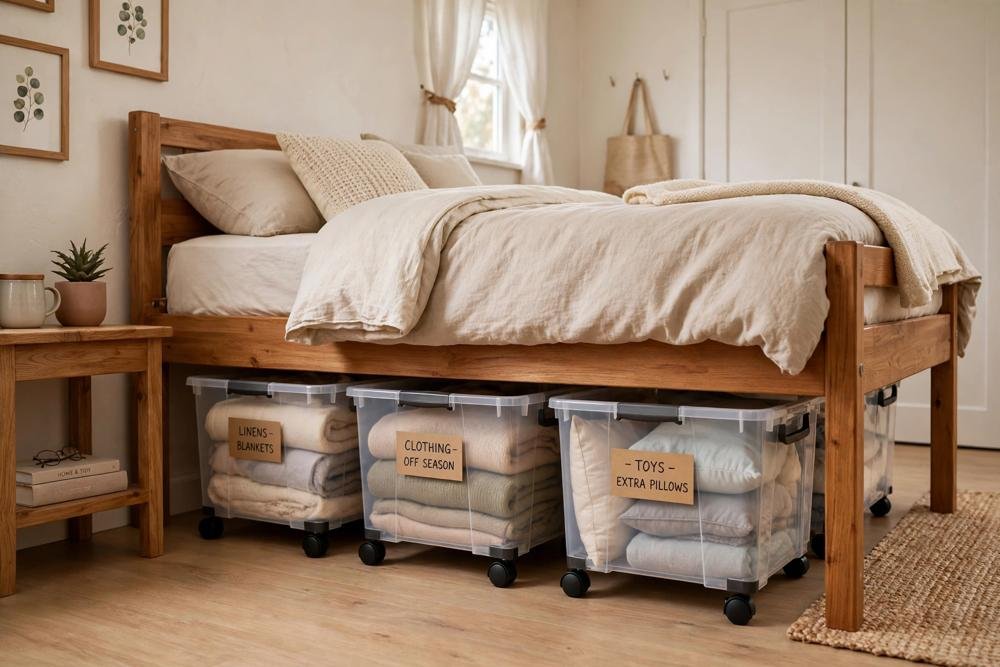
There are three main options. Rolling bins are the most flexible. They slide out without lifting the mattress and suit shoes, spare bedding, and seasonal clothes, but they need clear space in front of the bed and can look messy if they are open and overflowing. Lift up storage beds are the most space efficient, because the whole base becomes one large compartment for winter duvets, suitcases, and spare pillows. The downside is cost, weight, and the need to lift the mattress every time you need something, so they are best for seasonal items, not daily clothes. Drawer beds sit in the middle. They look tidy and are easy to open, but the drawers need full clearance, which may not work if the bed is pushed against a wall on one side. For options that still look good, see Under-Bed Storage Ideas That Are Not Ugly.
Whatever system you choose, keep under bed storage for weekly or seasonal items, not daily clothes. Daily clothes belong at waist to shoulder height. Label the bins on the end that faces outwards, and use matching bins with closed lids where possible.
Idea 2: Take Storage Up the Wall
When the floor is full, the walls are the next place to look, but not all wall storage is equal. Low wall storage can block walkways and make a room feel crowded. High wall storage, used carefully, can add a lot of volume without taking any floor space.
The most useful high zones are above the door, above a wardrobe, and the upper part of a wall not used for art or a mirror. These areas are ideal for things you need a few times a year, such as spare bedding, photo boxes, or seasonal decorations. They are not ideal for daily items, because climbing to reach them every morning quickly becomes annoying and unsafe.

Before fixing anything high on a wall, check what the wall is made of and whether you can fix into a stud. Heavy shelves need proper fixings, not just adhesive strips, especially above a bed or doorway, where a falling shelf could cause injury. If you rent, use a freestanding tall unit that can be secured safely and removed without major damage, and check your rental agreement first.
Keep high storage closed. Matching boxes with lids, or a shallow wall cabinet with doors, will look calmer and protect the contents. As a guide, shelves above about 180 centimetres are for seasonal storage only. Shelves between 150 and 180 centimetres can hold monthly items if you can reach them safely with a small step stool. Vertical storage should also stay slim, so deep shelves do not make a narrow room feel narrower.
Idea 3: Make the Door and the Space Behind It Work Harder
The back of a bedroom door is one of the most overlooked storage surfaces in a small home. It is already there, it does not use floor space, and it can hold a surprising number of everyday items if it is used with discipline.
Over door hooks and organisers work best for light, flat, or hanging items: tomorrow’s outfit, a dressing gown, a bag, a scarf, or a set of belts. They work less well for heavy coats, a full shoe collection, or anything that makes the door hard to open and close. If the door starts to drag, squeak, or not close properly, the organiser is too heavy or too bulky for that door.

A slim over door shoe organiser can help, but it needs a clear limit. Use it for shoes you wear often, and keep the total realistic. Six to eight pairs on a door organiser, with the rest stored under the bed or in a wardrobe, is a better balance than trying to fit every pair on the door. Overloading a door can also damage its hinges over time.
Door storage should follow the frequency rule too. Choose three or four hooks for real daily use and leave the rest empty. Empty hooks are not wasted space. They are what keep the system usable. For renters, over door storage is especially useful because it usually needs no drilling. Check that hooks fit your door thickness and do not damage paint or the frame.
Idea 4: Store Inside Furniture You Already Own
The best storage in a small bedroom is often storage you already have but are not using fully. Beds, wardrobes, nightstands, and ottomans all have internal volume that can be planned better, without buying new furniture or using more floor space. If you still need drawers, see Small Bedroom Dresser Alternatives That Save Floor Space.
Start with the wardrobe. Many wardrobes lose space to a single long hanging rail and one high shelf. A second, lower hanging rail for shirts and trousers can double hanging space in part of the wardrobe, while leaving one section long for dresses and coats. Slim, matching hangers also help, because bulky hangers waste width and make clothes harder to slide along the rail. The goal is not to cram more clothes in, but to make the clothes you own easier to see and reach. If your room has no closet at all, see How to Organise a Bedroom Without a Closet for wardrobe-free ideas.

Nightstands are another missed opportunity. A nightstand with a drawer can hold chargers, a notebook, and small personal items that would otherwise end up on the floor beside the bed. If yours has no drawer, a small lidded box on an open shelf can do the same job and keep the surface clear.
Ottomans and storage benches at the foot of the bed can be useful, but only if they do not block the walkway. A slim bench works best for spare bedding or shoes. If you have to climb over it to make the bed, it is too big for the room. Inside furniture generally, keep one category per drawer or compartment, with a clear limit on what goes in.
How to Measure Your Bedroom Before You Buy Anything
Measurements prevent the most common storage mistakes in small bedrooms. Before you buy bins, shelves, or a new bed base, measure the room and the furniture you already have, and write the numbers down. Guessing from memory in a shop is how people end up with bins that do not fit under the bed or shelves that block a door. If your room is very small, our guide to Small Bedroom Layout Ideas for a 10 by 10 Room can help you plan the layout before you buy anything.
Measure under bed clearance, the usable length and width under the bed, and the space in front of the bed needed to pull bins out. Measure ceiling height and the height of any wall space you plan to use, and note where light switches, sockets, and radiators are. A shelf that covers a socket or blocks a radiator is not a good shelf, even if it looks neat in a photo.
Measure door swing and drawer swing as well. Check them with doors and drawers fully open, not just closed, because a drawer or door that cannot open fully is wasted storage and a daily frustration.
What to Store Where by Frequency
Divide bedroom items into three groups. Daily items should be at waist to shoulder height, within one step of where you use them. Weekly items can be in a drawer, a wardrobe shelf, or an under bed bin that is easy to pull out. Seasonal items can go high, low, or behind something, because you only need them a few times a year.
Daily items usually include clothes for today and tomorrow, phone chargers, medication, and personal care items. These should not be under the bed, on a high shelf, or in a box at the back of a wardrobe. Weekly items might include spare bedding, laundry supplies, gym clothes, and shoes you wear a few times a week. These can go in under bed bins, in a wardrobe, or on a mid level shelf, where they are easy to access but do not need to be on display.
Seasonal items include winter coats, heavy duvets, holiday clothes, and decorations. These are ideal for high shelves, lift up bed storage, and the top of a wardrobe. When you are unsure where something belongs, ask how often you used it in the last month. If it is not at all, it may not need to be in the bedroom at all.
What to Avoid
The first mistake is buying storage before measuring. Bins too tall for under bed clearance, shelves too deep for a narrow wall, and drawer beds that cannot open fully are expensive mistakes that a tape measure could have prevented.
The second mistake is using open storage for everything. Open shelves, baskets, and racks can look good in photos, but in a small bedroom they quickly become visual clutter. Use closed storage for most items, and keep open storage for a small number of things that look tidy and are used often. One open shelf with a few books and a plant is calming. Five open shelves full of mismatched boxes are not.
The third mistake is storing daily items in hard to reach places. If you have to climb, crawl, or move three other things to get dressed, the system will fail, even if it looks organised on day one. Daily items need easy, waist to shoulder height storage.
The fourth mistake is overfilling every new space. Storage that is about eighty percent full is much easier to use than storage packed tight. Finally, avoid blocking light, air, and movement for the sake of storage. If your room has no ceiling light, our guide to Cozy Bedroom Lighting Ideas Without an Overhead Light can help you keep it bright.
FAQs
How do I add storage to a small bedroom without making it feel cramped?
Use wall height, under bed space, door space, and inside furniture space before adding floor furniture. Keep most storage closed and matching, leave some empty space in bins and on shelves, and avoid blocking windows, walkways, and radiators.
What is the best storage for a tiny bedroom with no floor space?
Start with under bed rolling bins or a lift up bed base for seasonal items, plus one high closed shelf above the door or wardrobe for things you use a few times a year. Add an over door organiser for a small number of daily items, and reorganise the wardrobe with a second hanging rail and matching hangers.
Are storage beds worth it in a small bedroom?
Storage beds can be worth it, especially lift up beds for seasonal bedding and drawer beds for weekly items. They are less useful for daily clothes, because lifting a mattress or opening a drawer every morning can become annoying. Before buying, measure under bed clearance, drawer opening space, and the space needed to get around the bed.
How much space is under a queen bed for storage?
It depends on the frame and clearance, but with about 30 centimetres of clearance, a queen bed can hold several shallow bins or a lift up compartment for duvets, spare bedding, and seasonal clothes. Measure your own bed from the floor to the underside of the frame, because legs and centre supports can reduce the real volume.
Should bedroom storage be open or closed?
Most bedroom storage should be closed, especially in a small room. Closed bins, boxes with lids, and cabinets with doors hide visual clutter and protect contents from dust. Open storage works best for a small number of items that are used often and look tidy, such as a few books, one plant, or a neatly folded throw.
How do I organise a small bedroom closet without adding floor furniture?
Use the inside of the closet more efficiently. Add a second hanging rail for shirts and trousers, use slim matching hangers, add a shelf above the existing rail, and use the inside of the closet door for slim organisers. Keep daily clothes at easy reach height, move seasonal items to the top shelf, and use under bed storage for overflow. For more ideas, see Small Reach In Closet Organisation Ideas.
Conclusion
Small bedroom storage does not have to mean a smaller, more crowded room. Using the space under the bed, up the walls, behind the door, and inside furniture you already own can add useful volume without losing floor space.
The most important steps are simple: measure first, store by frequency, keep most storage closed and matching, and leave room to move. Start with one or two ideas that fit your room and routine, and add more only if you still need them.