Introduction
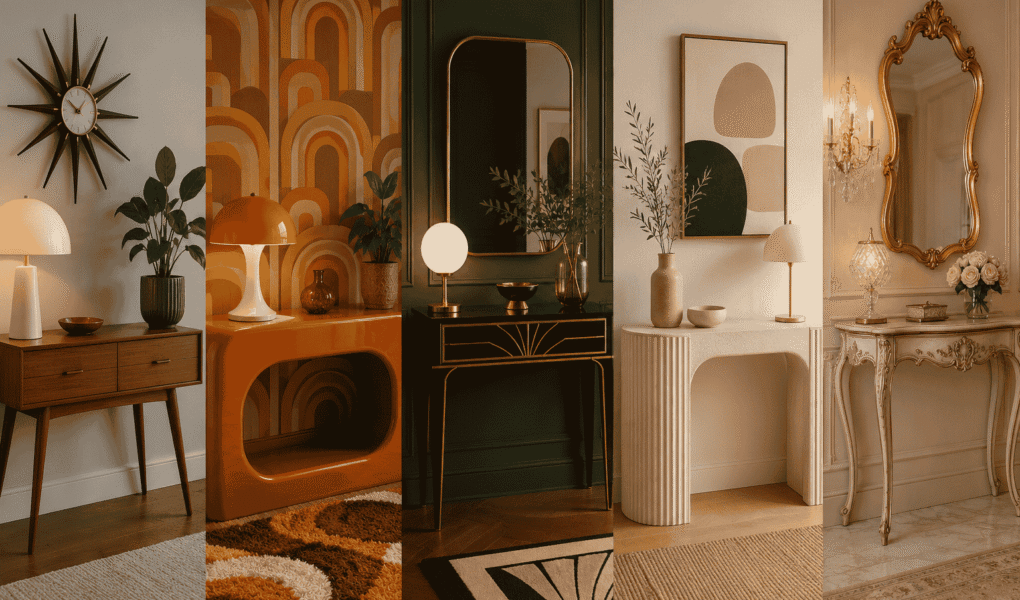
retro console table is one of the fastest ways to give a hallway, entryway, or living room a genuinely distinct identity — the kind that makes a space feel personally chosen rather than assembled from a single shopping trip. The challenge most people run into is that “retro” covers about six entirely different design decades, and each one has its own material language, proportions, and character that do not translate across eras the way the word “retro” implies they might.
A 1950s Danish teak console table and a 1970s lacquered brass-trimmed sideboard are both technically retro and genuinely nothing alike. Choosing one over the other without knowing which era you are actually drawn to — and why — leads to the kind of room that looks like it contains vintage pieces without feeling like it has a perspective. This guide covers the five key retro design eras, what distinguishes each one visually and materially, and how to style a retro console table in a way that anchors a space rather than simply occupying it.
🔗 Looking for more entryway and hallway decor ideas? Read our economy home decor guide and our feng shui home decorating guide for more.
What Is a Retro Console Table?
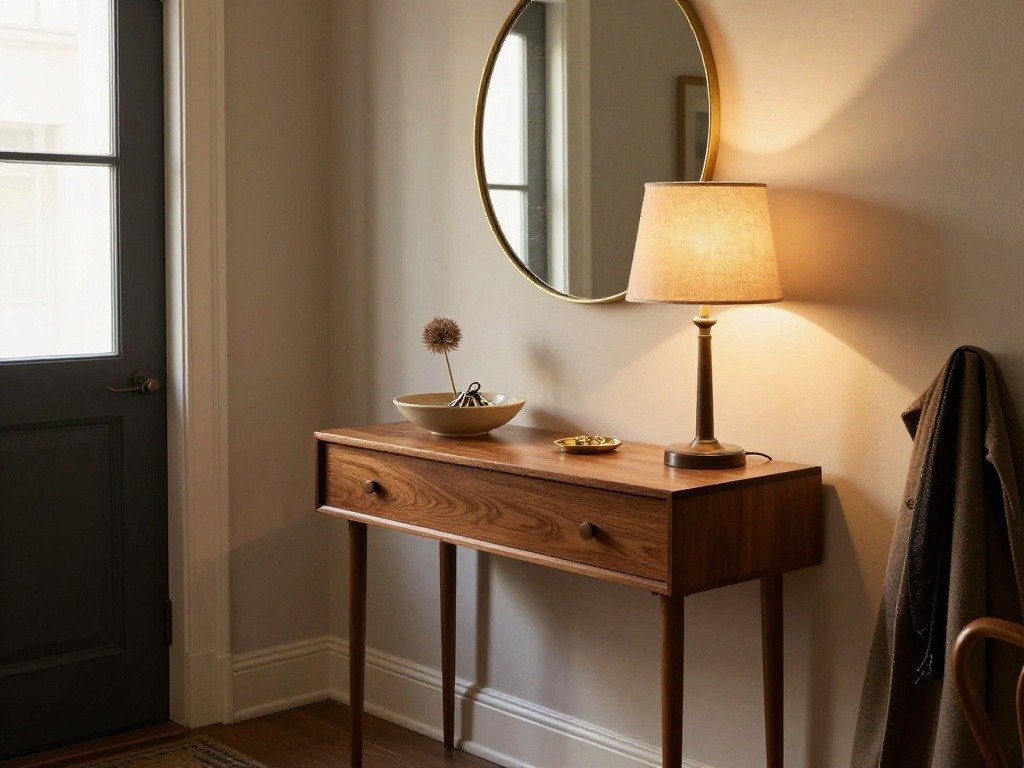
A console table is a narrow table — typically 12–18 inches deep — designed to sit flush against a wall. Traditionally used in entryways and hallways, console tables have expanded into living rooms (behind sofas), dining rooms (as a sideboard alternative), and bedrooms (as a vanity-adjacent surface).
A retro console table specifically references a furniture design era — most commonly the mid-century period (1945–1969), the 1970s, or occasionally the Art Deco-influenced Hollywood Regency style of the same decades. What makes a console table read as “retro” rather than simply “traditional” or “modern” comes down to a specific set of design signals: tapered or hairpin legs, warm wood tones (walnut and teak especially), geometric brass or chrome hardware, and proportions that are noticeably slimmer and more architectural than the heavier console tables of earlier traditional styles.
The 5 Retro Console Table Styles
1. Mid-Century Modern Console Table
The most popular and most widely available retro console table style. Mid-century console tables are defined by clean lines, tapered legs (often angled outward, sometimes called “hairpin” when made of thin metal rod), warm wood tones, and a complete absence of ornamental carving or excess detail.
Key features:
- Walnut or teak wood — the two defining mid-century woods
- Tapered or hairpin legs, often angled outward at 10–15 degrees
- Minimal or no hardware — handleless drawers with a discreet finger pull, or simple round wood knobs
- Often includes one or two slim drawers
- Clean rectangular or gently curved tabletop
Best for: Entryways, behind sofas in open-plan living rooms, hallways in mid-century or transitional homes
2. 1970s Console Table
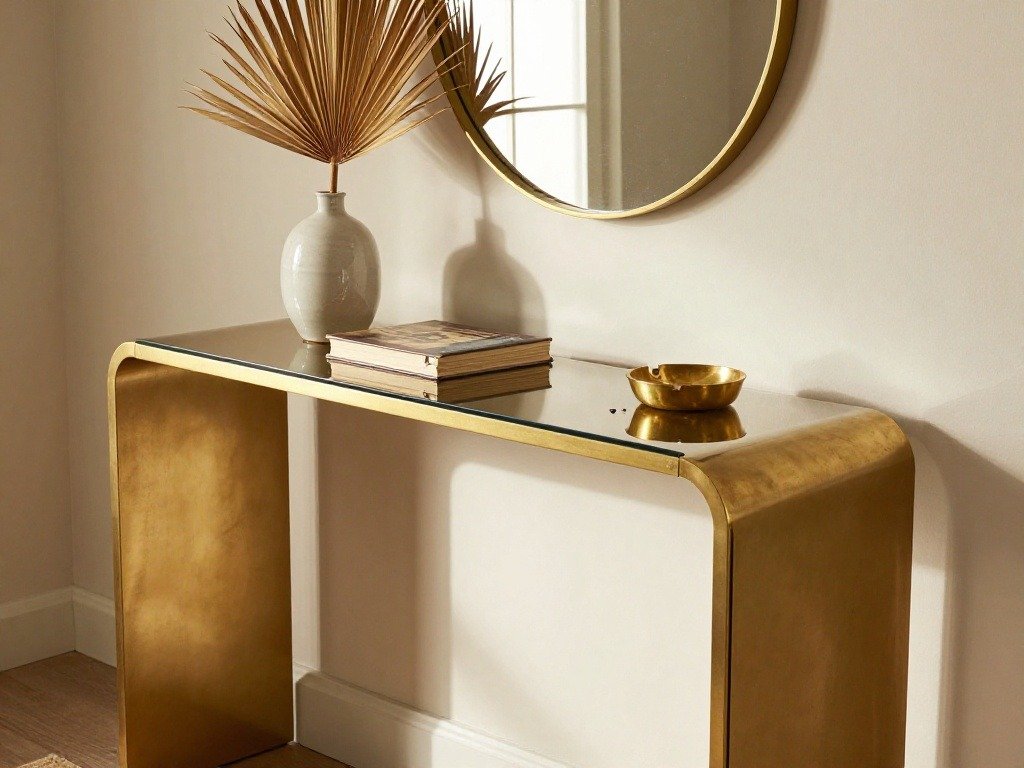
The boldest and most characterful retro console table style. The 1970s console table leans into the decade’s love of brass, glass, chrome, and dramatic geometric form.
Key features:
- Brass or chrome frame — often with a distinctive geometric base (X-shaped, waterfall curve, or angular Z-form)
- Glass tabletop — smoked or clear glass was the defining surface material of the era
- Sometimes incorporates lucite or acrylic elements
- Bold, sculptural silhouette rather than the restraint of mid-century design
Best for: Maximalist living rooms, glam entryways, anyone wanting a genuine statement piece rather than a quiet background table
You can also read Feng Shui Home Decorating: The Complete 2026 Guide to Harmonious Living
3. Hollywood Regency Console Table
The most glamorous and most dramatic retro console table style — referencing the lacquered, mirrored, and gilded furniture of 1930s–1960s Hollywood interior design, which has experienced a significant revival.
Key features:
- High-gloss lacquer finish — black, white, emerald, or a jewel tone
- Mirrored or marble tabletop
- Gold or brass hardware and trim
- Often features fluted or reeded leg detailing
- Curved or scalloped silhouette
Best for: Glam, maximalist, and romantic aesthetic homes. Particularly striking in an entryway with a statement mirror above.
4. Danish Pastel Retro Console Table
A softer, more contemporary reinterpretation of mid-century retro design — taking the tapered legs and clean lines of the era and applying them in soft, muted colours rather than traditional wood tones.
Key features:
- Painted finish in sage green, dusty blue, soft pink, or warm cream
- Retains mid-century tapered or hairpin leg silhouette
- Often paired with natural wood or rattan accents
- Combines retro structure with a contemporary, gentle colour palette
Best for: Danish pastel, kawaii-adjacent, and soft contemporary aesthetic homes wanting retro structure without heavy wood tones
5. Industrial Retro Console Table
The most rugged retro console table style — combining reclaimed or distressed wood with raw metal framing, referencing both mid-century simplicity and an industrial, utilitarian sensibility.
Key features:
- Reclaimed or distressed wood tabletop
- Black or raw steel frame and legs
- Often includes open shelving rather than drawers
- Visible joinery and hardware as a deliberate design feature
Best for: Industrial, rustic, and indie aesthetic entryways and living rooms
How to Choose the Right Size
The most common mistake when buying a console table — retro or otherwise — is getting the proportions wrong for the space.
Entryway console table: 30–48 inches wide is standard. Leave at least 36 inches of clear walking space in front of the table for comfortable passage.
Behind-sofa console table: Match the table length to roughly 75–90% of the sofa’s length for the most visually balanced look. Height should be similar to or slightly above the sofa’s back height — typically 28–32 inches.
Hallway console table: In a narrow hallway, choose a console no more than 12–14 inches deep to avoid obstructing the walkway. Length depends on the hallway — leave clear passage of at least 30 inches at all times.
Standard console table depth: 12–18 inches. Anything deeper starts to function more like a sideboard or buffet table than a true console.
You can also use our Free Rug Size Calculator
How to Style a Retro Console Table — The Complete Guide
Styling the top of a console table is where most of the visual impact happens — and where the “rule of three” and asymmetric balance principles consistently produce the best results.
The Entryway Styling Formula
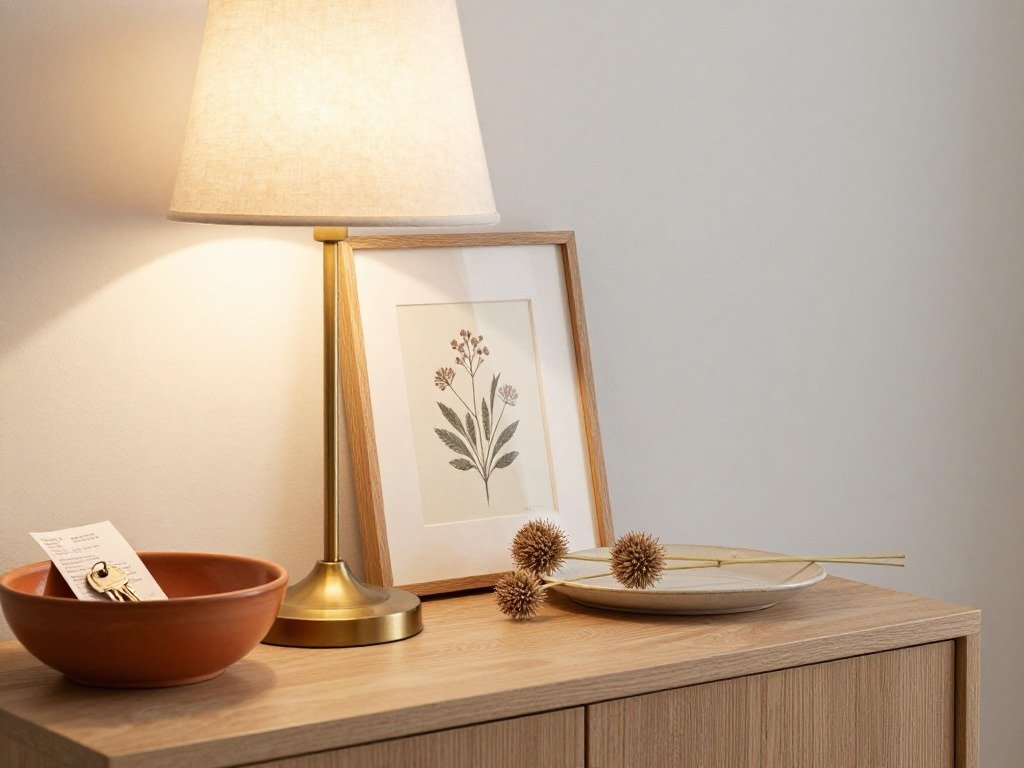
One functional element: A ceramic bowl or tray for keys, a small dish for jewellery removed at the door, or a simple basket for mail.
One vertical element: A table lamp, a tall vase, or a small framed print leaning against the wall above the table. This is what gives the styling height and prevents the surface from feeling flat.
One organic element: A plant, a bunch of dried flowers, or a single branch in a vase. Living or organic texture is what keeps a styled surface from feeling sterile.
Optional — one personal element: A small stack of books, a framed photograph, or a single meaningful object that makes the styling feel like yours rather than a showroom display.
The Behind-Sofa Styling Formula
A console table behind a sofa typically holds slightly more than an entryway table because it usually sits in active living space rather than a transitional one.
- A table lamp at one end for ambient lighting
- A stack of 2–3 books with a small object placed on top
- A plant or vase of flowers at the other end for balance
- Optionally, a small tray with a candle and a couple of smaller decorative objects in the centre
The Aesthetic-Specific Styling Guide
| Console Style | Best Styling Objects |
|---|---|
| Mid-century | Ceramic bowls, a single sculptural vase, a wood-and-brass table lamp, dried pampas grass |
| 1970s brass/glass | A large art book, a dramatic dried floral arrangement, a brass ashtray as catch-all |
| Hollywood Regency | A mirrored tray, a single orchid or white floral arrangement, a crystal or glass lamp |
| Danish pastel | A soft ceramic vase in a complementary pastel, a small stack of pastel-spined books, a rattan tray |
| Industrial | A reclaimed wood tray, a single succulent in a concrete pot, an exposed-bulb table lamp |
Materials Guide — What to Look For
Solid wood (walnut, oak, teak): The most authentic and most durable option for a genuine mid-century retro console table. Solid wood ages beautifully and can be refinished if damaged. More expensive than veneer alternatives.
Wood veneer over engineered wood: A more affordable way to achieve the look of solid walnut or teak. Quality varies significantly — look for veneer that is at least 1/16 inch thick for durability, and avoid pieces where the veneer edge is visibly thin or peeling at the seams.
Brass and metal (1970s and Hollywood Regency styles): Solid brass develops a beautiful natural patina over time and can be polished back to a bright finish if desired. Brass-plated or brass-finished metal is more affordable but will not develop the same patina and may show wear at contact points over time.
Glass tabletops: Tempered glass is essential for safety — always confirm before purchasing, particularly with vintage or reproduction pieces. Smoked glass hides fingerprints and dust more effectively than clear glass.
Lacquer finishes (Hollywood Regency): High-gloss lacquer shows scratches and fingerprints readily. Look for pieces with a catalysed or conversion lacquer finish, which is significantly more durable than standard lacquer.
You can also read Economy Home Decor: 40 Budget Decorating Ideas That Look Expensive
Where to Find a Retro Console Table
Vintage and original pieces: Genuine vintage mid-century and 1970s console tables can be found through Etsy, Chairish, 1stDibs, and local estate sales or vintage furniture shops. Genuine vintage pieces carry the most authentic character and often the best build quality — but require patience, careful inspection for structural integrity, and typically a higher budget ($200–$1,500+ depending on designer and condition).
New reproductions and retro-inspired pieces: Most major furniture retailers now carry retro-styled console tables at accessible prices. Look for solid wood construction and metal (rather than metal-look plastic) hardware as the key quality indicators at this price point. Expect $150–$500 for a well-made reproduction piece.
Budget options: IKEA and similar retailers offer console tables with mid-century-adjacent silhouettes (tapered legs, simple lines) at the most accessible price points, typically $60–$150. These will not have the material authenticity of solid wood or solid brass pieces but can achieve the visual silhouette effectively when styled well.
Secondhand marketplaces: Facebook Marketplace and local thrift or charity shops are consistently the best source for genuinely characterful retro console tables at low prices — often $20–$100 for pieces that would cost considerably more from a vintage dealer. A coat of wax or a light sand-and-oil treatment can dramatically refresh a tired secondhand find.
Frequently Asked Questions
Q: What is the difference between a console table and a sofa table?
A: The terms are often used interchangeably, but a sofa table specifically refers to a console table positioned directly behind a sofa, typically matched in height to the sofa back. A console table is the broader category and can be used in an entryway, hallway, or against any wall, regardless of whether a sofa is nearby. Most retro console tables work equally well in either application.
Q: How tall should a console table be?
A: Standard console table height is 28–32 inches — roughly the same as a typical dining chair seat height plus a few inches. For a behind-sofa placement, match the table height closely to the sofa’s back height for visual balance. For an entryway, a slightly taller table (30–34 inches) can feel more substantial and architectural.
Q: What goes well on top of a retro console table?
A: A ceramic bowl or tray for keys and small items, a table lamp for height and warmth, and a plant or dried floral arrangement for organic texture form the foundation of most successful console table styling. Add one or two personal items — a framed photo, a meaningful small object, or a stack of books — to keep the surface from feeling like a showroom display rather than a lived-in home.
Q: Are mid-century console tables a good investment?
A: Genuine vintage mid-century furniture, including console tables by recognised designers or manufacturers, has historically held or increased in value over time, particularly solid walnut and teak pieces in good original condition. Well-made reproductions will not appreciate in the same way but offer the aesthetic at a significantly lower upfront cost and are a reasonable choice for most homes.
Q: Can a retro console table work in a modern home?
A: Yes — retro console tables are one of the most versatile furniture choices for exactly this reason. A single well-chosen mid-century or retro piece reads as an intentional design choice rather than a clash when the rest of the room is more contemporary. The contrast between a warm walnut retro console and a clean, modern white-walled entryway is one of the most consistently successful pairings in residential interior design.
🔗 Continue styling your home — read our Decorative Metal Panels Ideas and our How to Make a Fairy House for more entryway and living room ideas.