A dining room with the wrong drapes is one of those things that bothers people without them being able to say exactly why. The room looks almost right. The furniture is good, the table is set well, the lighting is considered — and yet something about the window feels unfinished, or too heavy, or slightly off in a way that quietly undermines the rest of the room every time someone sits down to eat.
Drapes are doing more work in a dining room than in almost any other space in the house. They need to look composed enough for a dinner party and relaxed enough for a Sunday brunch. They have to manage light across a room that swings between candlelit evenings and full daylight mornings. And they often have to contend with layout problems that don’t come up elsewhere — a window directly behind a sideboard, a bay that doesn’t suit a standard rod, or two windows on the same wall that are subtly different sizes and need to look intentional rather than mismatched.
Getting drapes right in a dining room means solving the layout problem first, then choosing the fabric, length, and colour that actually suits how the room is used — not just how it looks in a showroom.
This guide covers the fabrics that suit different formality levels honestly, the hanging and length styles worth knowing, colour guidance that works across real dining rooms rather than idealized ones, and — because almost no guide addresses this properly — what to do when your specific dining room has a bay window, mismatched windows, or furniture sitting directly in front of the glass.
Before any styling decision, it’s worth being clear about why drapes matter in a dining room specifically, since this shapes every other choice that follows.
Privacy during meals. Drapery panels increase privacy by blocking the view from outside, and the level of privacy varies depending on fabric weight and lining — but even sheer drapes offer some degree of softening between the room and the street or garden outside.
Genuine light control. Sheer fabric filters and softens daylight beautifully for daytime meals, while a heavier fabric with blackout lining gives full control for evening dinners or rooms that double as a home office or homework space during the day.
A finished, polished aesthetic. Drapery adds design dimension to a window that nothing else quite replicates, giving the whole room a sense of completion rather than leaving the window as the one unfinished element in an otherwise styled space.
Choosing the Right Fabric by Formality Level
This is the single most important decision, and it should come before colour or pattern, since the fabric itself sets the tone for the entire room.
For a Formal Dining Room
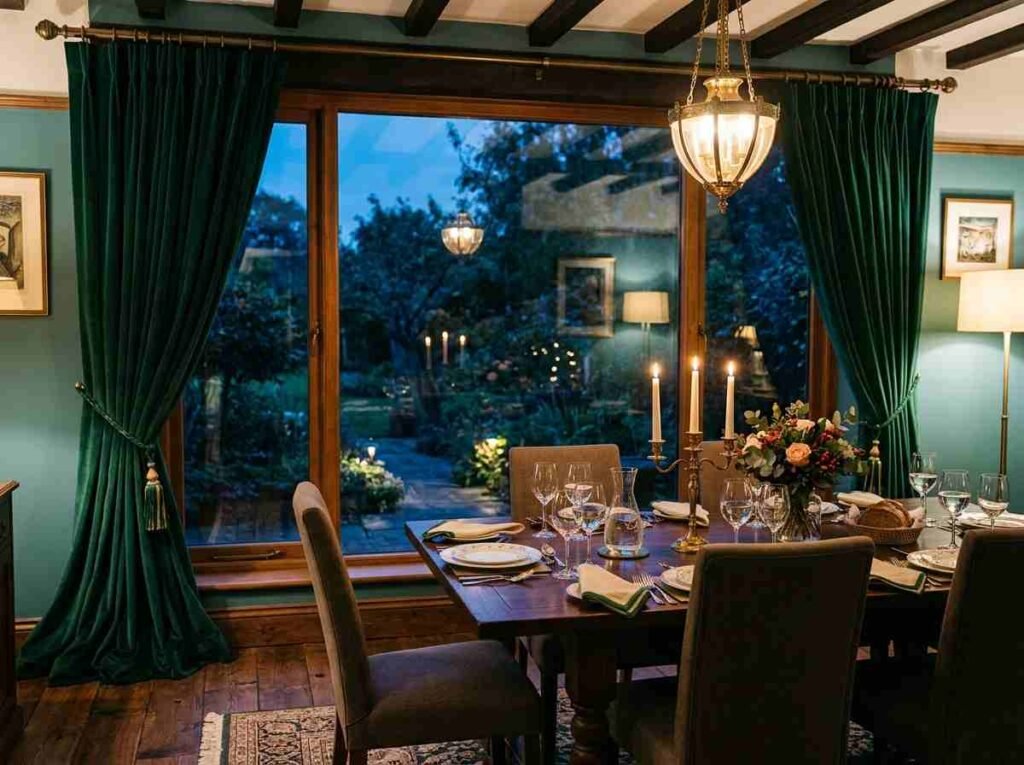
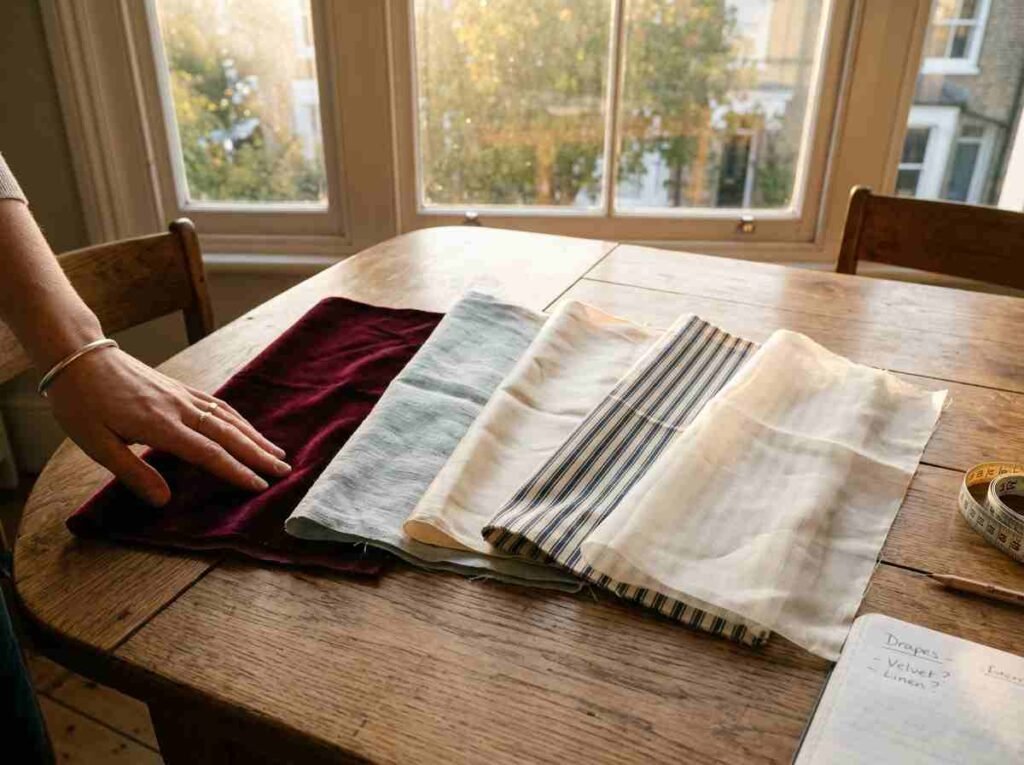
Velvet is the most consistently recommended fabric for a genuinely formal dining room. It looks luxurious, helps insulate the space, and dampens sound — a real benefit in open-plan homes where the dining area isn’t fully enclosed. Velvet’s weight also gives excellent light control, keeping the space cozy during evening dinners.
Silk brings a sheer elegance and formality that’s hard to match, with a subtle sheen and a flowing drape that velvet doesn’t replicate. It is more delicate and often needs professional cleaning, which is worth factoring in for a room that sees regular use.
Brocade offers intricate, heavyweight pattern that makes a genuine statement, particularly well suited to a more traditional or vintage-leaning formal dining room.
For a Semi-Formal or Everyday Dining Room
Cotton is versatile, flowing, and comes in a huge range of colours and weights — from semi-sheer to fully opaque — making it one of the most practical choices for a dining room that needs to look good without demanding velvet-level upkeep.
Linen brings a natural, breathable, casual elegance that works particularly well for farmhouse-style or coastal-inspired dining rooms, and its durability and easy maintenance make it a strong long-term choice for a room used daily.
For a Casual Dining Room
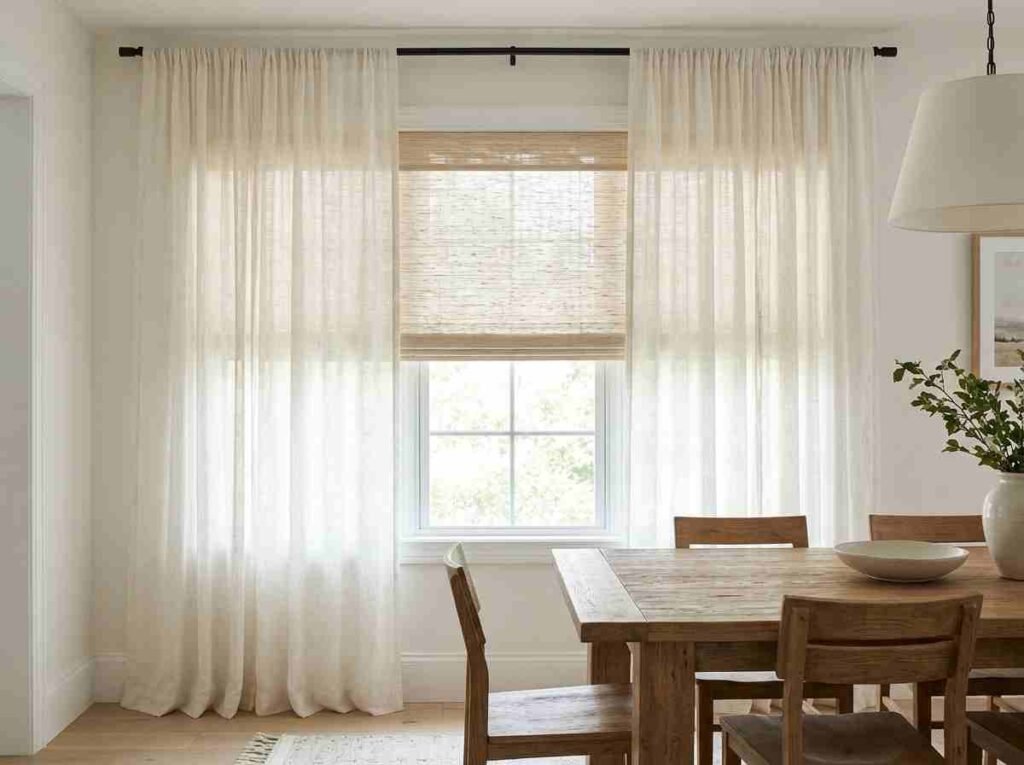
Sheer fabrics in linen or light cotton keep the space feeling airy and light-filled, ideal for a dining room that’s used for everyday meals and benefits from soft, filtered daylight rather than heavy drama.
High-quality polyester blends shouldn’t be underestimated — they offer durability and easy maintenance while often mimicking the look of natural fibres convincingly, sometimes with the added benefit of fire-retardant options.
One of the most practical solutions for any dining room — formal or casual — is layering two types of window treatment together rather than choosing just one.
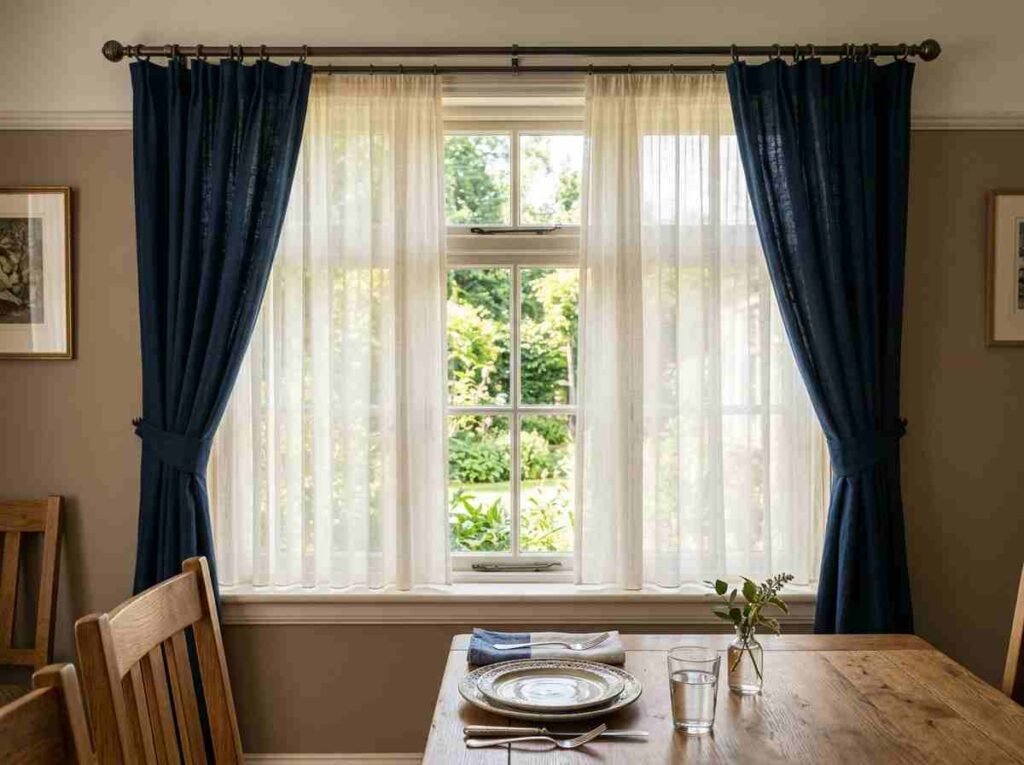
The combination that works best: sheer curtains hung closest to the window, with heavier blackout or lined panels layered over them on a second rod or track. This gives genuine flexibility for a room that often serves dual purposes — bright, soft-lit daytime brunches and fully private, ambiance-controlled evening dinners — without needing to compromise on either.
Why this matters specifically for dining rooms: few other rooms swing this dramatically between daytime and evening use within the same day, which makes the layered approach more genuinely useful here than in many other rooms of the house.
Length and Hanging Style
Floor-length drapes create a sense of height and grandeur, and are particularly effective in rooms with higher ceilings. For genuine drama, puddled drapes extend slightly beyond the floor, while kissing drapes barely brush it, and floating drapes stand just an inch above — each creating a progressively more formal or more relaxed impression.
Sill-length or shorter drapes suit a more modern, minimalist dining room, and are the practical choice if there’s regular foot traffic near the window, since long curtains can present a genuine tripping hazard in a busy dining space with children or pets.
Mounting height and width matter as much as length. Installing the curtain rod just below the ceiling, or at minimum 6 inches above the window frame, draws the eye upward and makes the room feel taller. Extending the rod at least 6 inches beyond each side of the window frame allows the panels to stack back fully when open, maximising the natural light that reaches the room rather than the fabric covering part of the glass even when “open.”
Neutral palettes — beige, ivory, soft grey — create a serene, sophisticated backdrop that works with almost any existing decor and rarely dates.
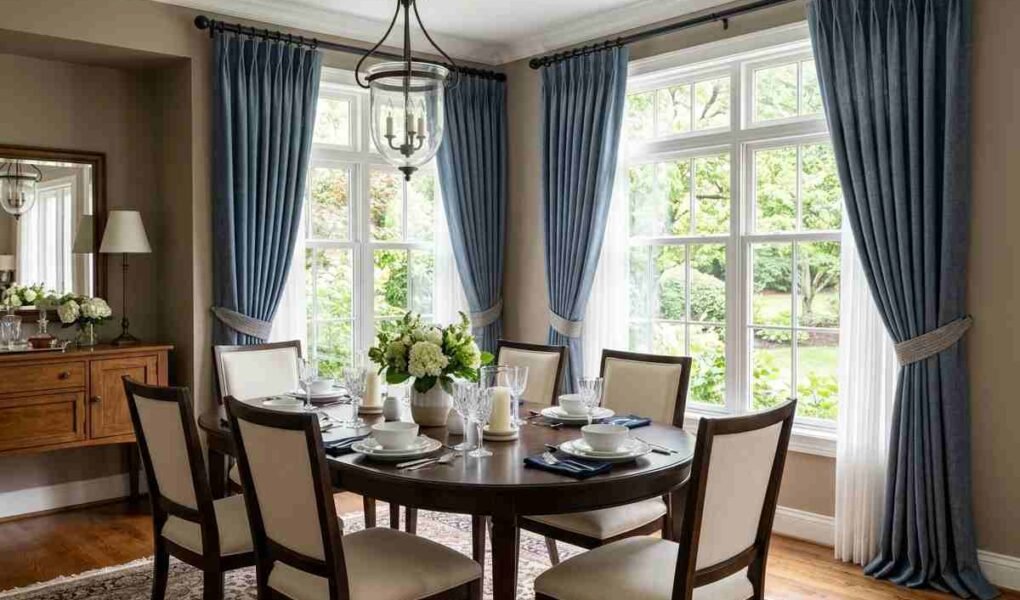
Bold colours, including deep blues, work as a genuine style statement. Blue drapes specifically bring a calming, classic quality to a dining room and pair particularly well with warm wood furniture and brass or gold hardware, creating a rich contrast that reads as considered rather than accidental.
Jewel tones — emerald, sapphire, burgundy — are the most consistently recommended colours for a dramatic, formal dining room, adding genuine depth in a way that’s hard to achieve with lighter shades.
Patterns — stripes, ikat, or botanical prints — work best as a deliberate focal point against otherwise neutral walls, since a heavily patterned room with patterned drapes can quickly feel busy. Pair the boldest patterned drapes with the calmest wall colour for the best balance.
A useful rule of thumb on colour relationship to the room: choose a drape colour a shade or two lighter or darker than the existing wall colour, rather than an exact match, which generally produces a more cohesive yet still layered result than perfectly matching tones.
Should drapes match the tablecloth? Coordinate colours rather than matching them exactly — complementary tones create more visual interest than an identical match, which can read as slightly dated.
This is the section most guides skip, focused on the practical layout challenges unique to dining room windows.
Bay Windows
A bay window in a dining room creates a genuinely different challenge than a standard flat window, since the angled glass means a single straight rod won’t sit flush against the wall the way it would elsewhere.
The best approach: Use a curved or custom-bent curtain rod that follows the angle of the bay precisely, allowing drapes to be drawn fully open and stack neatly into each corner rather than bunching awkwardly at the angles. For a bay window with a window seat beneath it, choose sill-length rather than floor-length drapes to avoid the fabric pooling onto a surface that’s meant to be sat or placed on. If the bay window is the room’s main architectural feature, consider hanging drapes only at the two outer windows of the bay and leaving the central pane uncovered or fitted with a simple sheer, to preserve the view while still framing the whole feature.
Windows With Furniture or a Radiator Beneath Them
Many dining room windows have a sideboard, buffet, bench seating, or a radiator positioned directly underneath, which makes traditional floor-length drapes impractical — the fabric either drapes awkwardly over the furniture or creates a fire hazard near a heat source.
The best approach: Choose sill-length drapes that stop precisely at or just below the windowsill, avoiding any contact with the furniture or radiator beneath. If the formal, floor-length look is non-negotiable for the room’s overall design, consider mounting the rod and drapes outside the direct footprint of the furniture, allowing the fabric to fall along the wall to either side rather than directly in front of the obstruction itself.
Multiple Windows of Different Sizes in the Same Room
Many dining rooms have two or three windows of slightly different proportions along the same wall or on different walls entirely, which can make a cohesive drape scheme genuinely tricky to plan.
The best approach: Use identical fabric, colour, and hardware finish across every window in the room regardless of each window’s individual size, so the consistency of material and style ties the room together even when the actual panel dimensions differ window to window. Avoid the temptation to use different drape styles for different-sized windows in the same room, since this tends to read as unplanned rather than intentionally eclectic.
Frequently Asked Questions
Q: What is the best fabric for dining room drapes?
A: Velvet is the most consistently recommended fabric for a formal dining room, offering luxury, sound dampening, and excellent light control. Silk offers a more delicate, sheer elegance suited to formal settings but requires more careful cleaning. For everyday or semi-formal dining rooms, cotton and linen are the most practical choices, balancing style with easy maintenance and durability for a room used regularly.
Q: How long should dining room drapes be?
A: Floor-length drapes create the most elegant, formal impression and work particularly well in rooms with higher ceilings, with options ranging from floating (an inch above the floor) to fully puddled (extending several inches onto the floor) depending on how dramatic a look is wanted. Sill-length drapes are the more practical choice for dining rooms with heavy foot traffic, young children, or pets, since floor-length fabric can present a genuine tripping hazard in a busy space.
Q: What do I do about drapes if my dining room has a bay window?
A: Use a curved or custom-bent curtain rod that follows the exact angle of the bay, allowing the drapes to stack neatly into the corners when open rather than bunching awkwardly. If there’s a window seat within the bay, choose sill-length rather than floor-length drapes to avoid fabric draping onto the seating surface. For bay windows that are already a strong architectural feature, hanging drapes only at the two outer panes and leaving the centre pane with a simple sheer preserves the view while still framing the feature.
Q: What colour drapes work best for a dining room?
A: Neutral colours like beige, ivory, and soft grey create a sophisticated, versatile backdrop that suits almost any existing decor. Blue is a particularly popular and classic choice, pairing beautifully with warm wood furniture and brass hardware. Jewel tones such as emerald, sapphire, and burgundy are the most recommended choices for a dramatic, formal dining room. As a general guide, choosing a drape colour one or two shades lighter or darker than the existing wall colour tends to produce a more cohesive result than an exact colour match.
Q: What if my dining room window has a sideboard or radiator directly underneath it?
A: Choose sill-length drapes that stop at or just below the windowsill, avoiding contact with the furniture or heat source beneath. This is both the safer choice near a radiator and the more practical choice over a sideboard or buffet, since floor-length fabric draping over furniture tends to look cluttered and can interfere with the furniture’s actual use. If a floor-length look is essential to the room’s design, mounting the drapes wide enough that the fabric falls along the wall to either side of the furniture, rather than directly over it, can preserve the formal look without the practical drawbacks.
Sufian Ahmed
Home decor enthusiast and founder of astheticdecor.com. Passionate about helping people create beautiful, personalised aesthetic rooms on any budget. Covering romantic, dark academia, kawaii, gothic, coquette and every aesthetic in between.