Christmas bedroom decor works best when it feels warm, calm, and easy to sleep in, not like a shop window moved into the room where you sleep. A bedroom is not a living room: you need clear walkways, dim light at night, and a bed you can actually get into, even in late December. The best Christmas bedrooms use a small number of festive changes, in a calm palette, with warm light, and a plan for packing away in January, rather than a large number of decorations that need dusting, untangling, and storing.
This guide covers a cosy overall look, a small tree for a small room, festive bedding, window lights and wreaths, a colour palette that does not clash with your existing room, safety and sleep, and packing away, plus what to avoid and answers to the questions people ask most about decorating a bedroom for Christmas.
Key takeaways: pick one festive focal point, usually the bed or a small tree, and keep the rest calm; use warm white lights, not flashing or multicolour lights, in a bedroom; keep walkways, doors, and the bed clear; choose bedding and throws you can wash and reuse; and pack decorations in labelled boxes in January, so next December is easy.
Start With a Calm Christmas Palette
Before you buy decorations, pick a palette that works with the bedroom you already have, not a palette that fights it. If your bedding is neutral, white, beige, or sage, a palette of warm white, soft green, and wood tones will look calm and festive without clashing. If your bedding is already colourful, pick one festive accent, such as deep red or gold, and use it sparingly, in cushions or a throw, rather than adding three new colours at once.
A calm palette also makes a small bedroom feel larger, because the eye is not pulled in many directions at once. Two or three colours, repeated in small touches, look intentional, while five or six colours, each in a different decoration, look busy. Choose your palette, write it down, and check every new decoration against it before you buy. If it does not fit the palette, do not buy it, even if it looks festive in the shop.
Natural materials help a Christmas bedroom feel cosy rather than plastic: wood, pinecones, dried orange slices, linen, wool, and paper stars, rather than shiny plastic in many colours. Natural materials also age better, store better, and can be reused or composted, which matters if you decorate every year. A simple garland of greenery, real or good quality faux, over a headboard, with warm lights, can look more expensive than a large number of small ornaments.
Keep the existing room in mind: if you already have art, curtains, and bedding you love, do not cover them all with Christmas decor. Add festive touches around them, not over them, so the room still feels like your bedroom, just with a Christmas layer for a few weeks.
Idea 1: A Cosy Overall Look With Warm Light

A cosy Christmas bedroom starts with light, not with ornaments. Warm white fairy lights, on a headboard garland, along a shelf, or in a jar on a dresser, change the room’s evening mood immediately, without adding clutter. Use warm white, around 2700 Kelvin, rather than cool white or multicolour, because warm light feels restful in a bedroom, especially in winter evenings. Use a timer, so lights turn off at bedtime automatically, rather than staying on all night, which can disturb sleep and waste energy.
Layer light, rather than relying on one bright source: a bedside lamp with a warm bulb, fairy lights for ambience, and the overhead light off, or dimmed, in the evening. This is the same layered lighting that works well for reading and for winter bedrooms generally, and it makes a Christmas bedroom feel calm rather than bright. Keep lights away from bedding, curtains, and paper decorations, and check cords for damage before you use them each year.
Add texture for cosiness: a knitted throw at the foot of the bed, a wool cushion, and a soft rug by the bed, in your chosen palette. Texture makes a room feel warm even before lights are on, and it is easy to remove in January. Avoid adding many small cushions that need moving every night to get into bed; two or three cushions, plus a throw, are enough, and they should be easy to put on a chair at night.
Keep the bed as the focal point, not as a display shelf. A made bed, with festive bedding or a throw, a garland on the headboard, and warm light, looks finished, while a bed covered in ornaments, gifts, and decorations looks cluttered and is hard to sleep in. Put gifts and large decorations elsewhere, in the living room or in a corner, not on the bed.
Idea 2: A Small Tree That Fits a Small Bedroom
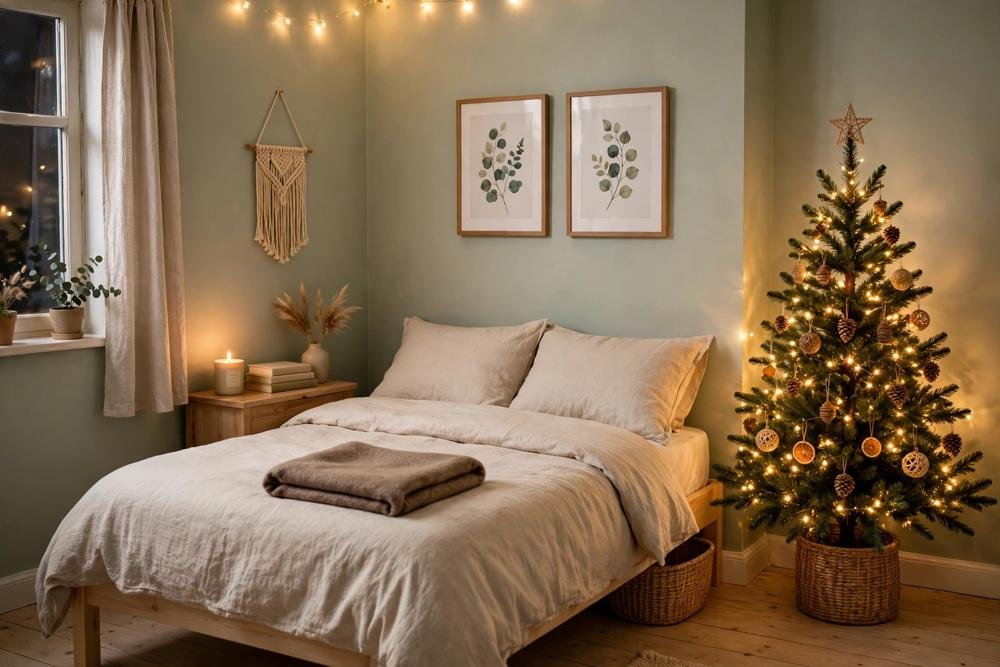
A small tree is the best Christmas tree for a small bedroom, because a full-size tree blocks walkways, doors, and light, and it needs a large base and many ornaments. Choose a tabletop tree, a slim pencil tree, or a small potted tree, in a corner that is not a walkway, away from heaters, radiators, and curtains. Measure the corner, including height to the ceiling and space for the base, before you buy, because a tree that is too tall or too wide will dominate the room.
Decorate a small tree simply: warm white lights, a small number of ornaments in your palette, and a simple topper, rather than every ornament you own. A small tree with ten ornaments, evenly spaced, looks better than a small tree overloaded with fifty ornaments that hide the branches. Use shatterproof ornaments in a bedroom, especially if the tree is near the bed or a walkway, because glass ornaments can break and are hard to clean from carpet or bedding.
If you have no floor space for a tree, use alternatives that give you the same feeling without a tree: a branch in a vase with lights, a wall tree made from lights or garland on a wall, or a small tree on a dresser or shelf. These work well in rental bedrooms, small bedrooms, and bedrooms with no spare corner, and they pack away in a small box in January.
Water a real small tree regularly, if you choose one, and keep it away from heat sources, because a dry tree is a fire risk. Check lights for damage, do not overload sockets, and turn tree lights off at bedtime, with a timer if possible. A small tree that is safe, simple, and in a clear corner will be enjoyed more than a large tree that is in the way.
Idea 3: Festive Bedding and Throws You Can Wash
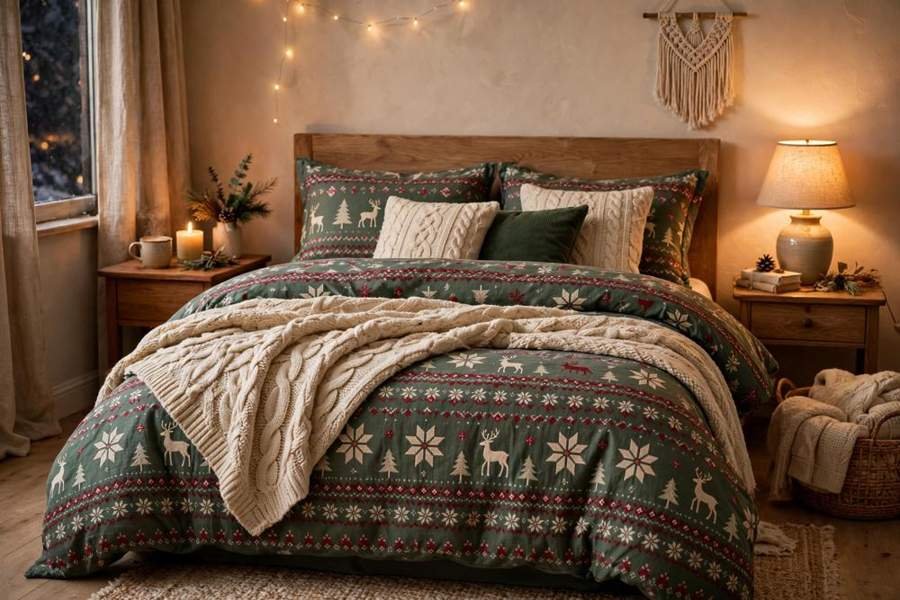
Festive bedding is the easiest Christmas change in a bedroom, because it covers the largest surface, the bed, and it can be washed and stored easily. Choose a duvet cover set in your palette, with a subtle festive pattern, such as small trees, stars, or snowflakes on a green, red, or neutral background, rather than a very loud pattern that clashes with the rest of the room. A subtle pattern looks festive without making the bed feel like a novelty item, and it can be used for several weeks, not just on Christmas Day.
Layer bedding for winter warmth and for looks: a fitted sheet, a duvet, a festive duvet cover, a knitted throw at the foot, and two or three cushions in accent colours. This layering also helps with temperature, because you can add or remove the throw at night without changing the whole bed. Wash festive bedding before first use, and again before packing away in January, so it is clean for next year and does not attract moths or dust in storage.
If you do not want a full festive duvet set, use a festive throw and cushion covers instead, over your normal bedding. Throw and cushion covers are cheaper, easier to store, and easier to change if you change your palette next year. Choose washable fabrics, cotton or a cotton blend, rather than dry-clean only fabrics, because bedroom bedding needs washing often, especially in winter when rooms are closed and heated.
Keep sleep in mind: festive bedding should still be breathable and comfortable, not heavy, scratchy, or made from synthetic fabric that traps heat. If you sleep hot, use a light festive cover with a separate throw, rather than a heavy festive duvet, so you can adjust layers at night. A bed that looks festive but sleeps badly will not be enjoyed for long.
Idea 4: Window Lights and a Simple Wreath
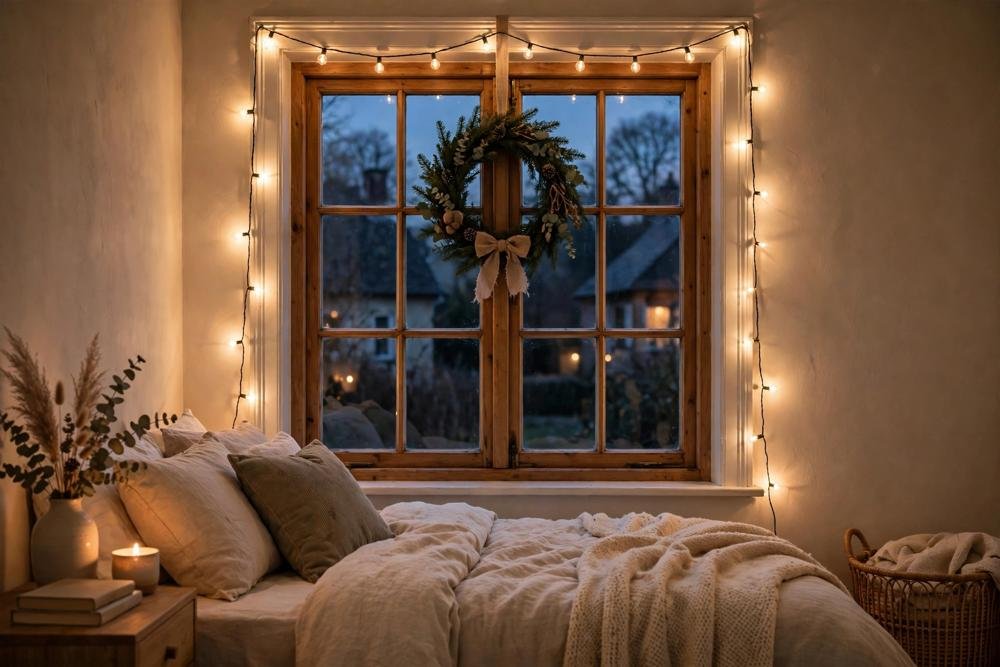
Window lights and a wreath give a Christmas bedroom a festive view from inside and outside, without taking floor space. Hang warm white fairy lights around the window frame, or in a simple swag across the top, with a timer, so they turn on in the evening and off at bedtime. Keep lights inside, away from curtains and bedding, and check that cords do not trail across walkways or the bed, where they can be tripped over or pulled.
A simple wreath, on the window, on a door, or above a dresser, adds greenery and scent without clutter. Choose a wreath in your palette, with pine, eucalyptus, or dried oranges, rather than a large wreath with many colours and ornaments that competes with the rest of the room. Hang a wreath with a removable hook or a ribbon over a door, rather than a nail, especially in a rental bedroom, so removal in January leaves no mark.
If your bedroom window faces a street, window lights will also be seen from outside, which can be a nice touch, but keep them warm and steady, not flashing, because flashing lights can disturb neighbours and sleep. If you have blackout curtains for sleep, check that window lights do not leak through or around them at night, or put window lights on a timer that turns them off well before bedtime.
Keep window areas clear for safety and for light during the day: do not block a window with a large tree, a pile of decorations, or heavy curtains that cannot be opened. A window that can be opened for fresh air, even in winter, and that lets in daylight, is more important than a window fully covered in decorations.
Idea 5: Packing Away Cleanly in January
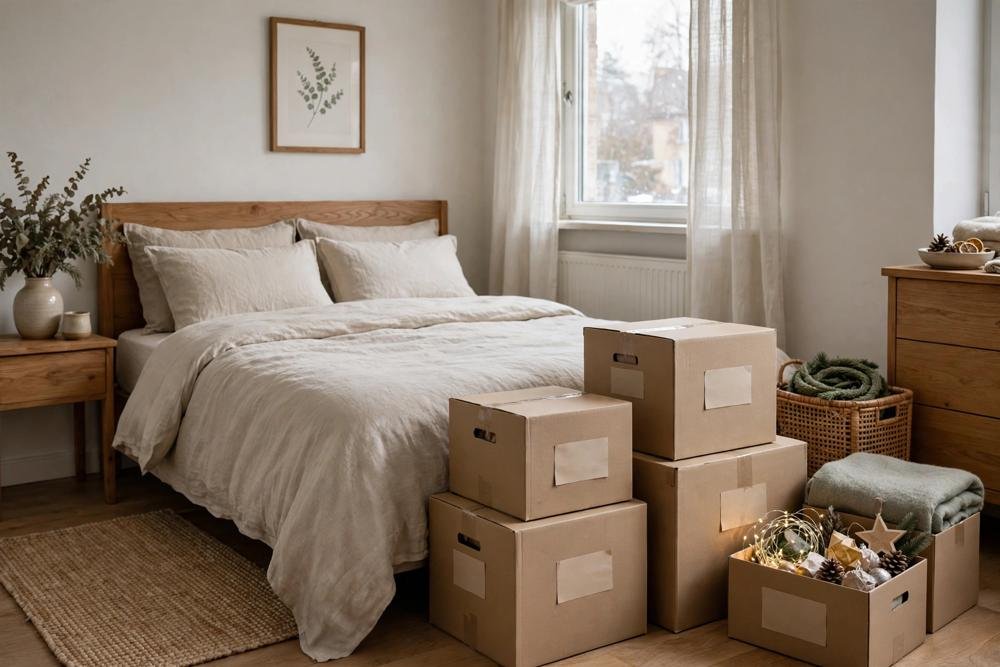
Packing away cleanly in January is part of Christmas bedroom decor, not an afterthought, because how you pack decides how easy next December will be. Take decorations down in reverse order: tree ornaments first, then lights, then garlands, then bedding, so you can see what you have and check for damage as you go. Wrap ornaments in tissue or old fabric, coil lights neatly without tangling, and label every box with its contents and the room it belongs to.
Wash festive bedding, cushion covers, and throws before packing, and store them in clean, dry boxes or bags, away from damp and direct sunlight. Check lights for damage before storing, and replace any damaged sets, rather than storing a faulty set that will be a problem next year. Keep a small box for spare bulbs, batteries, and hooks, so you do not need to buy new ones every year.
Return the bedroom to its normal state, not just by removing decorations, but by cleaning: dust shelves and headboards, vacuum under the bed and in corners where decorations were, and check walls for marks from hooks or tape. Take photos if you are renting, to show the room returned to its original condition. A bedroom that is clean and calm in January feels like a fresh start, rather than a room still half-decorated in February.
Keep a note, in the top box, of what worked and what did not: which palette you used, which tree size fitted, which lights had a timer, and what you want to change next year. This note, written in January when it is fresh, will save you time and money next December, because you will not buy duplicates or repeat mistakes.
Safety and Sleep at Christmas
Safety and sleep matter more in a bedroom than in any other room at Christmas, because you sleep there, often with lights, candles, and decorations nearby. Never leave candles unattended, and do not use real candles near bedding, curtains, paper decorations, or a tree. Battery candles give you the same warm glow without flame risk, and they can be used on a timer. Keep fairy lights away from bedding and curtains, check cords and plugs for damage, do not overload sockets, and turn lights off at bedtime.
Keep walkways, doors, and escape routes clear, even with a tree and decorations, because you need to be able to leave the room quickly in an emergency, in the dark, without tripping. Do not block a door with a tree, a pile of gifts, or storage boxes, and do not run cords across a walkway. If you have smoke alarms, check them before Christmas, and keep them working throughout the festive period.
Protect sleep by keeping Christmas lights on a timer, using warm steady light rather than flashing light, and keeping the bedroom dark and quiet at bedtime, even if the rest of the house is festive. A bedroom that is bright, noisy, or cluttered at night will disrupt sleep, even if it looks festive during the day. Turn off tree and window lights at least an hour before bed, or use a timer, so the room can settle before sleep.
What to Avoid
Do not overload a small bedroom with decorations, because it will feel cluttered, hard to clean, and hard to sleep in. Do not use flashing or multicolour lights in a bedroom, because they disturb sleep and can look harsh. Do not block walkways, doors, or windows with a large tree or piles of decorations, and do not use real candles near bedding, curtains, or paper. Do not buy decorations that do not fit your palette, your room size, or your storage, because they will be hard to use and hard to pack away. And do not leave packing until February, because decorations left up too long lose their charm and make the room feel untidy.
FAQs
When should I decorate a bedroom for Christmas?
Most people decorate in late November or early December, which gives you several weeks to enjoy it without it feeling stale. If you want to follow the 6 to 8 weeks early rule for search and planning, start planning in October, but put decorations up in late November, so the bedroom still feels fresh on Christmas Day.
What is the best Christmas tree for a small bedroom?
A tabletop tree, a slim pencil tree, or a small potted tree, in a clear corner away from heaters and curtains, with warm white lights and a small number of ornaments. If you have no floor space, a branch in a vase with lights, or a wall tree made from lights, works well.
Are fairy lights safe in a bedroom?
Yes, if you use good quality lights, check cords for damage, keep them away from bedding and curtains, do not overload sockets, and turn them off at bedtime with a timer. Do not use damaged lights, and do not leave lights on all night.
How do I keep a Christmas bedroom from looking cluttered?
Pick one focal point, a calm palette of two or three colours, and a small number of decorations, rather than many small items. Keep walkways and the bed clear, use texture and warm light for cosiness, and remove anything that does not fit the palette or the room.
Can I use Christmas bedding all winter?
Yes, if it is comfortable and breathable, and you wash it regularly. A subtle festive pattern can be used from late November to early January, then washed and stored. If you sleep hot, use a light festive cover with a separate throw, so you can adjust layers.
When should I take Christmas bedroom decor down?
Early January is common, after the festive period, before the room feels stale. Pack in reverse order, wash bedding, label boxes, and clean the room, so next December is easy and the bedroom feels fresh for the new year.
Conclusion
Christmas bedroom decor works best when it is cosy, calm, and easy to sleep in: warm light, a small tree in a clear corner, festive bedding you can wash, simple window lights and a wreath, and a calm palette that fits your existing room. Keep walkways clear, turn lights off at bedtime, use battery candles rather than real flames near bedding, and pack away cleanly in January with labelled boxes. Done that way, the bedroom feels festive for December, restful at night, and fresh again in January, without clutter, without waste, and without a difficult clean-up.