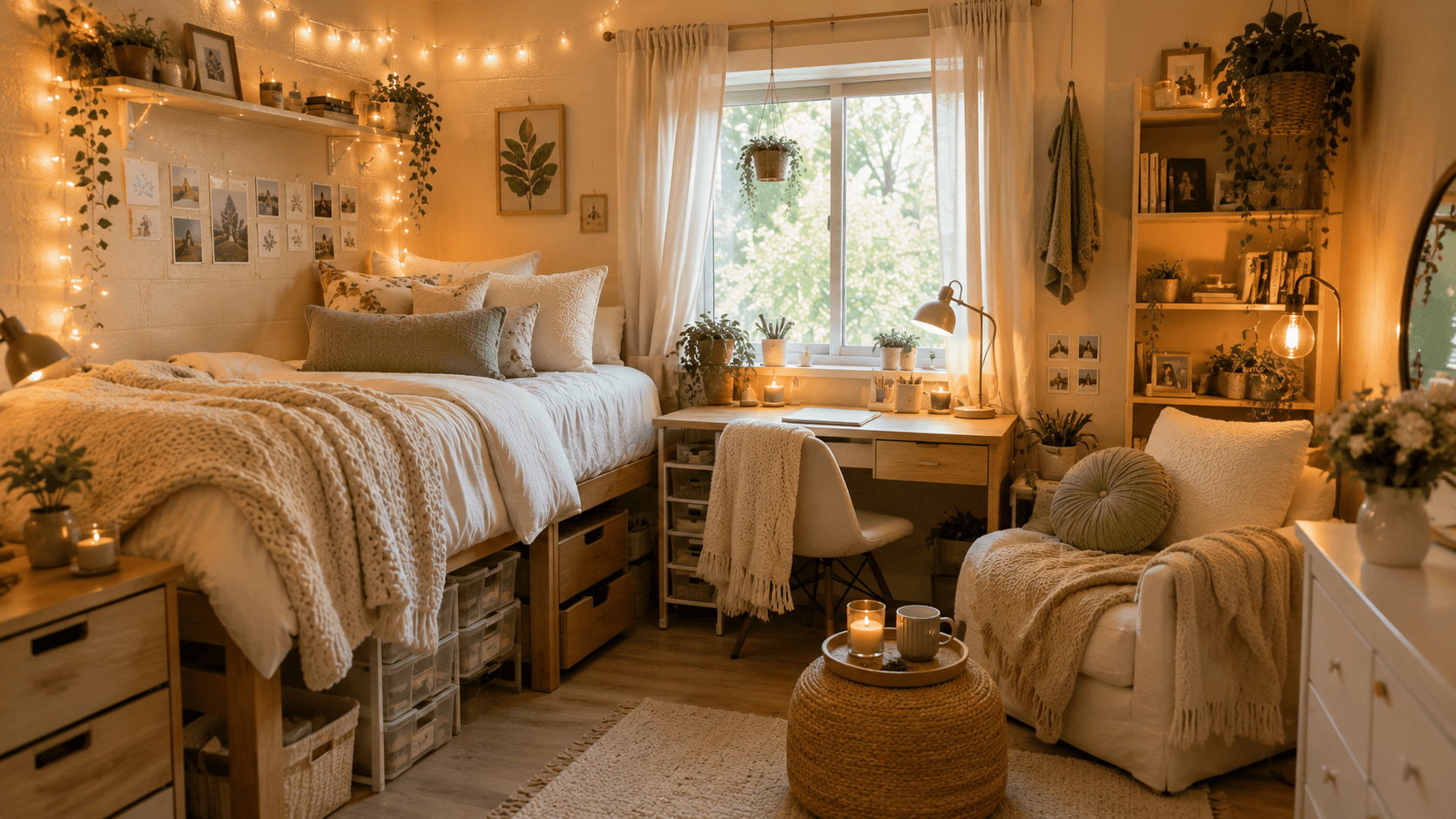
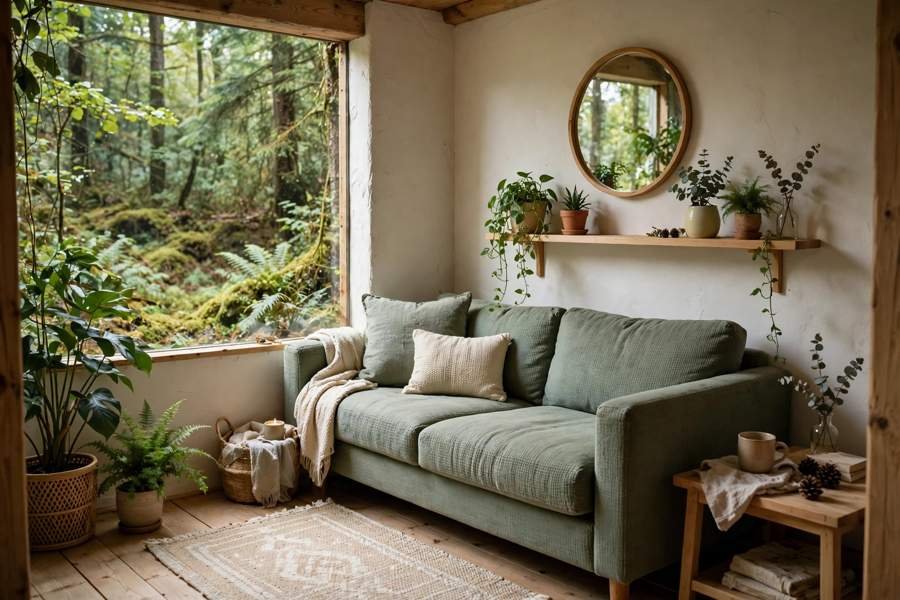
A forest living room works when it feels like a calm clearing, not a theme park. Start with a pale base, add deep green and warm wood in measured amounts, bring in living plants and soft natural textiles, and finish with warm light. Done that way, the room feels sheltered and restful every day, not just in a photo, and it still works for television, reading, guests and everyday mess.
Key takeaways
- Keep walls pale, usually cream or soft white, and let green and wood do the work as accents.
- Use deep green on one strong element, such as a sofa, rug or accent wall, not on every surface.
- Warm wood matters more than dark wood: oak, pine, walnut and rattan all count, as long as the tone is warm.
- Plants should be healthy and easy to keep, placed where they get the light they need and where they will not be knocked over.
- Natural textiles, linen, cotton, wool and chunky knits, soften wood and green and stop the room feeling cold.
- Warm white light, layered from lamps rather than one overhead light, is what makes a green room feel cosy in the evening.
- Small rooms and rented homes suit the light version best, with colour carried by cushions, throws, art and plants.
- One mushroom lamp, one moss plant or one wooden hero piece is enough for character; a collection on every surface is not.
1. Start With Light, Layout and a Pale Base
Before buying anything green or wooden, look at the light and the layout. A forest room needs daylight to stay calm, because deep green in a dark room can quickly feel heavy. If the room faces north or has one small window, keep the walls cream, choose a light rug, and put a mirror opposite the window to bounce light back into the room. If the room is bright, you can afford a deeper green sofa or a green accent wall, because daylight will keep it from closing in.
Layout matters just as much. A forest living room should invite sitting and talking, not just looking. Put the sofa where people can see the window and each other, leave a clear walkway to the door, and keep the coffee table within easy reach. A low wooden coffee table, a soft rug underfoot and a reading chair near a lamp will do more for the forest feeling than a wall of themed ornaments. If the television is the main seat, angle the sofa for both the screen and the window, rather than pushing everything against the walls and leaving a bare middle.
Renters can do almost all of this without paint or drilling. Cream walls are usually already there, a light rug can cover a tired floor, and a leaning mirror, a floor lamp and freestanding shelves can change the room without a single hole. The test for any new piece is simple: if you took it away tomorrow, would the room still work? If the answer is yes, it is a good forest piece. If the room only works with that one themed item, it is decoration, not design.
2. The Palette: Green, Cream and Warm Wood
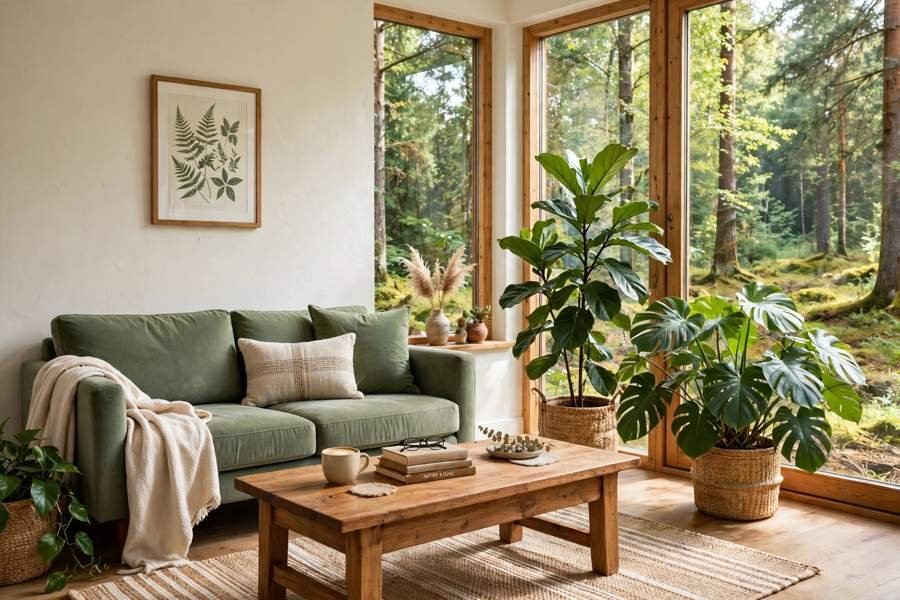
The forest palette is small on purpose. Cream or soft white is the base, deep green and moss green are the main accents, and warm wood is the counterpoint that stops green feeling cold. Add stone grey or bark brown only in small amounts, such as a stone coaster set, a brown leather cushion or a wooden tray. Three main colours are enough. A fourth colour, such as terracotta or soft gold, can appear once, in a single cushion or a lamp, but it should not compete with green.
For a sofa, deep green velvet or green linen works well in a bright room, while sage green suits a smaller or darker room because it reflects more light. If a new sofa is not in the budget, green cushion covers, a green throw and a green rug can carry the same palette for far less. The key is to repeat the same green, or two close greens, rather than mixing emerald, olive, lime and teal in one room. One green, repeated calmly, reads as forest. Four greens, scattered, read as confusion.
Wood should be warm and varied in texture, not matched and shiny. A pale oak coffee table, a walnut side table, a rattan basket and a pine shelf can live together, because they share warmth even though they are not the same wood. Avoid very dark, very glossy wood in a small room, because it can feel heavy next to deep green. If you already own dark furniture, balance it with cream cushions, a light rug and warm lamps, rather than buying a whole new set.
Paint, where you are allowed it, should be used sparingly. One green accent wall behind the sofa can anchor the room, while the other walls stay cream. Test a patch in daylight and in lamplight before committing, because green changes a lot between the two. In a rented home, the same effect can be got from a large green artwork, a green curtain panel or a tall green plant, with no paint at all.
3. Furniture That Looks Like It Belongs in a Forest, Not a Cabin Display
Forest furniture is comfortable first and rustic second. A deep sofa with soft cushions, a wooden coffee table you can put your feet near, a reading chair with a good lamp and a side table for a cup are the essentials. A chunky log table, a tree-stump side table or a live-edge shelf can be a beautiful hero piece, but only one such piece per room. Two or three rough, heavy pieces together will make a normal living room feel like a cabin set, and they are hard to move and hard to clean around.
Choose furniture with visible legs where you can, especially in a small room, because seeing floor underneath makes the room feel larger. A low, open wooden shelf is better than a tall, closed bookcase for a forest room, because it lets light through and gives plants a place to trail. A rattan or wicker basket for throws, a wooden tray for remotes and a fabric storage box for toys or cables will keep the room calm without hiding everything behind doors.
Scale matters. A large sectional in a small room will swallow the forest feeling, however green it is. Measure the room, leave at least 60 centimetres for walkways, and choose a sofa that fits the wall it sits on with room for a lamp and a side table. If the room is long and narrow, a slim sofa, a narrow console and a round coffee table will flow better than a square, bulky set. Comfort should be tested by sitting, not by looking: a forest room is for living in, and a beautiful chair that no one sits in is just an ornament.
4. Plants: Living Green, Placed With Care
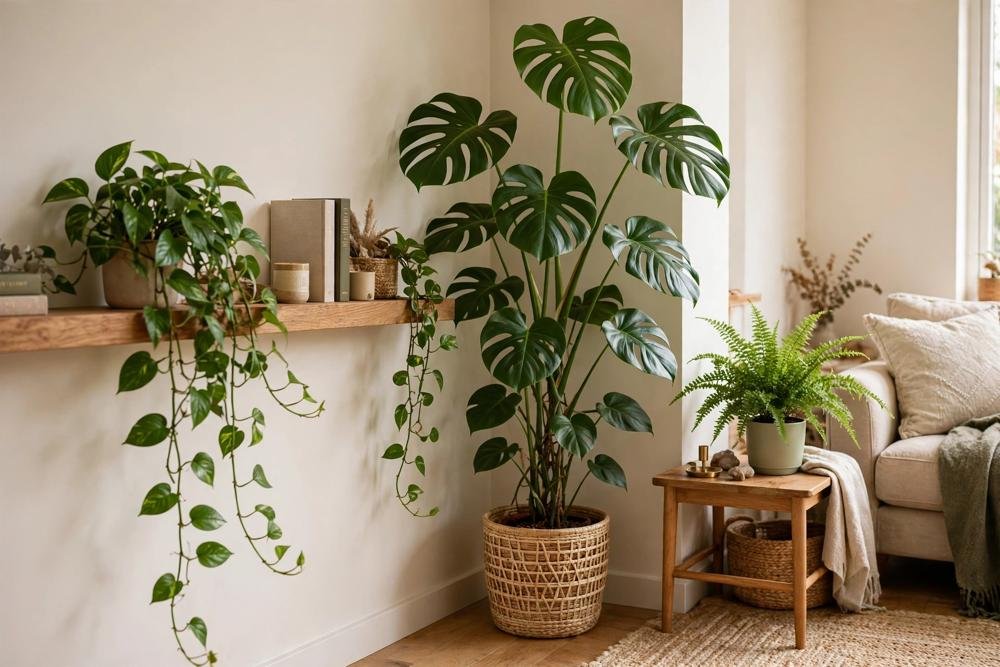
Plants are the most honest forest element, because they are actually alive. They also improve a room in a way that fake plants cannot, by softening hard edges and adding different greens and leaf shapes. Start with plants you can keep alive in your light. A monstera, a fern, a pothos, a snake plant or a peace lily suits most living rooms, depending on light and watering habits. Buy one large plant for a corner and two or three smaller ones for shelves and tables, rather than twenty small pots scattered everywhere.
Place plants where they will thrive and where they will not be a hazard. A tall plant by the window, a trailing pothos on a high shelf and a fern on a side table give height, middle and low green without blocking walkways. Keep plants away from radiators, from the television heat and from places where they will be knocked by doors or pets. If you have pets or small children, check that each plant is safe for your home before buying, and keep any plant you are unsure about out of reach.
Care should be simple and honest. Water only when the soil needs it, give each plant the light its label asks for, and remove dead leaves promptly. A healthy plant with a few leaves looks better than a struggling collection. If a plant dies, replace it with a variety that suits your light better, rather than buying the same one again. Dried branches, pinecones and moss can add texture on a shelf, but keep them away from candles, fairy lights and radiators, and clean found material before bringing it indoors, following the safety notes in the pillar guide.
5. Textiles: The Soft Layer That Stops Green Feeling Cold
Textiles are what turn a green and wooden room from a display into a home. Linen curtains, cotton cushion covers, a wool throw and a chunky knit blanket add softness, warmth and movement. They also let you change the season without changing furniture: lighter linen and cotton in summer, heavier wool and knit in winter, with the same green and wood underneath.
Choose textures that invite touch. A linen sofa cover, a woven rug, a knitted throw and a velvet cushion in the same green family will feel layered, even if the colours are close. Avoid shiny, slippery fabrics in large amounts, because they can make a forest room feel formal rather than cosy. A rug should be large enough for the front legs of the sofa and chairs to sit on it, otherwise it will look like a mat in the middle of the floor. In a small room, a light, flat-weave rug in cream or jute works better than a thick, dark rug that swallows light.
Patterns should be used sparingly. One pattern, such as a leaf print, a subtle check or a small floral, can be the accent, with the rest plain in cream, green or natural linen. Two strong patterns in one room will fight each other, especially if one is leafy and the other is geometric. Curtains deserve attention too: linen or cotton in cream or sage, hung high and wide so they frame the window rather than covering it, will make the room feel taller and brighter. Heavy, dark curtains will undo much of the forest work, by blocking the very light the room needs.
6. Lighting: Warm Layers, Not One Bright Ceiling Light
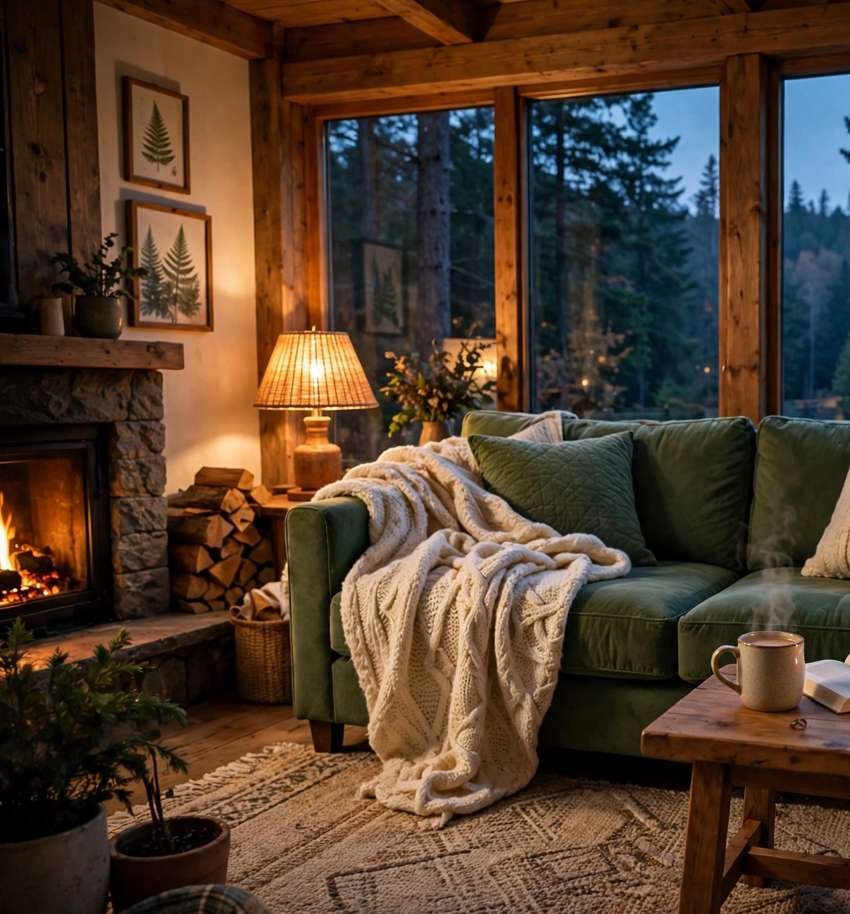
Lighting is the difference between a forest room that feels cosy and one that feels like a stage set. One bright overhead light will flatten green, make wood look harsh and make plants look tired. Layered warm light, from a floor lamp, a table lamp and a small accent lamp, will make the same room feel sheltered. Use warm white bulbs, not cool white, because cool light makes deep green look cold and grey.
Place light where people sit and read, not just where the ceiling fitting happens to be. A floor lamp behind a reading chair, a table lamp on a side table and a warm lamp on a shelf will create pools of light that invite sitting. A dimmer, where it can be fitted safely, helps even more, because forest light in the evening should be low and warm, like light through trees at dusk. If you cannot fit a dimmer, a lower-wattage warm bulb in a table lamp will give a similar effect.
Safety comes first with any lighting near fabric, dried material or plants. Use LED and low-heat bulbs near curtains, throws and dried decor, keep fabric away from bulbs, and never place a candle or an open flame near dried branches, pinecones or moss. A mushroom lamp, a wooden lamp or a paper lantern can be a beautiful forest accent, but it should be one accent, not the only light in the room. In the evening, the room should still be bright enough to read and move safely, even if the mood is soft.
7. Small Living Rooms, Open Plan Spaces and Shared Homes
A small living room can be forest, but it needs the light version. Keep walls cream, choose a sage or mid-green sofa rather than a very dark one, and use one wooden hero piece rather than a set of heavy furniture. A mirror, a light rug and furniture with visible legs will keep the room feeling open. Plants should be chosen for height rather than width: a tall, slim plant in a corner and a trailing plant on a shelf give green without taking floor space.
In an open plan home, use the forest palette to link spaces without making them identical. The living area can carry deep green and wood, the dining area can carry cream and wood with a green plant, and the kitchen can carry herbs and wood boards, so the home feels connected but each area still has its own job. A rug can define the living area, and a low shelf or a plant can mark the boundary without blocking light or conversation.
In a shared home, agree on the palette and the plant plan before buying. One person may love a dark green wall, while another may find it heavy. A compromise, such as a green sofa and cream walls, usually works better than a room that one person loves and another avoids. Keep shared surfaces clear, agree on one shelf for curious objects such as stones or a mushroom lamp, and keep the rest of the room calm. A forest room should be a place everyone wants to sit in, not a theme that only one person enjoys.
8. What to Avoid
A forest living room fails most often by trying too hard. Avoid a room full of themed items: a tree wall decal, a forest mural, mushroom lamps on every table, animal cushions, bark wallpaper and a log coffee table together will feel like a display, not a home. Choose one strong idea, such as deep green and wood, and let the rest be calm.
Avoid dark on dark. Deep green walls, dark wood furniture, a dark rug and dark curtains together will make even a bright room feel small and gloomy. If you love dark green, balance it with cream walls, a light rug and warm lamps. Avoid fake plants in large numbers, because they collect dust, fade and never quite convince, while one or two good fakes mixed with living plants are less obvious.
Avoid ignoring practical life. A white rug in a home with pets or children, a low coffee table with sharp corners in a play area, or a trailing plant within reach of a curious toddler will cause more trouble than beauty. Choose washable cushion covers, a rug that can be cleaned, and furniture that can be moved for cleaning. A forest room should be easy to live in, clean and enjoy, not a room you are afraid to use.
Conclusion
A calm forest living room is not built from themed products, but from a pale base, one or two greens, warm wood, living plants, soft textiles and warm, layered light. Start with light and layout, choose furniture you can sit in comfortably, add plants you can keep alive, and finish with one or two character pieces, such as a mushroom lamp or a wooden hero table. Keep the palette small, keep dark elements to one strong piece, and let the room stay easy to clean, easy to share and easy to live in. The other guides in this series will help you carry the same calm into the bedroom, kitchen and the rest of the home, room by room.
Related reading
- Forest Home Decor: The Complete Guide to Bringing the Woods Indoors
- Forest Themed Bedroom Ideas for Adults
- Forest Kitchen Decor Ideas Without a Remodel
- Forestcore vs Cottagecore vs Cabincore vs Goblincore vs Mushroomcore
Frequently Asked Questions
What colour walls work best for a forest living room?
Cream or soft white works best, because it keeps the room bright and lets green and wood stand out. If you want a green wall, use it on one accent wall only, behind the sofa, and keep the other walls cream. Test the green in daylight and in lamplight first, because it can look very different in the two.
Is a green sofa a good idea for a small living room?
Yes, if the green is sage or mid-green rather than very dark, and the walls and rug stay light. A deep green sofa can work in a bright room, but in a small or north-facing room it can feel heavy. Green cushion covers and a green throw are a lower-cost way to test the colour before buying a sofa.
How do I keep a forest living room from looking like a theme room?
Lead with one idea, deep green and warm wood, and keep everything else calm. Use living plants, natural textiles and warm light, and limit themed items to one accent, such as a single mushroom lamp or a wooden hero table. Avoid a wall decal, a mural, themed bedding and themed ornaments all in the same room.
Which plants are easiest for a forest living room?
Monstera, pothos, snake plant, fern and peace lily suit most living rooms, depending on light. Choose plants that match your light and watering habits, place a tall plant in a corner and smaller plants on shelves, and remove dead leaves promptly. If you have pets or children, check that each plant is safe for your home first.
Can I do a forest living room in a rented home?
Yes, and it suits renting well. Use green cushion covers, a throw, a rug, plants, wooden trays and warm lamps, with no paint or drilling. A large green artwork or a tall plant can give the same anchor as a painted accent wall, and everything can move with you.
How should I light a green living room in the evening?
Use layered warm white light from floor and table lamps, rather than one bright overhead light. Warm bulbs make deep green look cosy, while cool white bulbs can make it look cold. Keep fabric and dried decor away from bulbs, use LED and low-heat lights near curtains and throws, and keep the room bright enough to read and move safely.