Introduction
Every kitchen has a corner that is hard to reach, and in most kitchens that corner becomes a graveyard for pots, appliances, and items bought twice because the first one was lost at the back. Corner cabinets are not a design flaw, they are a geometry problem. Two runs of cabinets meet at a right angle, and the space where they meet is deep, dark, and awkward to reach from either door.
This guide focuses on practical corner cabinet solutions, not just product names. You will learn how to tell whether you have a blind corner, a diagonal corner, or an L shaped corner, which solution fits each type, and which ideas are worth the money in a small kitchen. The goal is simple: everything in a corner cabinet should be reachable without kneeling, stretching, or emptying half the cabinet to find one pan.
Start by emptying your corner cabinet and measuring the door width, the depth to the back corner, and any post, pipe, or drawer unit blocking access. Those measurements decide almost everything that follows.
Idea 1: Lazy susan turntables for round and diagonal corners
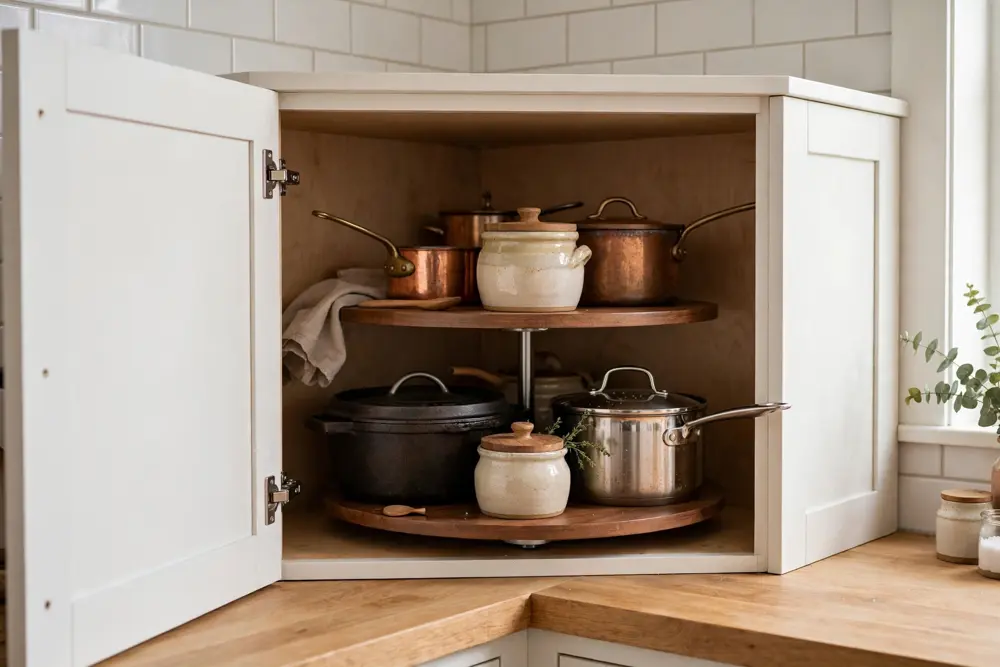
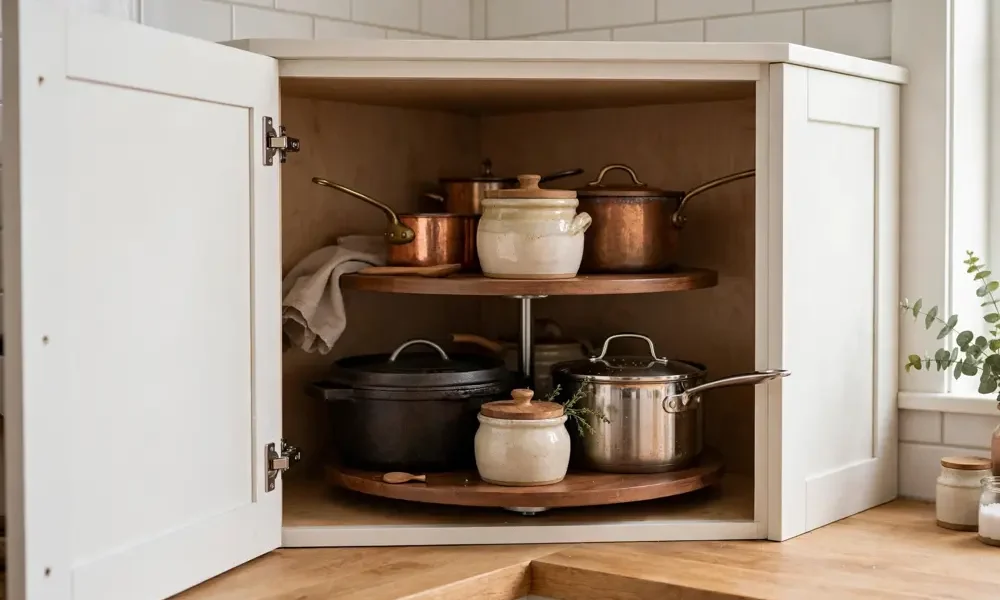
A lazy susan is the classic corner solution for a reason. A round turntable inside a corner cabinet brings the back of the cabinet to the front with one spin, and it works best in diagonal corner cabinets, where the door sits at an angle and opens onto a wide, round space. In a blind corner, a standard round lazy susan can still help, but it will leave dead space at the very back, because the turntable cannot reach into the full depth.
Choose a two tier turntable if your cabinet is tall, with the lower tier for heavy pots and the upper tier for smaller items like mixing bowls and lids. Look for a turntable with a raised edge, so items do not slide off when it spins, and a bearing that turns smoothly when loaded. Cheap turntables wobble under weight, and a wobbling turntable in a corner cabinet is worse than no turntable at all.
Lazy susans suit items you use often and can grab quickly, such as everyday pots, spice jars, and baking trays stood on their sides. They are less good for very tall items, for stacks of plates that slide, or for small items that fall between tiers. If your corner cabinet is full of small, loose items, use bins on the turntable, one bin per category, so spinning does not become a hunt.
Idea 2: Pull out shelves and blind corner pull out systems

Pull out shelves are the best solution for a blind corner, where one cabinet run hides behind another and a normal door only opens onto part of the space. A blind corner pull out system has shelves that slide out in two stages: first the front shelf comes out, then the back shelf swings or slides into the space the front shelf vacated. Done well, it makes the whole corner reachable from one door.
There are two main types. A half moon or kidney shaped pull out follows the curve of the corner and is good for pots and pans. A full blind corner unit, with two or three rectangular trays that pull out in sequence, is better for heavier items and for cabinets where you want to see everything at once. Both need precise measuring, because a pull out that is a centimetre too wide will jam against the neighbouring cabinet.
Pull out systems cost more than a lazy susan, and they need solid fixing to the cabinet carcass, not just to a shelf. If you are retrofitting, check that the cabinet floor and sides are strong enough, and that there is no pipe or drawer mechanism in the way. If you are planning a new kitchen, ask for a blind corner unit at the design stage, because retrofitting is possible but fitting a new unit into an existing cabinet is always tighter.
Idea 3: Corner drawers and diagonal drawer solutions
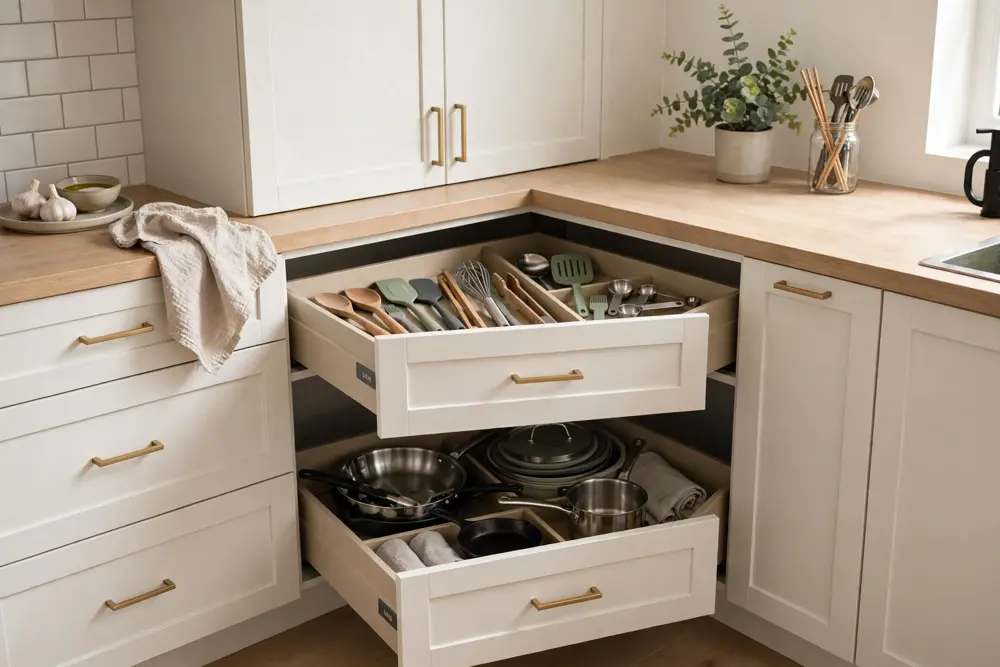
Corner drawers are the most satisfying corner solution, because drawers are easier to use than shelves. Instead of reaching into a dark cabinet, you pull a drawer towards you and see everything from above. Diagonal corner drawers, shaped to fit the corner, give you several deep drawers where a cabinet door would have given you one awkward space. They are especially good for cutlery, utensils, baking tools, and smaller pots.
Corner drawers work best in a new kitchen or a full cabinet replacement, because the drawer boxes need to be made to fit the corner angle exactly. Retrofitting drawers into an existing corner cabinet is possible with some systems, but it usually means losing a little space to the drawer mechanism and the corner post. If your existing cabinet has a centre post that blocks a drawer, a drawer solution may not be practical without removing that post, which is a job for a fitter, not a weekend project.
Use corner drawers for items you use daily, not for rarely used appliances. Deep drawers are heavy when full, so use good quality runners rated for kitchen use, and keep the heaviest items in the lowest drawer. A corner drawer unit with soft close runners will last longer and feel better than a cheap unit that sags after a year, and it is one of the few corner upgrades that genuinely changes how a kitchen feels to use.
Idea 4: Open corner shelving and freestanding corner storage
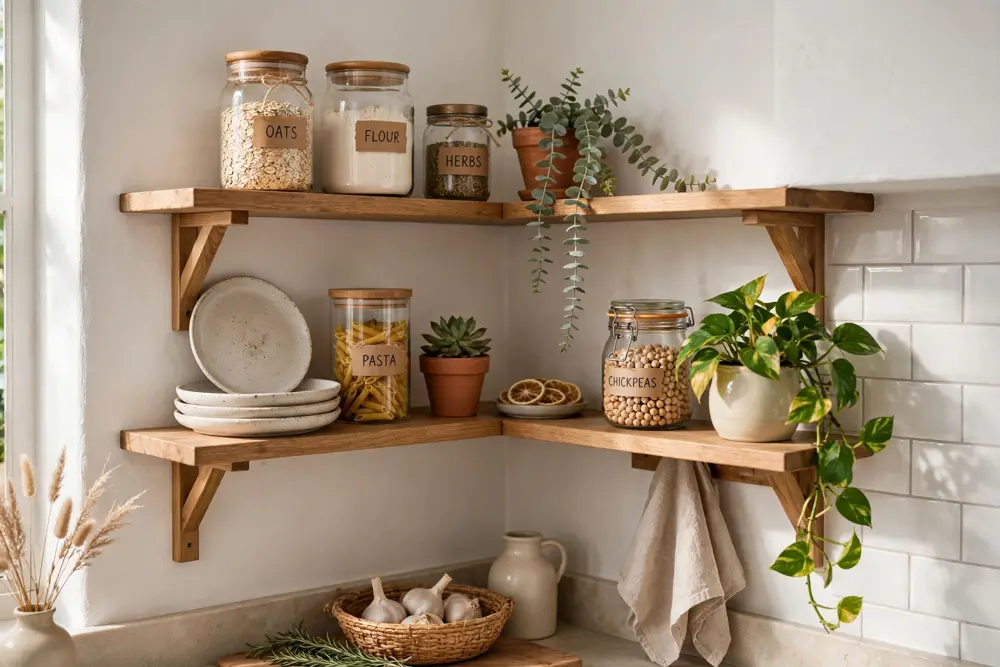
Open corner shelving is a good solution when a corner cabinet is too awkward to fix, or when you want a corner to look lighter. Removing a corner wall cabinet door, or replacing a corner cabinet with open shelves, turns dead space into display and everyday storage for plates, jars, and plants. It works best in a corner that is not right next to a cooker, where steam and grease would coat open items quickly.
Keep open corner shelves shallow, about 25 to 30 centimetres deep, so items at the back are still reachable. Style them with repetition, for example white plates together, glass jars together, and leave breathing space, because a crowded open corner looks cluttered faster than a crowded closed cabinet. If you have a corner floor cabinet that is hard to use, a freestanding corner unit, a small trolley, or a tiered stand placed in front of it can also help, by giving you accessible storage while the awkward cabinet behind holds rarely used items.
Open shelving suits items you use and clean often, like plates and jars, and needs regular dusting. Keep spices and oils in a closed cabinet away from heat and light.
Which solution fits your corner type
A diagonal corner, with a door at 45 degrees, suits a lazy susan best, because the door opens onto a wide space and a round turntable fits naturally. A blind corner, where one run of cabinets hides behind another, suits a pull out system best, because it brings the hidden back section to the front in stages. An L shaped corner with two doors, one on each run, can work with pull out shelves on each side, or with a lazy susan on one side and normal shelves on the other, depending on what you store.
Measure the door opening, not just the cabinet width. A pull out system needs to pass through the door, and a lazy susan needs to fit through the door when it is installed. Note any hinge, drawer, or appliance that intrudes into the corner, and check the height of the cabinet, because a tall corner cabinet may need two tiers or two separate solutions, one low and one high, rather than one tall system.
Choosing by budget and by what you store
Budget changes the choice more than any other factor. Under a small budget, a two tier lazy susan, a set of sturdy bins, and a shelf riser inside the corner cabinet can transform access for very little money. A mid range budget buys a good blind corner pull out system, which is the best value upgrade for a blind corner you use daily. A larger budget, usually as part of a new kitchen, buys corner drawers, which are the most convenient but also the most expensive option.
What you store matters just as much. Pots and pans need a strong, wide system, either a lazy susan with a raised edge or a pull out tray rated for weight. Small items, like spices, baking tools, and cleaning supplies, need bins or small trays, otherwise they fall behind a turntable or get lost at the back of a pull out. Appliances you use rarely, like a large food processor or a slow cooker, do not need a premium corner system at all; put them at the back of a corner cabinet and use the accessible front for daily items.
Installing and maintaining corner solutions
Most turntables and bins can be fitted without tools beyond a screwdriver and a level, and they can be removed without damage, which makes them good for renters. Pull out systems and corner drawers usually need drilling, precise alignment, and sometimes removal of a cabinet shelf or post, so they are better for owners, or for renters with landlord permission.
After fitting, test the system loaded, not empty, and clean it monthly, because crumbs and leaks from a nearby sink often collect unseen at the back of a corner cabinet. If a system jams, do not force it; check first for a fallen item, a loose screw, or a misaligned runner.
Corner cabinets in small kitchens
Small kitchens suffer most from wasted corners, because there is no spare storage elsewhere. In a small kitchen, prioritise the corner you use most, usually the corner nearest the cooker or sink, and give it the best solution you can afford. A pull out system in that one corner, plus simple bins in other corners, will do more than a premium system in a corner you rarely open.
Avoid filling every corner with a complex system. In a small kitchen, one good pull out and one lazy susan are usually enough, with deep drawers and a tall pantry carrying the rest. For renters, turntables, bins, and freestanding corner stands add accessible storage without drilling and can move with you.
What to avoid
- Buying a pull out or turntable before measuring the door opening, depth, and any pipes or posts inside the cabinet
- Choosing a standard round lazy susan for a deep blind corner, where it will leave dead space at the very back
- Overloading a pull out or turntable beyond its weight rating with cast iron pots and pans
- Putting open shelving right next to a cooker, where steam and grease will coat everything quickly
- Fitting a corner drawer unit into a cabinet with a centre post without checking whether the post can be removed safely
- Forcing a jammed pull out, which can bend the mechanism and turn a small blockage into a replacement
- Filling a corner with small loose items and no bins, so spinning or pulling out becomes a hunt rather than a help
Frequently asked questions
What is the best solution for a blind corner cabinet?
A blind corner pull out system is usually best, because it brings the hidden back section out in stages so you can reach the whole cabinet from one door. A lazy susan can help, but it often leaves dead space at the very back of a deep blind corner.
Are lazy susans worth it in a kitchen corner?
Yes, especially in a diagonal corner cabinet, where the door opens onto a wide space and a round turntable fits naturally. Choose a two tier turntable with a raised edge and a smooth bearing, and use bins on it for small items so they do not slide off.
Can you put drawers in a corner cabinet?
Yes, diagonal corner drawers work well in a new kitchen, giving you deep drawers you can see from above instead of a dark cabinet. Retrofitting drawers into an existing cabinet is harder, especially if there is a centre post, and it usually needs a fitter.
How do I measure a corner cabinet for a pull out system?
Measure the door opening width, the depth to the back corner, the height inside the cabinet, and note any pipes, posts, hinges, or drawer mechanisms that intrude. The system must pass through the door and fit the depth, so door width is often the limiting measurement.
What should I store in a corner cabinet?
Daily pots, pans, and baking trays on a strong turntable or pull out, small items in bins or trays, and rarely used appliances at the very back. Keep heavy items low, keep small items contained, and do not put spices or oils in a corner next to heat.
Can renters improve a corner cabinet without drilling?
Yes. A turntable, sturdy bins, a shelf riser, and a freestanding corner stand or trolley all improve access without drilling and can move with you. Pull out systems and corner drawers usually need drilling and landlord permission, so they suit owners better.
Conclusion
Corner cabinets do not have to be wasted space. A lazy susan suits a diagonal corner, a pull out system suits a blind corner, corner drawers suit a new kitchen, and open shelving or a freestanding stand suits a corner that is too awkward to fix or a rental kitchen. Measure first, choose by corner type and by what you store, check weight ratings, and start with a cheap reversible solution if you are unsure.
Empty your corner cabinet this weekend, measure the door and depth, and fit one solution to the corner you use most. When you can reach a pot without kneeling, emptying half the cabinet, or buying a second one because the first was lost at the back, your corner cabinet will finally be working for you, not against you.