Introduction
A kitchen table does two jobs at once. It is where meals happen, homework spreads out, and coffee cups land, and it is also the visual centre of the room. A table with no decor can feel bare and unfinished, while a table with too much decor becomes impossible to eat at. The best kitchen table decor sits in the middle: it looks intentional when the table is empty, and it still leaves room for plates, glasses, and elbows when everyone sits down.
This guide focuses on centrepieces and table styling that work in a real kitchen, not just in a photo. You will find ideas for everyday centrepieces, for gatherings, for small tables, and for seasonal changes, plus the practical rules that keep a centrepiece from getting in the way. The goal is a table that feels welcoming every day, not a display you have to clear away before every meal.
Start with how you use the table. Do you eat there every day, or only at weekends? Do you need space for laptops, school books, or crafts? Do you host often, or mostly cook for two? Those answers decide how tall, how wide, and how permanent your centrepiece should be.
Idea 1: A low greenery centrepiece for everyday use
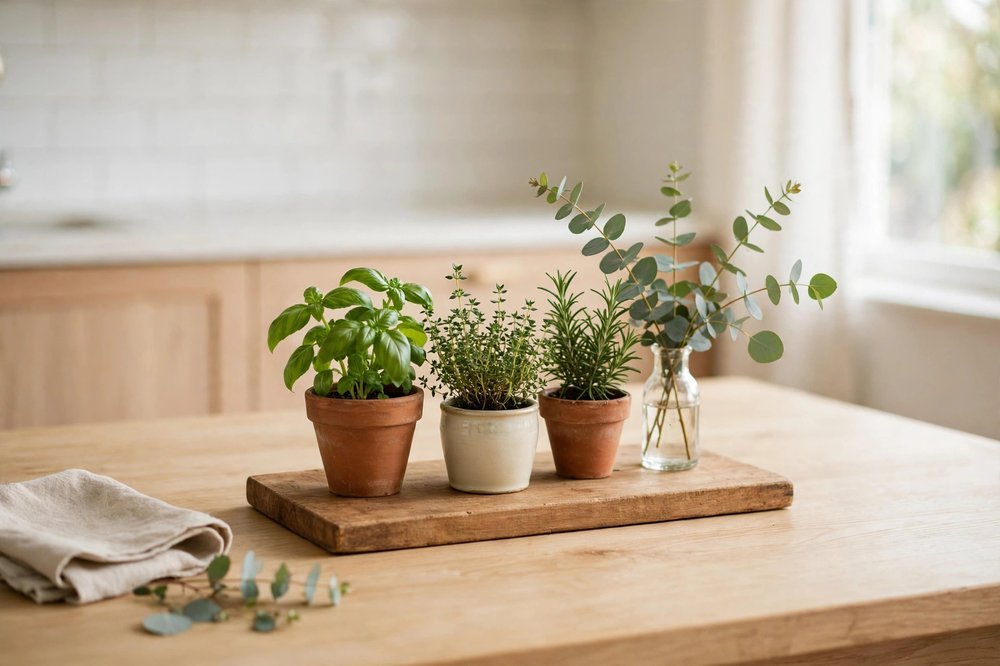
A low greenery centrepiece is the easiest everyday option, because it looks good, costs little, and never blocks conversation. Use a shallow wooden board, a ceramic tray, or a low bowl as a base, then add a small potted herb, a few sprigs of eucalyptus in a bud vase, or a trailing plant in a simple pot. Keep the whole arrangement under about 25 centimetres high, so people can see each other across the table.
Greenery works in a kitchen because it connects to cooking. Fresh herbs like basil, rosemary, and mint smell good, look good, and can be snipped for a meal. If you do not want live plants, good quality faux greenery in a simple vase gives the same shape without watering, and it survives steam and heat better than fresh flowers.
Avoid tall, wide arrangements for everyday use, because they dominate a small table and get knocked over when plates are passed. Change the greenery with the season, but keep the base the same. A wooden board in spring with fresh herbs, in summer with a small olive branch, in autumn with dried leaves, and in winter with pine sprigs gives you four different looks without buying a new centrepiece each time. That consistency also makes the table feel settled, rather than restyled from scratch every month.
Idea 2: Candles and lanterns for warmth in the evening
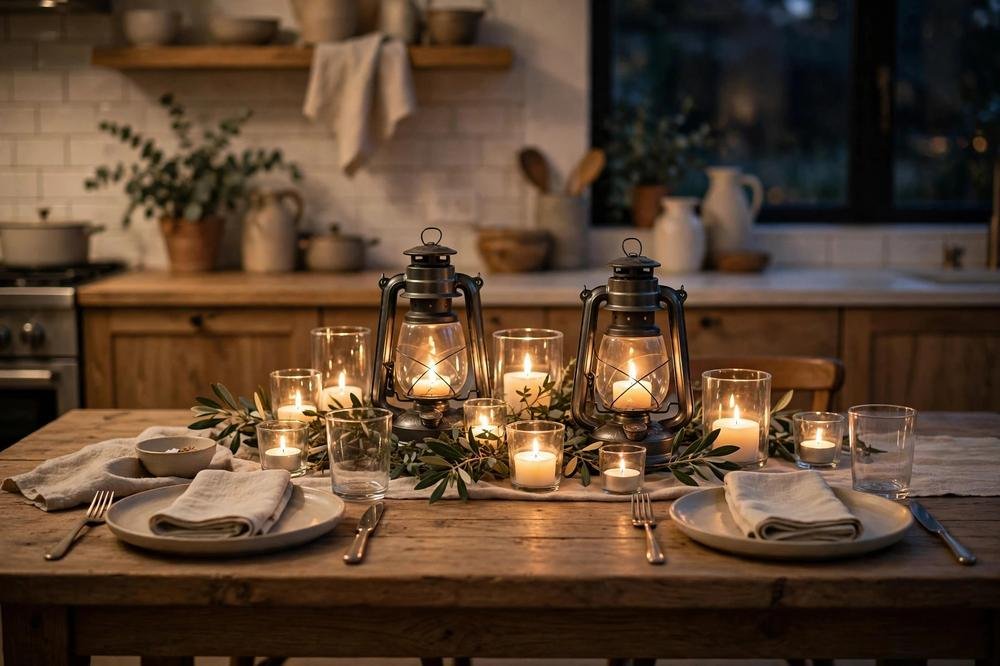
Candles and lanterns are the fastest way to make an evening meal feel special, and they work even on a plain table. Use a cluster of three candles in different heights, a single lantern with a pillar candle inside, or a row of small tea lights in glass holders down the centre of a long table. Glass holders are important in a kitchen, because they protect the flame from draughts and stop wax from reaching the table.
Safety comes first with candles in a kitchen. Keep flames away from curtains, paper napkins, and anything flammable, never leave candles burning unattended, and do not place candles where children or pets can reach them easily. Battery candles are a good alternative for a household with small children, because they give warm light without a real flame, and they can stay on a table all day without worry.
For everyday use, choose unscented or lightly scented candles, because strong scents compete with food. Save heavily scented candles for a table that is not being used for a meal, or for a sideboard rather than the centrepiece. A candle centrepiece should add warmth and light, not overpower the smell of dinner.
Idea 3: A table runner with a simple bowl or tray
A table runner is a simple way to define the centre of a table, especially on a plain wood or white table. Choose a runner in a natural fabric, like cotton or linen, in a colour that suits your kitchen, and lay it down the centre, leaving bare table at each end for placemats. A runner that is too long and hangs to the floor will get pulled when chairs move, so let it overhang by about 20 to 30 centimetres at each end, no more.
On top of the runner, place one low bowl or tray, not a collection of small objects. A bowl of lemons, a tray with a candle and a small plant, or a wooden board with a few seasonal fruits gives the table a focal point without clutter. Fruit is a practical kitchen centrepiece, because it is beautiful, it gets eaten, and it is replaced naturally. Choose fruit that looks good for a week, like lemons, oranges, and apples, rather than soft fruit that bruises quickly.
A runner also protects the table. It catches crumbs, absorbs small spills, and can be washed easily. Keep a second runner in a drawer, so you can swap a stained one without leaving the table bare. In a kitchen with children, a washable runner is more useful than a delicate embroidered one, no matter how pretty the delicate version looks in a shop.

Idea 4: Seasonal centrepieces that change without a full restyle
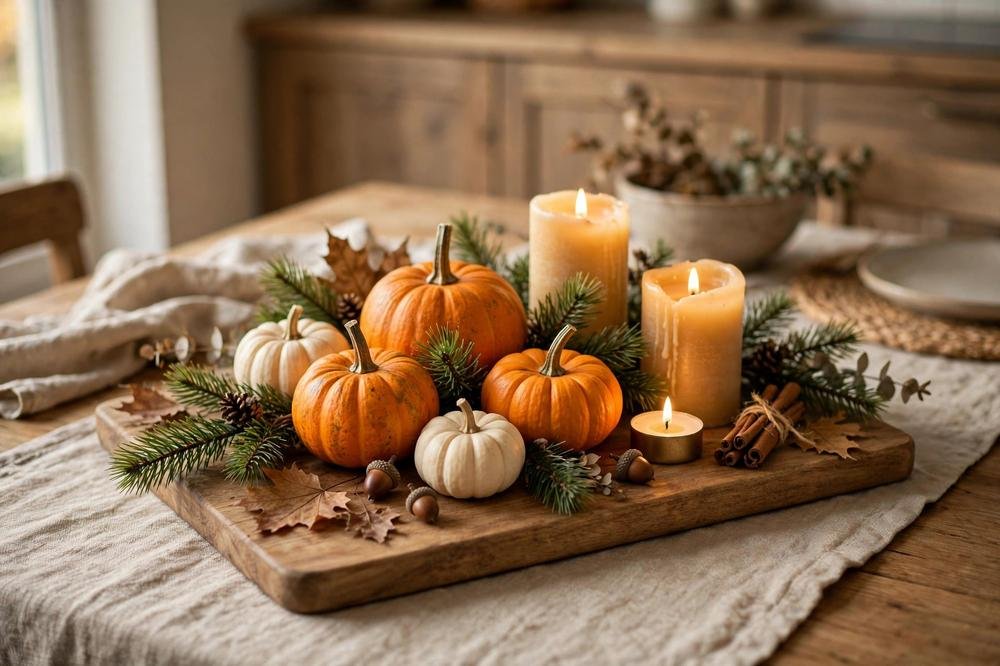
Seasonal centrepieces keep a kitchen table feeling fresh, but they work best when only one or two elements change. Keep a permanent base, like a wooden board, a ceramic tray, or a simple vase, and swap the seasonal items on top. In spring, add fresh flowers and light greenery. In summer, add citrus fruit and bright herbs. In autumn, add small pumpkins, dried leaves, and warm candles. In winter, add pine branches, pinecones, and a lantern.
This approach saves money and storage space, because you are not buying a whole new centrepiece four times a year. It also stops the table from feeling like a themed display. A kitchen table should still look like a kitchen table in December, not like a shop window. One seasonal touch, plus your everyday base, is usually enough.
For gatherings, you can build on the seasonal base without starting again. Add a few extra candles, a second small vase, or a name card for each place, then remove the extras after the meal and return to the everyday version. That way, a special occasion feels special, but the table does not stay dressed up for a week afterwards.
Centrepieces for small tables
Small tables need small centrepieces, and that rule matters more than any styling trend. On a round table for two or four, a single small vase, a tiny plant, or a candle in a glass holder is enough. A large bowl or a long runner will leave no room for plates, and it will make the table feel crowded before anyone sits down.
Choose a centrepiece that can move easily. A small tray with a plant and a candle can be lifted to a sideboard in seconds when you need the full table for a meal or for work. Avoid centrepieces that are glued, wired, or too heavy to move, because a kitchen table centrepiece that cannot move will eventually be in the way. Height matters even more on a small table. A tall centrepiece on a small table blocks eye contact and makes the room feel smaller. Keep it low, keep it narrow, and leave at least 30 centimetres of clear table on each side of the centrepiece for a plate and a glass.
Centrepieces for gatherings and special meals
For a gathering, a centrepiece should help conversation, not hinder it. Use a low, long arrangement down the centre of a rectangular table, or a single low arrangement in the middle of a round table, so guests can see and hear each other. Avoid tall flower arrangements, candelabras, or anything that forces guests to lean around it to talk.
Leave room for serving dishes. A centrepiece that takes up the whole middle of the table leaves nowhere for a shared salad bowl, a bread basket, or a jug of water. Plan the centrepiece and the serving dishes together, not separately. A good rule is to leave at least one third of the table surface clear for food and drinks, even at a dressed table.
For a special meal, add personal touches that cost little: a handwritten place card, a sprig of herbs tied to a napkin, or a small favour at each place. These details make guests feel welcome without requiring an expensive centrepiece. After the meal, the centrepiece should be easy to clear, so avoid arrangements that shed petals or leaves all over the table.
Choosing colours and materials
Colour should connect a centrepiece to the rest of the kitchen, not introduce a completely new palette. If your kitchen is white and wood, choose natural materials like wood, ceramic, glass, and greenery, with one accent colour from a fruit bowl or a candle. If your kitchen already has a strong colour, like sage cabinets or a blue backsplash, echo that colour in a vase, a runner, or a candle, rather than adding a second strong colour.
Materials matter in a kitchen, because of steam, heat, and spills. Ceramic, glass, wood, and metal all wipe clean and survive kitchen conditions. Paper, untreated fabric, and delicate dried flowers are harder to maintain near cooking, and they can absorb smells. Choose materials you can wipe, wash, or replace easily, especially for an everyday centrepiece.
Keep the number of materials low. Wood plus ceramic plus greenery is a calm, natural combination. Wood plus ceramic plus glass plus metal plus fabric plus dried flowers is busy, even if each item is pretty on its own. Two or three materials, repeated across the table, look more intentional than a collection of unrelated objects.
What to avoid
- Using a tall centrepiece that blocks conversation across the table
- Filling the whole table with decor and leaving no room for plates, glasses, and serving dishes
- Placing real candles near curtains, paper napkins, or where children and pets can reach them
- Using strongly scented candles at a table where food is served, which competes with the meal
- Choosing a centrepiece that cannot be moved easily when you need the full table for work or a meal
- Changing the entire centrepiece every season, which costs money and needs storage space
- Mixing too many colours and materials, which makes a kitchen table look cluttered rather than styled
Frequently asked questions
What is the best everyday kitchen table centrepiece?
A low greenery centrepiece on a wooden board or tray, under about 25 centimetres high, with a small potted herb or a few sprigs in a vase. It looks good every day, leaves room for plates, and does not block conversation.
How tall should a table centrepiece be?
For everyday use, under 25 centimetres, so people can see each other across the table. For a gathering, keep it low as well, or use a long, low arrangement down the centre, rather than a tall arrangement that forces guests to lean around it.
Can I use candles as a kitchen table centrepiece?
Yes, in glass holders, away from curtains and paper, and never left burning unattended. Use unscented or lightly scented candles for meals, because strong scents compete with food. Battery candles are a safer option with small children.
What should I put in the middle of a small kitchen table?
One small item only, like a tiny plant, a single vase, or a candle in a glass holder, on a small tray that can be moved easily. Leave at least 30 centimetres of clear table on each side for a plate and a glass.
How do I style a kitchen table for a gathering?
Use a low, long centrepiece, leave at least one third of the table clear for food and drinks, and add simple personal touches like place cards or a herb sprig on a napkin. Avoid tall arrangements that block conversation.
How often should I change a seasonal centrepiece?
Change only one or two elements each season, keeping the same base, like a wooden board or tray. Swap greenery, fruit, or candles for spring, summer, autumn, and winter, rather than buying a whole new centrepiece four times a year.
Conclusion
Kitchen table decor works when it is low, simple, and easy to live with. Start with a low greenery centrepiece for everyday use, add candles for warmth in the evening, use a runner with a single bowl or tray to define the centre, and change just one or two seasonal elements through the year. Keep the centrepiece low enough to talk across, narrow enough to leave room for plates, and movable enough to clear when you need the full table. Choose colours and materials that match your kitchen, keep to two or three materials, and avoid tall arrangements, strong scents at mealtimes, and decor that cannot move. A table styled this way feels welcoming when it is empty, works properly when it is full, and is easy to refresh for a gathering without a full restyle. Start with one low arrangement this week, live with it for a few meals, and adjust the height, size, and colour until it feels right for how you actually use your table.