Introduction
A small bedroom can hold a good desk, but only if the desk is chosen for the room, not for a catalogue photo. The problem is rarely the desk itself. It is the chair that cannot pull out, the cables that trail across the floor, the monitor glare at midday, and the feeling that work never leaves the room at night.
The aim is simple. You want a work surface that is comfortable for real working hours, a chair you can sit in without hitting the bed, and a bedroom that still feels calm when work ends. That is possible in a room as small as 10 by 10 feet, in a long narrow room, and in a rental room that already has a wardrobe and a dresser.
Start by measuring the wall, the door swing, and the chair space. Then choose a desk type that fits that exact footprint. This guide compares five desk types, chair and cable space, and a close at night routine.
Key takeaways
- Keep the floor clear with a floating desk, a fold-down desk, or a corner desk in dead space.
- A desk can replace a nightstand and do two jobs, without crowding the bed.
- Measure the chair and cable footprint before you buy, not just the desk size.
- Get light and glare right, and close the office at night so the bedroom still feels like a bedroom.
Idea 1: Use a Floating Desk to Keep the Floor Clear
A floating desk is fixed to the wall, with no legs taking up floor space. That makes it one of the best choices for a very small bedroom, because the area under the desk stays open for your feet, a small bin, or a bag.
Choose a depth of 45 to 55 centimetres for most laptop and single monitor setups. A deeper desk, around 60 centimetres, is better if you use a large monitor or keep books open beside the laptop. For width, 80 to 100 centimetres works for focused work, while 120 centimetres gives room for a monitor, a notebook, and a cup without crowding.
Fix the desk at the right height. For most adults, the surface should sit at 72 to 76 centimetres from the floor, with elbows close to a right angle when typing. If your feet do not rest flat on the floor, a footrest can solve a small height gap and is cheaper than replacing a desk.
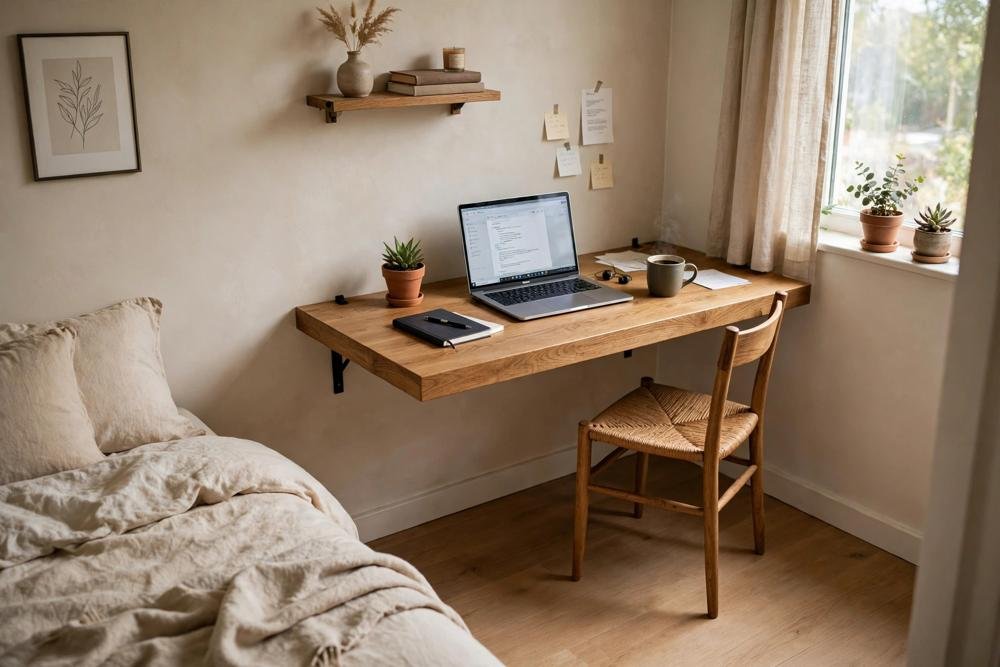
A floating desk works best on a solid wall, not on a wall shared with a wardrobe door or a bed headboard. Check for studs before fixing it, because a desk that holds a monitor and books needs proper support. In a rental, use a heavy duty wall rail or a freestanding narrow console that mimics a floating desk, rather than drilling into a wall you cannot repair.
Idea 2: Try a Fold Down Desk for Work That Has an End Time
A fold down desk is a wall mounted surface that folds up when work is finished. It is ideal if you work from home only part of the day, if the bedroom is also a guest room, or if you want the room to look like a bedroom again in the evening.
The main advantage is the closing action. When the desk folds up, papers, pens, and cables disappear behind a door or panel. That visual reset matters. Many people do not need more space. They need a clear signal that work has ended.
Choose a fold down desk with a depth of at least 40 centimetres when open. Shallower models look neat, but they force the laptop too close to your eyes and leave no room for a notebook. Check the weight rating before buying. A good fold down desk should hold a laptop and a few books without sagging.
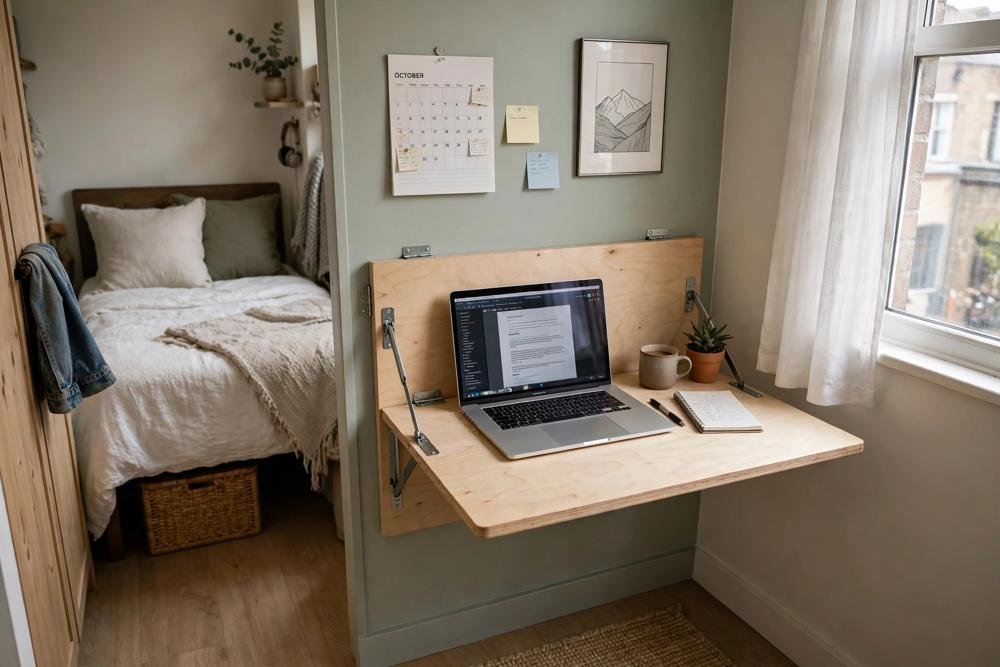
Plan what lives inside the desk. A small tray for pens, a cable clip for the charger, and a pocket for a notebook will stop the desk from becoming a dumping ground. If everything has a place, folding it up takes seconds. If it does not, you will leave it open and lose the whole benefit.
Idea 3: Make a Corner Desk or a Cloffice Work Hard in Dead Space
Corners are often wasted in small bedrooms. A corner desk turns that dead space into a work zone without blocking the main walkway. A cloffice, which is a closet turned into an office, does the same thing inside an existing closet or alcove.
A corner desk should have at least 90 centimetres of clear space on each side of the corner for the chair to move. If the corner is too tight, choose an L shaped desk with one short return, rather than a large wraparound unit that eats the whole wall. Keep the monitor on the longer side, and use the shorter side for notes or a small lamp.
A cloffice needs light more than it needs decoration. Closets are often dark, so add a battery or plug in light bar under the shelf, and paint the inside a light colour if your rental rules allow it. Remove the closet door if it blocks the chair, or replace it with a curtain that can be pulled across at night. That curtain is your close at night system.
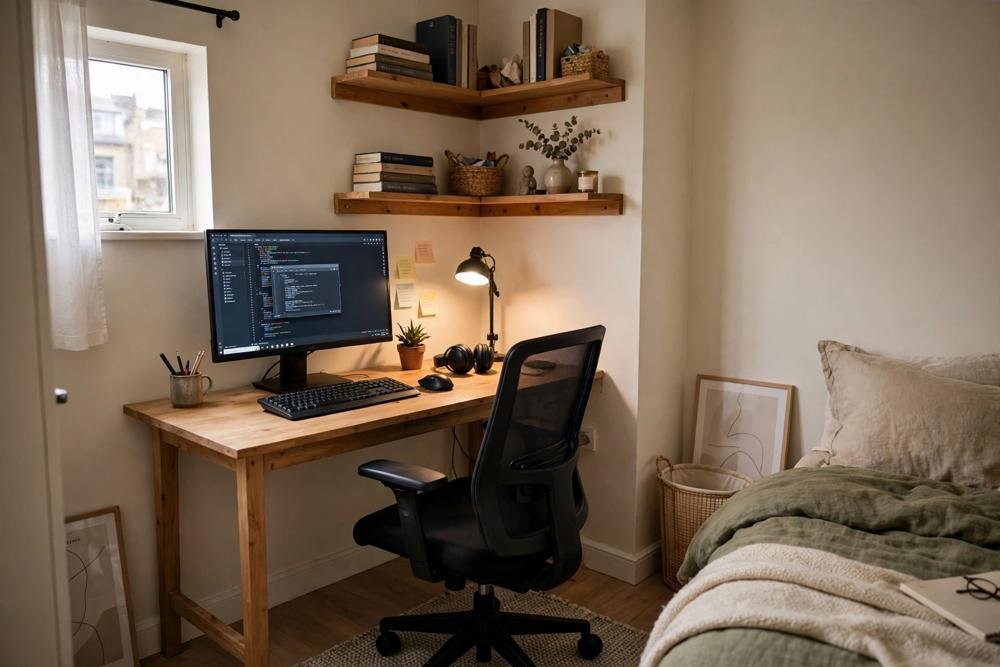
Measure the closet before you commit. A closet less than 60 centimetres deep will feel cramped for a chair and a desk. A closet 75 centimetres or deeper can work well, especially if you add a shelf above the desk for books and a small drawer unit below. Keep desk storage separate from clothes storage, so the two jobs do not mix.
Idea 4: Replace the Nightstand With a Desk That Does Two Jobs
In the smallest bedrooms, a separate desk and a separate nightstand may simply not fit. A nightstand replacement desk solves that problem by doing both jobs. It gives you a work surface by day and a bedside surface by night.
Choose a desk close to nightstand height, or slightly higher, so it does not look odd beside the bed. A width of 60 to 80 centimetres is often enough for a laptop and a lamp. Use a small drawer or tray for bedside items, so a book, a phone charger, and a glass of water have a home without taking over the work surface.
This idea works best for one person, or for the side of the bed used by the person who works from home. If both people work from home, a shared nightstand desk will cause arguments about space and noise. In that case, look for two smaller work zones instead, such as a floating desk on one wall and a fold down desk on another.
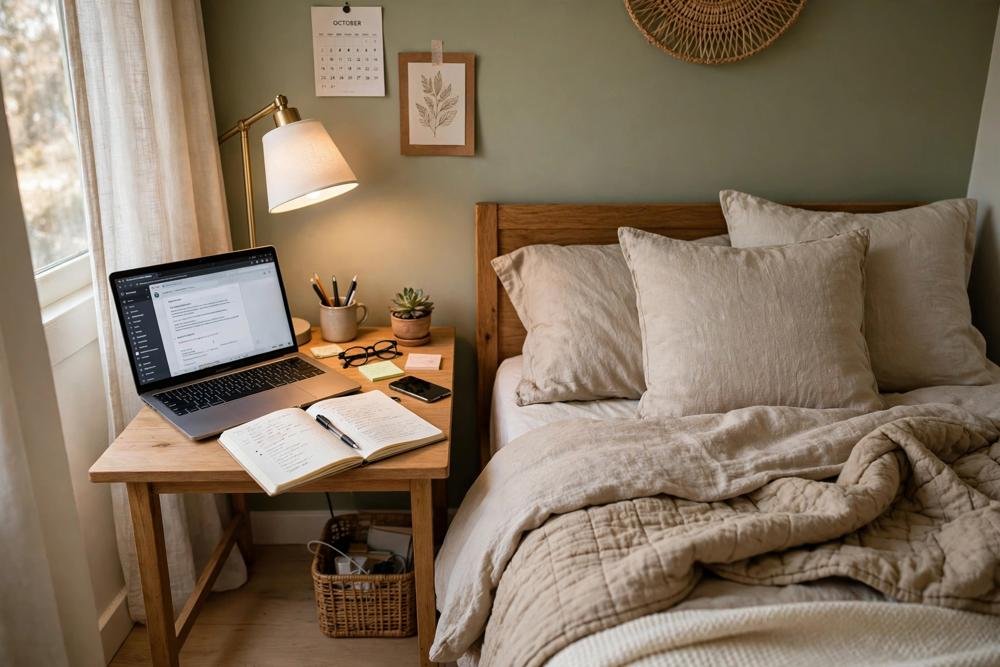
Keep the work zone tidy with a single cable and a laptop stand. A laptop stand lifts the screen to eye level, which helps your neck, and frees space underneath for a notebook. When work ends, close the laptop, move it to one side, and put a book or a small lamp in its place. That small change helps the bedside look like a bedside again.
Measure the Chair and Cable Footprint Before You Buy
Most desk guides talk about desk width and forget the chair. The chair is where the space really goes. A standard office chair needs about 60 centimetres of width and about 70 to 80 centimetres of depth when pulled out. Add at least 10 centimetres behind the chair so you can stand up without hitting the wall or the bed. For standard dimensions, see Bedroom Furniture Sizes and Clearances You Should Check Before You Buy.
Mark the chair footprint on the floor with tape. Sit in the chair, pull it out, and stand up. Walk past it as you would at night. If you have to squeeze sideways, the desk is in the wrong place or the chair is too large. Try a chair with no arms, or arms that fold down, to save width. If you work long days, keep the arms and move the desk to a wall with more pull out room.
Cables need a plan too. Use a cable tray under the desk, a clip on the desk edge, and a short extension lead behind the desk, not in the walkway. Route cables along the wall and away from the bedside.
Get Light and Glare Right for Day and Evening Work
Light can make a small bedroom desk feel good or unusable. The best position is usually side on to a window. That gives you daylight without direct glare on the screen, and it stops you from facing a bright window during video calls.
Avoid placing the desk directly facing a window if you work on a screen for long periods. The bright light behind the screen can cause eye strain, and the window can become a washed out background on calls. Avoid placing the desk with your back to a window for the same reason, because the light will shine into the camera and make your face dark.
How to Close the Office at Night
A bedroom desk works best when it has a closing routine. Without one, work papers stay visible, the laptop stays open, and the room never feels restful. A closing routine does not need to take long. It needs to be simple enough to do every day.
Start with one box, drawer, or basket for work items. At the end of work, put pens, papers, and chargers in that box. Close the laptop or put it on a stand at the side of the desk. If you use a cloffice, pull the curtain across. If you use a fold down desk, fold it up. If you use a floating desk, clear the surface and put a small plant or a book in the centre, so the desk looks like part of the bedroom again.
What to Avoid
Avoid buying the largest desk that fits the wall. A desk that fills the wall leaves no room for a chair, a lamp, or a walkway, and it makes the room feel like an office. Leave at least a small gap at each end of the desk.
Avoid placing the desk where the door swings into the chair. Check the door swing before you choose a wall. A desk behind a door is hard to use, and it can be damaged by the door handle.
Avoid a desk with no cable plan. Cables across the floor are unsafe, especially at night, and they make a small room look messy even when the desk is tidy.
Avoid working from the bed as a permanent solution. It may feel comfortable for an hour, but it hurts posture, blurs the line between work and rest, and can make sleep worse over time. A proper desk, even a small one, is better for both work and sleep.
FAQs
Where should a desk go in a small bedroom?
Put the desk on the longest clear wall that is not blocked by a door swing or a wardrobe door. Side on to a window is usually best for light. Test the chair pull out space with tape on the floor before you fix or buy anything, and leave a clear walkway to the bed.
Should a bedroom desk face the wall or the window?
Facing the wall is usually better for focus and for video calls, because it avoids glare and a bright background. Side on to a window gives good daylight without glare. Facing directly into a window can cause eye strain, while sitting with your back to a window can make you appear dark on camera.
What is a cloffice and does it work in a small bedroom?
A cloffice is a closet turned into an office. It works well in a small bedroom if the closet is at least 60 centimetres deep, has good light, and has a desk surface that leaves room for a chair. Add a curtain or door to close it at night, and keep closet storage separate from the work zone.
What size desk is best for a small bedroom?
For laptop work, a desk 80 to 100 centimetres wide and 45 to 55 centimetres deep is often enough. For a single monitor and a notebook, aim for 100 to 120 centimetres wide and 55 to 60 centimetres deep. Always check the chair footprint as well, because the chair needs about 70 to 80 centimetres of depth when pulled out.
How do I fit a desk in a bedroom with no spare wall?
Use a nightstand replacement desk, a fold down desk, or a narrow floating desk on a short wall. A corner desk can also use dead space that a straight desk cannot. If no wall works, consider a rolling cart desk that can be moved beside the bed during work and stored away at night.
How can I keep a bedroom desk tidy in a small room?
Keep only daily items on the desk, use one drawer or box for work items, and follow a close at night routine. Clear the desk surface each evening, put cables in a tray, and move anything that is not current work to a wardrobe or under bed storage. For more ideas, see Small Bedroom Storage Ideas That Do Not Use Floor Space.
Conclusion
Fitting a desk in a small bedroom is a measurement problem first and a shopping problem second. A floating desk keeps the floor clear, a fold down desk gives you a clean finish at night, a corner desk or cloffice uses dead space, and a nightstand desk does two jobs when space is very tight. Whichever type you choose, measure the chair, plan the cables, get the light right, and close the desk when work ends.
Do that, and the desk will support your work without taking over your bedroom. The room will still feel like a place to rest, and work will have a clear place to start and a clear place to stop. For the whole room, see Small Bedroom Ideas: The Complete Guide to Layout, Storage, Light and Style.