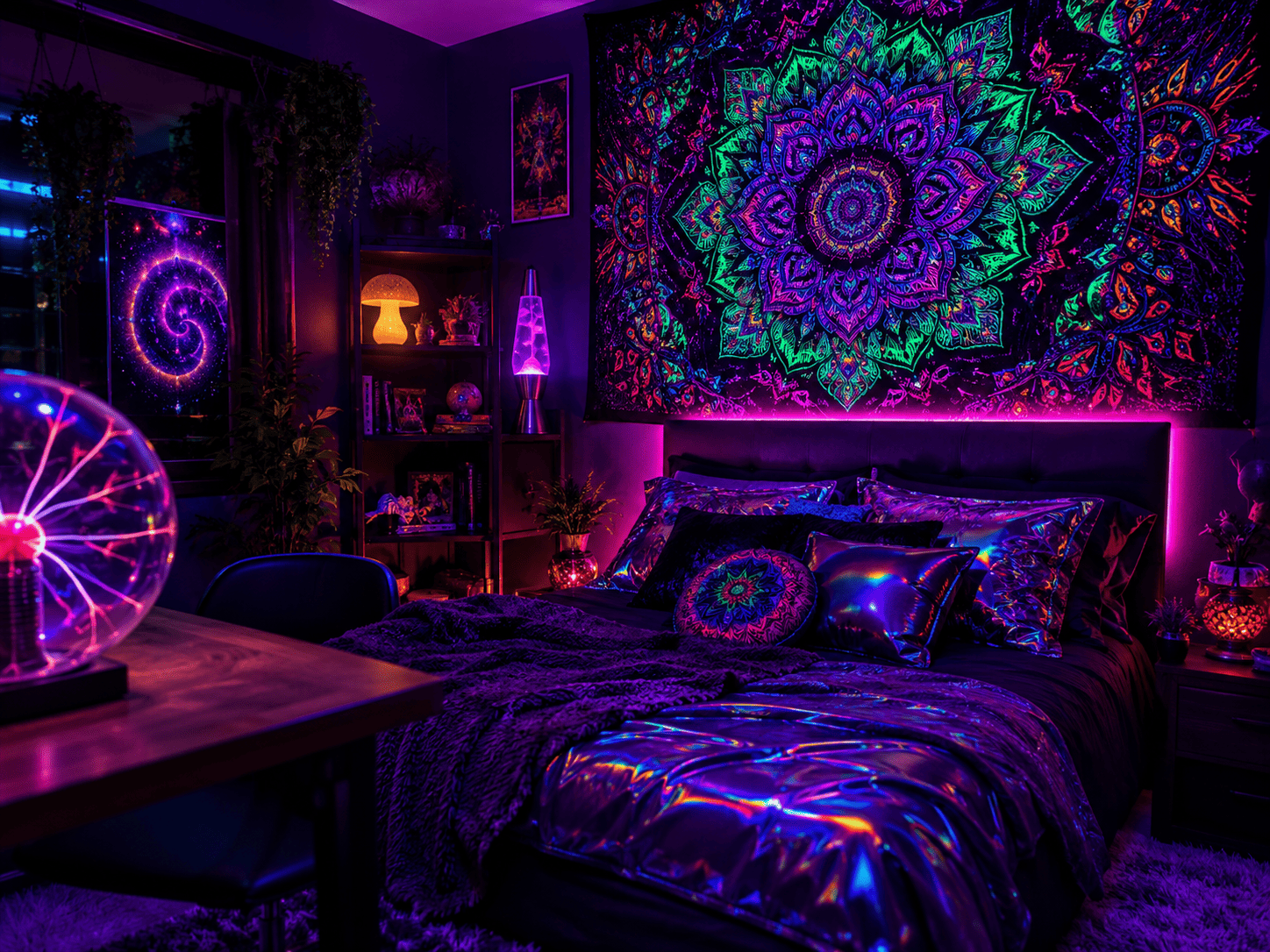
If your bedroom has no overhead light, or the one ceiling light you do have makes the room feel harsh and flat, you do not need an electrician to fix it. You need layers.
A cozy bedroom at night usually has three soft sources of warm light at different heights, not one bright light from above. Most of them can be plug-in, battery-powered, or simply placed on a table, so renters can use them too and take them when they move.
This guide gives you a complete, no-wiring plan: what to put where, what colour temperature to choose, and how to dim everything down for sleep. It focuses on warm light, small rooms, and a budget, because those are the parts most generic lighting lists skip.
Idea 1: Layer three lights at three heights

Do not try to light the whole room from one spot. Put light low, at eye level, and higher up, so the room feels deep instead of flat.
A good starter set is:
- One bedside lamp at eye level when you are in bed, for reading and winding down
- One taller floor lamp or wall light to wash a wall with soft light
- One low accent light, such as a small lamp on a dresser or an LED strip under the bed
Use warm white bulbs, around 2700K to 3000K, in all three. Cool white bulbs above 4000K will make the same room feel clinical, even with nice furniture. When all three are on at a low level, you can turn the ceiling light off completely and the room will still feel bright enough to move around in, but much calmer.
Idea 2: Use plug-in and battery sconces by the bed, with no wiring

Wall sconces are one of the best space-savers in a small bedroom, because they free up your nightstand. The renter-friendly versions do not need wiring at all.
Look for:
- Plug-in sconces that mount with a small hook or adhesive pad and plug into a nearby outlet
- Battery or rechargeable sconces with a magnetic base, which you can charge by USB and stick back on the wall
- Swing-arm or adjustable sconces, so you can aim light at a book without lighting the whole room
Mount them just above and slightly outside your pillows, so the light falls on the page, not in your eyes. Hide the cord behind the headboard or along the wall with small cord clips, and choose a fabric or frosted shade so the light is diffused, not glaring. If you move, you can take the sconces with you and patch one small hole, or leave no mark at all with adhesive mounts.
This is also a good companion to proper vanity lighting. If you want to understand heights and placement for wall lights in general, see our complete guide to vanity light height.
Idea 3: Add warm LED strips and fairy lights behind the headboard

LED strips and fairy lights are the cheapest way to make a bedroom feel intentional at night, but only if you keep them warm and hidden.
Put an adhesive LED strip behind the headboard, so the light washes the wall instead of shining directly at you. Choose a warm white strip, 2700K, with a dimmer or remote, not a bright multicolour strip. Under the bed, a second short strip gives a soft floating glow that also works as a night light.
For fairy lights, use warm white copper-wire lights, draped along the headboard, a shelf, or a mirror frame. Battery strands with a timer are useful here: set them to come on at dusk and off at bedtime, so you do not have to remember. Keep all lights away from bedding and fabric canopies, and avoid cool white strands, which tend to look like a dorm room rather than a calm bedroom.
In a very small or awkward bedroom, this hidden glow also helps the room feel larger, because your eye reads the lit wall as farther away. For more small-room ideas, see our guide to very small attic bedroom ideas.
Idea 4: Light the dark corner and dim everything for sleep

Every bedroom has a dark corner the ceiling light never reaches, and that dead zone makes the room feel smaller at night. Put a floor lamp there, ideally an arc or torchiere that bounces light off the ceiling, with a warm dimmable bulb and a heavy base so it does not wobble.
Then, and this is the step most people skip, put everything on a dimmer. You do not need to rewire for this:
- Use screw-in dimmer plugs for table and floor lamps: plug the lamp into the module, and the module into the wall
- Use smart bulbs if you want to dim from your phone or set a wind-down routine
- Check the bulb is labelled dimmable, or it may flicker or buzz
In the last hour before bed, dim to about 20 to 30 percent, turn off any cool or bright sources, and keep only warm, low light. That wind-down is what makes the room feel cozy and also helps your body get ready for sleep. Avoid bright blue-white light late at night, and if you need a night light, choose a dim amber or red hue.
What to avoid
- One bright overhead light as your only source
- Cool white bulbs above 4000K in the evening
- Exposed bulbs with no shade, which create harsh shadows
- String lights touching bedding, or lights left on all night without a timer
Frequently asked questions
Can I light a bedroom well with no overhead light at all?
Yes. Three warm, layered sources — bedside, wall or floor, and one low accent — are usually enough for a bedroom, especially if you use dimmable warm bulbs and light the corners, not just the centre of the room.
What is the best colour temperature for a cozy bedroom?
Warm white, around 2700K to 3000K. That gives a golden, sunset-like glow. Cooler temperatures feel more alert and clinical, and are better for a workspace than for winding down.
What is the best renter-friendly bedroom lighting?
Plug-in sconces, battery or rechargeable wall lights, table and floor lamps, and adhesive LED strips. All of them can be installed without an electrician and removed when you move, which is why they work well alongside bedroom furniture choices like those in our guide to bedroom sets with a vanity.
What kind of floor lamp is best for replacing an overhead light?
Choose a tall floor lamp with an upward-facing or diffused shade, such as a torchiere or a globe-style lamp. That spreads light across the ceiling and mimics the glow of an overhead fixture. Place it diagonally across from the bed or near a mirror for maximum impact, and choose a dimmable version if you can.
Can I install a ceiling light in a rental, and do I need an electrician for plug-in lights?
Plug-in, battery, and table or floor lamps do not need an electrician, because you are not changing the wiring. A hard-wired ceiling light is different: ask your landlord for written permission first, and use a licensed electrician if it is approved. If permission is refused, the plug-in system in this guide is the safe, removable alternative.
How many lumens do I need in a bedroom?
Plan about 10 to 20 lumens per square foot in total, split across your lamps. A typical 120 square foot bedroom needs roughly 1,200 to 2,400 lumens in total, so about 600 to 1,200 lumens per main lamp. For reading in bed, use a focused lamp of about 450 to 800 lumens at 2700K to 3000K, aimed at the page, not at the whole room.
Conclusion
You do not need a ceiling light to have a cozy bedroom. Start with three warm lights at three heights, add no-wiring sconces by the bed, hide a warm LED glow behind the headboard, and dim everything down at night. That simple system works in small rooms, rentals, and bedrooms with no overhead fixture at all, and it costs far less than rewiring a room.
Start tonight with the easiest change: swap any cool bulbs for 2700K warm white, turn off the overhead light in the evening, and use only lamps. You will feel the difference immediately.