Introduction
A bedroom rug is easy to get wrong. It looks generous in a shop photo, then disappears under the bed, leaving only a narrow strip on each side. Or it stops just short of where your feet land in the morning, which defeats the whole point of having it.
The question what size rug for a bedroom is not about one magic size. It is about how much rug shows beside and beyond the bed, and what happens when the room is small. This guide starts with the measurement that matters most, gives clear sizes for twin, full, queen and king beds, compares the three main placements, and covers small rooms, budgets, material and cleaning.
Key takeaways
- Start with side space, not rug size alone: aim for comfortable barefoot space on both sides of the bed.
- Standard sizes depend on bed size, so check queen and king guidance before ordering.
- Placement matters as much as size: under the bed, beside it, or runners each suit different rooms.
- Measure before you order, and use a runner fallback in tight rooms or on a tight budget.
Idea 1: Start With Side Space, Not Rug Size Alone

Most guides begin with a list of sizes. That is backwards. Begin with your feet. When you get out of bed, you want soft rug under both feet, and enough rug that you do not step straight off it when you stand up. Aim for 18 to 24 inches of rug showing on each side of the bed, and a similar amount at the foot, where space allows. That range feels comfortable and looks intentional, without crowding the door, wardrobe or dresser.
Less than about 12 inches on a side is where problems start. The rug can look like a bath mat, slide more easily, and bunch where you step on and off it daily. That is why a 5 by 8 rug under a twin bed and a 6 by 9 rug under a full bed can fall short, even though both are commonly sold as bedroom rugs. Once bedding overhang is counted, they may leave less than that 12 inch minimum.
Idea 2: The Standard Sizes by Bed Size
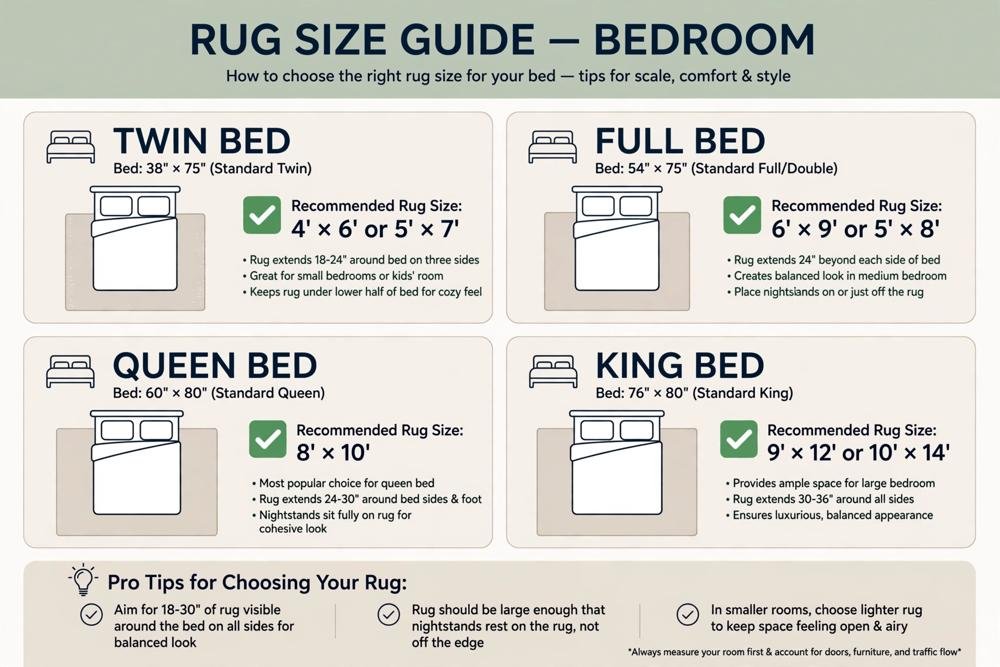
These sizes are starting points, not fixed rules, because room size, bed height and furniture layout all change the result.
For a twin bed, usually 38 by 75 inches, an 8 by 10 rug is generous and a 6 by 9 rug is a workable minimum in a larger room. A 5 by 8 rug can work only if placed carefully, so it extends well beyond the foot and on the open side. With two twin beds, one large rug under both often looks better than two small rugs that drift apart, but only if the room can hold it without blocking walkways.
For a full bed, usually 54 by 75 inches, aim for 7 by 9 or 8 by 10. A 6 by 9 rug is the lower end, and works best under the lower two thirds of the bed, so more rug is available where you step out. For a queen bed, usually 60 by 80 inches, the classic recommendation is 8 by 10. It gives useful side space in a medium room and a good amount at the foot. In a larger room, 9 by 12 under a queen bed can look even better, because it anchors the bed and nightstands as one group.
For a king bed, usually 76 by 80 inches, 9 by 12 is the standard recommendation. An 8 by 10 rug under a king bed is often too tight, because little is left on each side once the bed width is subtracted. A 10 by 14 rug is worth considering in a large primary bedroom, especially with wide nightstands or a bench at the foot. Room size matters as much as bed size. In a 12 by 14 room, an 8 by 10 rug under a queen bed usually leaves a comfortable border. In a smaller room, you may need a different placement, a runner pair, or a slightly smaller rug.
Idea 3: Three Placements Compared

Choosing a placement is often more important than choosing between two sizes only a foot apart.
First, the rug under the whole bed, including under the headboard and nightstands. This looks the most finished, because the bed, nightstands and rug form one grounded group, and the weight of the bed holds the rug in place. The drawback is size and cost. You need a larger rug, much of it is hidden, and it can crowd a small room. This suits larger bedrooms, where the rug can still leave a clear border of floor around it.
Second, the rug under the lower two thirds of the bed. It starts partway down the bed, often around the middle, and extends well beyond the foot. Nightstands sit on bare floor. This is the most useful placement for small and medium rooms, because it gives a large area of soft floor where you actually walk while using a smaller rug. Cleaning is easier too, because you can slide the rug out without moving nightstands. Make sure it extends well beyond both sides, not just beyond the foot, or it can look less anchored from the side.
Third, two bedside runners, one on each side, instead of one large rug. Runners are usually 2 to 3 feet wide and 6 to 8 feet long, and sit where your feet land. This is an excellent fallback for very small rooms, for rooms where a door or wardrobe blocks a large rug, and for budgets that cannot stretch to an 8 by 10 rug. Runners are also easier to wash, move and replace. They do not anchor the room in the same way, and they can slide or curl without backing or a pad. A runner should run at least the length of the bed, and ideally a little beyond the foot.
Idea 4: Small Rooms, Tight Budgets and Runner Fallbacks
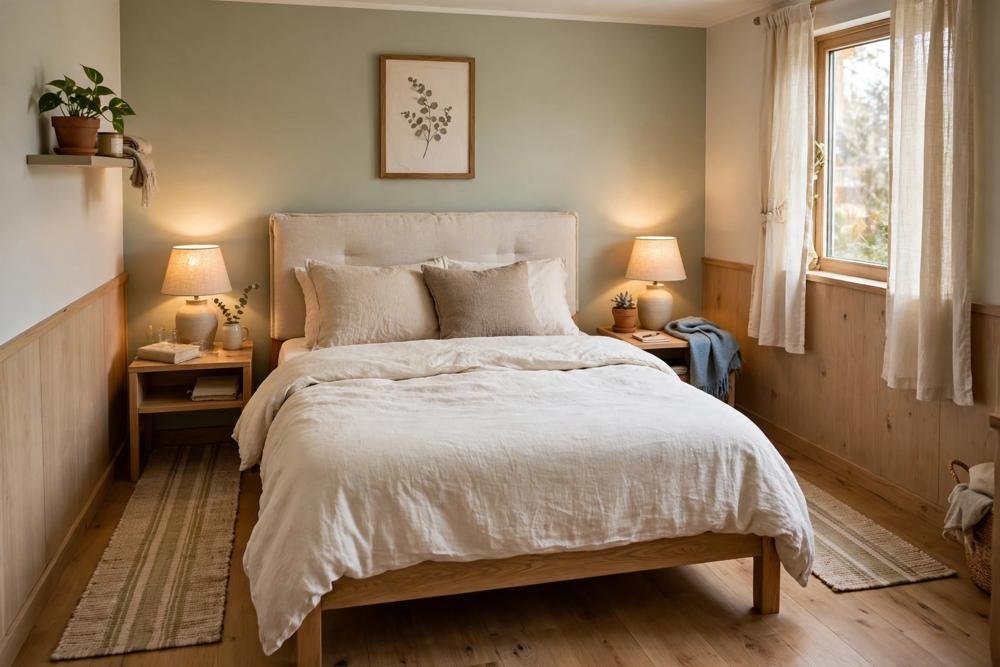
Small rooms are where standard size tables break down. Take a 10 by 10 room. An 8 by 10 rug is 80 square feet in a 100 square foot room. Once you allow for door swing, a wardrobe and a dresser, that rug may leave almost no bare floor border, bunch against furniture, and make the room feel smaller rather than softer. In that situation, a smaller rug under the lower two thirds of the bed, or a pair of runners, is the better design choice, not a compromise to be embarrassed about.
Budget follows the same logic. A good quality smaller rug is better than a poor quality large rug that sheds or wears thin in the middle within a year. If your budget only stretches to a 5 by 8 rug for a queen bed, do not centre it under the whole bed. Place it under the lower two thirds, so the visible part is where you walk, and pair it with a washable runner on the other side if needed. If you can wait and save, sizing up from 5 by 8 to 8 by 10 is one upgrade where the difference is visible every morning. Renters also benefit from runners and smaller rugs, which are easier to take when moving and easier to clean before a deposit inspection.
How to Measure Before You Order
Measure bed width and length, including any headboard that extends beyond the frame. Measure the distance from each side of the bed to the nearest wall, wardrobe, dresser and door. Note where drawers open and where you stand to get dressed. Those are the zones the rug must serve or avoid. If you are buying new pieces too, check the bedroom furniture sizes and clearances to allow for before you order.
Then mark the rug size on the floor with painter tape. Walk the room as you normally would. Open the wardrobe, pull out a drawer, sit on the edge of the bed and stand up. If you step off the taped rug every time, move the tape or choose a larger size or a different placement. If the tape touches furniture on three sides, the rug will look cramped and be hard to clean around. Take a photo of the outline from the doorway, which often shows crowding that is hard to see while standing in the room. For a quick double check, run your measurements through a rug calculator before you order.
Material and Pile: What Feels Right and What Lasts
In a bedroom, softness matters more than toughness, because you walk on it barefoot, but durability still matters in the paths you use daily. Low to medium pile, usually under half an inch, is a good balance. It feels soft, traps less dust than deep pile, and is easier to vacuum.
Wool is warm and resilient, but it needs care and can shed or trigger allergies. Cotton rugs are soft, often washable and budget friendly, but can wear faster beside the bed. Synthetic fibres such as polypropylene and nylon are stain resistant, easy to clean and often more affordable in large sizes, which makes them practical for households with pets or children. They may feel less luxurious underfoot, so a good pad underneath can help.
Rug Colour and Pattern Without Shrinking the Room
Colour does not change the correct rug size, but it changes how large the rug looks. In a small bedroom, a rug in a colour close to the floor or bedding, with a simple pattern, tends to make the floor look continuous and the room feel larger. A very dark rug on a light floor, or a bold pattern that stops abruptly, can chop the room into pieces and make a small room feel smaller, even if the rug itself is the right size.
Cleaning, Pets and Everyday Wear
A bedroom rug collects dust, hair and daily wear in the same two strips beside the bed. Vacuum those strips more often than the centre, which is protected by the bed. Rotate a rug that is not under the whole bed every few months, so wear evens out and sunlight does not leave a sharp fading line at the foot.
What to Avoid
Avoid buying a rug based only on a catalogue photo, where furniture has been pushed back and the rug looks larger than it will in your room. Avoid a rug that leaves less than 12 inches on the side you step out on. Avoid a rug so large that it blocks a door, drawer or wardrobe, and avoid one so thick that it makes a door catch or a drawer drag.
FAQs
What size rug should I buy for a queen bed?
For most rooms, 8 by 10 is the best starting point for a queen bed. It gives useful space on each side and at the foot, and works well under the lower two thirds as well as under the whole bed. In a large room, 9 by 12 can look even better. In a very small room, a 6 by 9 rug under the lower two thirds, or a pair of runners, may fit better.
What size rug for a king bed in a small bedroom?
A king bed in a small bedroom is a tight fit for any rug, because the bed itself leaves little side space. The standard 9 by 12 rug may be too large, so measure free floor first. If 9 by 12 leaves almost no border and blocks furniture, use a rug under the lower two thirds of the bed, or two runners, one on each side. Aim for at least 12 inches of soft floor where you step out.
Should a bedroom rug go under the bed or beside it?
Both can work, and the best choice depends on room size. Under the whole bed looks most finished in a large room. Under the lower two thirds is often best in a medium or small room, because it gives soft floor where you walk while using a smaller rug. Beside the bed, in the form of runners, is best when the room is very small, when a door or wardrobe blocks a large rug, or when budget or moving plans make a large rug impractical.
Can a 5 by 8 rug work for a queen bed?
It can work only in limited situations, and it is not recommended for most queen beds. A 5 by 8 rug under a queen bed will usually leave less than 12 inches on each side, and it can look too small once bedding is added. If it is the only size your budget or room allows, place it under the lower two thirds so the visible part is where you walk, and consider a runner on the other side.
How far should a rug extend beyond the sides of the bed?
Aim for 18 to 24 inches on each side where space allows, and treat 12 inches as a practical minimum. At the foot of the bed, a similar extension helps the rug look intentional. If your room cannot provide that much space on both sides, prioritise the side you get out on most often, and use a runner or smaller rug on the other side.
Conclusion
Choosing what size rug for a bedroom is a measurement problem first and a style problem second. Start with the space beside and beyond the bed, use 18 to 24 inches as your ideal side target and 12 inches as your minimum, and then choose between a full under bed rug, a lower two thirds rug, or bedside runners based on your room and budget. Use the size tables for twin, full, queen and king beds as a starting point, but let a tape outline on your own floor make the final decision. For layout, storage, light and style beyond the rug, see Small Bedroom Ideas: The Complete Guide to Layout, Storage, Light and Style.