Introduction
Sharing a small bedroom with a partner is not really a decorating problem. It is a fairness problem, a storage problem, and a sleep problem, all in one room. Two people bring two wardrobes, two phones, two chargers, two sets of books, and often two very different routines. When the room is small, there is nowhere for the extras to hide, and every small decision becomes visible.
The good news is that a small shared bedroom does not need to feel like a compromise that nobody likes. It needs a clear system. Each person needs a defined place for their clothes, a place to charge a phone, a light they can control, and a way to get ready without waking the other person. When those basics are sorted, the room can look calm, even if it is not large. For the full picture, read Small Bedroom Ideas: The Complete Guide to Layout, Storage, Light and Style.
Key takeaways
- Split storage fairly before you buy anything, so neither person ends up squeezed out.
- Plan for different schedules and tastes, not just different styles.
- Fit two nightstands in a tight room, even if they are small or wall-mounted.
- Agree a colour and bedding compromise, and keep a layout that gives both people room to move.
Idea 1: Split Storage Fairly Before You Buy Anything
Most arguments about a small shared bedroom start with storage, even if nobody says so directly. One person takes over the wardrobe because they got there first. The other person lives out of a chair, a suitcase, or a pile on the floor. That is not a personality clash. It is a missing system.
Start by counting what you actually own, not what you think you own. Count hanging clothes, folded clothes, shoes, bags, work items, and seasonal clothes separately for each person. You may find that one person has mostly hanging clothes and the other has mostly folded clothes. That changes the solution completely. A second hanging rail helps the first person. Extra drawers help the second person.
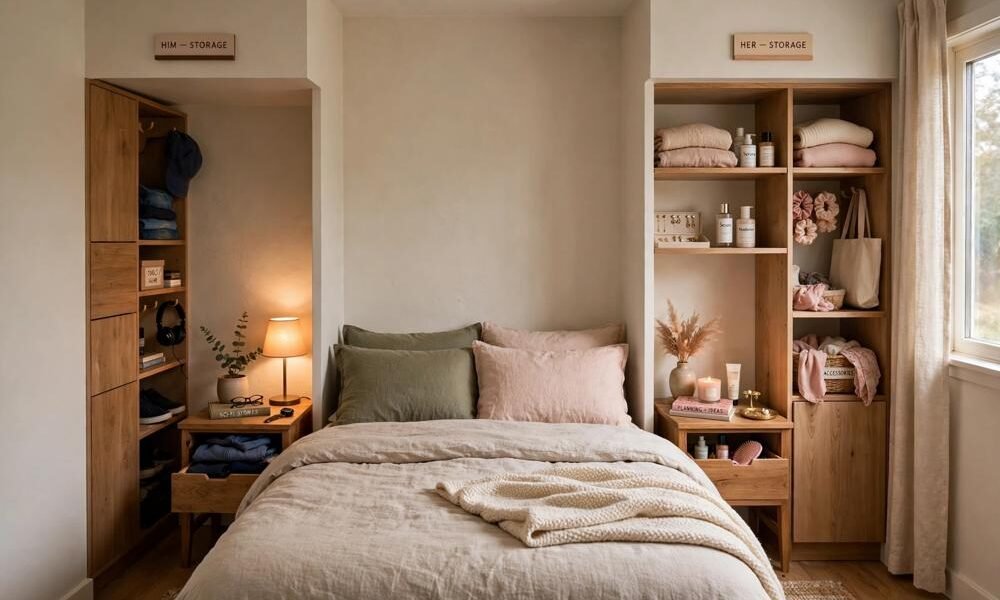
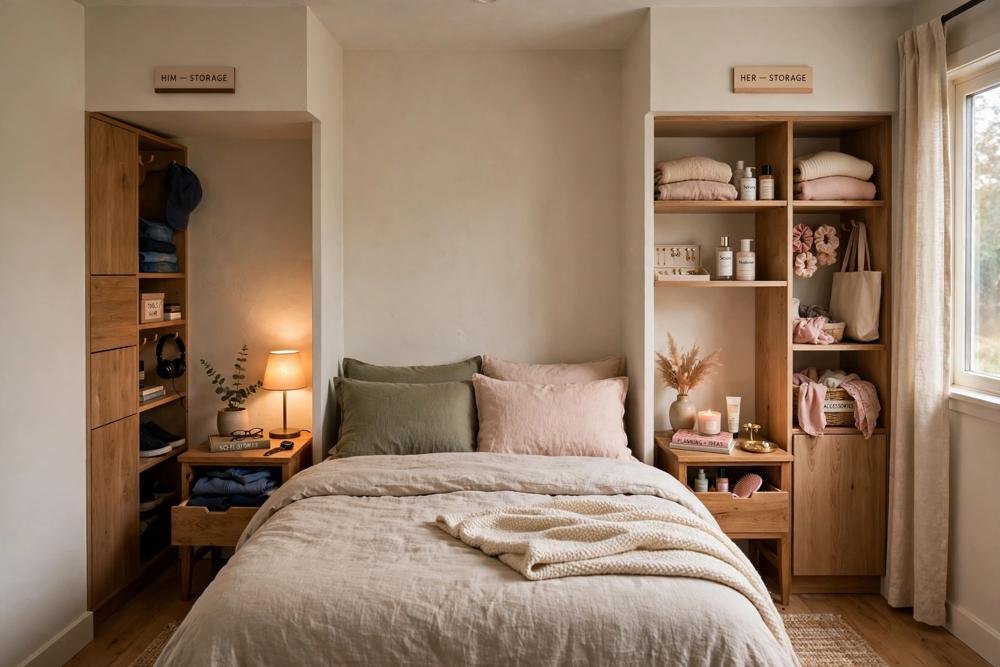
Then split the room into zones, and write the split down if it helps. For example, one person gets the left half of the wardrobe and the top two drawers. The other person gets the right half and the bottom two drawers. Each person gets one nightstand drawer, one hook by the door, and one shelf. When the split is visible and agreed, it is much easier to keep.
Use mirrored storage where you can. Two identical baskets, two identical drawer dividers, or two matching storage boxes make the room look intentional and make it obvious when one side is overflowing. Avoid one large shared pile of clothes, because shared piles always become one person’s job to sort.
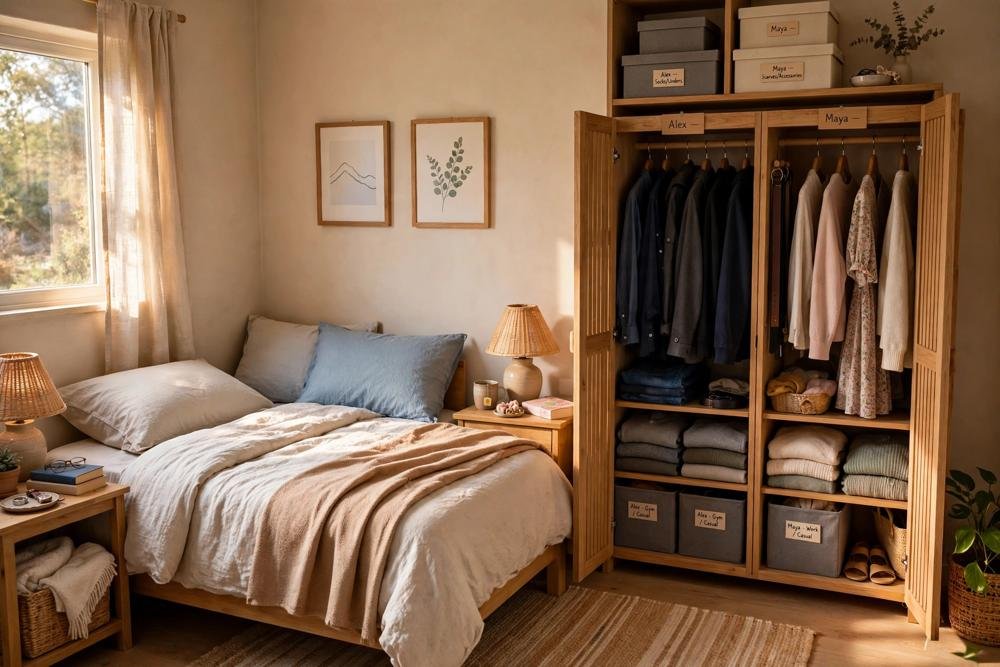
If you share a closet, split it by hanging length rather than by half the rail. Short shirts and trousers can double hang, which means two short rails stacked on top of each other. Long coats and dresses need one long section. Give each person a section that fits their clothes, rather than an equal length of rail that wastes space. Our guide to organising a bedroom without a closet shows how to zone shared storage when there is no built-in closet at all.
A useful rule is this: if something does not fit in your zone, something else has to leave your zone. That rule sounds strict, but it protects both people. It stops the room from slowly filling up, and it stops one person from quietly taking over the spare shelf, the spare drawer, and then the spare corner.
Idea 2: Plan for Different Schedules, Not Just Different Tastes
Many couples do not go to sleep at the same time, wake up at the same time, or need the same amount of light. One person may read until midnight. The other may need to be up at five in the morning. In a large bedroom, you can solve this with distance. In a small bedroom, you need to solve it with light, sound, and routine. See how to make a bedroom dark and quiet for shift work and light sleepers.
Individual reading lights are the single most useful change for couples with different schedules. A wall mounted light, a clip on light, or a small lamp on each side of the bed lets one person read while the other sleeps. Choose warm light, and choose a light that can be dimmed or pointed at a book rather than across the room. Avoid a bright overhead light for late night reading, because it wakes the whole room.
Charging points matter just as much. Each person should be able to charge a phone without reaching across the other person or trailing a cable across the bed. A small power strip behind each nightstand, or a nightstand with a built in charging point, solves this quietly. Keep cables short and tidy, so nobody trips over them in the dark.
Think about the early riser routine as a sequence. What does the early riser need, in order? Clothes laid out the night before, a bag by the door, shoes that are easy to find, and a bathroom routine that does not require turning on every light in the bedroom. If the early riser has to open drawers, search for clothes, and turn on the main light, the late sleeper will wake up every time.
Laundry is another hidden schedule problem. A shared laundry basket in a small bedroom can overflow quickly, and it can also become a source of mess. Two smaller baskets, one for each person, or one basket with a divider, makes laundry fairer and easier to carry. Empty the basket on a set day, rather than waiting until it overflows.
Idea 3: Fit Two Nightstands in a Tight Room
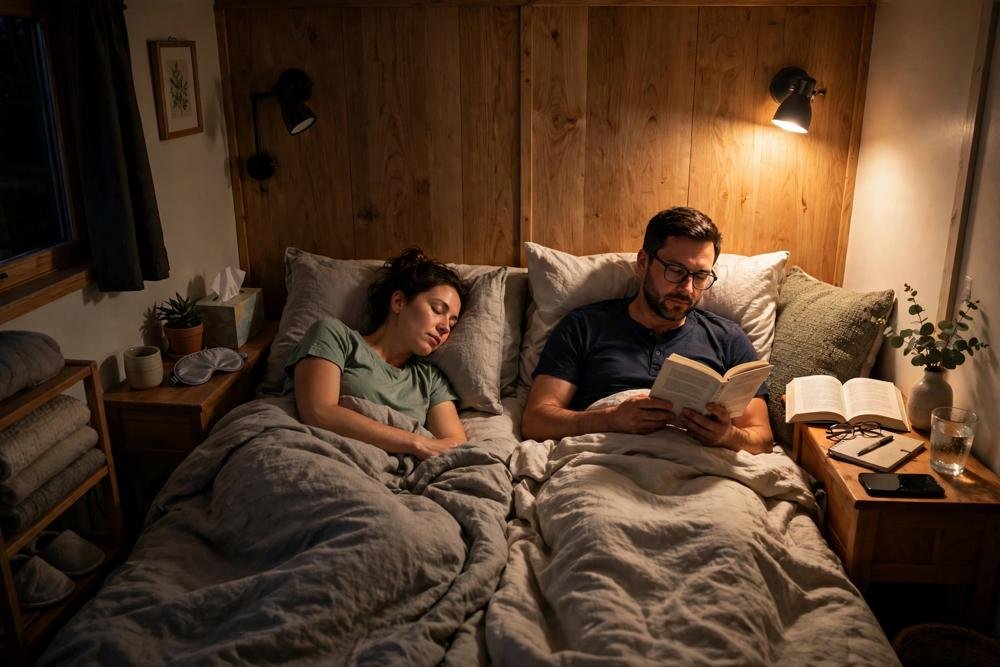
Two nightstands sound like a luxury in a small bedroom. In practice, they are a fairness tool. Each person gets a place for a phone, a glass of water, a book, and a charger. Without two nightstands, one person ends up using the floor, the windowsill, or the other person’s side of the bed.
The trick is to stop thinking of a nightstand as a wide wooden box. In a tight room, a nightstand can be a floating shelf, a wall mounted pocket, a slim stool, or a narrow table. A floating shelf takes no floor space at all, which is a major advantage in a small room. A wall shelf with a small lip can hold a phone and a glass without taking up the whole side of the bed.
Measure before you buy. Check the height of your mattress, because a nightstand that is much higher or lower than the mattress is awkward to use. Our small bedroom layout ideas for a 10 by 10 room show how tight the clearances beside a queen bed really are, and which trade-offs are worth making. A good guide is to keep the nightstand surface close to mattress height, so you can reach a phone or a glass without sitting up fully. Check the width of the space beside the bed, including room for the door to open and for drawers to pull out.
If you truly only have room for one nightstand, do not give it to one person and leave the other with nothing. Use a wall pocket, a hanging organiser on the bed frame, or a small shelf on the other side. The goal is not symmetry for its own sake. The goal is that both people have somewhere to put their essentials within arm’s reach.
Idea 4: Agree a Colour and Bedding Compromise
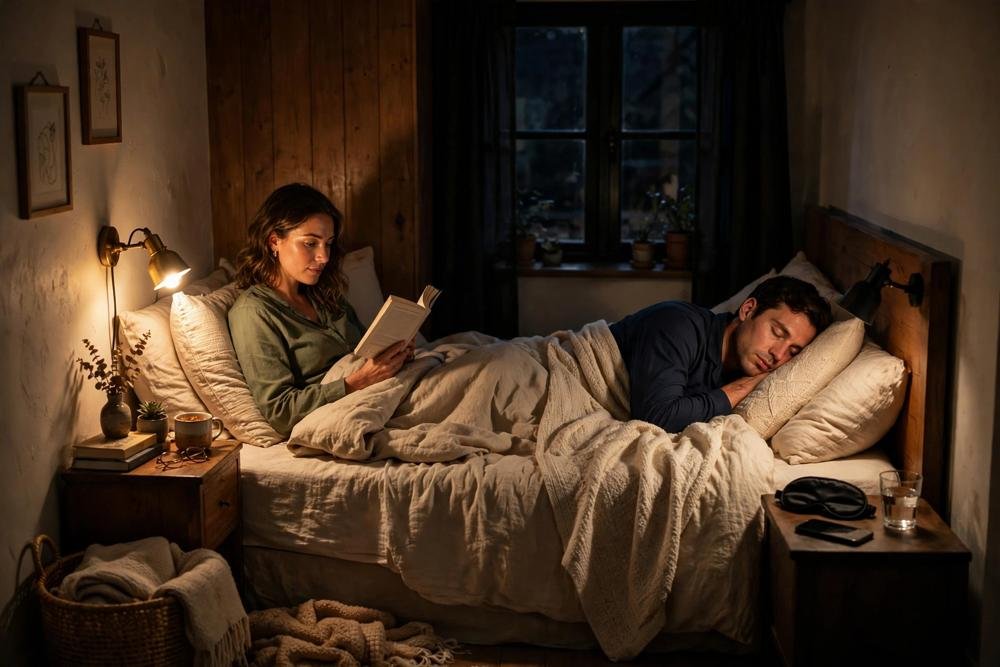
Colour arguments in a shared bedroom are rarely about colour alone. They are about whose taste gets to define the room. One person may love bold colour. The other may want calm neutrals. A small room makes this harder, because bold colour covers a larger share of what you see.
A neutral base is the easiest compromise, and it does not have to be boring. Start with warm white, soft beige, warm grey, or sage on the walls and bedding. Then let each person choose one accent that appears in a limited way. For example, one person chooses a throw, and the other chooses two pillow covers or a piece of art. The room still feels personal, but it does not feel divided down the middle.
Bedding is where compromise matters most, because both people sleep under it every night. If one person sleeps hot and the other sleeps cold, a single heavy duvet will suit neither of you. Two separate duvets on one bed, often called the Scandinavian sleep method, can solve this without looking odd. Use a shared bed cover or throw across the foot of the bed to pull the look together during the day.
Pillows are another easy win. You do not need matching pillows. Each person can choose the pillow height and firmness that suits them, as long as the pillowcases match or coordinate. This is a small detail, but it affects sleep every night, so it is worth getting right.
Layout That Gives Both People Room to Move
A good layout for couples starts with walkways, not with furniture. Each person should be able to get out of bed without climbing over the other person, and without squeezing past a dresser. If your bed is against a wall, the person on the wall side will always have a harder time. If you can, leave space on both sides of the bed, even if that space is narrow. A rug that fits the bed properly also helps each side feel defined; see what size rug for a bedroom.
If space is very tight, a bed in a corner can still work, but you need to plan for it. The person on the wall side needs a wall shelf, a wall light, and a clear place for a phone. The person on the open side needs to be the one who gets up first more often, or you need a routine for getting in and out without disturbing each other.
A Shared Closet and Laundry System That Actually Works
If you share a closet, agree on a rotation system. Seasonal clothes go to the top shelf or under the bed. Everyday clothes stay at eye level. Work clothes and weekend clothes can be grouped separately, so you are not searching through everything each morning. Our small reach-in closet organisation ideas show how to zone a tiny closet for two people.
What to Avoid
Avoid buying a matching bedroom set just because it looks tidy in a shop. Matching sets are often too large for a small room, and they leave no room for personal storage needs. Choose pieces by size and function first, and let them coordinate through colour and material, rather than through an exact match.
Avoid one person’s taste taking over the whole room. A room that only reflects one partner will feel less like home to the other partner, and that feeling builds up over time. Small, agreed accents are better than a room that one person loves and the other merely tolerates.
Avoid filling the room with extra seating that nobody uses. A chair in a small bedroom often becomes a clothes chair within a week. If floor space is the problem, our small bedroom storage ideas that do not use floor space show how to move storage up the walls and under the bed instead. If you need a place to sit to put on shoes, a low bench at the foot of the bed or a small stool that tucks away is more useful than a large armchair that blocks a walkway.
Avoid a single bright overhead light as your only light source. It makes the room feel harsh at night, and it gives you no way to have one person awake and one person asleep. Layer your lighting with bedside lights, a warm lamp, and, if possible, a dimmer. For more ways to light a bedroom without a ceiling fixture, see our cozy bedroom lighting ideas without an overhead light.
FAQs
How do two people share a small bedroom without clutter?
Start with a fair storage split, one zone per person, and a rule that anything that does not fit in a zone has to leave it. Use closed storage for messy items, matching bins for open storage, and a daily reset of surfaces. Clutter in a shared room is usually a storage system problem, not a tidiness problem.
How do you organise a shared closet in a small bedroom?
Split the closet by hanging length, not just by half the rail. Double hang short clothes, keep one long section for coats and dresses, and use shelf dividers and drawer dividers for folded items. Put seasonal clothes on the top shelf or under the bed, and keep everyday clothes at eye level.
What bed size is best for a small bedroom for couples?
A queen bed is often the best balance for couples in a small room, because it gives both people reasonable space without taking over the whole floor. A king bed can work in a larger small room, but it leaves little room for nightstands and walkways. Measure walkway space on both sides before choosing, and remember that a full bed may feel too narrow for two adults over time.
How can a couple with different sleep schedules share a small bedroom?
Use individual reading lights, separate charging points, and a routine for the early riser that does not require the main light. Lay out clothes the night before, keep a bag by the door, and use warm, dim light in the evening. Two separate duvets can also help if one person sleeps hot and the other sleeps cold.
How do you decorate a small bedroom for two people with different tastes?
Start with a neutral base for walls and bedding, then let each person choose one limited accent, such as a throw, pillow covers, or art. Use texture to add warmth, rather than many small decorations. Agree the palette together before buying, so neither person feels the room was decided without them.
Conclusion
A small bedroom for a couple works best when it is designed around fairness and routine, not around a single style. Split storage clearly, give each person a nightstand and a light they can control, plan for different sleep schedules, and agree a neutral base with personal accents. These are not glamorous changes, but they are the changes you will notice every morning and every night.
Start with the biggest daily friction in your room. For many couples, that is storage. For others, it is light or getting out of bed without waking each other. Fix that one thing first, then move to the next. A small shared bedroom does not need to be perfect. It needs to work for both people, every day, without one person quietly giving up space, sleep, or comfort.