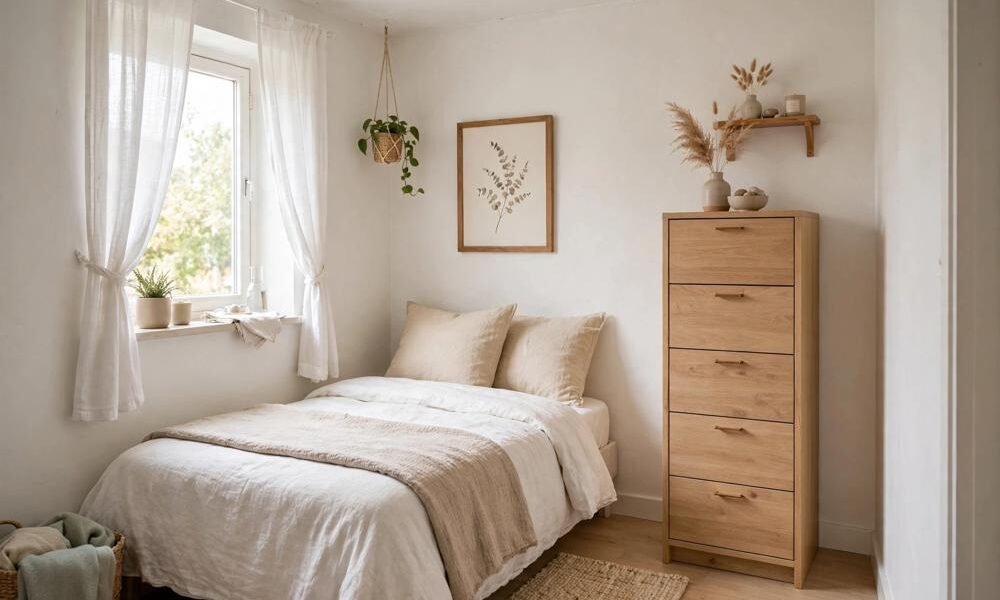
A standard wide dresser is often the first piece that will not fit in a small bedroom. It needs wall width, drawer clearance, and a walkway in front, and in a 10 by 10 room that can eat the only usable wall. The good news is that a dresser is not the only way to store folded clothes. You can use height instead of width, combine storage into a wardrobe, use open shelves, or split the dresser into smaller units around the room.
This guide covers four practical alternatives, how much each one holds, and how to choose the right one for your room, your clothes, and your budget. It assumes you have already checked what you actually own, because no alternative will work if it has to hold clothes you never wear.
Key takeaways: use height when you lack width; combine hanging and folded storage in one wardrobe; keep daily clothes within easy reach; use open shelves only for folded items you keep tidy; and measure drawer clearance before you buy anything.
Idea 1: A Tall Chest Instead of a Wide Dresser
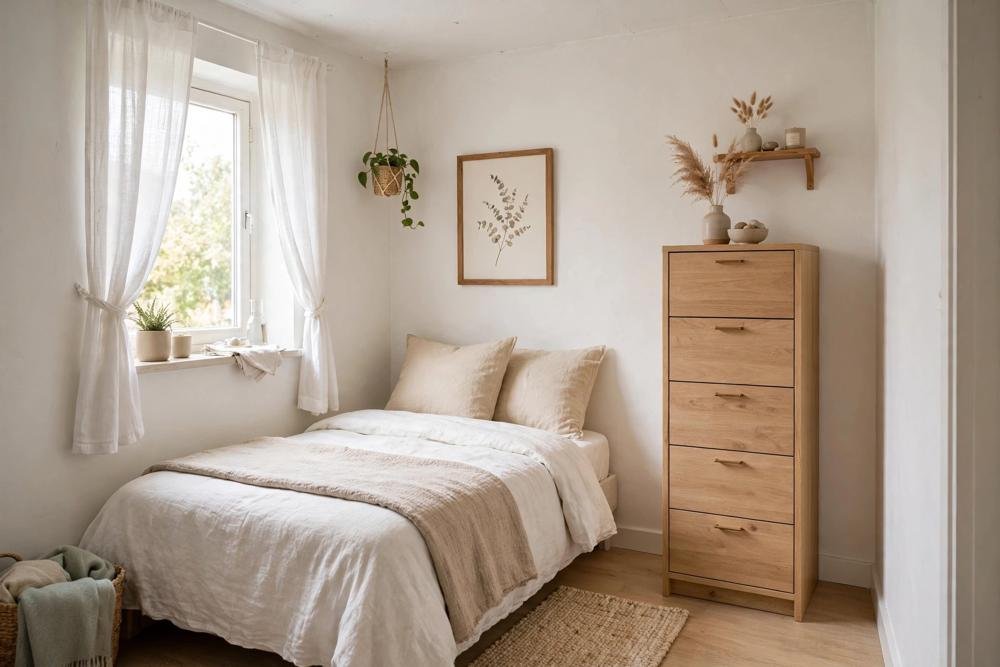
A tall chest, five or six drawers high and only 50 to 60 centimetres wide, holds almost as much as a wide dresser, but uses far less wall. It fits in a gap beside a wardrobe, between a bed and a door, or on a short wall that a wide dresser cannot use. It also leaves more floor free, because the footprint is smaller, even though the height is greater.
Check three measurements before buying: width, depth, and drawer clearance. A tall chest needs a clear space in front equal to its drawer depth, usually 40 to 45 centimetres, plus room to stand. If the chest is beside a bed, leave enough room to open the bottom drawer without moving the bed. If the chest is near a door, check that the door swing does not hit it, and that you can still pass through with the drawer open.
Organise a tall chest by frequency, not by item type alone. Put daily items in the top two drawers, weekly items in the middle, and seasonal or rarely used items at the bottom. Heavy items, such as jeans and jumpers, go in lower drawers, so the chest stays stable. Anchor a tall chest to the wall, especially in a home with children, because a tall, narrow piece can tip if a child climbs it or pulls a drawer out fully.
A tall chest works best when you have mostly folded clothes and few hanging items. If you have many hanging clothes, combine a tall chest with a wardrobe rail, or use the next alternative, a wardrobe with built-in drawers.
Idea 2: A Wardrobe With Built-In Drawers and Shelves
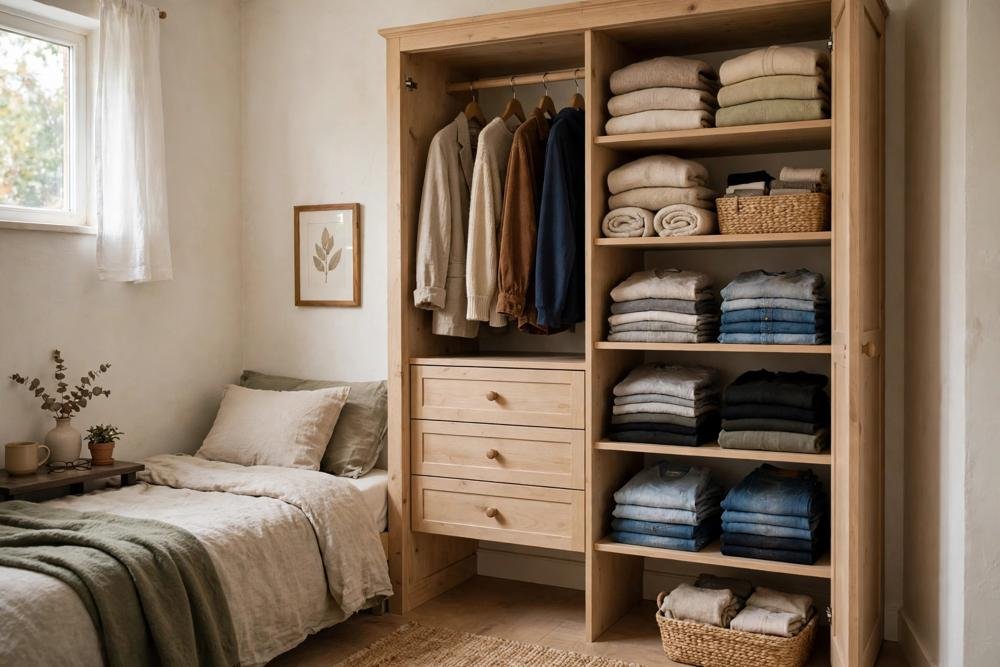
A wardrobe that combines hanging space, shelves and drawers can replace both a wardrobe and a dresser, and it uses one wall instead of two. That is a big win in a small bedroom, where every wall is needed for a bed, a door, or a window. A wardrobe with two or three drawers at the bottom, shelves above, and a rail on one side, can hold hanging clothes, folded clothes, shoes and bags in one unit.
Plan the inside before you buy, or before you add inserts to a wardrobe you already own. Measure your hanging clothes: how many items, and how long are they? Short items, such as shirts and folded trousers, need about 100 centimetres of hanging height. Long items, such as dresses and coats, need 130 to 150 centimetres. Use double hanging for short items, with two rails, one above the other, to double the hanging space in the same width.
Use drawers for items that are hard to hang or fold neatly on a shelf, such as underwear, socks, t-shirts and gym clothes. Use shelves for jumpers, jeans and bedding, folded in stacks no more than 25 to 30 centimetres high, so you can pull one item without toppling the stack. Use baskets on shelves for small items, so they do not spread. Keep daily items at waist to eye level, and seasonal items at the top or bottom.
If you rent, use a freestanding wardrobe, or add drawer inserts and shelf dividers to a built-in wardrobe, rather than fitting a new built-in unit. If you own, a built-in wardrobe that reaches the ceiling uses dead space above a freestanding wardrobe, and it can be fitted around a door or a sloping ceiling.
Idea 3: Open Shelves and Baskets for Folded Clothes
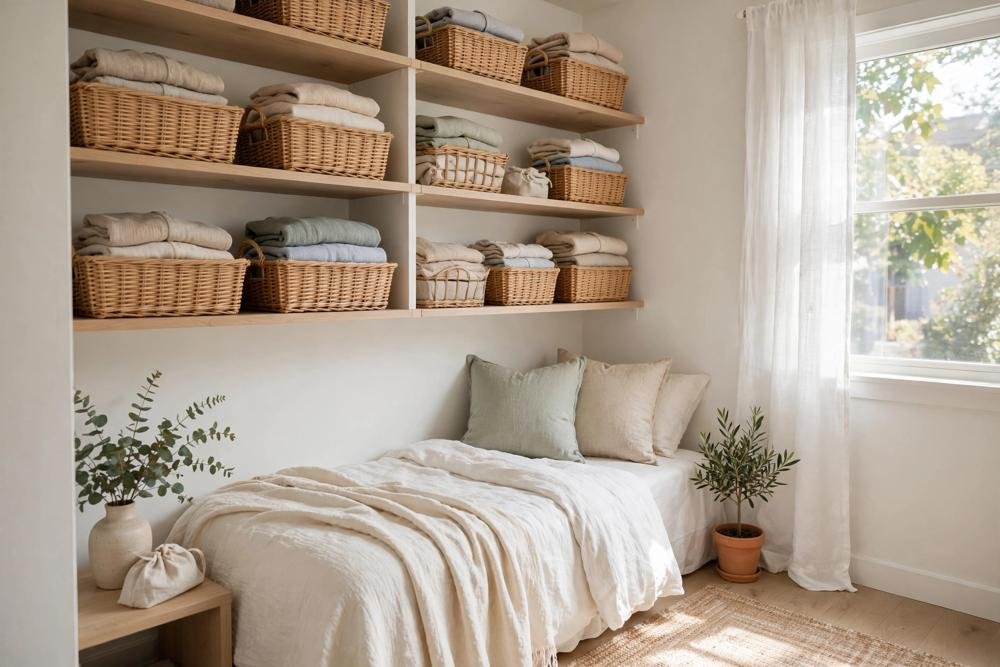
Open shelves, with baskets or boxes, can replace a dresser when you have a wall that cannot hold a deep piece of furniture, such as a wall beside a bed, above a desk, or in an alcove. Shelves are shallow, usually 30 to 40 centimetres deep, so they do not eat floor space, and they make it easy to see what you own. They work best for folded clothes, bedding and bags, not for small items that need a drawer.
Use baskets to keep shelves tidy. One basket per category, such as t-shirts, jumpers, gym clothes, and bedding, with a label on the front if the basket is not clear. Fold clothes in a way that lets you see the edge, such as file folding, where items stand upright like files, so you can pull one out without disturbing the rest. Keep stacks low, and do not overfill a basket, because an overfilled basket will spill when you pull it out.
Open shelves need more upkeep than drawers, because everything is visible. If you do not keep shelves tidy, they will look messy quickly, and dust will settle on clothes. Use shelves for items you use often, so they are rotated and dust does not build up, and keep rarely used items in closed boxes on a high shelf. In a dusty room, use boxes with lids, or a curtain over the shelves, rather than open baskets.
Open shelves also work well above a desk, above a bed, or in a hallway nook, when the bedroom itself has no free wall. Keep the shelves at a height you can reach without a step, for daily items, and use a step only for seasonal items.
Idea 4: Split Storage Around the Room
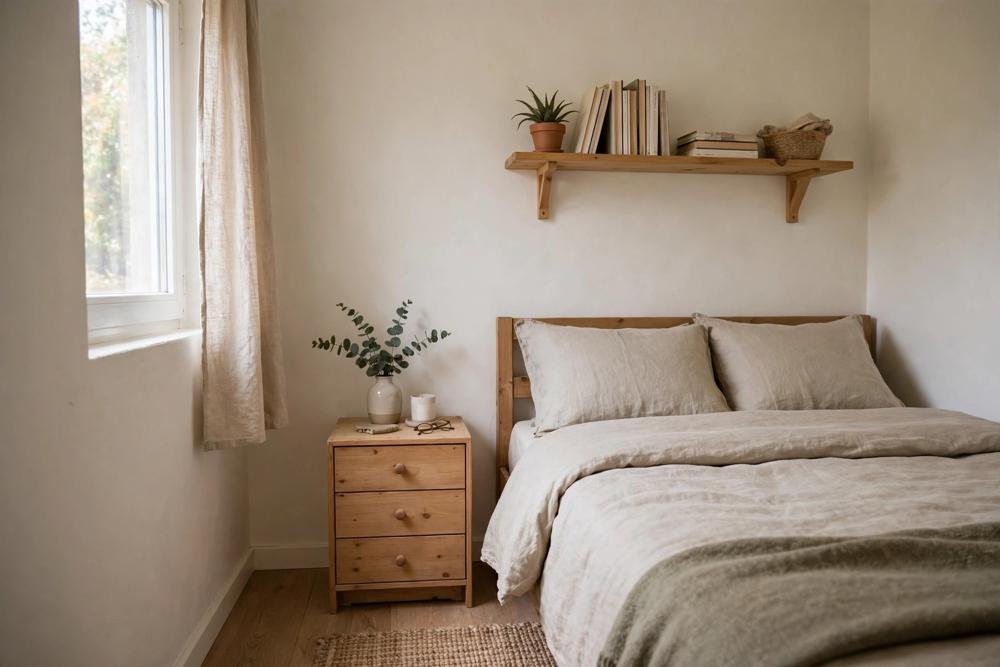
If no single alternative will hold everything, split the dresser into smaller units around the room. Use a small two or three drawer unit beside the bed, a wall shelf above it, under-bed boxes for seasonal clothes, and a wardrobe rail for hanging items. This spreads storage across walls that are too small for a full dresser, and it keeps daily items near the bed, where you dress.
This approach works best when you plan by zone: dressing zone near the bed, with daily clothes in a small drawer unit and a mirror nearby; seasonal zone under the bed or on a high shelf, with items you rotate twice a year; and hanging zone in a wardrobe or on a rail, with items that wrinkle easily. Keep a simple list of where each category lives, so you do not hunt for a jumper in three places.
Split storage needs discipline, because it is easy to end up with clothes in four places and no clear system. Use one category per unit, label baskets, and do a quick check once a month: if a unit is overfull, or a category has spread to two units, move items or declutter. Do not add a new unit without removing something, because a small room cannot absorb endless storage.
Split storage is also a good renter option, because small units, wall shelves with removable fixings, and under-bed boxes can move with you, unlike a built-in wardrobe or a large dresser.
What to Avoid
Do not buy a wide dresser and hope it will fit, without measuring wall width, drawer clearance, door swing and walkway. Do not use open shelves for small items without baskets, because they will spread and look messy. Do not put heavy items in top drawers of a tall chest, because it can tip. Do not keep clothes you never wear in a small bedroom, because no alternative will make room for them. And do not use a dresser alternative that blocks a window, a radiator, or a door, because the room will feel smaller and be harder to use.
FAQs
What can I use instead of a dresser in a small bedroom?
A tall chest, a wardrobe with drawers and shelves, open shelves with baskets, or split storage around the room. Choose by what you own: folded clothes suit a tall chest or shelves, hanging clothes suit a wardrobe with a rail.
How much can a tall chest hold compared to a wide dresser?
A five or six drawer tall chest holds almost as much as a wide dresser with six drawers, because the drawers are similar in depth, just narrower. It uses less wall width, but needs wall anchoring and drawer clearance in front.
Are open shelves good for clothes in a small bedroom?
For folded clothes you use often, yes, especially with baskets and file folding. For small items, or in a dusty room, use boxes with lids or drawers instead, because open shelves show dust and clutter quickly.
Can I replace a dresser with a wardrobe only?
Yes, if the wardrobe has drawers and shelves as well as hanging space. A wardrobe with hanging only will not hold folded clothes well, so add drawer inserts or shelf dividers.
What is the best dresser alternative for a renter?
A tall chest, small drawer units, wall shelves with removable fixings, and under-bed boxes. These move with you and do not need built-in fitting.
How do I keep split storage from becoming messy?
One category per unit, label baskets, keep daily items near the bed, seasonal items under the bed or high up, and check once a month for overfull units or categories that have spread.
Conclusion
You do not need a wide dresser to store clothes in a small bedroom. A tall chest uses height instead of width, a wardrobe with drawers combines two pieces into one, open shelves use shallow wall space, and split storage uses small gaps around the room. Measure first, organise by frequency, anchor tall pieces, and keep daily clothes within easy reach. Choose the alternative that fits your room, your clothes, and how you actually dress, and the bedroom will feel larger, not just more stored.