Under-bed storage usually fails for two reasons: it looks messy, and it is so hard to reach that you stop using it. Both are fixable. The secret is not buying more boxes. It is using matching containers, keeping only the right things under the bed, and leaving a clear way to pull each box out without moving the bed.
This guide covers boxes, drawers, labelling and raised frames, plus what not to store under a bed, and how to keep the space dust-free without a weekly clean.
Key takeaways: use matching boxes with handles, one category per box; keep daily items out from under the bed; use shallow boxes, not deep ones; leave a gap at the foot or side to pull boxes out; and clean under the bed once a season, not once a week.
Idea 1: Matching Boxes With Handles
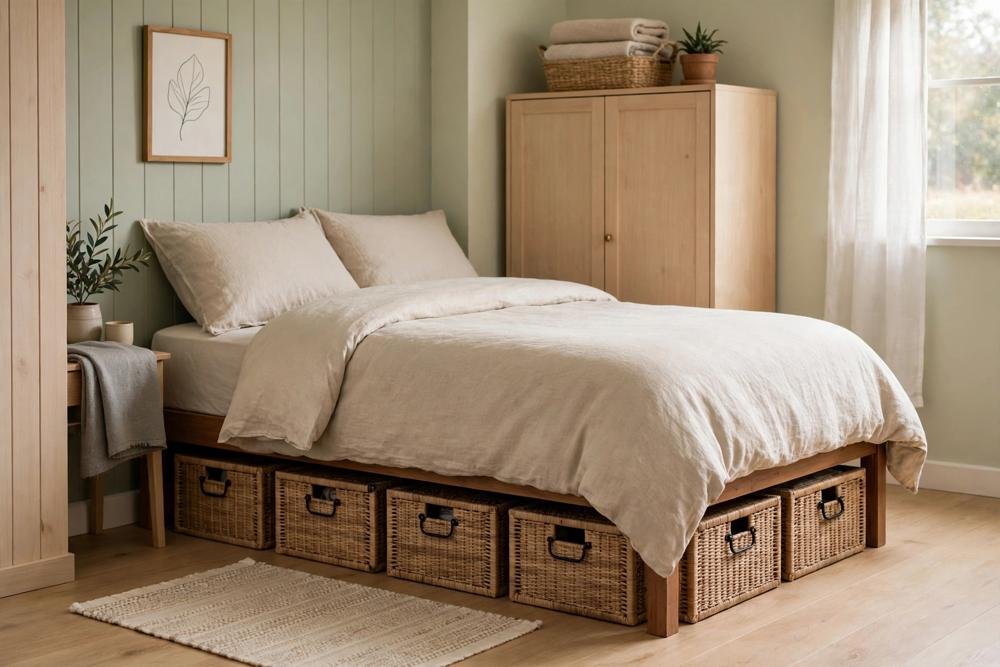
The fastest way to make under-bed storage look good is to make it match. Use boxes in one material, one colour and one size, with handles on the short side. Wicker baskets, fabric boxes with a firm frame, or clear boxes with a lid all work, as long as they match each other. Mixed boxes in different sizes and colours will always look like storage, even when they are tidy.
Measure the space under the bed first: height, width and depth, minus 2 centimetres for clearance. Most beds leave 15 to 25 centimetres of height. Shallow boxes, 12 to 18 centimetres high, slide out easily. Deep boxes, 30 centimetres or more, need the bed moved or the box dragged, and they will be ignored. If your bed is very low, use flat rolling boxes, or raise the bed slightly with risers, but check that the bed stays stable and the mattress height still feels comfortable.
Put handles on the side you pull from, usually the long side of the bed. If you pull from the foot, put handles on the short side. Use boxes that slide on the floor, not boxes that catch on a rug. If a rug runs under the bed, keep the rug short of the boxes, or use boxes with wheels. Label each box on the handle side, not on top, so you can read it without pulling the box out.
Keep the front row tidy. If you have two rows of boxes, the back row will be forgotten. Use one row only, or use the back row for seasonal items you reach twice a year, and the front row for items you reach monthly. Do not stack boxes under a bed unless you can lift the top box without moving the bed.
Idea 2: Built-In Drawers and Lift-Up Beds
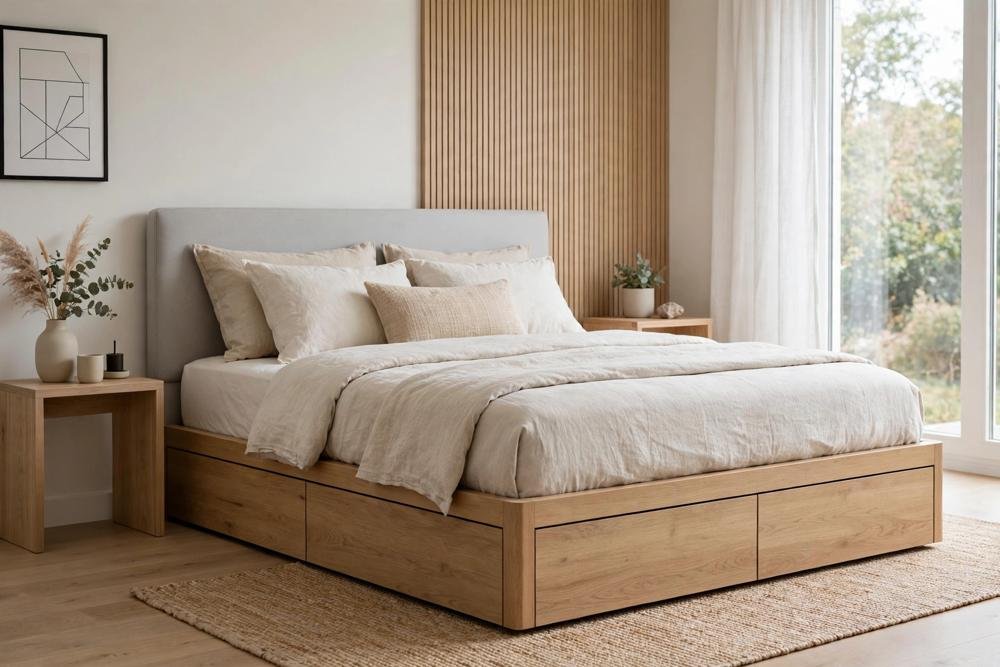
Built-in drawers are the neatest under-bed storage, because they look like furniture, not boxes. A bed frame with two or three drawers on each side gives you easy access, a clean front, and no dust on top of boxes. Drawers work best for clothes, bedding and shoes, because they slide out fully and you can see everything inside.
Check the drawer depth and the walkway before buying. A drawer that opens 50 centimetres needs 50 centimetres of clear floor in front of it, plus room to kneel or sit. If the bed is against a wall on one side, that side’s drawers will be hard to use. In that case, use drawers on the open side only, and use the wall side for long-term storage you reach rarely.
Lift-up beds, where the whole mattress lifts on gas struts, give you the most space, but they are best for large, light items, such as spare duvets, suitcases and seasonal clothes. They are not good for daily items, because lifting a mattress every day is a chore, and heavy items make the lift hard. Use a lift-up bed for seasonal rotation, and keep daily items in a wardrobe or drawer elsewhere.
If you already have a bed you like, you do not need to replace it. A bed frame with a skirt, a valance, or a fitted bed base cover can hide boxes and make them look intentional. Choose a cover in the same colour as the bedding, and keep it long enough to cover the boxes, but short enough to lift for access. A cover that drags on the floor will collect dust and trip you.
Idea 3: Label by Category, Not by Season Only

Labelling by season alone, such as winter and summer, is not enough, because you will forget what is in each box by the time the season changes. Label by category and season together, such as winter jumpers, spare bedding, shoes, and bags. One category per box, and no box with a label that says miscellaneous, because that box will become the place where everything goes to be forgotten.
Use a simple system: daily items stay out, weekly items stay in a wardrobe, monthly items go under the bed in the front row, seasonal items go under the bed in the back row or in a lift-up bed. Rotate seasonal boxes twice a year, in spring and autumn, and check each box as you rotate it. If you have not used something in a year, and it is not seasonal, it probably does not need to be under the bed.
Keep an inventory on your phone if you have more than four boxes. A simple list, such as box 1 winter jumpers, box 2 spare bedding, box 3 shoes, box 4 bags, will save you pulling out every box to find one thing. Update the list when you rotate, not when you remember later.
For shoes, use one pair per section, or a shoe box with a photo on the end, so you do not open every box to find one pair. For bedding, use vacuum bags only for spare duvets you use rarely, because vacuum bags need to be resealed and they can trap damp if the room is humid. For clothes, use breathable fabric boxes, not sealed plastic, unless the room is very dusty.
Idea 4: Raised Frames, Dust Control and Easy Access
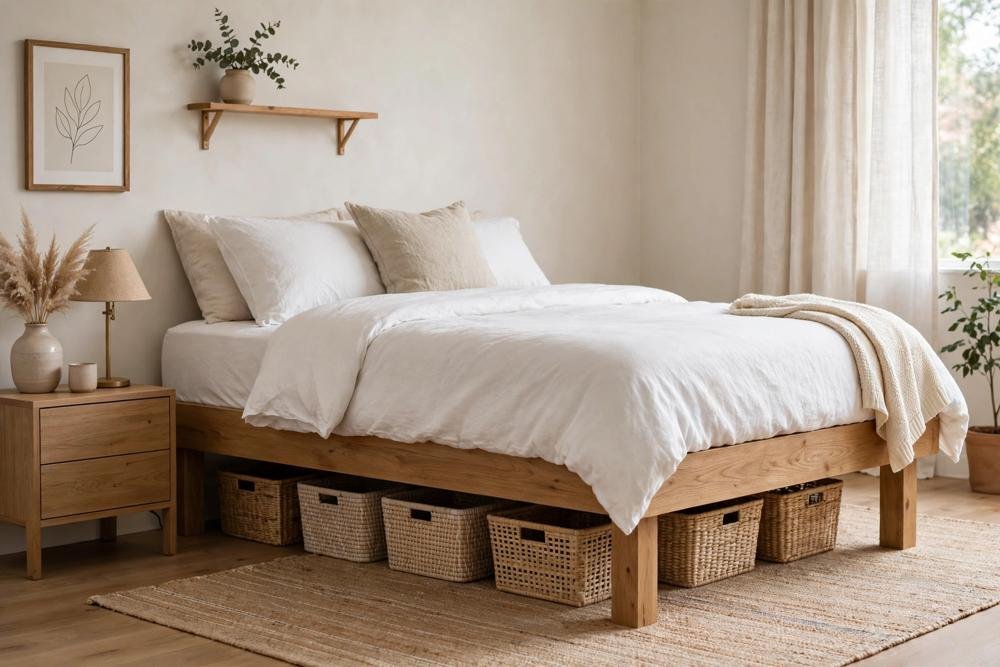
A raised frame, with legs 20 to 25 centimetres high, gives you usable under-bed space without a special bed. It also makes cleaning easier, because you can vacuum under the bed without moving it. Check that the frame is stable, the legs are level, and the mattress height still allows you to sit on the edge with feet flat on the floor. If the bed becomes too high, use a step or a lower mattress, not a wobbly riser.
Control dust with a simple routine: vacuum under the bed once a season, wipe boxes with a damp cloth when you rotate them, and use lids or covers on boxes that hold clothes or bedding. Do not use open baskets for clothes in a dusty room, because they will collect dust on the top layer. Use a bed skirt or cover if the room is very dusty, and wash it with the bedding.
Keep access easy. Leave a gap of at least 10 centimetres between the boxes and the wall, so you can grip a handle, and keep the rug from blocking the boxes. If the bed is against two walls, pull boxes out from the foot only, and use long, narrow boxes that slide out from the foot. Do not put heavy boxes under a bed you cannot reach, because you will not use them and they will become a dust trap.
Check for damp and pests once a season, especially in ground-floor rooms and older homes. If the floor feels damp, the boxes smell musty, or you see signs of pests, move the boxes out, clean the floor, and fix the damp source before putting boxes back. Do not store food, important papers, or anything that cannot get damp under a bed in a room with damp problems.
What to Keep Under the Bed, and What Not To
Keep under the bed: seasonal clothes, spare bedding, shoes, bags, suitcases, and hobby items you use monthly. Do not keep under the bed: daily clothes, daily shoes, food, important documents, electronics, batteries, candles, or anything flammable near a heater. Daily items belong in a wardrobe or drawer, because under-bed access is slower than a wardrobe door. Important papers belong in a dry, safe place, not under a bed where they can get damp or forgotten.
What to Avoid
Do not use mismatched boxes in different sizes and colours, because they will always look messy. Do not use deep boxes that need the bed moved, because you will stop using them. Do not stack boxes under a bed unless you can lift the top one easily. Do not store everything under the bed and leave the wardrobe empty, because the wardrobe is easier to use for daily items. Do not ignore dust and damp, because under-bed storage that is never cleaned will smell, even if it looks tidy.
FAQs
What is the best under-bed storage for a small bedroom?
Matching shallow boxes with handles, one category per box, in one row. Built-in drawers are neater if you are buying a new bed, but boxes work with a bed you already own.
How high should under-bed boxes be?
Measure your bed clearance first, then choose boxes 2 centimetres shorter than the clearance. Most beds suit boxes 12 to 18 centimetres high. Deep boxes over 25 centimetres are hard to pull out without moving the bed.
How do I keep under-bed storage from looking messy?
Use matching boxes, label the handle side, keep one row only, and use a bed skirt or cover in the same colour as the bedding. Keep the front row tidy and the back row for seasonal items only.
What should I not store under a bed?
Daily clothes and shoes, food, important documents, electronics, batteries and flammable items. Keep daily items in a wardrobe, and keep papers and electronics in a dry, safe place.
How often should I clean under the bed?
Vacuum once a season, wipe boxes when you rotate seasonal items twice a year, and check for damp or pests at the same time. You do not need to clean under the bed weekly if boxes have lids or covers.
Are lift-up beds worth it for under-bed storage?
For large, light seasonal items, yes, because they use the whole space. For daily items, no, because lifting a mattress every day is a chore. Use lift-up storage for spare duvets and seasonal clothes, and keep daily items elsewhere.
Conclusion
Under-bed storage does not have to look ugly, and it does not have to be hard to use. Use matching shallow boxes with handles, or built-in drawers if you are buying a new bed, label by category, keep daily items out, and clean once a season. Measure first, keep one row, and leave a clear way to pull each box out. Done that way, the space under the bed becomes useful storage that looks intentional, not a hiding place for things you forgot you owned.