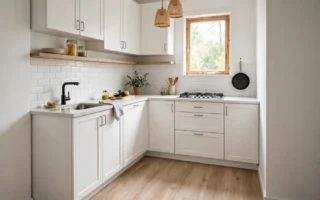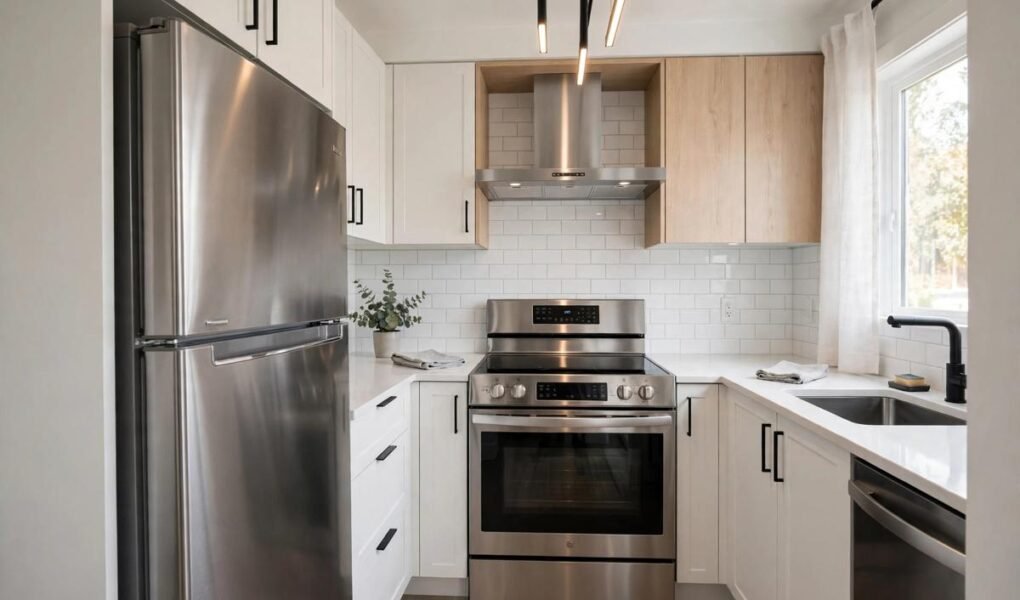
A small kitchen does not need fewer good meals. It needs smarter choices. The right kitchen appliances for small kitchens save counter space, reduce clutter, and still let you cook the food you love every day. The wrong ones crowd every surface, block your prep area, and end up stored in a cabinet you rarely open.
This guide will help you choose slim, multi use, and compact appliances that fit your space, your cooking style, and your budget. You will learn what to keep on the counter, what to store, what to skip, and how to measure before you buy.
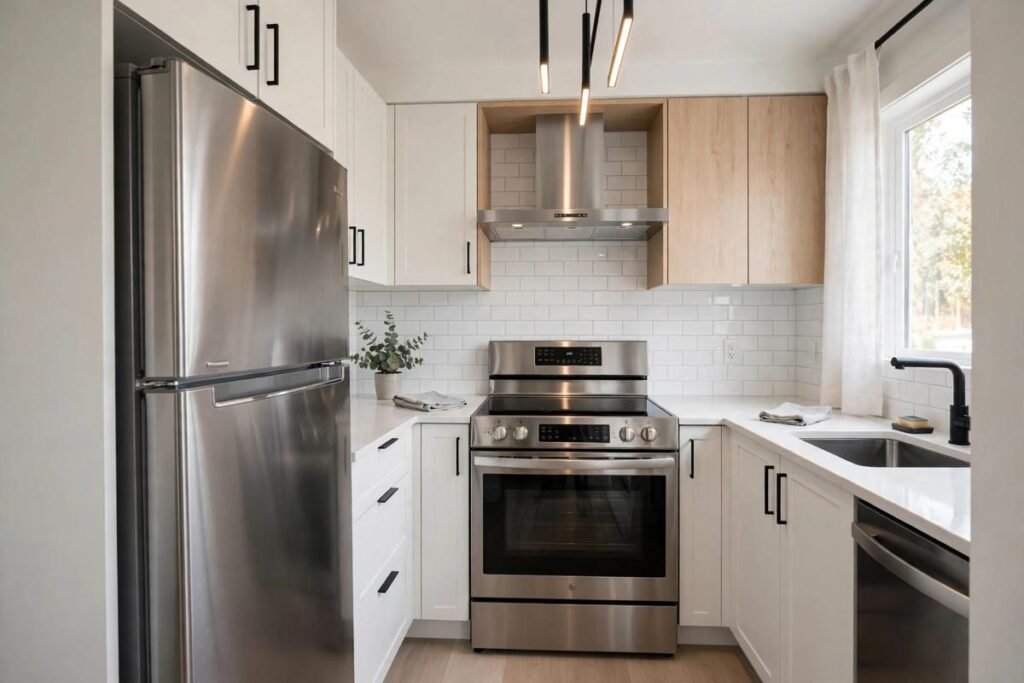
Idea 1: Go Slim and Compact First
Start with size, not features. In a small kitchen, every inch matters. Measure your counter depth, the height under your cabinets, and the width of the spot where the appliance will live. Leave room to open doors and lids, and leave a little breathing space for heat and steam.
Slim appliances are designed for this job. A slim toaster, a narrow coffee maker, or a compact kettle can do the same daily work as a bulky model without taking over the counter. Look for a small footprint, a cord that can be tucked away, and a shape that fits neatly against a wall or in a corner.
Think vertically as well. A tall, narrow appliance often uses less valuable counter space than a wide, low one. If you have a clear stretch of counter near an outlet, that is your prime real estate. Reserve it for the one or two appliances you use every morning, and move everything else off the counter.
Before you buy, tape out the footprint on your counter with masking tape. Live with that outline for a day. If it blocks your cutting board, your sink, or your stove, the appliance is too big, no matter how good it looks in the store.

Idea 2: Choose Multi Use Appliances
Multi use appliances are the best friends of a small kitchen. One appliance that bakes, air fries, roasts, and reheats can replace three separate machines. A good blender can also crush ice, make soups, and mix sauces. A multi cooker can pressure cook, slow cook, steam, and keep food warm.
The test is simple: will you use at least two of its functions every week? If yes, it earns its counter or cabinet space. If you will only use one function, a smaller, single-purpose tool may be better and easier to store.
Multi use does not mean complicated. Choose controls you understand at a glance, parts that are easy to clean, and a size that still fits your storage. A large multi cooker that never leaves the cabinet is not saving space, even if it replaces other tools in theory.
For many small kitchens, the winning combination is one multi use cooker or air fryer oven, one blender or food processor, and one kettle or coffee maker. Everything else can be stored, borrowed, or skipped.
Idea 3: Store Appliances by Frequency, Not by Size
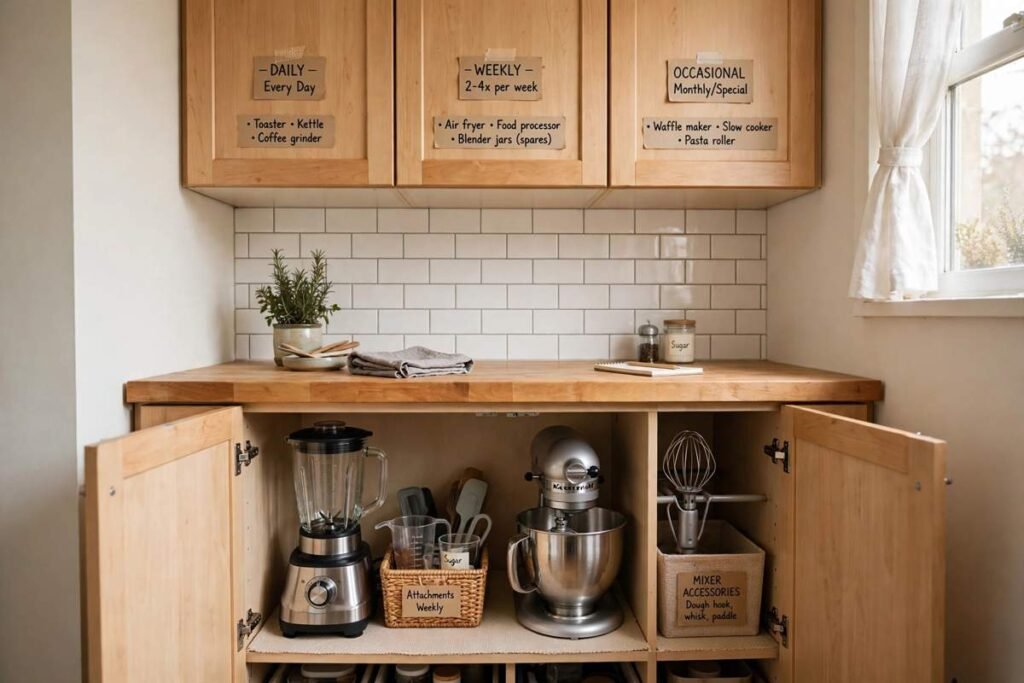
Storage by frequency is a simple rule that keeps a small kitchen calm. Daily appliances stay on the counter. Weekly appliances go in an easy-to-reach cabinet. Monthly or seasonal appliances go higher, deeper, or in another room if needed.
Your daily list should be short. For most people, it is coffee or tea, plus one cooking tool. Your weekly list might include a blender, a food processor, or a stand mixer. Anything you use less than once a month does not need prime cabinet space.
Use the cabinet closest to where you cook for weekly tools, and keep lids, attachments, and cords together so you are not hunting for parts. A small bin inside a cabinet can keep a blender base, jar, and lid as one unit. Label nothing fancy, just keep like with like.
If an appliance is hard to lift, hard to reach, or stored behind five other things, you will stop using it. That is a sign to move it, donate it, or replace it with a smaller version you can actually reach.

Idea 4: Keep Counters Clear and Only Essentials Out
Clear counters make a small kitchen feel larger, cleaner, and easier to cook in. The goal is not an empty kitchen. It is a kitchen where every item on the counter earns its place by being used daily and being hard to store.
Try the clear counter test. Remove everything from the counter, clean it, and then put back only what you used yesterday and will use again today. Live with that for a week. You will quickly see which appliances were just taking up space out of habit.
Use wall space, the inside of cabinet doors, and the top of the refrigerator only if it is safe and easy to reach. A hook for measuring tools or a small shelf for spices can free a surprising amount of counter space. Do not, however, move clutter from the counter to another visible surface. The aim is less visual noise, not relocated noise.
When you finish cooking, return weekly appliances to their cabinet home. This one habit, repeated daily, is what keeps a small kitchen feeling spacious over time.
Energy: Choose Efficient Sizes, Not Just Efficient Labels
Energy use in a small kitchen is closely linked to size. A smaller appliance that heats a smaller amount of food often uses less energy than a full-size oven for the same small meal. An air fryer, a toaster oven, or a multi cooker can be more efficient for one or two servings than heating a large oven.
Look for clear energy information, a timer, and an automatic shut-off. Those features prevent wasted heat and give you peace of mind. Also check standby power. Unplug appliances you do not use daily, or use a switched outlet strip so they are truly off.
Do not buy a larger capacity than you need in the hope of future use. A right-sized appliance cooks faster, cleans faster, and stores more easily. Efficiency starts with fit.
Cooking Style: Match Appliances to How You Really Cook
Your cooking style should decide your appliance list. If you make smoothies and soups often, a strong blender matters more than a specialty baker. If you roast vegetables and reheat leftovers, a good air fryer oven or toaster oven will be used daily. If you batch cook, a multi cooker may be your most valuable tool.
Write down what you cooked in the last two weeks. Circle the meals you make most often, then match one appliance to each pattern. This list is far more useful than a generic must-have list, because it reflects your real life, not an ideal kitchen.
Also consider who cooks, and when. A simple, one-button appliance may be best for busy mornings, while a more flexible tool can be saved for weekend cooking. Ease of cleaning matters too. An appliance that is hard to clean will be used less, however well it cooks.
Installation: Measure, Power, and Ventilation
Installation starts before delivery. Measure doorways, cabinet openings, counter height, and the distance to the nearest outlet. Check that cords reach safely without crossing the sink or stove, and that you are not overloading one outlet with several high-power appliances at once.
Ventilation matters for ovens, air fryers, and cookers that release steam. Leave the clearance recommended by the maker, and do not push an appliance tight against a wall if it needs airflow. If you plan a built-in appliance, confirm the exact cut-out size and allow access for cleaning and service.
For countertop appliances, a stable, heat-safe surface is essential. Avoid placing heat-producing appliances directly under low cabinets without clearance, and keep them away from curtains, paper towels, and other flammable items.
What to Avoid in a Small Kitchen
Avoid single-use appliances that duplicate a tool you already own. Avoid oversized models that force you to move other items every time you cook. Avoid buying a set just because it matches, if you will only use half of it.
Be careful with appliances that need special parts, hard-to-find filters, or complex cleaning. In a small kitchen, maintenance time is also space and energy. Simpler tools that you can clean in minutes will serve you better in the long run.
Finally, avoid impulse buys during sales. A bargain that crowds your counter for a year is not a bargain. Wait, measure, and buy only when an appliance solves a real, repeated problem in your cooking routine.
FAQs
What is the best appliance for a very small kitchen?
A multi use air fryer oven or multi cooker is often the best first choice, because it replaces several single-use tools. Pair it with a kettle or coffee maker you use daily, and keep the rest stored by frequency.
How many appliances should stay on the counter?
For most small kitchens, one to three daily appliances is a good limit. If an appliance is not used daily, store it in an easy-to-reach cabinet so your prep space stays clear.
Are compact appliances less powerful?
Not necessarily. Many compact models are designed for one or two servings and heat food quickly. Check capacity and power for your household size, rather than assuming bigger is always better.
Should I choose an air fryer or a toaster oven?
An air fryer oven that also toasts, bakes, and reheats can cover both jobs in one footprint. Choose the model that fits your counter height and the foods you cook most often.
How do I store appliances I rarely use?
Store them high or deep, with cords and attachments together, and in a place you can reach without moving daily tools. If you have not used an appliance in six months, consider donating it.
What size should I buy for a small kitchen?
Measure your counter, cabinet, and outlet space first, then buy the smallest size that comfortably cooks for your household. Leave clearance for lids, doors, steam, and heat.
Conclusion
The best kitchen appliances for small kitchens are slim where it counts, multi use where it helps, and stored by how often you really use them. Start with measurement, choose for your cooking style, keep only daily essentials on the counter, and skip anything that duplicates a tool you already love.
For more small kitchen ideas, see our guides on kitchen storage for small kitchens without a pantry, best kitchen countertops for small kitchens on a budget, kitchen lighting ideas under cabinet, and kitchen hardware handles and knobs. Together, these choices will help your small kitchen feel larger, work harder, and stay easy to enjoy every day.