Introduction
Most kitchen makeovers start at counter height and stop there, which is why so many kitchens still feel flat even after new cabinets or a new backsplash. The ceiling and the walls are the largest surfaces in the room, and they are the surfaces you see first when you walk in. A plain white ceiling and a bare wall above the cabinets make a kitchen feel unfinished, while a little intentional decor up high makes the whole room feel taller, warmer, and more complete.
This guide focuses on the gap most kitchen decor guides skip: ceiling and wall ideas that work without a full remodel, without moving plumbing, and without hiring a contractor for weeks. You will find ideas for low ceilings and high ceilings, for renters and owners, and for small kitchens where every inch of wall has to earn its place. The goal is not to fill every surface. It is to choose one or two strong moves up high, and let the rest of the kitchen breathe.
Start by looking up. Is your ceiling flat and low, or high with awkward empty wall above the cabinets? Is there a beam, a vent, or a slope you have been trying to hide? Those answers decide which idea below will help most, and which ones to skip.
Idea 1: Paint the ceiling a colour, not just white
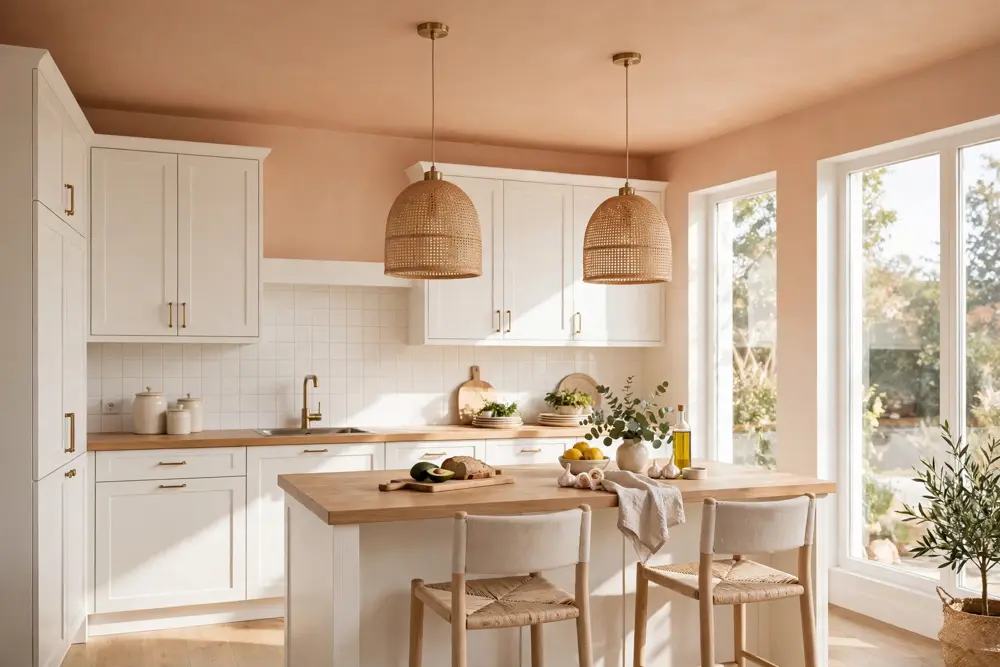
A painted ceiling is the fastest way to change a kitchen, and it costs little more than a tin of paint and a weekend. White is safe, but it is also the reason many kitchens feel cold. A soft warm white, a pale sage, a dusty blue, or a warm greige on the ceiling adds depth without making the room dark, as long as the walls stay lighter or the cabinets stay pale.
The trick is contrast and finish. In a small kitchen, paint the ceiling one shade deeper than the walls, in a matte or eggshell finish, so it reads as intentional rather than dirty. In a kitchen with white cabinets, a ceiling in a warm neutral makes the cabinets look brighter by comparison. Avoid glossy paint on a ceiling, because it shows every bump and roller mark, especially under kitchen downlights.
Test the colour at night as well as in daylight. Kitchen lighting is often cool white, and a warm ceiling colour can look muddy under cool light. Paint a large test patch, live with it for two evenings, and only then commit. If you are renting, use a colour you can paint back over in one coat, and keep the original paint name for move out day.
Idea 2: Add faux beams, planks, or a wood ceiling accent
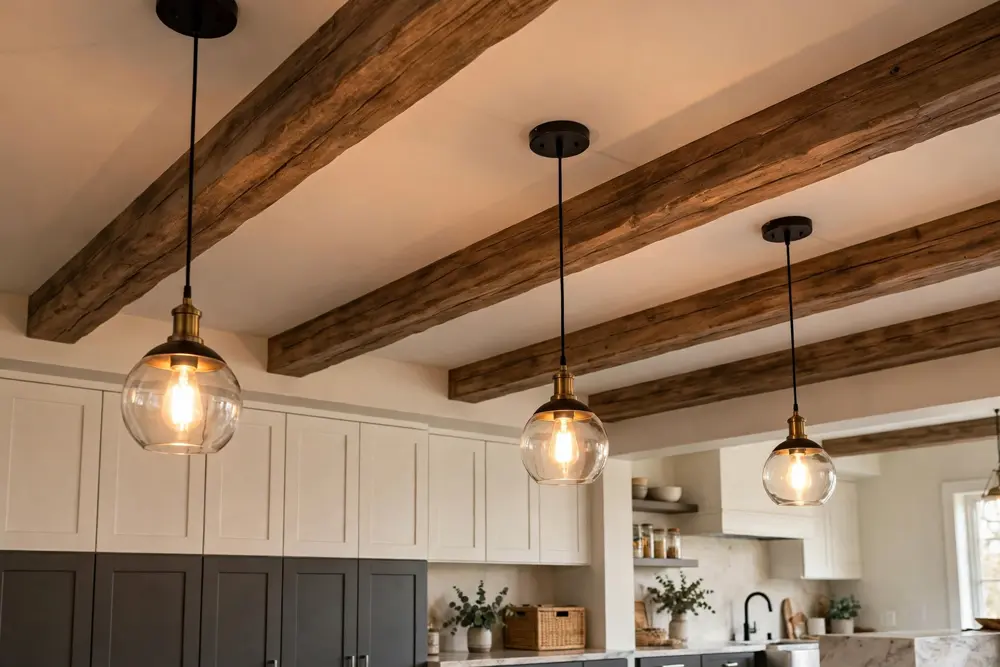
Faux beams are the ceiling idea most people assume is expensive, but lightweight foam or hollow wood beams are made for exactly this job. They add warmth and structure to a flat ceiling, they hide a crack or a join, and they give pendant lights something to hang from visually. In a modern kitchen, use slim, straight beams in a pale wood or painted finish. In a farmhouse or rustic kitchen, use wider beams with a rougher texture.
You do not need to beam the whole ceiling. Three beams across a main kitchen area, spaced evenly, are usually enough. Too many beams in a low kitchen will make the ceiling feel lower, so keep the beam depth shallow, about four to six inches, if your ceiling is under nine feet. Planks are another option: tongue and groove boards on a ceiling, painted white or left in pale wood, add texture without the weight of beams, and they work well in a kitchen with a pitched or sloped ceiling.
Measure first, and mark the joists. Even lightweight beams need solid fixings, and a beam that sags in the middle will ruin the effect. If you are not confident with a drill and a level, this is the one idea in this guide worth paying a handyman for a half day.
Idea 3: Panel one wall, not every wall
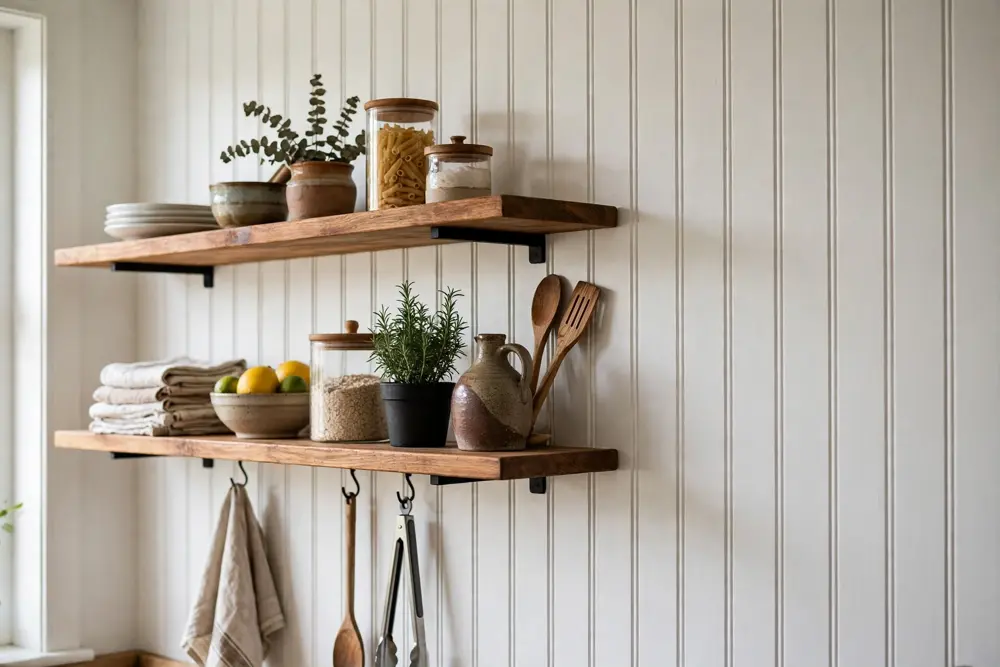
Wall paneling works in a kitchen when it is used on one wall, not wrapped around the whole room. Beadboard, vertical shiplap, or simple picture frame moulding on the wall opposite the main work area, or on the wall behind a dining table, adds character without competing with cabinets, tiles, and appliances. Paint it the same colour as the cabinets for a calm look, or one shade deeper for a feature wall that still feels like part of the kitchen.
Beadboard is especially useful in a kitchen because it is easy to wipe clean, and it covers a wall that has dents, old tile adhesive, or uneven plaster. Use moisture resistant board near a sink or a cooker, and seal the edges well so steam does not get behind it. In a small kitchen, vertical panels draw the eye up and make the wall feel taller, while horizontal panels make a narrow kitchen feel wider. Choose the direction that fixes your room’s problem.
Keep the rest of the walls simple once you have panelled one. If you add paneling, busy wallpaper, and a gallery wall all at once, the kitchen will feel cluttered. One textured wall, plain paint elsewhere, and a few well chosen items on the panelled wall is the balance that works.
Idea 4: Use art, plates, and open shelves as wall decor that works
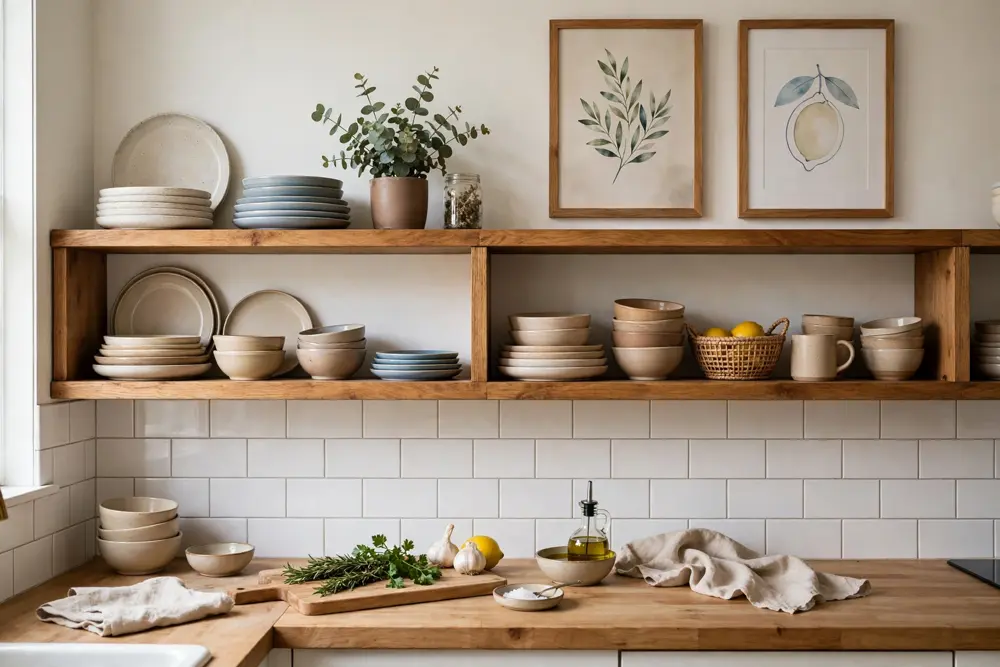
Kitchen wall decor should earn its place, especially in a small kitchen. Open shelves with everyday plates, bowls, and a few plants look good and save cupboard space, but only if you actually use what is on them. Dusty, unused shelves quickly look like clutter. Keep open shelves to one or two runs, style them with repetition, for example white plates together, wood boards together, and leave breathing space between groups.
A plate wall is a classic kitchen idea that still works, because plates are flat, light, and easy to hang with plate hangers. Use a single colour family, or a single pattern, rather than a random mix, and lay the arrangement on the floor first. Framed art belongs in a kitchen too, but choose prints that can handle steam and splashes, hang them away from the cooker, and use glass or acrylic covers that wipe clean. Food prints, botanical prints, and simple line art suit a kitchen better than heavy oil paintings.
The rule for all of these is height. Hang art and shelves at eye level when standing, not so high that you need to stretch to see them, and not so low that they block a backsplash or a work surface. In a kitchen, wall decor that sits just above a counter or a sideboard feels connected to the room. Decor floating high on an empty wall feels lost.
Choosing by ceiling height
Low ceilings, under eight feet, need light colours, shallow beams, and vertical lines. Avoid dark ceilings, deep beams, and heavy chandeliers that hang low over a walkway. Flush mount lights, slim pendants over an island only, and vertical paneling will help more than any bold colour.
Standard ceilings, eight to nine feet, can take most ideas in this guide. A painted ceiling, a few beams, and one panelled wall all work, as long as you do not use all three at full strength at once. Pick one hero, and keep the other two subtle.
High ceilings, over nine feet, or a wall of empty space above cabinets, need something to break the height. This is where beams, a wood plank ceiling, or a tall piece of art above the cabinets actually helps. Without it, a high kitchen can feel like a hall. A long, horizontal piece of art, a row of baskets, or a shelf with plants above the cabinets fills that gap without adding clutter at work height.
Lighting that makes ceiling and wall decor work
Ceiling and wall decor only looks good if the lighting shows it. A painted ceiling under a single harsh downlight can look patchy, while the same ceiling under warm, dimmable lights looks rich. If you add beams, add a light that washes across them, not just a light that shines straight down. If you panel a wall, a small picture light or a warm LED strip above the panel will make the texture show in the evening.
Avoid mixing colour temperatures in one kitchen. If your main lights are warm white, keep decorative lights warm white too. Cool white spotlights on a warm wood ceiling will make the wood look grey. Test at night, because most kitchens are used most in the evening, and that is when ceiling and wall decor either glows or disappears.
Small kitchens and renter friendly ceiling and wall ideas
Small kitchens benefit most from ceiling and wall decor, because there is less floor space to decorate. A painted ceiling, removable wallpaper on one wall, adhesive picture ledges, and lightweight art hung with adhesive hooks can transform a rental kitchen without drilling. Removable wallpaper on a ceiling is harder than on a wall, so in a rental, paint is usually safer than paper up high, as long as you check your lease and keep the original colour.
For renters, focus on walls, not ceilings, if you are unsure. A removable panel effect can be made with lightweight foam boards painted to look like beadboard, hung with adhesive strips, and removed without damage. Open shelves need fixings, so in a rental, use a freestanding shelf unit against a wall instead, and style the wall above it with light art on adhesive hooks.
Budget also matters here. Paint is the cheapest ceiling idea, followed by adhesive wall decor and a plate wall using plates you already own. Faux beams and real paneling cost more, but they also last longer and add the most value if you own the home. Start with paint, live with it for a month, and only then spend on beams or paneling.
What to avoid
- Painting a ceiling dark in a low kitchen, which makes the room feel lower and smaller
- Adding deep beams to a ceiling under eight feet, which eats headroom visually and physically
- Paneling every wall, which competes with cabinets and tiles and makes a small kitchen feel busy
- Hanging art or shelves so high they cannot be seen properly, or so low they block work surfaces
- Mixing warm and cool white lights on the same ceiling, which makes wood and paint colours look wrong
- Using non moisture resistant board near a sink or cooker, which warps and peels with steam
- Filling every empty wall, which leaves no breathing space and makes the kitchen feel cluttered
Frequently asked questions
Should a kitchen ceiling be white?
White is safe and bright, but it is not the only choice. A soft warm white, pale sage, or light greige ceiling can add warmth without darkening the room, as long as the finish is matte and the walls stay light. Test at night before committing.
Do faux beams make a low ceiling feel lower?
They can, if they are too deep or too many. In a low kitchen, use shallow beams, four to six inches deep, spaced evenly, and keep them in a light colour. Three beams are usually enough, and they should run across the shorter direction of the room.
Is wall paneling practical in a kitchen?
Yes, on one wall, with moisture resistant board and sealed edges. Beadboard and vertical shiplap wipe clean and cover damaged walls well. Avoid raw MDF near a sink or cooker, and keep paneling away from direct splash zones unless it is sealed.
Can renters decorate a kitchen ceiling and walls without damage?
Yes, with paint you can repaint, removable wallpaper on one wall, adhesive hooks and picture ledges, and freestanding shelf units. Avoid drilling into ceilings in a rental, and always check your lease and keep the original paint colour for move out.
How high should kitchen wall art and shelves be?
At eye level when standing, usually with the centre of the art about 145 to 155 centimetres from the floor, and shelves just above a counter or sideboard, not floating high on an empty wall. In a kitchen, decor should connect to the furniture below it.
What is the cheapest kitchen ceiling decor idea?
Paint. One tin of ceiling paint, a roller, and a weekend can change the whole room for less than most other kitchen upgrades. A plate wall using plates you already own, and adhesive wall decor, are the next cheapest options.
Conclusion
Ceiling and wall decor is not about filling a kitchen, it is about finishing it. Paint the ceiling a soft colour, add a few shallow beams or a plank accent if your ceiling can take them, panel one wall instead of every wall, and use shelves, plates, and art that actually work in a kitchen. Choose by your ceiling height, light it warmly, and leave breathing space.
Start with the cheapest move, paint, and live with it for a few weeks. You will quickly see whether your kitchen needs warmth, texture, or height, and your next step, whether it is beams, paneling, or a simple plate wall, will be an easy one. A kitchen that looks good from the floor up, not just from the counter down, feels like a room that was designed, not just fitted.