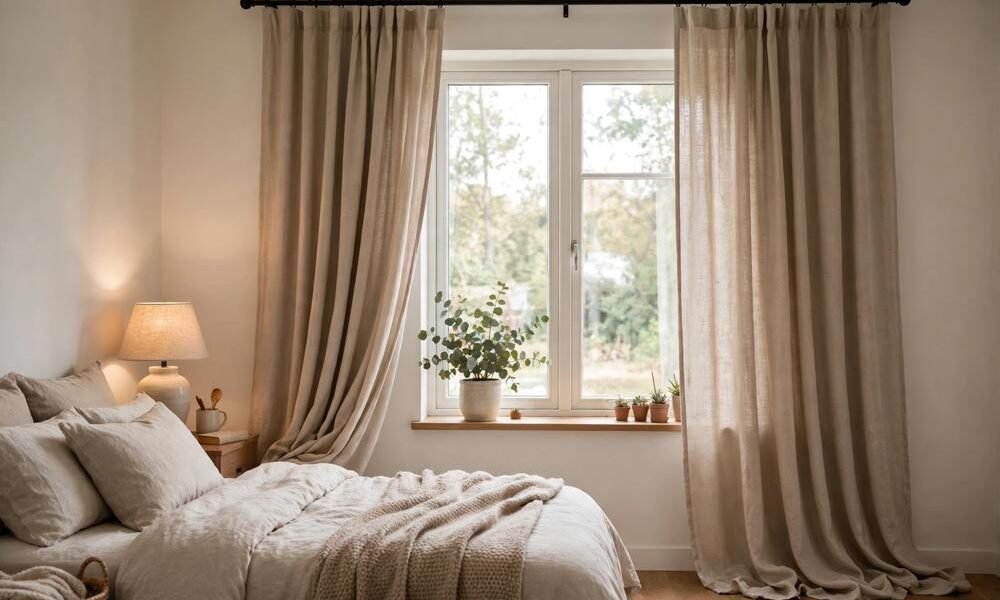
Introduction
Curtains do more than finish a bedroom. They control light, protect privacy, soften sound, and help your body understand when it is time to sleep. Yet many bedrooms fail at the simplest part: the curtains are hung too low, too narrow, or too short, so light leaks in around the edges and the room never feels truly dark or private.
This guide fixes that problem with measurements you can use today. You will learn how high and how wide to hang the rod, how to layer sheer and blackout curtains, how to seal the light gaps that wake you early, and how to adapt the same system for a small bedroom or a rental where drilling is not allowed.
It is a bedroom that feels calm during the day and dark, quiet, and private at night, without buying a new window or changing your whole room.
Key takeaways
- Hang the rod high and wide, so the window looks bigger and light stays out.
- Layer sheer curtains behind blackout curtains for day privacy and night darkness.
- Seal the light leaks that wake you early, around edges and gaps.
- Adapt the system for a small bedroom or a rental, without drilling if needed.
Idea 1: Hang the Rod High and Wide
The most common curtain mistake is hanging the rod just above the window frame. That makes the window look smaller, cuts off light during the day, and leaves the curtains bunched in the middle of the glass at night.
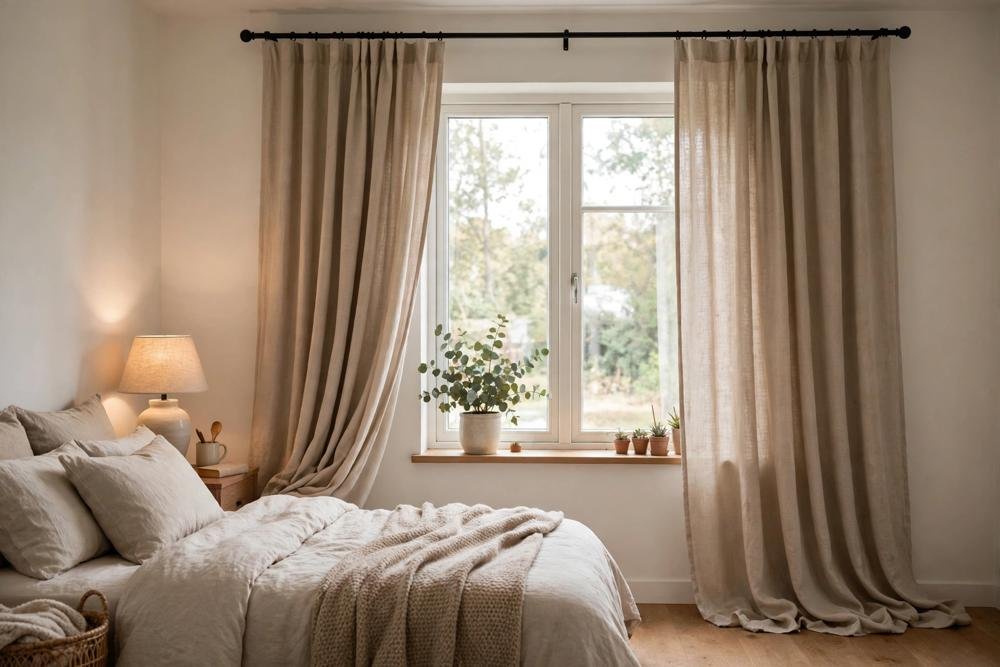
Instead, hang the rod high and wide. A good starting point is to place the rod 4 to 6 inches above the window frame, or close to the ceiling if you have at least a few inches of wall above the frame. This draws the eye upward, makes the ceiling feel higher, and gives the curtain room to fall in a clean line.
Width matters just as much. Extend the rod 8 to 12 inches beyond the frame on each side. That extra width lets you pull the panels fully clear of the glass during the day, so you get full daylight and a clear view. At night, the same width gives the fabric room to overlap the wall, which helps block light at the sides.
Before you drill or mount anything, measure three times: the width of the window frame, the distance from the floor to your planned rod height, and the distance from the rod to the floor for panel length. Panels should just kiss the floor or break very slightly on it. Panels that stop several inches short look unfinished and let light spill underneath, while panels that pool heavily on the floor collect dust and can be a trip hazard.
Idea 2: Layer Sheer Curtains Behind Blackout Curtains
One curtain layer cannot do two opposite jobs well. Sheers give privacy during the day while letting light in. Blackouts give darkness at night. Together, they give you control in every season and at every hour.
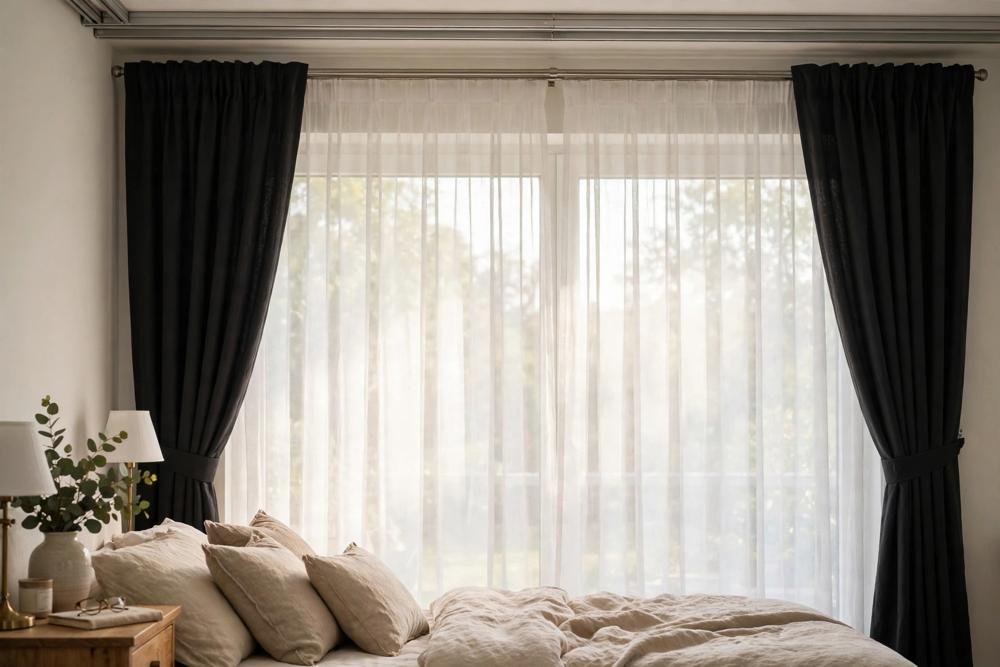
The best setup is a double track or a double rod. Hang the sheer layer closest to the glass and the blackout layer closest to the room. During the day, close the sheers and open the blackouts. You keep privacy from the street without living in darkness. At night, close the blackouts over the sheers for full darkness.
If a double track feels too heavy for a small room, a blind plus a curtain can work just as well. Use a slim roller blind or a light filtering blind for daytime privacy, then add one blackout panel on each side for night. This is often cheaper and easier to clean, and it keeps the window from looking bulky.
Choose sheer fabric that is light but not see through from outside during the day. Hold a sample up to the window in daylight and step outside if you can. A good sheer blurs shapes without making the room gloomy. For blackouts, look for a dense weave or a lined panel rather than a thin printed fabric that claims to be blackout but still glows when a streetlight hits it.
Idea 3: Seal the Light Leaks That Wake You Early
Even good blackout curtains can fail if light sneaks around them. The most common leaks are at the top, the sides, and the bottom, and each one needs a slightly different fix.

Start with the top gap. If the rod sits too far from the wall, light pours over the top of the curtain. A rod that sits closer to the wall, a simple cornice or pelmet, or a curtain that extends well above the frame can close this gap. You do not need a built in box. Even a shallow fabric valance can help, as long as it does not trap heat or block the curtain from moving.
Next, check the sides. Panels should overlap the wall by several inches when closed, not just meet in the middle. If your panels are too narrow, they will pull apart or leave a glowing stripe at each edge. Wider panels, or a second panel on each side, solve this better than constantly tugging the fabric closed.
The bottom gap is often caused by panels that are too short. Measure from the rod, not from the frame, and allow for the rings or hooks. If your floor is uneven, measure at both ends of the window. A panel that brushes the floor at one end and floats at the other will always leak light on the short side.
Many blackout sets block only part of the light, especially if they are unlined or made from a thin fabric. If you can see the shape of a streetlight through the fabric at night, add a separate blackout liner behind your chosen curtain. Liners are usually cheaper than replacing the whole set, and they also help with insulation and sound softening. Not sure which option to buy? Compare blackout curtains versus blackout liners for bedrooms.
Idea 4: Adapt the System for a Small Bedroom or a Rental
Small bedrooms and rental bedrooms need the same darkness and privacy, but they cannot always use the same hardware. The trick is to keep the principles and change the method. For the full room plan, see Small Bedroom Ideas: The Complete Guide to Layout, Storage, Light and Style.
In a small bedroom, keep the fabric light and close to your wall colour. Heavy, dark, patterned curtains can chop a small wall into pieces and make the room feel crowded. A light curtain that blends with the wall keeps the eye moving across the room. If you want pattern, use it on bedding or a throw instead, where it is easier to change.

Use a single wide panel on each side rather than several narrow panels. Fewer panels mean fewer gaps and a cleaner look. If space is very tight, a roller blind with a side curtain panel can give you darkness without taking up wall space for a full double track.
For rentals, tension rods are useful, but they have limits. They work best for lightweight sheers and light blackout panels in a standard window recess. They are not a good choice for heavy lined curtains, wide windows, or damp frames where the rod can slip. Always test a tension rod with the full weight of your curtains before you rely on it overnight.
If drilling is allowed with a small repair on move out, wall anchors in a stud or a proper wall plug will hold far better than a nail or a screw in bare plasterboard. If drilling is not allowed at all, focus on the blind plus light curtain combination, and use a door draft stopper and an eye mask as a backup for the last traces of light.
Measuring Your Window the Right Way
Good measurements prevent most curtain problems. Start by measuring the window frame width, then add 16 to 24 inches in total for rod extension, 8 to 12 inches on each side. That total is your rod length, not the window width.
Next, measure from your planned rod height to the floor. Write this number down and take it shopping with you. Curtain panels are often sold in standard lengths, so knowing your exact drop helps you choose between a panel that just touches the floor and one that needs hemming. Or plug your numbers into our curtain calculator for the right panel width and drop.
Also measure the depth of any window sill, handle, or radiator below the window. A curtain that catches on a radiator every time you close it will wear out quickly and will never sit straight. In that case, a panel that ends just below the sill, paired with a blind for darkness, may be more practical than a floor length panel.
Choosing Fabric for Sleep, Privacy, and Easy Care
Fabric choice affects sleep more than most people expect. A stiff, shiny blackout can look perfect in a photo but rustle every time you move it, while a soft cotton or linen blend moves quietly and feels better in a bedroom.
For sleep, choose a blackout layer with a tight weave and, if possible, a lining. For privacy, choose a sheer that softens the view without turning the room dark. For easy care, check the washing label before you buy. Curtains that must be dry cleaned will stay dirty longer in a real bedroom, while machine washable panels are far more likely to be cleaned regularly.
A Daytime and Nighttime Routine That Actually Works
Curtains work best when they are part of a simple routine. In the morning, open the blackouts fully and leave the sheers closed if you want privacy while you get dressed. This gives you daylight without exposing the room to the street.
During the day, use the sheers to soften harsh sun and reduce glare on a desk or a television. If the room gets too warm, close the blackouts on the sunniest window for an hour or two, then open them again once the sun moves.
In the evening, close the blackouts at least an hour before bed. This signals to your body that night is coming, and it gives you time to notice any light leaks while you can still fix them. Use a warm bedside lamp instead of a bright ceiling light, and keep screens dim in the last hour before sleep if you can.
What to Avoid
Avoid hanging curtains only as wide as the window frame. This is the fastest way to lose light control and make a window look small.
Avoid panels that stop well above the floor unless you have a radiator or a piece of furniture that makes floor length impractical. Short panels usually look unfinished and leak light underneath.
Avoid choosing blackout curtains by colour alone. A thin dark fabric can let through more light than a thick light fabric with a proper lining. Always check the weave, the lining, and, if possible, a sample against a bright light.
Avoid overloading a tension rod or an adhesive hook with heavy lined curtains. A curtain that falls in the night is not just annoying. It can damage paint, break a rod, and leave you without darkness when you need it most.
Avoid blocking a radiator, a vent, or a fire escape route with heavy floor length curtains. Safety and airflow matter more than a perfect look, and a shorter panel or a blind is a better choice in those spots.
FAQs
How high should I hang bedroom curtains?
Hang the rod 4 to 6 inches above the window frame, or close to the ceiling if there is enough wall above the frame. Keep the height consistent across the room, and measure panel length from the rod to the floor, not from the frame.
Should bedroom curtains be sheer, blackout, or both?
Both is usually best. Use sheer curtains behind blackout curtains on a double track or double rod. Sheers give daytime privacy and soft light, while blackouts give darkness and extra privacy at night. A blind plus a blackout panel is a good alternative in a small room.
How do I stop light leaking around blackout curtains?
Overlap the panels well beyond the window frame on both sides, close the top gap with a rod that sits close to the wall or a simple pelmet, and make sure panels reach the floor. Add a blackout liner if light still shows through the fabric, and check door gaps and standby lights as well.
Can I hang blackout curtains in a rental without drilling?
Yes, in many cases. Lightweight blackout panels on a tension rod work in a standard window recess, and removable brackets or adhesive hooks can help if they are rated for the weight. Test one fixing in a hidden spot first, photograph the wall before installation, and keep heavy lined curtains off tension rods.
What size curtains do I need for a bedroom window?
Add 8 to 12 inches on each side of the window frame for the rod, and measure from the rod to the floor for length. Wider panels are better than narrow ones because they overlap the wall and block side light. If you are unsure between two lengths, choose the longer panel and hem it if needed.
Do blackout curtains help with sleep?
They can help by making the room darker, which supports your natural sleep routine, especially if you are sensitive to early morning light or streetlights. They work best as part of a full routine: close them before bed, use warm light in the evening, and reduce other light sources in the room. Shift workers and light sleepers can go further with our guide on how to make a bedroom dark and quiet for shift work and light sleepers.
Conclusion
Hanging bedroom curtains well is less about decoration and more about control. Hang the rod high and wide, layer sheer behind blackout, seal the gaps at the top, sides, and bottom, and adapt the hardware to your room size and rental rules.
Start with measurements, choose fabric for sleep and easy care, and test the room in darkness before you call the job done. A few inches of extra width and a properly layered setup can turn a bright, exposed bedroom into a private, restful space that helps you sleep better every night.