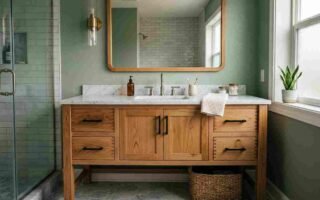
Forest lighting is not about brightness, but about warmth, layers and safety. In a forest, light filters through leaves, pools in clearings and fades softly at dusk, and a room should feel the same. Use warm white light, in layers, from lamps rather than one bright ceiling light, make the most of daylight, and keep every light safe near fabric, plants and dried decor. Done that way, a green room will glow in the evening instead of looking cold, flat or staged.
Key takeaways
- Warm white light suits forest rooms best, because cool white makes deep green look cold and grey.
- Layer light from floor lamps, table lamps and small accents, rather than relying on one overhead light.
- Daylight is the first layer: cream walls, mirrors and light curtains will make any forest room brighter.
- LED and low-heat bulbs are the safe choice near curtains, throws, plants and dried material.
- String lights and fairy lights can be beautiful, but only with rated fixtures, safe placement and no open flame near them.
- One mushroom lamp or wooden lamp is a good forest accent, but it should not be the only light in a room.
- Kitchens and bathrooms need rated, task-appropriate lighting, not decorative lights alone.
- Keep every room bright enough to read, cook and move safely, even when the mood is soft.
1. The Forest Lighting Principle: Warm, Layered and Low
A forest room needs three kinds of light, working together. Ambient light is the general glow that lets you move around safely, usually from a ceiling light on a dimmer or from a floor lamp. Task light is the brighter light where you read, cook or work, usually from a table lamp, a reading lamp or under-cabinet lights. Accent light is the small glow that makes a room feel special, such as a mushroom lamp on a shelf, a paper lantern in a corner or a warm light behind a plant.
One bright overhead light cannot do all three jobs. It will flatten green, make wood look harsh, cast hard shadows and make plants look tired. Layered warm light, by contrast, will make the same room feel sheltered, because pools of warm light invite sitting, reading and talking, while darker corners give the room depth. A dimmer helps, where it can be fitted safely, because forest light in the evening should be low and warm, like light through trees at dusk. If a dimmer cannot be fitted, a lower-wattage warm bulb in a table lamp will give a similar effect.
Colour temperature matters more than brightness. Warm white bulbs, which give a soft yellow-white glow, make deep green look rich and wood look warm. Cool white bulbs, which give a bluish-white glow, can make deep green look cold and grey, and can make a cosy room feel like an office. Check the bulb packaging for warm white, and use the same warm tone across lamps in one room, so the light does not mix warm and cool in a way that feels uneven.
2. Daylight First: The Light You Already Have
Daylight is the cheapest and most honest forest light, and it should be planned before buying any lamp. A forest room needs daylight to stay calm, because deep green in a dark room can quickly feel heavy. Keep windows clear, choose linen or cotton curtains in cream or sage, and hang them high and wide so they frame the window rather than covering it. Heavy, dark curtains will block the very light a forest room needs, and will undo much of the work of a pale base and light rug.
Mirrors are the next best tool. A mirror opposite a window will bounce daylight back into the room, while a mirror on a side wall will make a small room feel wider. A leaning mirror, a round mirror above a side table or a mirror in a wooden frame will all work, as long as the mirror reflects light, not a dark corner. Light walls, light rugs and pale wood furniture will also help, because they reflect daylight rather than absorbing it.
In a north-facing room, a small room or a room with one window, daylight planning matters even more. Keep walls cream, choose sage or mid-green rather than very dark green, use furniture with visible legs so light can move underneath, and place a reading chair and a lamp near the window, where daylight is strongest during the day. In the evening, the same chair can be lit by a warm table lamp, so the room works in both lights.
3. Lamps: Floor, Table and Reading Light
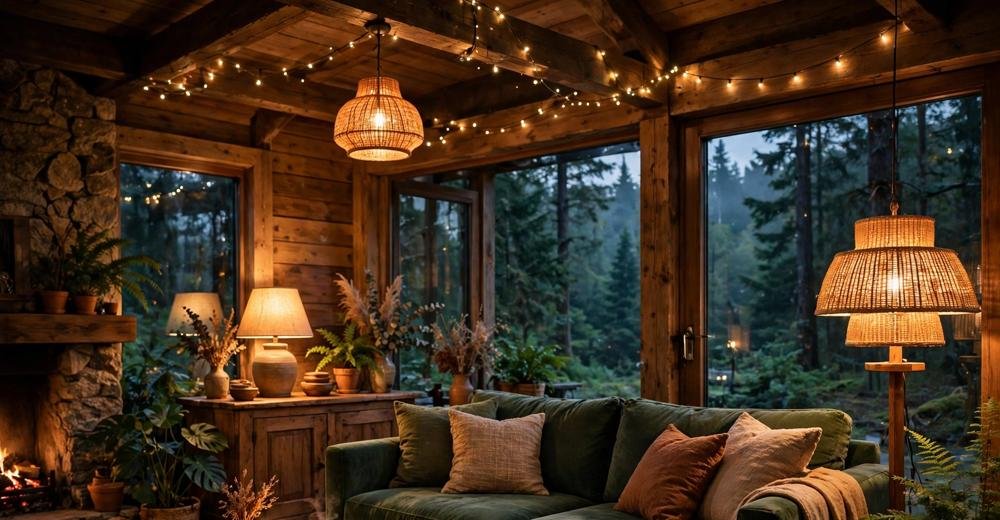
Floor lamps and table lamps are the workhorses of forest lighting, and they should be chosen for warmth, placement and safety, not just for looks. A floor lamp behind a reading chair, a table lamp on a side table and a warm lamp on a shelf will create pools of light that invite sitting. Place lamps where people sit and read, not just where a ceiling fitting happens to be, and make sure each seat has a lamp within reach, so no one has to sit in shadow.
Lamp shades matter. A linen, cotton or paper shade will soften light and give a warm glow, while a metal or glass shade can give a harder, more focused light. A wooden lamp base, a rattan shade or a ceramic base in a natural tone will suit a forest room better than a shiny, modern base, but the shade should still be rated for the bulb used, and fabric shades should be kept away from bulbs that run hot. LED bulbs, which run cooler, are the safer choice for fabric shades, paper lanterns and wooden lamps.
Reading light needs to be bright enough, even in a cosy room. A reading lamp should give a clear, warm pool of light on the book or the work, without glare in the eyes. An adjustable arm, a shade that directs light downwards, or a lamp that can be moved closer to the chair will all help. If a room feels too dark to read in, add a task lamp, rather than turning up every light in the room, because a bright task light in a soft room feels more forest-like than a uniformly bright room.
4. String Lights, Fairy Lights and Dappled Light
String lights and fairy lights can give a forest room its most magical quality, like light filtering through leaves, but they need care. Use LED string lights, which run cooler than older bulbs, and check that they are rated for indoor use, or for outdoor use if they will be used outside. Keep string lights away from curtains, throws, dried branches, pinecones and moss, and never place an open flame near them. A string light draped over a wooden shelf, along a mirror frame or behind a plant can give a soft, dappled glow, without being near fabric or dried material.
Battery string lights can be useful in a rented home or a room with few sockets, because they need no drilling or wiring, but they should still be kept away from fabric and dried decor, and batteries should be checked regularly. Plug-in string lights should be plugged into a socket that is easy to reach, so they can be switched off at night, and they should not be left on overnight or when the house is empty, unless they are designed for that use and the maker says so.
Dappled light can also be got without string lights. A lamp behind a plant will cast leaf shadows on a wall, a paper lantern will give a soft, diffused glow, and a lamp with a woven or rattan shade will give a patterned light that feels like leaves. These options are safer than string lights near fabric, and they give a similar forest feeling, without the risk of tangled wires or lights left on too long.
5. Mushroom Lamps, Wooden Lamps and Paper Lanterns
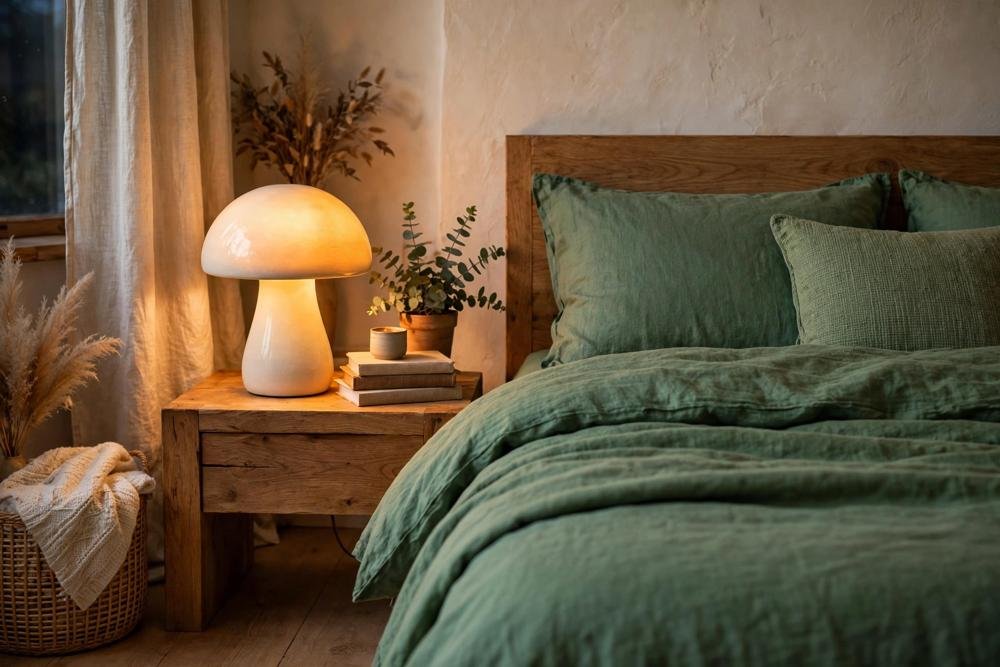
Mushroom lamps, wooden lamps and paper lanterns are the classic forest accents, and they work best as one accent per room. A mushroom lamp on a bedside table, a wooden lamp on a side table or a paper lantern in a corner will give a warm, characterful glow, and will be a talking point, without taking over the room. Two or three such lamps in one room, plus string lights, plus a themed shade, will feel like a display, not a home.
Choose a lamp that is safe for its place. A paper lantern should use a low-heat LED bulb, and should be kept away from curtains, bedding and dried decor, because paper can catch fire if it touches a hot bulb. A wooden lamp should be rated for its bulb, and should not be placed where it can be knocked over by pets or children. A mushroom lamp should be stable, with a cord that does not trail across a walkway, and it should be switched off when the room is empty, like any lamp.
A forest accent lamp should still leave the room bright enough to use. If a mushroom lamp is the only light in a bedroom, the room will be too dark to read, dress or move safely, however beautiful the glow is. Pair the accent lamp with a floor lamp or a table lamp for general light, and use the accent lamp for mood, not for all light. The test is simple: if you took the accent lamp away, would the room still work? If the answer is yes, it is a good accent. If the room only works with that one lamp, it needs more light.
6. Kitchen and Bathroom Lighting: Rated and Task-Ready
Kitchens and bathrooms need forest lighting that is also practical and rated for the room. In a kitchen, warm under-cabinet lights, a warm pendant over a table and a bright task light over work surfaces will make the room feel woodland without making cooking unsafe. Decorative lights alone, such as a single mushroom lamp or a string light, will not give enough light to cook safely, and they should never be placed near heat, steam or water unless they are rated for that place.
In a bathroom, lighting must be rated for moisture, and fixtures should be chosen for the bathroom zone they will be used in, following the maker and local rules. A warm, moisture-rated light, a mirror light and a small plant-safe accent can give a forest bathroom a calm glow, but a paper lantern, a fabric shade or an unrated lamp near water is not safe. If you are unsure about a fixture rating, ask a qualified electrician, rather than guessing, because water and electricity are a dangerous combination.
In both rooms, warm white light still suits forest palettes best, but task light should be bright enough. A kitchen with warm, dim light only will be hard to cook in, and a bathroom with only a soft accent light will be hard to use safely. Use layered light here too: a general warm light, a task light where work happens, and a small accent, such as a plant or a wooden tray, for character, rather than for light.
7. Small Rooms, Renters and Shared Homes
Small rooms need forest lighting that does not take floor space. A wall-mounted lamp, a clip-on reading light, a table lamp on a shelf or a string light along a mirror frame will give warm light without a floor lamp taking up a corner. A mirror, a light rug and pale walls will help daylight, and a warm lamp near the main seat will keep the evening glow. Avoid a large, dark lamp base in a small room, because it will take visual space, even if it does not take much floor space.
Renters can do almost all forest lighting without drilling or wiring. Freestanding floor and table lamps, battery string lights, a mushroom lamp on a table and a paper lantern on a shelf can change a room without a single hole. Adhesive hooks can hold a light string, but only within the weight limit the maker gives, and only on a surface that can take them, with landlord permission where needed. If a light needs wiring, a dimmer or a new fixture, ask the landlord first, and use a qualified person for any electrical work.
In a shared home, agree on lighting before buying, because one person may love a very dim, moody room, while another may need bright light to read or work. A compromise, such as a dimmer, or a task lamp for the reader and a soft accent lamp for the room, usually works better than a room that one person loves and another avoids. Keep walkways lit, keep cords out of walkways, and agree on one accent lamp per room, so the home feels calm, not cluttered with lights.

8. What to Avoid
Forest lighting fails most often by being too dark, too cold, or unsafe near fabric and dried material. Avoid a room lit only by candles, string lights or one accent lamp, because it will be too dark to read, cook or move safely, and an open flame near dried branches, pinecones, moss or curtains is a fire risk. Use LED and low-heat lights near fabric and dried decor, keep fabric away from bulbs, and never place a candle or an open flame near dried material.
Avoid cool white bulbs in a forest room, because they make deep green look cold and grey, and they make a cosy room feel like an office. Avoid one bright overhead light as the only light, because it will flatten green and make wood look harsh. Avoid string lights tangled across walkways, cords trailing across floors, or lights left on overnight when they are not designed for that use. Avoid unrated fixtures in kitchens and bathrooms, and avoid paper or fabric shades with hot bulbs.
Avoid lighting that looks good in a photo but does not work in life. A room that is beautiful in a single evening photo, but too dark to read in, too cold to sit in, or unsafe near a curtain, is not a good forest room. Test lighting in the evening, with the lamps you actually use, sitting in the seats you actually use, and walking the walkways you actually use. If a light does not help you live in the room, it is decoration, not lighting.

Conclusion
Forest lighting is warm, layered and safe: daylight first, then warm lamps where people sit, then one small accent for character. Use warm white LED bulbs, keep fabric and dried decor away from heat, choose rated fixtures for kitchens and bathrooms, and keep every room bright enough to read, cook and move safely. Done that way, light will do what it does in a forest, filtering softly, pooling warmly and fading gently, and the room will feel sheltered in the evening, not dark, cold or staged. The other guides in this series will help you carry the same calm into every room, with palettes, furniture and plants that work in the same warm light.
Related reading
- Forest Home Decor: The Complete Guide to Bringing the Woods Indoors
- Forest Themed Bedroom Ideas for Adults
- Forest Kitchen Decor Ideas Without a Remodel
- Forestcore vs Cottagecore vs Cabincore vs Goblincore vs Mushroomcore
- Forest Living Room Ideas for a Calm Woodland Home
- Forest Green and Moss Colour Palettes for Every Room
Frequently Asked Questions
What colour light is best for a forest room?
Warm white light suits a forest room best, because it makes deep green look rich and wood look warm. Cool white light can make deep green look cold and grey. Use the same warm tone across lamps in one room, so the light feels even, and use LED bulbs, which run cooler and are safer near fabric and dried decor.
How do I light a green room without making it dark?
Layer light, rather than relying on one overhead light. Use a floor lamp, a table lamp and a small accent, keep walls cream, use a mirror opposite the window, and choose sage or mid-green rather than very dark green in a small or north-facing room. A reading lamp near the main seat will keep the room usable, even when the overall mood is soft.
Are fairy lights safe in a forest room?
LED fairy lights can be safe, if they are rated for indoor use, kept away from curtains, throws, dried branches, pinecones and moss, and switched off at night and when the house is empty, unless the maker says otherwise. Never place an open flame near fairy lights or dried decor, and keep cords out of walkways.
What is a mushroom lamp and is it enough on its own?
A mushroom lamp is a small, mushroom-shaped lamp that gives a warm, characterful glow, and it suits a forest bedroom or living room as one accent. It is not enough on its own, because a room lit only by a mushroom lamp will be too dark to read or move safely. Pair it with a floor or table lamp for general light.
Can I use forest lighting in a rented home?
Yes. Freestanding floor and table lamps, battery string lights, a mushroom lamp and a paper lantern can change a room without drilling or wiring. Use adhesive hooks only within the maker’s weight limit and with landlord permission where needed, and use a qualified person for any wiring or new fixture.
What lighting is safe for a forest kitchen or bathroom?
Use warm, task-appropriate lights that are rated for the room, such as under-cabinet lights in a kitchen and moisture-rated lights in a bathroom, following the maker and local rules. Decorative lights alone will not give enough light to cook or use a bathroom safely, and paper, fabric or unrated lamps near water or heat are not safe. If unsure, ask a qualified electrician.