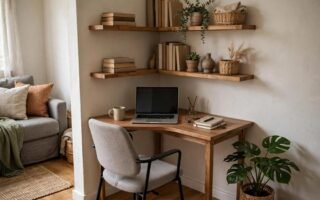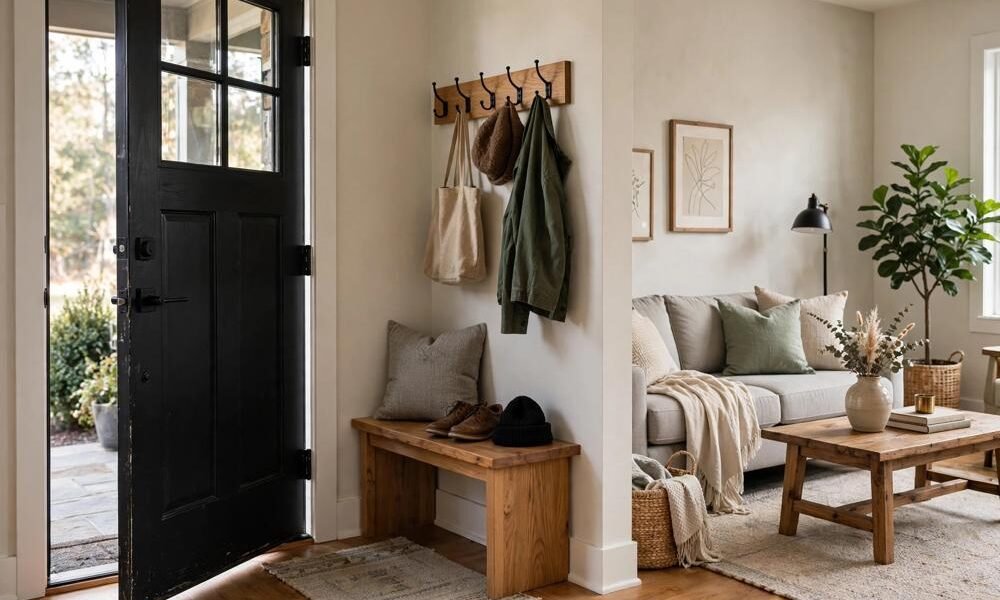
An open entryway is a home where the front door opens straight into a living room, with no hallway in between, and the entry zone has to be made, not found. Without walls to contain it, coats, shoes, and bags will spread across the living room unless you give them a clear place, a clear edge, and a clear routine. The trick is to make the entry zone feel like a welcome, not a barrier: a corner beside the door, a rug that marks where the entry ends and the living room begins, hooks and a bench that are easy to use, and nothing tall or wide that blocks light, sight, or the path into the room. All measurements in this guide are approximate ranges only, and sizes vary by home, so measure your corner and check listings before you buy.
Key takeaways
- In an open entryway, the corner beside the door is the entry zone, not the whole living room wall.
- A rug marks the edge of the entry zone better than furniture, and it is easier to move, wash, and change.
- Keep the entry zone shallow, slim, and low, so it does not block light, sight, or the path into the living room.
- Hooks, a bench or shoe place, and a tray for keys are the three jobs that matter most, in that order.
- A mirror, a plant, and a light can make the zone feel intentional, without making it larger.
- Anchor tall units, check adhesive hook weight limits, keep the exit route and door swing clear, and get landlord permission before drilling if you rent.
Start With the Corner Beside the Door
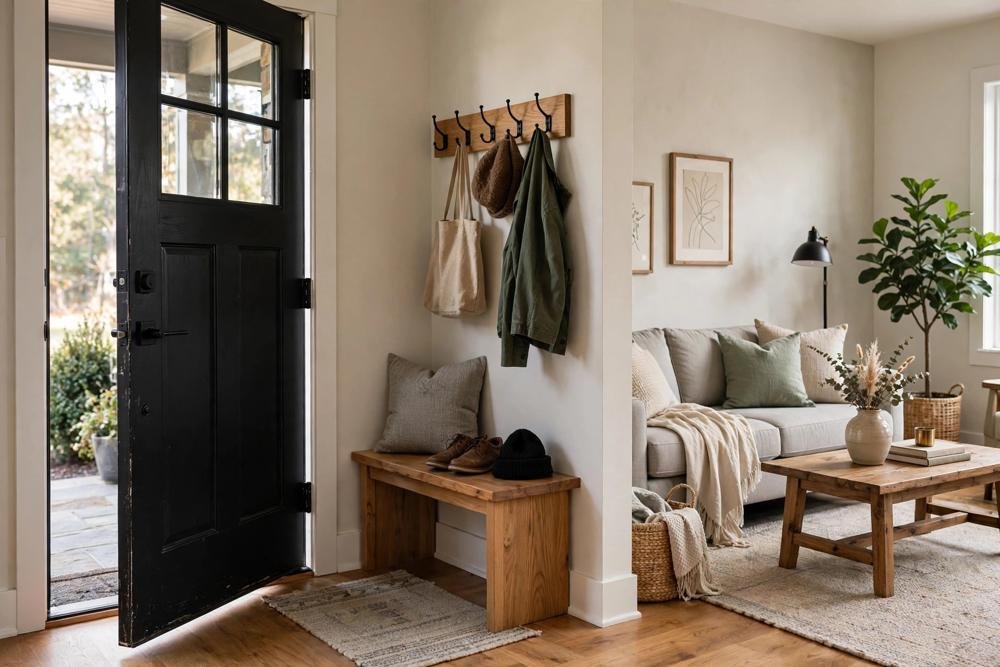
In most open entryways, the best entry zone is the corner beside the door, on the side where the door does not swing, or on the side with the most wall space, whichever gives you a place for hooks and a bench without blocking the door, the walkway, or a window. Stand at the door, open it fully, and watch where it swings, where you naturally step, and where you put a coat or bag when you come in. That natural landing spot, usually within one or two steps of the door, is where your entry zone should be, because a zone that is far from the door will not be used, and coats and shoes will end up wherever is closest instead.
Measure that corner, as in the size guide: width at floor, bench, and hook height, depth, door swing arcs, and the walkway you must keep clear into the living room, approximately 75 to 90 cm as a general comfort guide, not a building code. In an open entryway, the walkway matters even more than in a hallway, because the living room is the walkway, and a bench or hall tree that is too deep will narrow the path into the room, block a sofa or a chair, or make the room feel cramped, even if the entry zone itself is tidy.
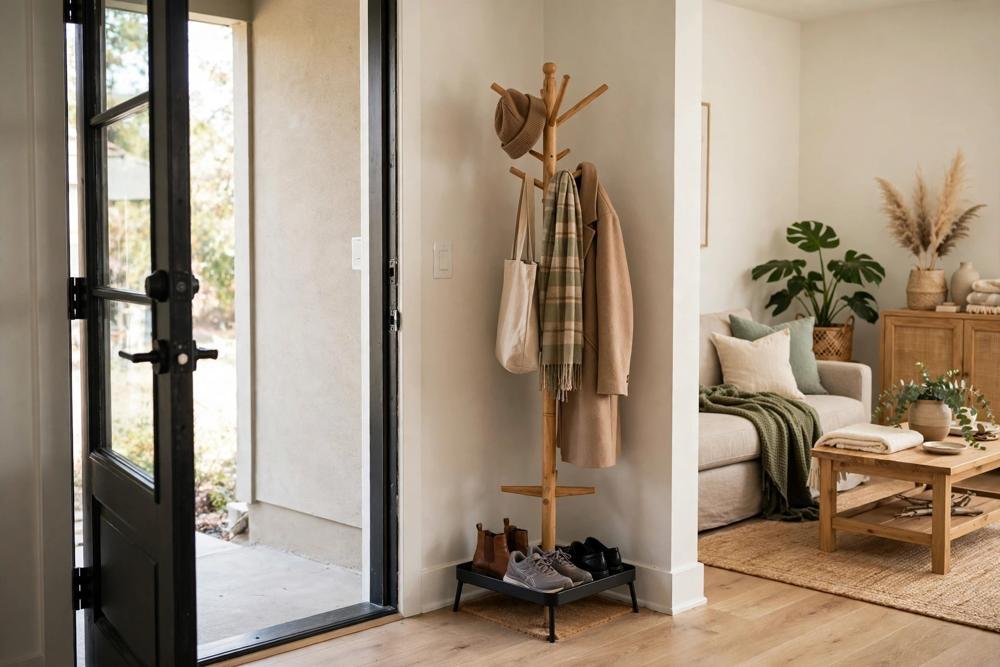
Choose the side of the door carefully. If the door opens against a wall, that wall is often the best place for hooks, because the door will hide the hooks when it is open, and the hooks will be visible and easy to use when it is closed. If the door opens into the room, the wall beside the door, on the hinge side, is often the best place, because it is out of the door swing and out of the main path. If both sides are tight, use a slim console or a freestanding coat rack in the corner, rather than a wide hall tree, and keep the zone shallow, approximately 30 to 40 cm deep for a bench or console, so it does not push into the room.
Use a Rug to Mark the Edge
A rug is the simplest way to mark an open entry zone, because it gives the eye a clear edge, it gives shoes a place to land, and it is easy to move, wash, and change, unlike a wall or a piece of furniture. Choose a rug that is large enough to stand on while you take off shoes and hang a coat, but small enough that it does not run into the living room seating area, and that fits the corner you measured, not a rug size you guessed. For rug sizing, use the rug calculator, which helps you choose a rug size for your room and layout, and check the guide link in Related reading.
Place the rug so that it starts at the door, or just inside it, and ends where the entry zone ends, with the bench or console on or beside it, not far from it, so that shoes, coats, and bags land on or near the rug, not on the living room floor. A washable rug or a low pile rug is easier to clean in an entryway than a thick pile rug, which will hold mud and dust, and a rug with a non slip backing, or a rug pad underneath, will stay in place when you step on it, rather than sliding into the room. In a small open entryway, a runner, approximately 60 to 80 cm wide, from the door to the next room, can work better than a large rug, because it marks a path, not a whole area, and it leaves more living room floor visible, which makes the room feel larger.
Avoid a rug that is too large for the corner, because it will make the entry zone feel like it owns the living room, and it will be hard to clean, and avoid a rug that is too small, because it will not catch shoes or mark the edge, and it will slide around. Avoid a rug that blocks a door swing, or that is thick enough to stop a door closing, and check that the door can open and close over the rug, or that the rug starts just past the door arc, before you buy. A rug that works is one that you step on without thinking, that catches dirt, and that you can wash or shake out easily, and that is enough, it does not need to be large or expensive to do its job.
Hooks, Bench, and Shoe Place in a Slim Zone
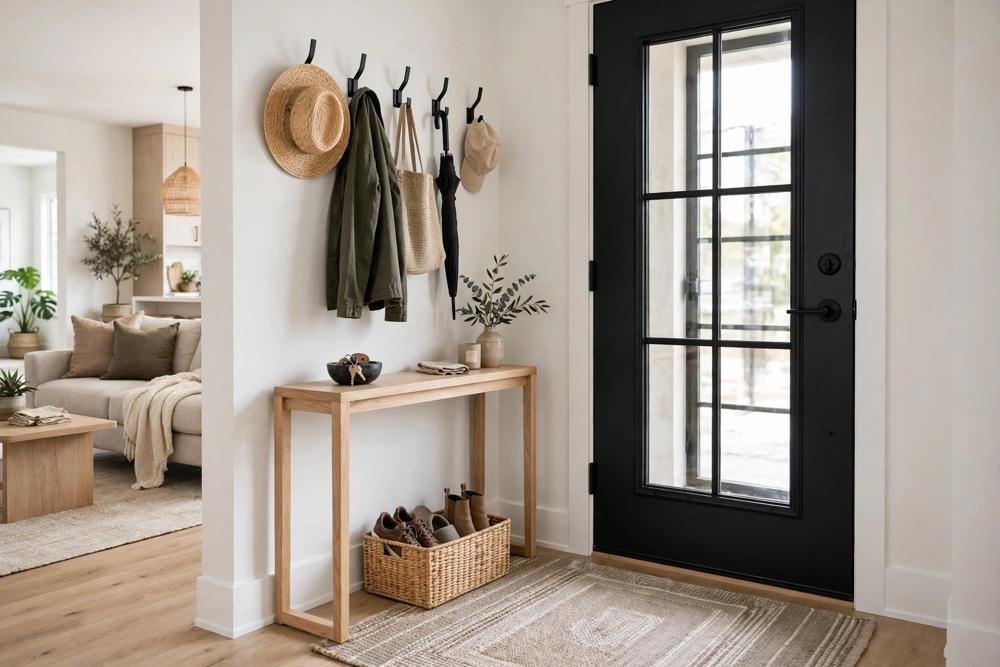
In an open entryway, the three jobs that matter most are hooks for coats and bags, a bench or shoe place for shoes, and a tray for keys, and they should be placed in that order, close to the door, in a shallow zone, so they are easy to use and easy to see. Hooks are first, because a coat that is not on a hook will end up on a sofa, a chair, or a bench, and a hook rail, or a row of hooks, at approximately 165 to 175 cm for most adults, with a lower hook for children if needed, will hold coats and bags that otherwise spread across the living room. Choose hooks that match the wall and the weight they need to hold, check weight limits, and get landlord permission before drilling if you rent, or use adhesive or over door hooks if you cannot drill, as in the renter guide.
A bench is second, because a place to sit makes changing shoes comfortable, and a bench with shoe storage underneath, approximately 30 to 40 cm deep, will hold shoes that otherwise end up on the rug or the living room floor. In an open entryway, choose a narrow bench, not a wide hall tree, unless the corner is wide enough for a hall tree that passes the fit checker in the size guide, with the walkway still comfortable, and with anchoring if it is tall. A slim console, approximately 25 to 35 cm deep, with a basket underneath for shoes, can work in a very tight corner, because it gives you a surface for keys and a place for shoes, without pushing far into the room.
A tray for keys is third, because keys that do not have a place will be lost, and a small tray on a console, a shelf, or a bench, near the door, will catch keys, sunglasses, and small items, so they do not end up on a coffee table or a kitchen counter. Keep the bench top and console top clear except for keys, and keep the shoe place to one pair per person, with other shoes stored elsewhere, as in the winter guide, so the entry zone stays shallow, tidy, and easy to clean, rather than becoming a second living room storage area.
Keep It Light, Low, and Open
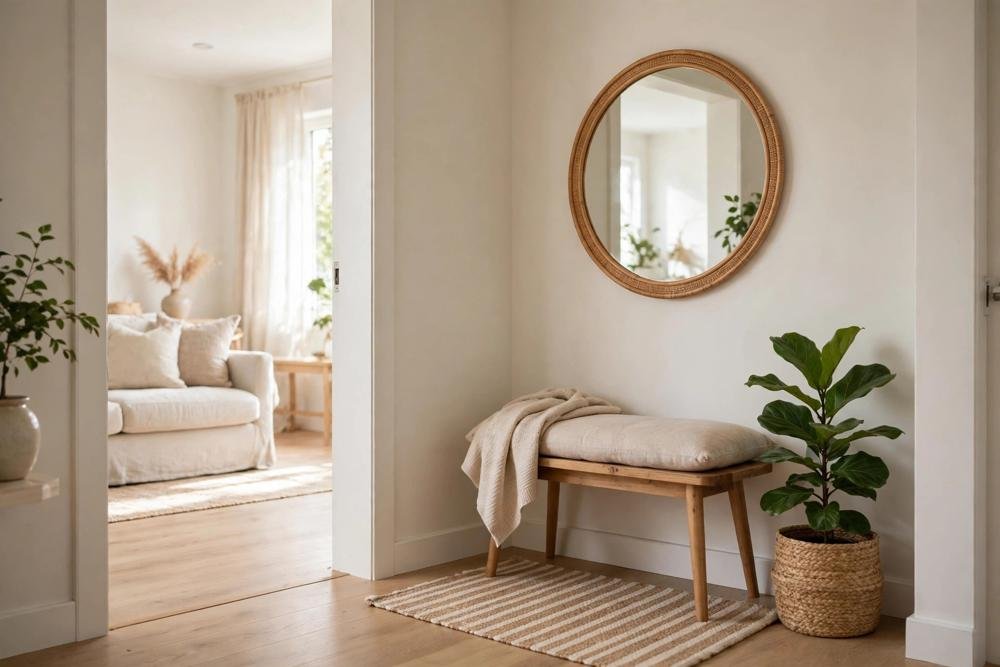
An open entryway should feel light, low, and open, because the living room is already the main room, and a tall, wide, or dark entry zone will make it feel smaller, darker, and more cramped, even if it is tidy. Keep entry furniture low, approximately bench height, or slim, approximately 30 to 40 cm deep, and keep the wall above it light, with a mirror, a small shelf, or a light colour, rather than a tall, closed cabinet that blocks light and sight. A mirror above a bench or console will make the corner feel wider, and it will let you check yourself before leaving, but choose a mirror that is the right size for the corner, fixed safely, or leaning safely if it is small and stable, and not so large that it dominates the living room wall.
Use light colours in the entry zone, as in the hallway guide, because a light wall, a light rug, and light furniture will make a small corner feel wider, while a dark wall or dark furniture will make it feel narrower, especially in a corner that gets little natural light. Use a plant, if you have light for it, and if it is not in the walkway, to make the corner feel alive, and use a small wall light, or a plug in light, if you can add lighting safely and are allowed to, with a slim profile that does not stick far out from the wall, so the corner is lit at night, without blocking the path.
Avoid a tall hall tree in a small open entryway, unless it fits and can be anchored safely, because it will block light, sight, and the path into the room, and it will make the living room feel like it has a wall in it, which defeats the purpose of an open plan. Avoid closed storage you will not open, because it will fill up and be ignored, and avoid a large bench that blocks a sofa, a chair, or a window, because it will be moved, returned, or resented, rather than used. Keep the entry zone to what you use every day, and store other items elsewhere, so the living room stays a living room, not a storage room with a door in it.
Living With an Open Entryway: Routine and Boundaries
An open entryway works only if it has a routine and boundaries, because without walls, the entry zone will expand into the living room unless you keep it to its corner, its rug, and its hooks. Make a simple routine: coats on hooks, shoes in the shoe place, keys in the tray, and bags on a hook or in a basket, every time you come in, and clear the zone once a week, taking out shoes, coats, and items that do not belong there, as in the winter guide. That routine, plus a rug edge and a bench, will do more than any furniture, because it keeps the zone small, even when the living room is large.
Set boundaries for the zone: one coat per person, one pair of shoes per person, one bag per person, and other items stored elsewhere, in a bedroom, a cupboard, or a closet, so the entry zone does not become a second wardrobe. If you live with others, agree on those boundaries, and on where each person’s hooks and baskets are, so the zone is shared fairly, and it does not become one person’s pile. If you have children or pets, use lower hooks for children, labelled baskets for each person, and a leash station for pets, as in the pets and kids guide, with height appropriate hooks and a stroller place if needed, so the zone works for everyone, not just adults.
Keep the exit route and door swing clear at all times, as in the rest of this series, because an open entryway is also an escape route, and a bench, a shoe rack, or a pile of shoes that blocks the door is a safety problem, not just a tidy problem. Check the zone at night, when it is dark, and when you are carrying bags, to make sure you can get out easily, and move anything that blocks the path, however tidy it looks in daylight. A safe, clear, open entryway will be used every day, and a crammed, blocked entryway will be avoided, however good it looks in a photograph.
What to Avoid in an Open Entryway
Avoid a wide hall tree in a tight corner, because it will block light, sight, and the path into the living room, and it will make the room feel smaller, even if it is tidy. Avoid a large bench that blocks a sofa, a chair, or a window, because it will be moved or resented, rather than used. Avoid closed storage you will not open, because it will fill up and be ignored, and avoid a rug that is too large, too small, or that blocks a door swing, because it will not mark the edge, and it will slide or trip you.
Avoid hooks that are overloaded, or that are fixed unsafely, because they will fail and damage the wall, and avoid adhesive hooks that are used beyond their weight limit, or on a surface they are not suited for, as in the renter guide. Avoid a mirror that is too large for the corner, or that is not fixed safely, because it will dominate the wall and be a safety risk, and avoid a plant that is in the walkway, or that does not get enough light, because it will be knocked over or die, and it will make the corner feel cluttered, not alive. Avoid a pile of shoes, coats, and bags that spreads beyond the rug, because that pile is the living room, not the entry zone, and it will make the whole room feel untidy, even if the rest of the room is clean.
Renter Friendly Open Entryways
If you rent and your door opens into a living room, you can still make an open entry zone, without drilling or painting, by using freestanding, adhesive, and over door pieces, as in the renter guide. Use a freestanding coat rack, or a leaning shelf, in the corner beside the door, rather than a wall fixed hall tree, and use adhesive hooks, or over door hooks, for coats and bags, checking weight limits and door closing, and using a door protector if needed, so the door is not damaged. Use a rug, a bench, a basket, and a tray, all freestanding, to mark the zone and give items a place, without changing the wall or floor, and use a small mirror that leans safely, or that hangs from an over door hook, rather than a mirror that needs drilling.
Check your lease before you paint or drill, and get permission in writing if needed, because some leases do not allow painting, and some allow it only if you return the wall to its original colour at the end of a tenancy. If you cannot paint, use a light rug, a light bench, and a plant, to make the corner feel fresh, without changing the wall, and use a plug in light, if you can add lighting safely and are allowed to, with a slim profile, so the corner is lit at night, without electrical work. A renter friendly open entryway that is freestanding, shallow, and tidy will work as well as a fixed entryway, and it will move with you to your next home, which is a benefit, not a compromise.
Small Corner, Door Into Living Room: A Worked Example
Imagine a small flat where the front door opens into a living room, with a corner beside the door, approximately 90 cm wide and 40 cm deep, on the hinge side, out of the door swing, with a walkway into the room of approximately 90 cm. In that corner, a rug, approximately 80 cm by 120 cm, from the door to the bench, marks the entry zone, a hook rail, with three hooks, at approximately 170 cm, holds coats and bags, a narrow bench, approximately 80 cm wide and 35 cm deep, with a basket underneath for shoes, gives a place to sit and a place for shoes, and a small tray on a shelf above the bench holds keys. A mirror above the bench, approximately 40 cm wide, makes the corner feel wider, and a plant, in a pot on the floor beside the bench, makes it feel alive, without blocking the walkway.
That worked example, approximately, uses only the corner beside the door, a rug, hooks, a bench, a basket, a tray, a mirror, and a plant, and it keeps the walkway clear, the door swing clear, and the living room visible, so the flat feels open, not cramped, and the entry zone feels intentional, not accidental. If your corner is wider, you can add a wider bench or a slim console, and if your corner is narrower, you can use wall hooks only, with a shoe basket, rather than a bench, and the same principles apply: corner beside the door, rug edge, hooks first, bench second, keys third, keep it light, low, and open, and keep the walkway and exit clear.
Checklist: Open Entryway Without a Hallway
- Choose the corner beside the door, on the side out of the door swing, with the most wall space.
- Measure width, depth, height, door arcs, and walkway, approximately 75 to 90 cm as a comfort guide.
- Use a rug, or a runner, to mark the edge of the entry zone, with a size from the rug calculator.
- Place hooks first, then a bench or shoe place, then a tray for keys, all close to the door.
- Keep entry furniture slim, approximately 30 to 40 cm deep, and low, so it does not block light or sight.
- Use a mirror, a plant, and a light, if safe and allowed, to make the zone feel intentional.
- Anchor tall units, check adhesive hook weight limits, keep the exit route and door swing clear.
- Get landlord permission before drilling or painting if you rent, or use freestanding pieces.
- Set boundaries: one coat, one pair of shoes, one bag per person, other items stored elsewhere.
- Clear the zone once a week, and check it at night and when carrying bags, for a safe exit.
Conclusion
An open entryway works when you make a zone, not a wall: a corner beside the door, a rug that marks the edge, hooks first, a bench or shoe place second, and a tray for keys third, all in a shallow, low, light zone that does not block light, sight, or the path into the living room. Measure first, choose the side of the door out of the swing, use a rug size from the rug calculator, keep furniture slim and low, and keep the walkway and exit clear at all times, with anchoring for tall units, weight limits for adhesive hooks, and landlord permission before drilling or painting if you rent.
Done that way, a home with no hallway can have an entryway that feels welcoming, tidy, and easy to use, without making the living room feel smaller, darker, or more cramped, and without a large piece that blocks the room. A corner, a rug, hooks, a bench, and a routine, kept to their boundaries and cleared once a week, will do more than a wall ever could, because they make the entry zone clear, without making the living room closed.
Related reading
- Corner Entryway Ideas for a Tight Corner
- Mini Mudroom Entryway Ideas for Apartments and Small Homes
- Corner Storage Ideas for Entryways
- Winter Entryway Organization Ideas for a Tidy Corner
- Hallway Corner Ideas for Narrow Hallways
- Renter Friendly Entryway Ideas Without Drilling
- Bench and Hall Tree Size Guide for Entryways
- Budget Entryway Makeover Ideas for a Small Corner
- Rug Calculator
- Functional Entryway Zones, Entryway Corner Decor, and Entryway Storage for Kids and Pets, in this series, to follow.
Frequently Asked Questions
How do I make an entryway when my door opens into the living room?
Use the corner beside the door, on the side out of the door swing, as your entry zone, with a rug to mark its edge, hooks for coats and bags, a narrow bench or shoe place, and a tray for keys, all within one or two steps of the door. Keep the zone shallow, approximately 30 to 40 cm deep, and low, so it does not block light, sight, or the path into the living room.
What size rug should I use for an open entryway?
Choose a rug that is large enough to stand on while you take off shoes and hang a coat, but small enough that it does not run into the living room seating area, and use the rug calculator for your room and layout. A runner, approximately 60 to 80 cm wide, from the door to the next room, can work better than a large rug in a small open entryway, because it marks a path, not a whole area.
Should I use a hall tree in an open entryway?
Use a hall tree only if your corner is wide enough for it to pass the fit checker in the size guide, with the walkway still comfortable, approximately 75 to 90 cm as a comfort guide, and with anchoring if it is tall. Otherwise, use a narrow bench plus hooks, or a slim console plus hooks, which are shallower, lower, and easier to move, and which will not block light or sight into the living room.
How do I keep an open entryway from spreading into the living room?
Set boundaries: one coat, one pair of shoes, one bag per person, with other items stored elsewhere, and clear the zone once a week, taking out items that do not belong there. A rug edge, hooks, and a bench, plus a simple routine of coats on hooks, shoes in the shoe place, and keys in the tray, will keep the zone small, even when the living room is large.
Can I make an open entryway if I rent and cannot drill?
Yes, use a freestanding coat rack or leaning shelf, adhesive or over door hooks, checking weight limits and door closing, a rug, a bench, a basket, and a tray, all freestanding, without drilling or painting. Check your lease, get permission in writing if needed, and use a plug in light, if safe and allowed, rather than electrical work, for lighting at night.
Where should I put shoes in an open entryway?
Put one pair per person in a basket or shoe place under a bench or console, close to the door, on or beside the rug, with other shoes stored elsewhere, in a bedroom, cupboard, or closet. That keeps the entry zone shallow and tidy, and it stops shoes spreading across the living room floor, which is the most common problem in an open entryway.