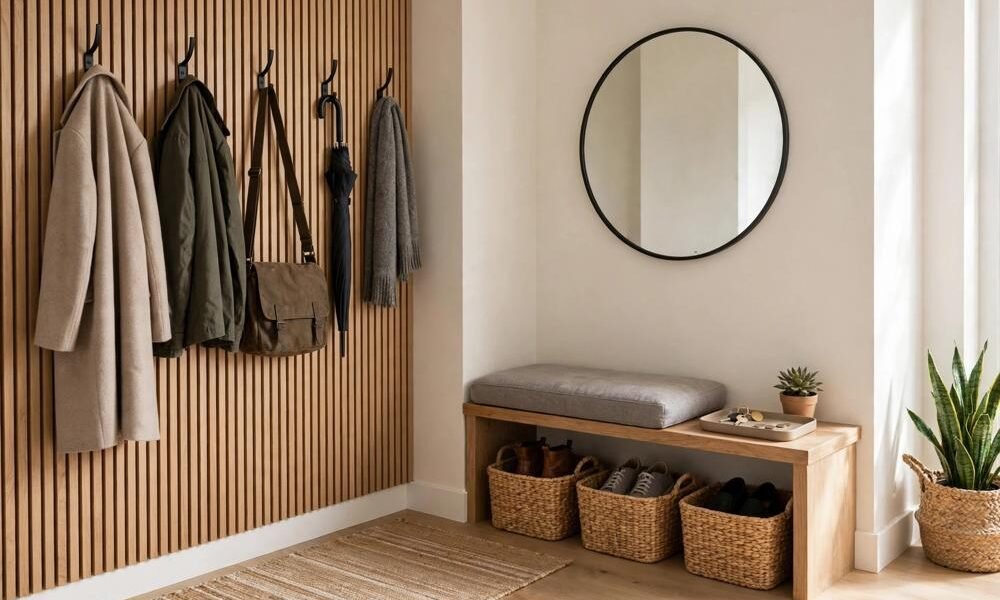
A functional entryway is not one big storage area, it is five small zones, each with one job, each in the right place, so that coats, shoes, keys, and bags land where they belong, without thinking, every time you come in or go out. The five zones are: drop, for keys and small items; hang, for coats and bags; sit, for changing shoes; store, for shoes and seasonal items; and check, for a mirror and a last look before you leave. When each zone has its own place, the corner stays tidy, even on busy days, and when zones are mixed up, coats end up on the bench, shoes end up by the door, and keys end up lost, however much storage you have. All measurements in this guide are approximate ranges only, and sizes vary by home, so measure your corner and check listings before you buy.
Key takeaways
- Divide the entry corner into five zones: drop, hang, sit, store, and check, each with one job.
- Put zones in the order you use them: drop and hang first, then sit and store, then check last, near the door out.
- One zone, one place: keys always in the drop zone, coats always on hang hooks, shoes always in the store zone.
- Keep each zone shallow and clear, so it does not block the walkway, door swing, or exit route.
- Use a printable checklist, in the checklist section below, to set up zones in one weekend and keep them tidy weekly.
- Anchor tall units, check adhesive hook weight limits, keep the exit route and door swing clear, and get landlord permission before drilling if you rent.
The Five Zones, in Order
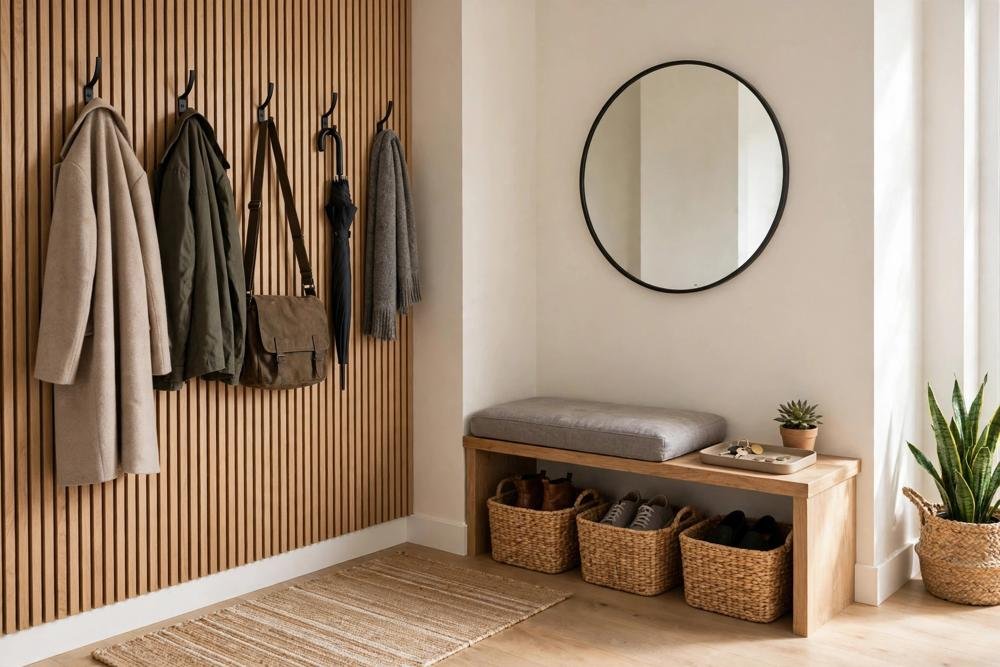
The five zones work best in the order you use them, from coming in to going out, and that order is: drop, hang, sit, store, and check. When you come in, you drop keys and small items first, then hang your coat and bag, then sit to change shoes, then store shoes and seasonal items, and when you go out, you check yourself in the mirror, pick up keys from the drop zone, and leave, without searching. That order matters, because a zone that is out of order will be skipped, and items will end up wherever is closest, rather than where they belong.
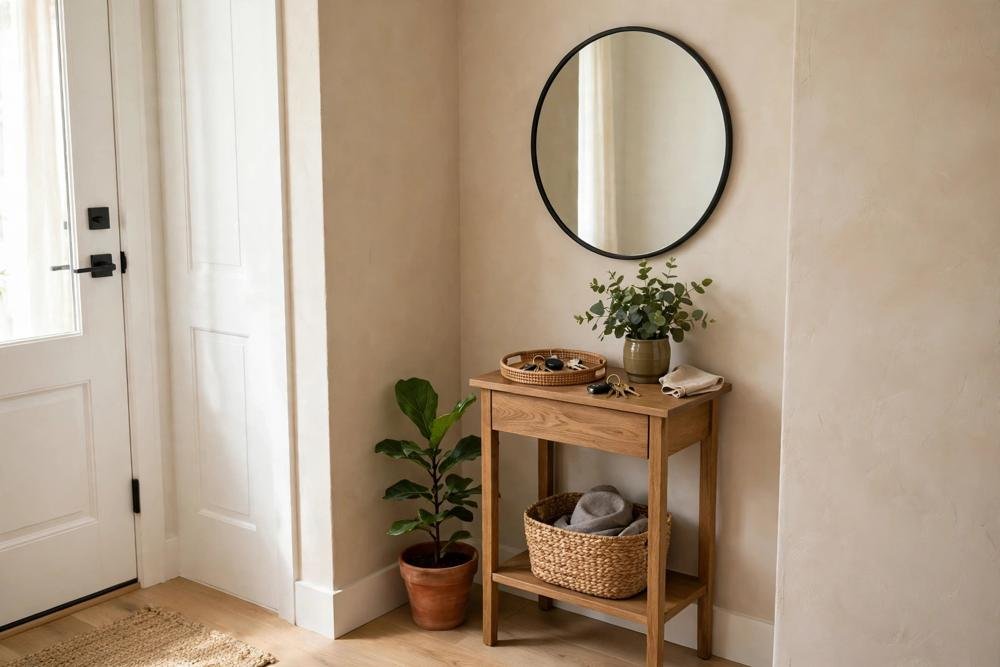
Drop zone: a small tray, bowl, or shelf, near the door, at a height you can reach without bending, approximately 90 to 110 cm, for keys, sunglasses, wallet, and small items, so they do not end up on a coffee table, a kitchen counter, or a bench. Keep the drop zone clear except for those small items, and clear it once a week, taking out items that do not belong there, so it stays a drop zone, not a storage pile.
Hang zone: hooks, a hook rail, or a coat rack, at approximately 165 to 175 cm for most adults, with a lower hook for children if needed, for coats, bags, and hats, so they do not end up on chairs, benches, or sofas. Choose hooks that match the wall and the weight they need to hold, check weight limits, and get landlord permission before drilling if you rent, or use adhesive or over door hooks if you cannot drill, as in the renter guide.
Sit zone: a bench, a stool, or a low seat, approximately 30 to 40 cm deep, with a height that is comfortable to sit and change shoes, approximately 45 to 50 cm, for sitting to change shoes, and for putting a bag down while you take off a coat. Keep the sit zone clear, except for a cushion if you want one, so it is always ready to sit on, not a place to pile coats and bags.
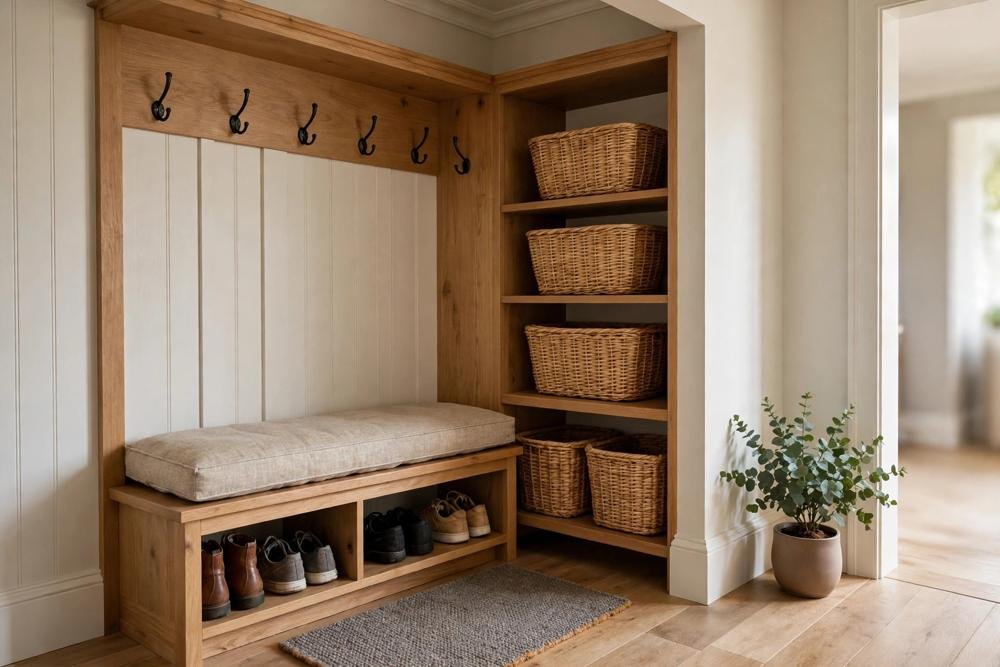
Store zone: baskets, a shoe rack, or a bench with storage underneath, for shoes, gloves, hats, and seasonal items, with one pair of shoes per person in the entry zone, and other shoes stored elsewhere, as in the winter guide. Label baskets if you live with others, so each person has a place, and keep the store zone to what you use every day, with seasonal items rotated out when the season changes.
Check zone: a mirror, above a bench or console, or on the wall near the door, fixed safely, or leaning safely if it is small and stable, for a last check before you leave, plus a small light, if you can add lighting safely and are allowed to, so the check zone is lit at night. Keep the check zone clear, with a mirror that is the right size for the corner, not so large that it dominates the wall, and not so small that it is useless, and keep the area in front of it clear, so you can step back and check yourself, without tripping over shoes or bags.
Zone by Zone: What Goes Where
Drop zone, what goes there: keys, wallet, sunglasses, phone, and small items you carry every day, in a tray, bowl, or on a small shelf, near the door, at approximately 90 to 110 cm. What does not go there: coats, bags, shoes, mail, or items that belong elsewhere, because a drop zone that fills up with mail and bags will stop being a drop zone, and keys will be lost again. Clear the drop zone once a week, and put back only daily items, so it stays clear and useful.
Hang zone, what goes there: one coat per person, one bag per person, and hats, on hooks that are the right height and weight limit for each person, with lower hooks for children, and a hook for a bag, so bags do not end up on the bench or floor. What does not go there: shoes, keys, or items that belong in the store zone, because a hang zone that is overloaded with bags and coats will fail, damage the wall, or be ignored, and coats will end up on chairs instead. Keep hang hooks to one coat and one bag per hook, and rotate seasonal coats out when the season changes, so the hang zone stays light and easy to use.
Sit zone, what goes there: a bench, a stool, or a low seat, with a cushion if you want one, and nothing else, so it is always ready to sit on. What does not go there: coats, bags, shoes, or piles, because a sit zone that is piled with coats and bags cannot be sat on, and shoes will be changed standing up, or not at all, which defeats the purpose of the zone. Keep the sit zone clear, and keep the area in front of it clear, so you can sit, change shoes, and stand up, without tripping.
Store zone, what goes there: shoes, gloves, hats, and seasonal items, in baskets, a shoe rack, or a bench with storage, with one pair of shoes per person in the entry zone, and other shoes stored elsewhere, and with baskets labelled if you live with others. What does not go there: coats, bags, or keys, because a store zone that fills up with coats and bags will stop being a store zone, and shoes will end up by the door instead. Rotate seasonal items: winter gloves, hats, and boots in winter, as in the winter guide, and lighter items in summer, so the store zone stays to what you use now, not what you used last season.
Check zone, what goes there: a mirror, a small light, and a clear space in front of it to step back and check yourself, near the door out, so you check yourself last, before you leave. What does not go there: coats, bags, shoes, or piles, because a check zone that is blocked by shoes and bags cannot be used, and you will leave without checking, or you will check in another room, which defeats the purpose of the zone. Keep the check zone clear, with a mirror that is the right size, and a light that is slim and safe, so it is lit at night, without blocking the path.
Household Tables: Zones for Different Homes
Zones work for every household, but the details change with who lives there, and the tables below show how to adjust zones for different households, so each person has a place, without the corner becoming cramped.
Single person, zones: drop tray for keys and wallet, two hooks for coat and bag, a small bench or stool, one basket for shoes, and a mirror, all in a corner approximately 90 cm wide, with a rug to mark the zone, as in the open entryway guide. Keep zones simple, with one hook, one basket, and one tray, because a single person does not need many hooks or baskets, and a simple zone will be easier to keep tidy than a complex zone that is half empty.
Couple, zones: drop tray with two sections, or two small trays, one per person, four hooks, two per person, for coat and bag, a bench with two baskets underneath, one per person, for shoes, and a mirror, all in a corner approximately 120 to 150 cm wide, with labelled baskets if needed, so each person has a place, and the zone is shared fairly. Agree on boundaries, one coat, one pair of shoes, one bag per person, so the zone does not become one person’s pile, and clear the zone together once a week, so it stays shared, not owned by one person.
Family with children, zones: drop tray at adult height, plus a small tray or basket at child height for school items, hooks at adult height, approximately 165 to 175 cm, plus hooks at child height, approximately 120 to 130 cm, for coats and school bags, a bench with baskets underneath, one per child, labelled, for shoes and school items, and a mirror at adult height, with a small mirror at child height if you want one, all in a corner approximately 150 to 180 cm wide, if you have it, or with zones split across two corners if you do not. Use lower hooks and labelled baskets, as in the pets and kids guide, so children can hang their own coats and put their own shoes away, without help, and keep the zone to one coat, one pair of shoes, one bag per child, with other items stored elsewhere, so the corner does not become a school storage room.
Shared house, zones: drop tray with a section per person, or a small tray per person, hooks labelled per person, one coat and one bag per person, baskets labelled per person, one pair of shoes per person, and a mirror, all in a corner, with a clear agreement on boundaries, so each person has a place, and the zone is shared fairly, not dominated by one person. Use labels, and a weekly clear out, so the zone stays fair, and if the corner is too small for everyone, split zones: drop and hang in one corner, sit and store in another, with check near the door out, so the entry system works across two corners, rather than cramming everything into one.
Renter, zones: use freestanding, adhesive, and over door pieces, as in the renter guide, with a freestanding coat rack, or a leaning shelf, for hang, a bench or stool for sit, baskets for store, a tray on a console for drop, and a mirror that leans safely, or hangs from an over door hook, for check, all without drilling or painting, unless you have permission in writing. Check your lease, get permission if needed, and use a rug to mark the zone, so a renter friendly zone works as well as a fixed zone, and moves with you to your next home.
Setting Up Zones in One Weekend
You can set up zones in one weekend, by working in order: Saturday clear, measure, and place zones, Sunday live with zones and adjust, and then keep zones tidy with a weekly clear out.
On Saturday morning, clear the corner completely, clean the floor and walls, and measure width, depth, height, door arcs, and walkway, approximately 75 to 90 cm as a comfort guide, with tape on the floor for any bench or hall tree footprint, as in the size guide. On Saturday afternoon, place zones in order: drop tray near the door, hang hooks next, sit bench next, store baskets next, check mirror last, near the door out, with a rug to mark the zone, as in the open entryway guide, and put back only one coat, one pair of shoes, one bag, and daily small items per person, with other items stored elsewhere.
On Sunday, live with zones for a day, and notice what is missing, what is in the wrong place, and what is not used, then adjust one thing at a time, rather than buying more storage, because a zone that is not used is in the wrong place, or has the wrong job, and moving it will work better than adding another basket. Keep safety in mind throughout, as in the rest of this series: anchor tall units, check adhesive hook weight limits, keep the exit route and door swing clear, and get landlord permission before drilling or painting if you rent. A zone system that is safe, clear, and easy to use will be used every day, and a zone system that is crammed, blocked, or hard to use will be avoided, however good it looks in a photograph.
Keeping Zones Tidy: Weekly Routine
Zones stay tidy only if they have a routine, because without a routine, zones will fill up, mix up, and become piles, however well they were set up. Make a simple weekly routine: once a week, clear each zone, take out items that do not belong there, put back only daily items, and rotate seasonal items if the season has changed, as in the winter guide. That routine, plus a daily habit of coats on hooks, shoes in the store zone, and keys in the drop zone, will keep zones tidy, without a large clean up, because zones are small, and a weekly clear out of a small zone is quick.
Daily habit: when you come in, drop keys, hang coat and bag, sit to change shoes, store shoes, and when you go out, check mirror, pick up keys, and leave, in zone order, without searching, because zones are in order and each item has a place. If you live with others, agree on that habit, and on where each person’s hooks and baskets are, so zones are shared fairly, and they do not become one person’s pile. If you have children, use lower hooks and labelled baskets, so children can do their own zones, without help, and praise a tidy zone, rather than criticising a messy one, so zones feel like a help, not a chore.
Seasonal rotation: when the season changes, rotate zones: winter gloves, hats, and boots in, summer items out, in winter, as in the winter guide, and lighter items in, heavier items out, in summer, so zones stay to what you use now, not what you used last season. Store seasonal items elsewhere, in a bedroom, cupboard, or closet, with a label, so they are easy to find when the season changes again, and they do not fill up the entry zone in the meantime. A zone system that rotates with the seasons will stay tidy all year, and a zone system that never rotates will fill up, however much storage it has.
What to Avoid With Zones
Avoid mixing zones, because a zone that has coats, shoes, and keys in it is not a zone, it is a pile, and it will be ignored, and items will end up wherever is closest, rather than where they belong. Avoid overloading zones, because a hook rail that is overloaded will fail, a basket that is overloaded will spill, and a bench that is piled with coats cannot be sat on, and zones that are overloaded will be avoided, rather than used. Avoid zones that block the walkway, door swing, or exit route, because a zone that blocks the path is a safety problem, not just a tidy problem, and it must be moved, however tidy it looks.
Avoid zones that are too large, too small, or in the wrong place, because a drop tray that is far from the door will not be used, a hang zone that is too high for children will not be used by children, and a check mirror that is blocked by shoes cannot be used, and zones that are not used are in the wrong place, or have the wrong job, and should be moved, not added to. Avoid buying more storage before you have lived with zones for a week, because a zone system that is not used does not need more storage, it needs a better place, a better job, or a better routine, and buying more storage will make the corner more crammed, not more tidy.
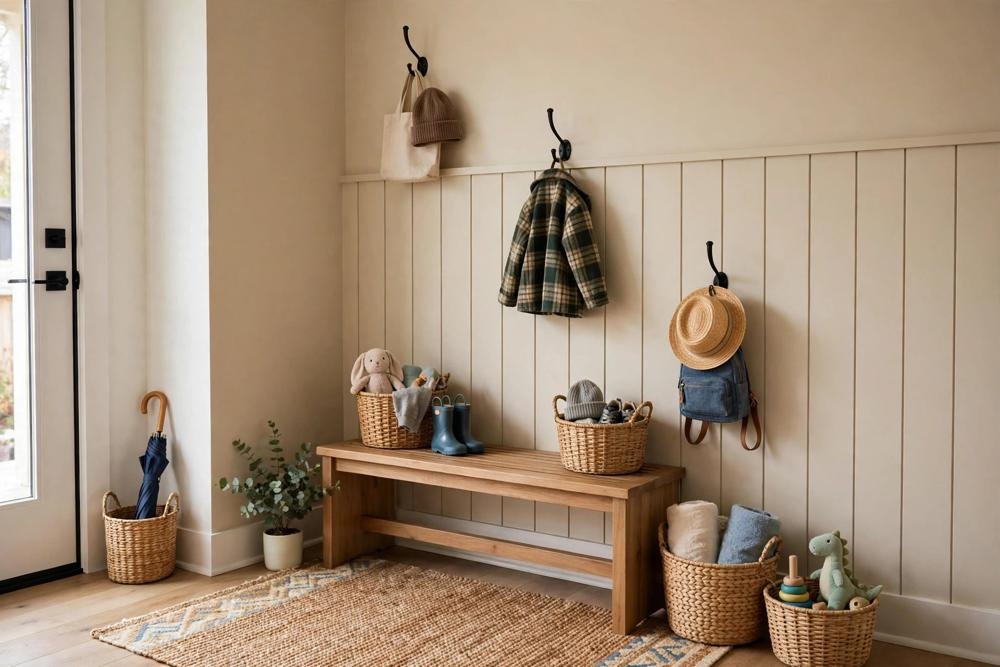
Printable Checklist: Functional Entryway Zones
Use this checklist to set up zones in one weekend, and to keep them tidy weekly. Print it, or copy it, and tick off each item as you do it.
Setup checklist:
- Clear the corner completely, clean the floor and walls, and measure width, depth, height, door arcs, and walkway, approximately 75 to 90 cm as a comfort guide.
- Tape footprints on the floor for any bench or hall tree, walk through them, open doors, and check at night and in daylight.
- Check your lease for drilling and painting, and get permission in writing if needed, or use freestanding pieces.
- Place drop zone first, near the door, at approximately 90 to 110 cm, with a tray for keys and small items.
- Place hang zone next, at approximately 165 to 175 cm for adults, lower for children, with hooks that match weight limits.
- Place sit zone next, a bench or stool, approximately 30 to 40 cm deep, approximately 45 to 50 cm high, kept clear.
- Place store zone next, baskets or a shoe rack, with one pair of shoes per person, labelled if shared.
- Place check zone last, near the door out, with a mirror fixed safely, and a light if safe and allowed.
- Place a rug to mark the zone, with a size from the rug calculator, and a washable rug or runner for easy cleaning.
- Put back only one coat, one pair of shoes, one bag, and daily small items per person, other items stored elsewhere.
- Anchor tall units, check adhesive hook weight limits, keep the exit route and door swing clear.
Weekly checklist:
- Clear drop zone, take out items that do not belong there, put back only daily items.
- Clear hang zone, take out extra coats and bags, rotate seasonal coats if needed.
- Clear sit zone, take off piles, so it is ready to sit on.
- Clear store zone, take out extra shoes, rotate seasonal items if needed.
- Clear check zone, take away piles, so you can step back and check yourself.
- Check walkway, door swing, and exit route, move anything that blocks the path.
- Wipe the drop tray, shake out the rug, and clean the mirror, so zones feel fresh.
Conclusion
Functional entryway zones work when each zone has one job, in the right order, in the right place: drop for keys and small items, hang for coats and bags, sit for changing shoes, store for shoes and seasonal items, and check for a mirror and a last look, all in a shallow, clear corner that does not block the walkway, door swing, or exit route. Measure first, place zones in order, keep each zone to daily items only, with one coat, one pair of shoes, one bag per person, and other items stored elsewhere, and keep zones tidy with a weekly clear out and a seasonal rotation, so they stay useful all year.
Use the printable checklist above to set up zones in one weekend, and to keep them tidy weekly, with anchoring for tall units, weight limits for adhesive hooks, and landlord permission before drilling or painting if you rent. Done that way, a small corner entryway will feel intentional, tidy, and easy to use, for a single person, a couple, a family, or a shared house, without a large piece that does not fit, and without zones that mix up, overload, or block the path.
Related reading
- Corner Entryway Ideas for a Tight Corner
- Mini Mudroom Entryway Ideas for Apartments and Small Homes
- Corner Storage Ideas for Entryways
- Winter Entryway Organization Ideas for a Tidy Corner
- Hallway Corner Ideas for Narrow Hallways
- Renter Friendly Entryway Ideas Without Drilling
- Bench and Hall Tree Size Guide for Entryways
- Budget Entryway Makeover Ideas for a Small Corner
- Open Entryway Ideas for Homes With No Hallway
- Rug Calculator
- Entryway Corner Decor and Entryway Storage for Kids and Pets, in this series, to follow.
Frequently Asked Questions
What are the five functional entryway zones?
The five zones are drop, for keys and small items; hang, for coats and bags; sit, for changing shoes; store, for shoes and seasonal items; and check, for a mirror and a last look before you leave. Put them in that order, from coming in to going out, so each item has a place, and you do not search for keys, coats, or shoes.
Where should I put the drop zone in an entryway?
Put the drop zone near the door, at a height you can reach without bending, approximately 90 to 110 cm, with a tray, bowl, or small shelf for keys, wallet, sunglasses, and small daily items. Keep it clear except for daily items, and clear it once a week, so it stays a drop zone, not a storage pile.
How many hooks do I need in a functional entryway?
Use one hook for a coat and one hook for a bag per person, at approximately 165 to 175 cm for most adults, with lower hooks at approximately 120 to 130 cm for children, if needed, and with weight limits checked. That keeps the hang zone light and easy to use, rather than overloaded, which will fail or be ignored.
How do I keep entryway zones tidy every week?
Clear each zone once a week, take out items that do not belong there, put back only daily items, and rotate seasonal items when the season changes, as in the winter guide. A daily habit of coats on hooks, shoes in the store zone, and keys in the drop zone, plus a weekly clear out, will keep zones tidy, without a large clean up.
Can I set up entryway zones if I rent and cannot drill?
Yes, use freestanding, adhesive, and over door pieces, as in the renter guide, with a freestanding coat rack for hang, a bench for sit, baskets for store, a tray on a console for drop, and a mirror that leans safely, or hangs from an over door hook, for check, all without drilling or painting, unless you have permission in writing.
What should I do if my entryway corner is too small for all five zones?
Split zones across two corners, or across a corner and a wall near the door, with drop and hang in one place, sit and store in another, and check near the door out, so the entry system works across two places, rather than cramming everything into one corner. Keep each zone shallow, approximately 30 to 40 cm deep, and keep the walkway and exit clear, so zones do not block the path.