Entryway storage for kids and pets works when each child and each pet has a place that they can use themselves, at their height, with a label they can read or recognise, in a corner that is shallow, clear, and safe, so coats, school bags, shoes, leads, and treats land where they belong, without help, every time you come in or go out. The trick is to keep the corner small and simple: one hook per child, one basket per child, one leash hook per pet, one place for a stroller, and one place for shoes, all within one or two steps of the door, with the walkway, door swing, and exit route clear at all times. All measurements in this guide are approximate ranges only, and sizes vary by home, so measure your corner and check listings before you buy.
Key takeaways
- Give each child a hook at their height, a labelled basket, and a place for shoes, so they can do it themselves.
- Give each pet a leash hook, a small shelf or basket for leads and treats, and a place for towels, near the door.
- Keep the corner shallow, approximately 30 to 40 cm deep for a bench or console, with the walkway clear, approximately 75 to 90 cm as a comfort guide.
- Keep a place for a stroller that does not block the door, walkway, or exit route, or store it elsewhere if it does not fit.
- Anchor tall units, secure cords and small items out of reach, check adhesive hook weight limits, and keep the exit route clear.
- Get landlord permission before drilling if you rent, or use freestanding, adhesive, and over door pieces.
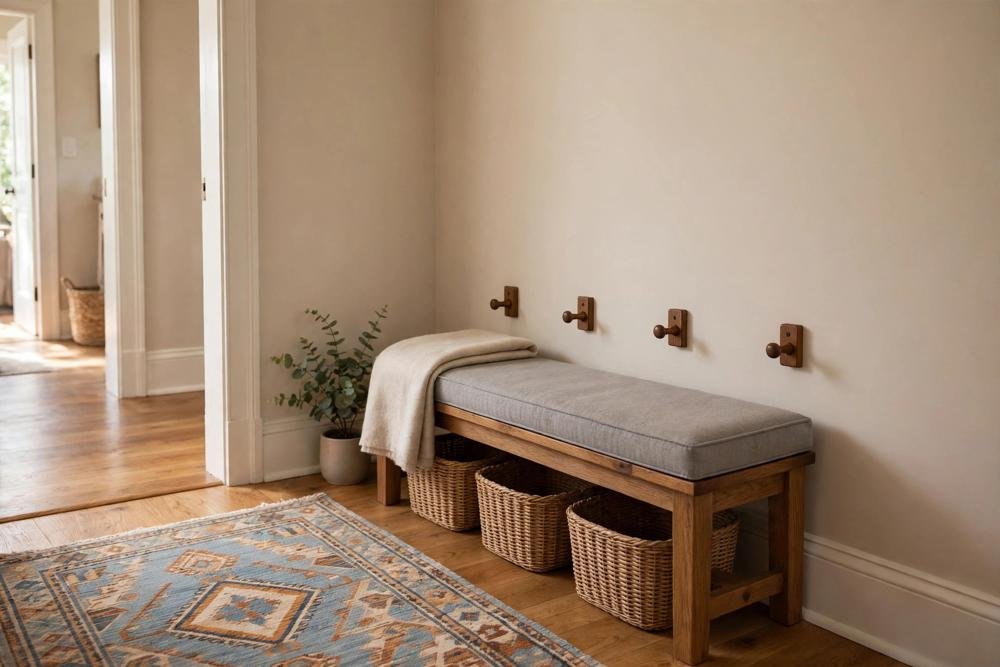
Start With Heights, Labels, and One Place Each
Start with heights, because a hook that is too high for a child will not be used by that child, and a basket that is too high will not be used either, and a corner that is not used by children will fill up with adult items, while children’s coats and school bags end up on chairs, benches, and floors. Use hooks at adult height, approximately 165 to 175 cm, for adults, and hooks at child height, approximately 120 to 130 cm for older children, and approximately 100 to 110 cm for younger children, for coats and school bags, so each child can hang their own coat and bag, without help, and without climbing. Use baskets at floor level, or on a low shelf, for shoes and school items, so children can put their own shoes away, without help, and without reaching high.
Use labels, because a basket that is not labelled will become a shared pile, and a shared pile will become a mess, however tidy it starts. Label baskets with a name, a colour, or a picture, so each child can recognise their own basket, even if they cannot read yet, and label hooks with a colour or a picture, if you want to, so each child knows which hook is theirs, without asking. Use one place each: one hook per child for a coat, one hook per child for a school bag, or one hook for both if space is tight, one basket per child for shoes and school items, and one place per pet for a lead, so the corner stays fair, and it does not become one child’s pile, or one pet’s corner.
Keep the corner shallow and clear, as in the zones guide: drop for keys, hang for coats, sit for shoes, store for shoes, and check for a mirror, all in a corner approximately 30 to 40 cm deep, with a rug to mark the zone, as in the open entryway guide, and with the walkway clear, approximately 75 to 90 cm as a comfort guide, and with the door swing and exit route clear at all times. A corner that is shallow, labelled, and at the right heights will be used by children and pets, without help, and a corner that is deep, unlabelled, or too high will be ignored, however much storage it has.
Kids: Hooks, Baskets, and School Bags
Kids need hooks, baskets, and a place for school bags, in that order, close to the door, at their height, with a routine they can follow themselves, without help, every time they come in or go out. Hooks first: one hook per child for a coat, at approximately 120 to 130 cm for older children, approximately 100 to 110 cm for younger children, with a hook that is safe, smooth, and not sharp, and with a weight limit checked, so a school bag that is heavy does not pull the hook off the wall, and so a child who pulls on a coat does not pull the whole rail down. If you rent, use adhesive hooks, or over door hooks, checking weight limits and door closing, as in the renter guide, or use a freestanding coat rack with hooks at child height, if you cannot drill, and if you can drill, get landlord permission in writing first, and use fixings suited to the wall type.
Baskets second: one basket per child, labelled with a name, colour, or picture, at floor level, or on a low shelf, for shoes, hats, gloves, and school items, so each child can put their own shoes away, without help, and without reaching high, and so shoes do not end up by the door, in a pile, or in the living room. Keep baskets to one pair of shoes per child in the entry zone, with other shoes stored elsewhere, as in the winter guide, and keep baskets to daily items only, with school items that are not used every day stored elsewhere, so baskets stay light, easy to carry, and easy to clean, rather than heavy, full, and ignored.
School bags third: one place per child for a school bag, either on a hook, in a basket, or on a bench, close to the door, so a school bag that is ready for tomorrow can be put by the door tonight, and picked up in the morning, without searching, and so school bags do not end up on chairs, benches, or floors, where they will be tripped over. If space is tight, use a hook for a school bag, at child height, next to the coat hook, so a coat and a bag are together, and a child can pick up both in one movement, and if space is very tight, use a basket for a school bag, on the floor, next to the shoe basket, so a bag is by the door, but not blocking the walkway, door swing, or exit route. Keep school bags to one per child, with other bags stored elsewhere, so the corner stays to what is used every day, not what is used once a week.
Pets: Leash Station, Towels, and Treats
Pets need a leash station, a place for towels, and a place for treats, in that order, close to the door, at a height you can reach without bending, with a routine you can follow every time you come in or go out with a pet. Leash station first: one hook per pet for a lead, at approximately 120 to 150 cm, with a small shelf, basket, or tray nearby for treats, bags, and small items, so a lead is always by the door, ready to grab, and a pet that is waiting by the door can be clipped on, without searching for a lead in another room. Use a hook that is safe, smooth, and not sharp, with a weight limit checked, and with a lead that is hung, not left on the floor, so it does not become a trip hazard, and so a pet does not chew it, if it is left within reach.
Towels second: one place for towels, in a basket, on a hook, or on a shelf, near the door, for wet paws, muddy paws, and rainy days, so a pet that comes in wet can be wiped down by the door, before it runs into the living room, and so towels do not end up on chairs, benches, or floors, where they will be forgotten. Use a washable towel, in a basket that is easy to wash, and keep one clean towel ready, with dirty towels washed regularly, so the towel place stays fresh, not damp and smelly, and so a pet that is wet can be dried quickly, without searching for a towel.
Treats third: one small place for treats, in a jar, basket, or on a shelf, out of reach of pets, but within reach of adults, near the door, so a pet that comes in and sits can be rewarded, without searching for treats in the kitchen, and so treats do not end up on the floor, where they will be eaten by a pet that should not have them, or by a child who should not eat them. Keep treats in a closed container, out of reach of pets and young children, with a lid that is easy for adults to open, but hard for pets to open, so treats stay fresh, safe, and ready, and so a pet that is waiting by the door does not help itself to treats while you are not looking.
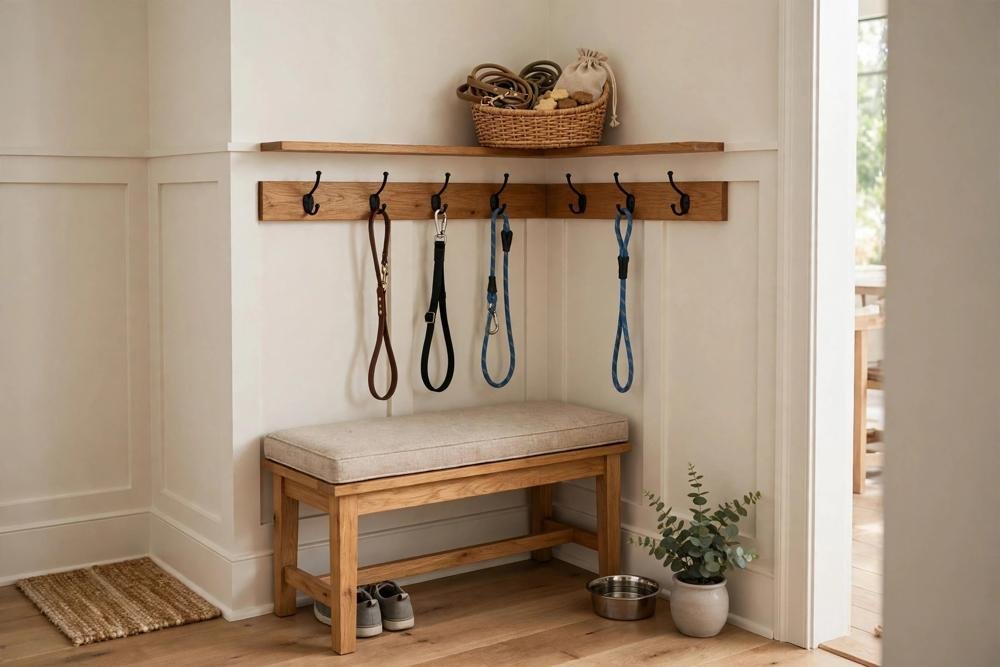
Stroller Space Without Blocking the Door
Stroller space is the hardest part of a family entryway, because a stroller is large, and a small corner entryway is small, and a stroller that blocks the door, walkway, or exit route is a safety problem, not just a tidy problem, and it must be moved, however convenient it is by the door. Measure first: measure the stroller, folded and unfolded, width, depth, and height, and measure the corner, width, depth, door swing arcs, and walkway, approximately 75 to 90 cm as a comfort guide, with tape on the floor for the stroller footprint, as in the size guide, and walk through it, open doors, and check at night and in daylight, before you decide where a stroller goes.
If a stroller fits in the corner, without blocking the door, walkway, or exit route, use that corner, with a rug or mat underneath, to protect the floor, and with hooks and baskets beside it, not behind it, so a stroller that is parked does not block access to hooks, baskets, or keys. If a stroller does not fit in the corner, store it elsewhere, in a bedroom, cupboard, hallway, or garage, if you have one, with a folded stroller that is easy to carry to the door, rather than an unfolded stroller that blocks the corner, and use a small basket by the door for stroller items, such as a rain cover, a blanket, and a small bag, so stroller items are by the door, even if the stroller itself is elsewhere.
If you have no other storage, and a stroller must be by the door, use a corner that is out of the door swing, with a walkway that is still comfortable, approximately 75 to 90 cm, and with an exit route that is still clear, so you can get out easily, even with a stroller parked, and check the corner at night, when it is dark, and when you are carrying a child, to make sure you can get out safely, without tripping over a stroller, shoes, or bags. A stroller that is parked safely, with a walkway and exit clear, will be used every day, and a stroller that blocks the door will be moved, resented, or cause a fall, however convenient it is by the door.
Safety: Anchoring, Cords, and Small Items
Safety comes first in a family entryway, because children and pets will pull, climb, chew, and explore, and a corner that is safe for adults may not be safe for children or pets, however tidy it looks. Anchor tall units, as in the rest of this series: any tall hall tree, shelf, or coat rack, that could tip over if a child pulls on it, or a pet jumps on it, must be anchored safely, following its instructions, with landlord permission if you rent, and with fixings suited to the wall type, so it cannot tip over, even if a child climbs it, or a pet pulls on it. Check anchoring regularly, especially after moving furniture, because a unit that was anchored safely may become loose, and a loose unit is a risk, not just a wobble.
Secure cords and small items out of reach, because cords from lights, chargers, and small electronics can be a strangulation or trip hazard for children and pets, and small items, such as keys, coins, and small toys, can be a choking hazard for young children and pets, if they are left within reach. Keep cords behind furniture, or in a cord cover, with no loose cords hanging in the walkway, and keep small items in a closed tray, basket, or on a high shelf, out of reach of young children and pets, with a lid that is easy for adults to open, but hard for children and pets to open, so small items stay safe, not scattered on a console top where they can be reached.
Check adhesive hook weight limits, as in the renter guide, because a hook that is overloaded with a heavy school bag, a coat, and a pet lead, will fail, damage the wall, and fall on a child or pet, and a hook that is fixed unsafely will be pulled off the wall by a child who pulls on a coat, or a pet who pulls on a lead. Use hooks that match the wall and the weight they need to hold, with a weight limit checked, and with a hook that is safe, smooth, and not sharp, so a child who runs into a hook does not get hurt, and a pet who brushes against a hook does not get caught. Keep the exit route and door swing clear at all times, because a family entryway is also an escape route, and a bench, a stroller, a pile of shoes, or a pile of school bags that blocks the door is a safety problem, not just a tidy problem, and it must be moved, however tidy it looks in daylight.
Routines: Morning, After School, and After Walks
Routines make a family entryway work, because without a routine, a corner that was set up well will fill up, mix up, and become a pile, however well it was labelled, and with a routine, a corner that is small and simple will stay tidy, because each person knows what to do, without thinking, every time they come in or go out. Morning routine: coats on hooks, school bags by the door, shoes in baskets, keys in the drop zone, leads on leash hooks, and a last check in the mirror, in zone order, as in the zones guide, so everyone leaves on time, without searching for coats, bags, shoes, keys, or leads, and so the corner is clear when everyone leaves, not full of items that were left behind.
After school routine: coats on hooks, school bags in their place, shoes in baskets, and school items in baskets, every time a child comes in, without help, because hooks are at child height, baskets are labelled, and school bags have a place, so a child can do it themselves, and so the corner does not fill up with coats, bags, and shoes that were dumped by the door. Praise a tidy zone, rather than criticising a messy one, so children feel like a help, not a chore, and so they will keep doing their own zones, without being asked, because it feels good to have a place that is theirs, and that is tidy.
After walks routine: leads on leash hooks, towels in their place, treats in their closed container, and shoes in baskets, every time a pet comes in, so a pet that is wet can be wiped down by the door, before it runs into the living room, and so leads, towels, and treats do not end up on chairs, benches, or floors, where they will be forgotten. Keep a clean towel ready, wash dirty towels regularly, and keep treats in a closed container, out of reach of pets and young children, so after walks, the corner stays fresh, not damp and smelly, and so a pet that is waiting by the door does not help itself to treats while you are not looking.
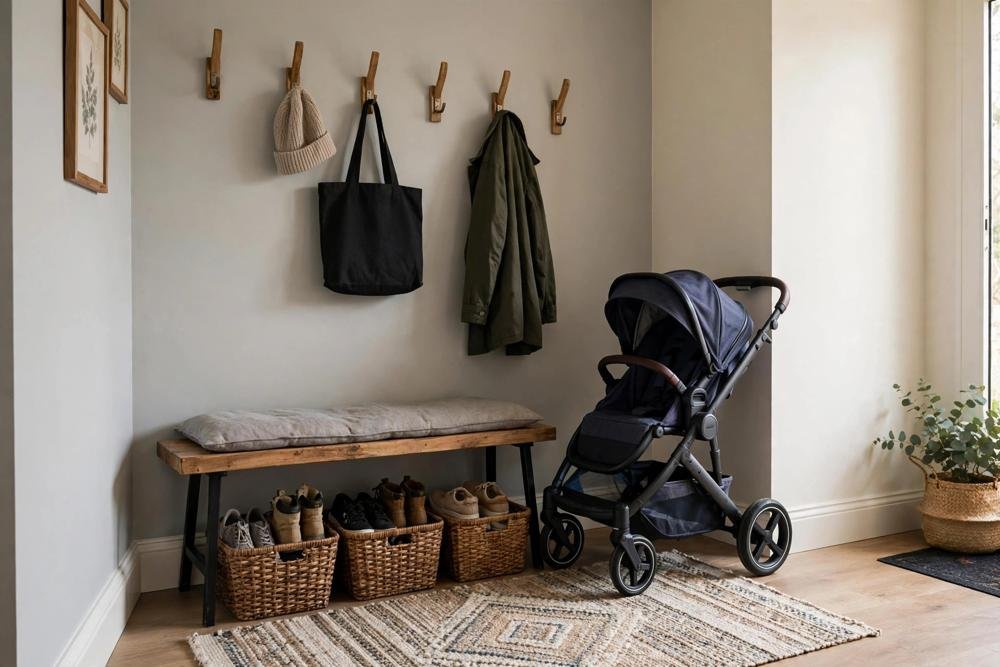
What to Avoid With Kids and Pets
Avoid hooks that are too high for children, because a hook that is too high will not be used by a child, and a child’s coat and school bag will end up on chairs, benches, and floors, instead of on a hook, and a hook that is too high for a child, but that a child climbs to reach, is a safety risk, not just a tidy problem, and it must be lowered, or replaced with a hook at child height. Avoid baskets that are not labelled, because a basket that is not labelled will become a shared pile, and a shared pile will become a mess, however tidy it starts, and a basket that is labelled with a name, colour, or picture, will be used by the right child, without help, and without mixing up.
Avoid a stroller that blocks the door, walkway, or exit route, because a stroller that blocks the path is a safety problem, not just a tidy problem, and it must be moved, however convenient it is by the door, and a stroller that is stored elsewhere, with a small basket by the door for stroller items, will work better than a stroller that blocks the corner, however much you want it by the door. Avoid tall units that are not anchored, because a tall unit that is not anchored can tip over if a child pulls on it, or a pet jumps on it, and a unit that tips over can hurt a child or pet, however sturdy it looks, and it must be anchored safely, following its instructions, with landlord permission if you rent.
Avoid cords and small items within reach of children and pets, because cords can be a strangulation or trip hazard, and small items can be a choking hazard, and a corner that has cords hanging in the walkway, or small items scattered on a console top, is not safe, however tidy it looks, and cords must be secured, and small items must be in a closed container, out of reach. Avoid overloading hooks, baskets, and benches, because a hook that is overloaded will fail, a basket that is overloaded will spill, and a bench that is piled with coats cannot be sat on, and zones that are overloaded will be avoided, rather than used, and they will fill up again, however much storage they have.
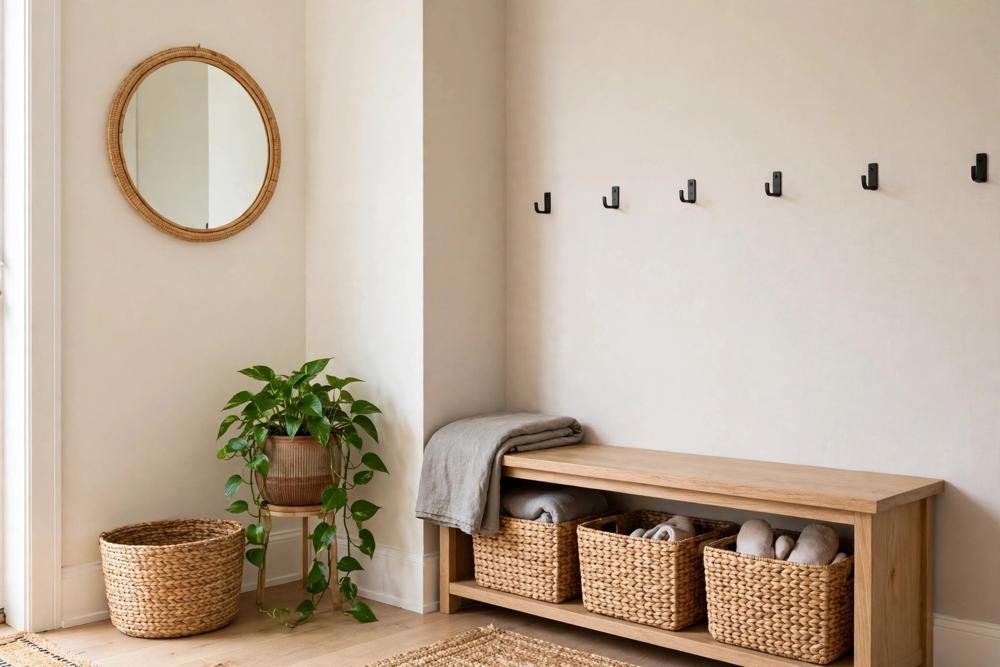
Checklist: Entryway Storage for Kids and Pets
- Measure the corner, width, depth, height, door arcs, and walkway, approximately 75 to 90 cm as a comfort guide.
- Tape footprints on the floor for any bench, hall tree, or stroller, walk through them, open doors, and check at night and in daylight.
- Check your lease for drilling, and get permission in writing if needed, or use freestanding, adhesive, and over door pieces.
- Place hooks at adult height, approximately 165 to 175 cm, and at child height, approximately 120 to 130 cm for older children, approximately 100 to 110 cm for younger children, with safe, smooth hooks and weight limits checked.
- Label baskets with a name, colour, or picture, one per child, at floor level, for shoes and school items, with one pair of shoes per child in the entry zone.
- Place school bags in their place, on a hook, in a basket, or on a bench, close to the door, one per child, with other bags stored elsewhere.
- Place a leash station near the door, one hook per pet, with a small shelf, basket, or tray for leads, treats, and bags, with treats in a closed container out of reach of pets and young children.
- Place towels in a basket near the door, for wet paws, with a clean towel ready, and dirty towels washed regularly.
- Place a stroller only if it fits without blocking the door, walkway, or exit route, otherwise store it elsewhere, with a small basket by the door for stroller items.
- Anchor tall units safely, secure cords out of reach, keep small items in a closed container out of reach, and keep the exit route and door swing clear at all times.
- Set routines: morning, after school, and after walks, with coats on hooks, shoes in baskets, keys in the drop zone, and leads on leash hooks, and clear the corner once a week.
Conclusion
Entryway storage for kids and pets works when each child and each pet has a place that they can use themselves, at their height, with a label they can recognise, in a corner that is shallow, clear, and safe, so coats, school bags, shoes, leads, and treats land where they belong, without help, every time you come in or go out. Measure first, place hooks at child height, label baskets, set up a leash station, towels, and treats, and place a stroller only if it fits without blocking the door, walkway, or exit route, with anchoring for tall units, weight limits for adhesive hooks, cords and small items out of reach, and landlord permission before drilling if you rent.
Use the checklist above to set up a family entryway in one weekend, and keep it tidy with morning, after school, and after walks routines, and a weekly clear out, so the corner stays to daily items only, with one coat, one pair of shoes, one bag per child, and one lead per pet, and other items stored elsewhere. Done that way, a small corner entryway will feel intentional, tidy, and easy to use, for children, pets, and adults, without a large piece that blocks the room, and without a pile that fills up again, however well it was set up.
Related reading
- Corner Entryway Ideas for a Tight Corner
- Mini Mudroom Entryway Ideas for Apartments and Small Homes
- Corner Storage Ideas for Entryways
- Winter Entryway Organization Ideas for a Tidy Corner
- Hallway Corner Ideas for Narrow Hallways
- Renter Friendly Entryway Ideas Without Drilling
- Bench and Hall Tree Size Guide for Entryways
- Budget Entryway Makeover Ideas for a Small Corner
- Open Entryway Ideas for Homes With No Hallway
- Functional Entryway Zones for a Tidy Corner
- Entryway Corner Decor Ideas for a Small Space
- Rug Calculator
Frequently Asked Questions
What height should hooks be for children in an entryway?
Use hooks at approximately 120 to 130 cm for older children, and approximately 100 to 110 cm for younger children, for coats and school bags, so each child can hang their own coat and bag, without help, and without climbing. Use hooks at approximately 165 to 175 cm for adults, with safe, smooth hooks and weight limits checked, so a heavy school bag does not pull a hook off the wall.
How do I keep kids entryway storage tidy?
Give each child one hook for a coat, one place for a school bag, and one labelled basket for shoes and school items, with one pair of shoes per child in the entry zone, and other items stored elsewhere. Use a routine: coats on hooks, school bags in their place, shoes in baskets, every time a child comes in, and clear the corner once a week, taking out items that do not belong there.
Where should I put a leash station in a small entryway?
Put a leash station near the door, with one hook per pet for a lead, at approximately 120 to 150 cm, with a small shelf, basket, or tray nearby for treats, bags, and small items, and with treats in a closed container out of reach of pets and young children. Keep leads hung, not on the floor, so they do not become a trip hazard, and keep a towel nearby for wet paws.
Where should I put a stroller in a small entryway?
Put a stroller in a corner only if it fits without blocking the door, walkway, or exit route, with a walkway still comfortable, approximately 75 to 90 cm, and with tape on the floor for the stroller footprint, checked at night and in daylight. If it does not fit, store it elsewhere, in a bedroom, cupboard, hallway, or garage, with a small basket by the door for stroller items, such as a rain cover and a blanket.
How do I make an entryway safe for kids and pets?
Anchor tall units safely, following their instructions, with landlord permission if you rent, secure cords out of reach, with no loose cords in the walkway, and keep small items in a closed container out of reach of young children and pets. Check adhesive hook weight limits, use safe, smooth hooks, and keep the exit route and door swing clear at all times, so you can get out easily, even with a stroller parked.
Can I set up kids and pets entryway storage if I rent?
Yes, use freestanding, adhesive, and over door pieces, as in the renter guide, with a freestanding coat rack with hooks at child height, adhesive hooks checking weight limits, baskets at floor level, and a leash station with hooks and a basket, all without drilling, unless you have permission in writing. Check your lease, and use a rug to mark the zone, so a renter friendly family entryway works as well as a fixed one, and moves with you to your next home.